How To Kill 22 Hours In The Frankfurt Flughafen

Editor’s Note: This was originally posted on March 25th, but a WordPress app issue (damn you, iOS!) caused it to revert to an ancient draft version and it vanished from published status. I’m pretty annoyed that the WordPress app can no longer be trusted to ever edit or view a post ever again. On with the original (republished) post:

The week before last, I got to spend a little bit of extra time in Frankfurt, somewhat against my will. On Tuesday the 12th of March, a large snowstorm caused the Frankfurt Airport to close for several hours. Hundreds of flights were cancelled and still more were delayed. My flights to Orlando were on Wednesday the 13th, one day later. The Munich to Frankfurt flight was delayed, but the Frankfurt to Orlando leg was not, resulting in me getting stuck.

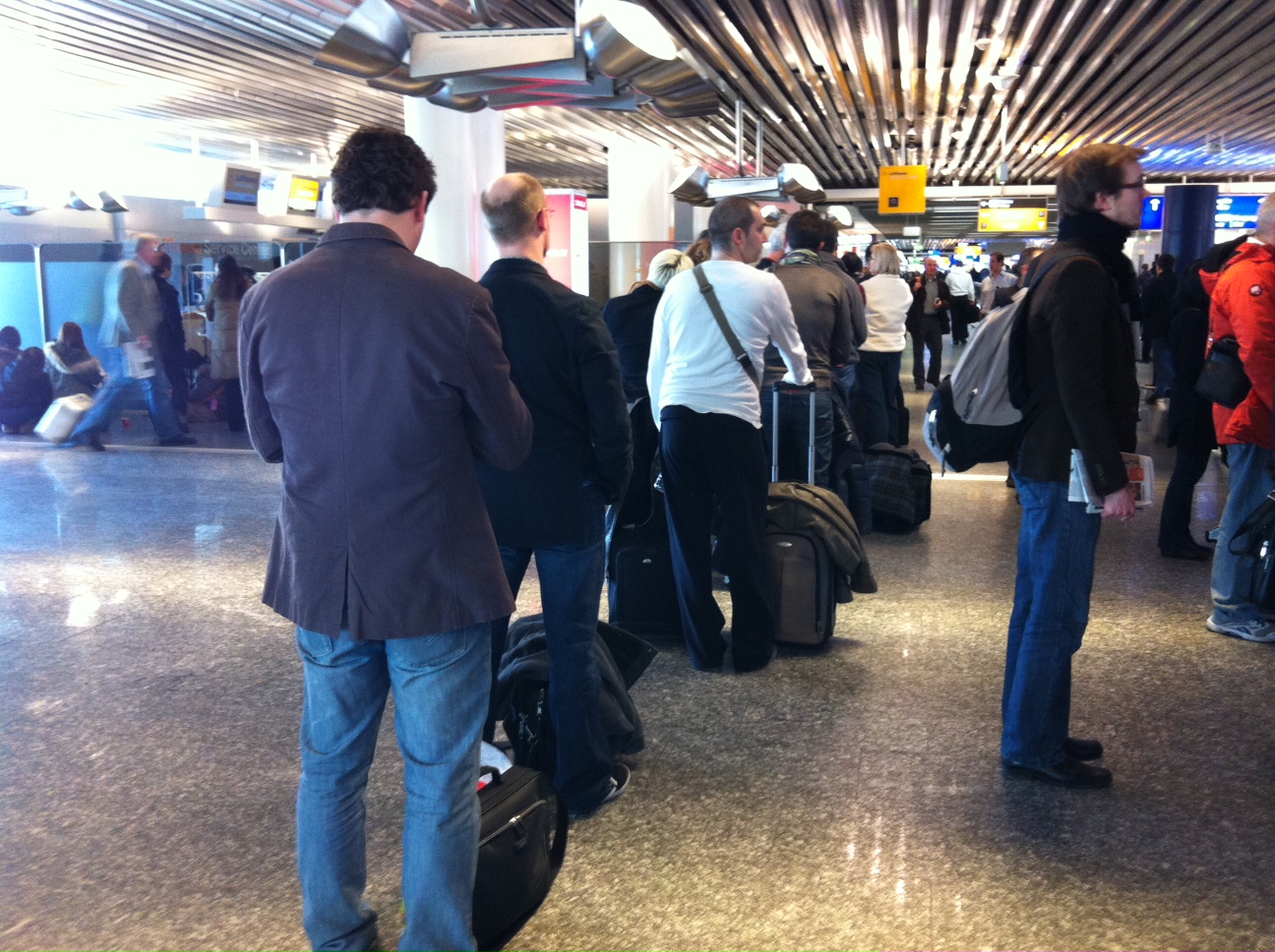
Lufthansa strove mightily to get me to my destination. The woman at the service counter checked other flights- everything going into the US was booked solid. The one possible route she found for me was from Frankfurt to Heathrow in London, and from there to JFK in New York. From JFK, I would have had to driveto Newark to get the last flight down to Orlando. This was, naturally, not a very good solution and I begrudgingly accepted a Lufthansa rebooking the following morning to get in via an extra stop in Chicago. I spent more than a half hour in line for the service desk, and another twenty minutes standing at the counter while the service desk was trying to help me. When I was done, this was the line for that service desk. The actual desk is off to the left there, just past the hanging yellow sign:

lufthansaline

Because of the resultant delays and cancellations, I was not the only traveler getting stuck in Frankfurt. Every hotel room in the city center was booked solid. This meant I was well and truly stuck. until 10:45 the following morning. (That flight was also delayed, but that’s not the point here.) With that much time to kill, I needed to come up with fun things to do. My extra time in the Frankfurt airport was not fun, but I have some ideas for future travelers in this position to help pass the time.

  1. Go to every restaurant on the terminal map. Order only a large ice water and a packet of sugar.
  2. Get a haircut. (There are at least two places you can do this without leaving the airport complex.)
  3. Befriend other stranded travelers, and create a review board to compare light levels in the various terminals.
  4. Chart the persistence of aroma by distance from the duty free shops. (Seriously, those places are intensely aromatic. People with headaches triggered by strong smells should beware.)
  5. Take a tour of the airport.
  6. Buy a bunch of postcards in the duty free shop, and then fill them out with “I’m trapped in Frankfurt. Send help!” messages. Use the Deutsche Post shop in Terminal 1 to mail them to all your friends.
  7. Find innovative ways to use the meal vouchers that the airline gave you for stranding you overnight in an unexpected city.
  8. Walk by Erster Wiener in Terminal 1, pointing and laughing. (“LOL, he said Wiener.”)
  9. Some of the stores in the terminal have mannequins. Pose with them. Hold out until a tourist snaps your picture with an iPhone.
  10. Talk back to the gate change announcements. Loudly.
  11. Get a massage.
  12. Go to Euroclean in Terminal 1 and ask them to press your underwear.
  13. Go to one of the book stores in the airport and reorganize the news magazines in reverse alphabetical order.
  14. Go to Flowerterminal (also in terminal 1) and send flowers to your mother.

As it turns out, I didn’t have to spend the entire time in the airport terminal, because I have really great friends. My usual partner-in-crime, Jenny, was at her computer at home, and was able to locate a still-available hotel room about 18 kilometers from the airport. It took me an hour to get there, via two trains and a brisk walk in the snow, but I made it just in time to snag the very last room in the hotel.

Let’s face it, sleeping in a hotel is much more relaxing than trying to sleep in an airport terminal.

Have you ever been stranded in an airport or train station? How did you pass the time?

ICE, ICE, Baby! (A Beginner’s Guide To The Deutsche Bahn)

December 2020 Update:  This post still gets a lot of visits, so I feel the need to say this:  The post that follows was written in March of 2013, while I was still living in Germany.  I moved back to the US at the end of 2014, and while I still ride the DB when I’m visiting, I cannot say with any certainty that this seven-year-old post is still accurate.    Please also bear in mind that I do not work for, and have never worked for, the Deutsche Bahn.  I am merely a happy passenger on their trains when I’m in Germany.  Happy travels, friends!

I love trains.

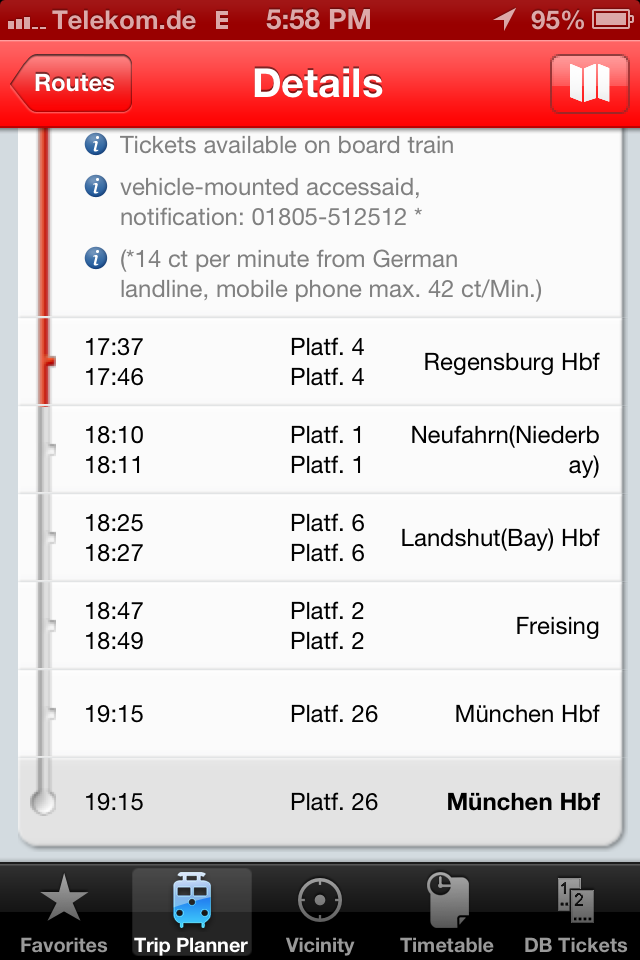
One of my favorite things about living in Regensburg is that we’re situated on a major rail line. From here, there are direct lines to Munich, Nuremberg, Frankfurt, Vienna, and Prague. That’s just without changing trains. If you don’t mind changing trains once or twice, you can go nearly anywhere on the continent. It’s a great way to travel.

Step One: Book Your Trip

appWhile you can get your train tickets from automated machines in the train station, or from a Deutsche Bahn counter, it’s generally advisable to do this ahead of time. The DB has a very excellent website in multiple languages, as well as a series of great apps to serve this purpose. It’s not much different than arranging air travel at this point- You can search with criteria like arrival or departure time, number of connections, and so forth.

The Website has also recently added a seat selection option to the booking process. The brown bars in the screen capture below are tables, so you’ll be sitting facing someone else. The boxed off sections toward the right are compartments with a door between you and the aisle. Click for a bigger view.

seatselector

Step One Point Five: Choose Your Type Of Train
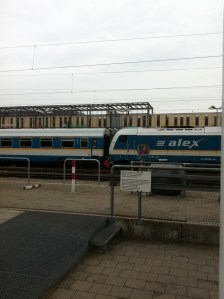
rb-alexWhile you book your trip, you should bear in mind that there are a number of different types of trains in use on Deutsche Bahn rail lines.

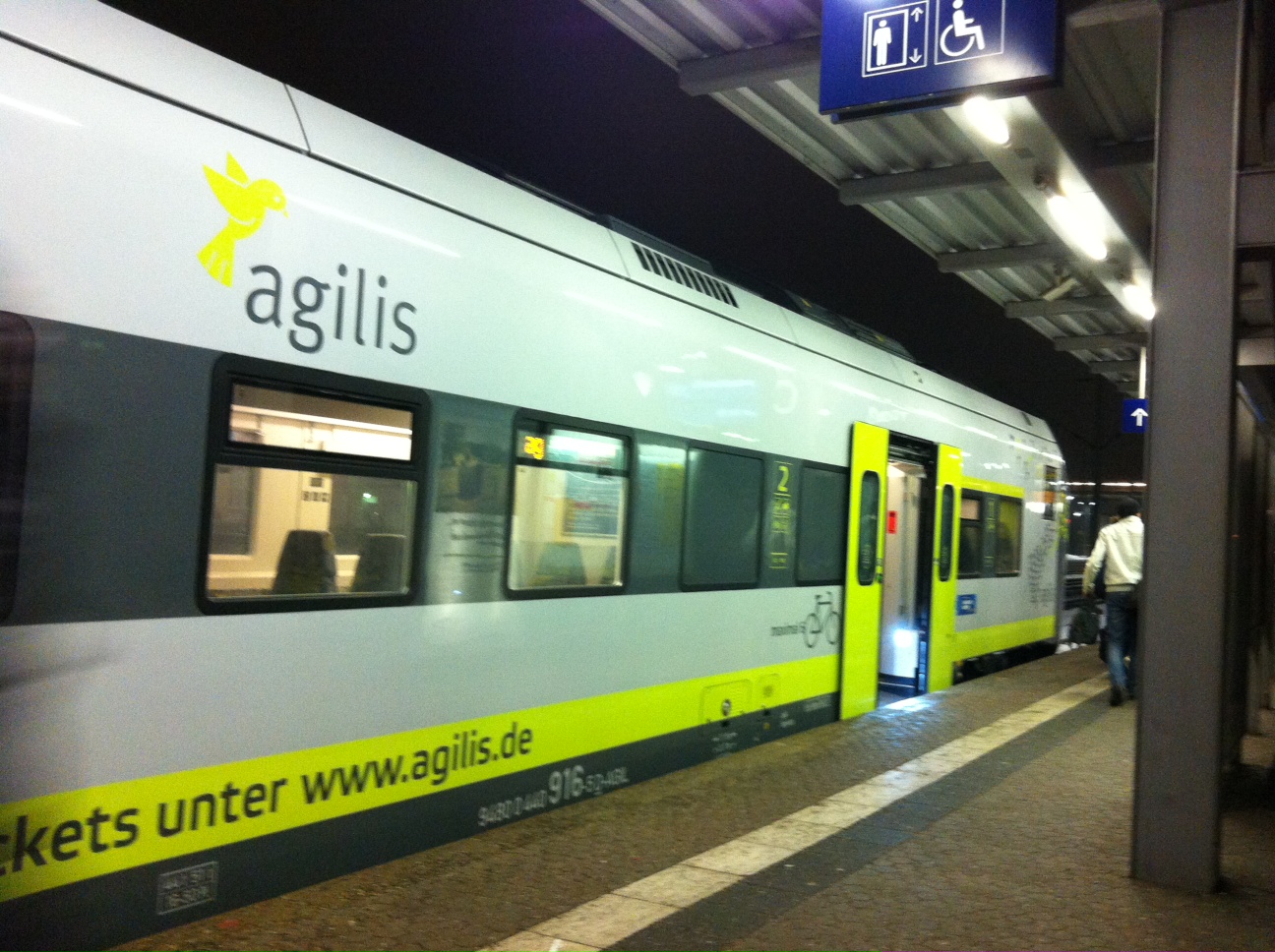
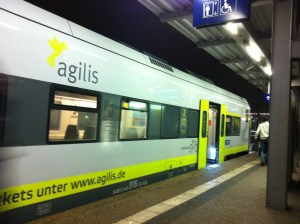
  • There are a few non-DB carriers that operate on German rail lines, like the Alex trains pictured on the right, and Agilis just below that. I’m not going to get into the specifics of them in this post, but I’ve used Alex trains for trips to Prague and Munich. The Prague trip was horrible, but the Munich run was smooth as glass. The Agilis trains tend to be run on local routes. For example, the one pictured here runs between Ingolstadt and Regensburg, on an almost hourly schedule.
    Agilis train
  • Regio-DB or RB (Regional Bahn) tend to be highly localized. These trains are usually painted red.
  • RE (Regional Express) lines are for slightly longer distances than the RB. For example, there are RE lines between Regensburg and Munich. You can travel throughout the entire country using only RE lines, but it will take you a while. RE trains are also painted red.
  • IC (Inter City) trains.  IC trains are the middle step between the RE and ICE trains.  They are typically mostly white with red stripes, like the ICE trains, and they are generally faster than the RE trains.
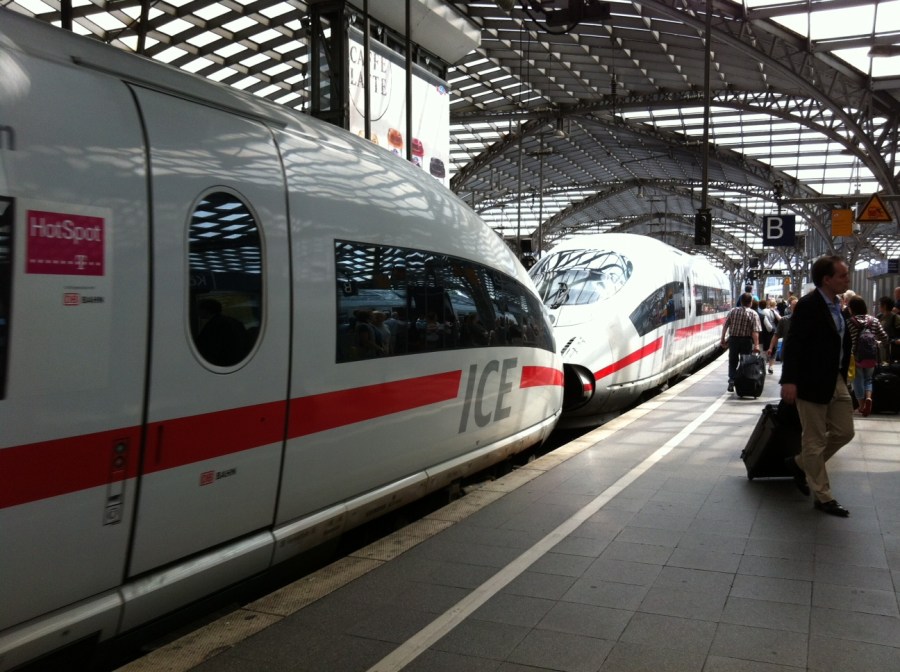
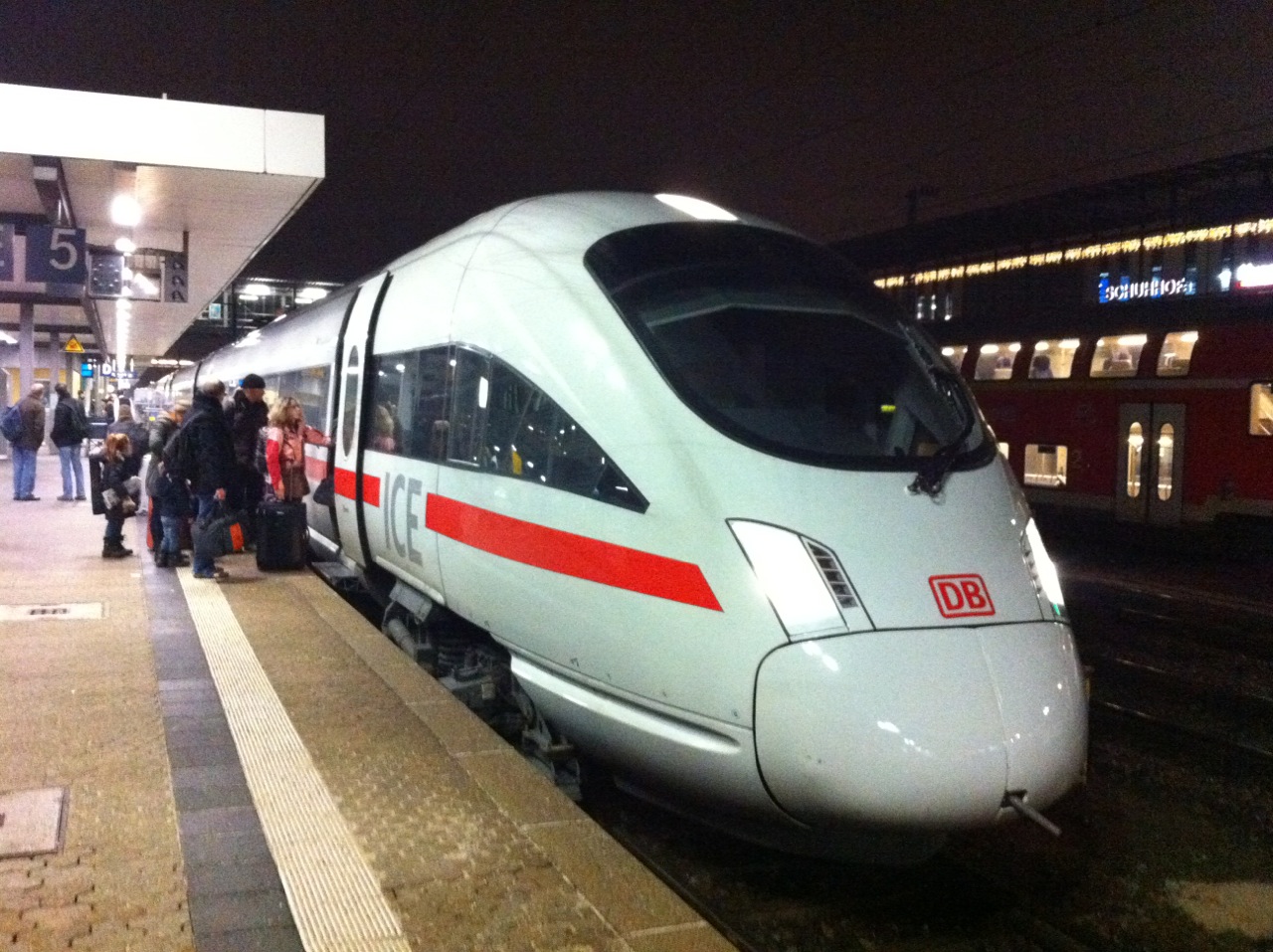
  • ICE (Inter City Express) lines are my personal favorite. These are the trains that look like monorails. ICE trains are always pronounced Eye See Eee, never like the word ‘ice’ despite my bad joke in the subject line of this post. ICE trains are painted white with a red stripe, and they’re fantastic.
  • When your trip moves you between countries, sometimes you’ll wind up on the rail network from another country. For example, the train below is Railjet, a high speed Austrian line. This train was going to Vienna.
    austrianrailjet

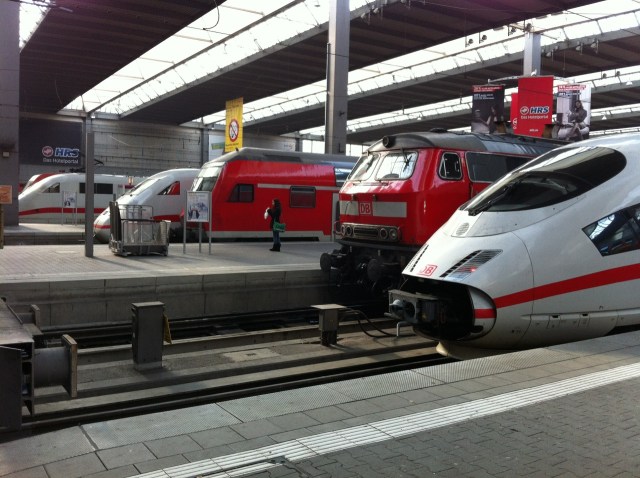
In the picture below, you can see four different DB train types. The trains are, from left to right, an ICE type one, an ICE type two, an RE, a RB, and an ICE type three. The type three is the newest and fastest type.
ice-123-3types-munich

I’m a huge fan of the ICE trains. Here’s two more pictures of them. First, an ICE-T train. The T stands for ‘Tilt.’ All the newer models do this, actually. The upper portion of the train is designed to tilt to allow for high speed navigation, even on curves. The practical result of this for me is that my trips to and from the bathroom on an ICE train while the body of the train is tilting back and forth are often high comedy.

icet

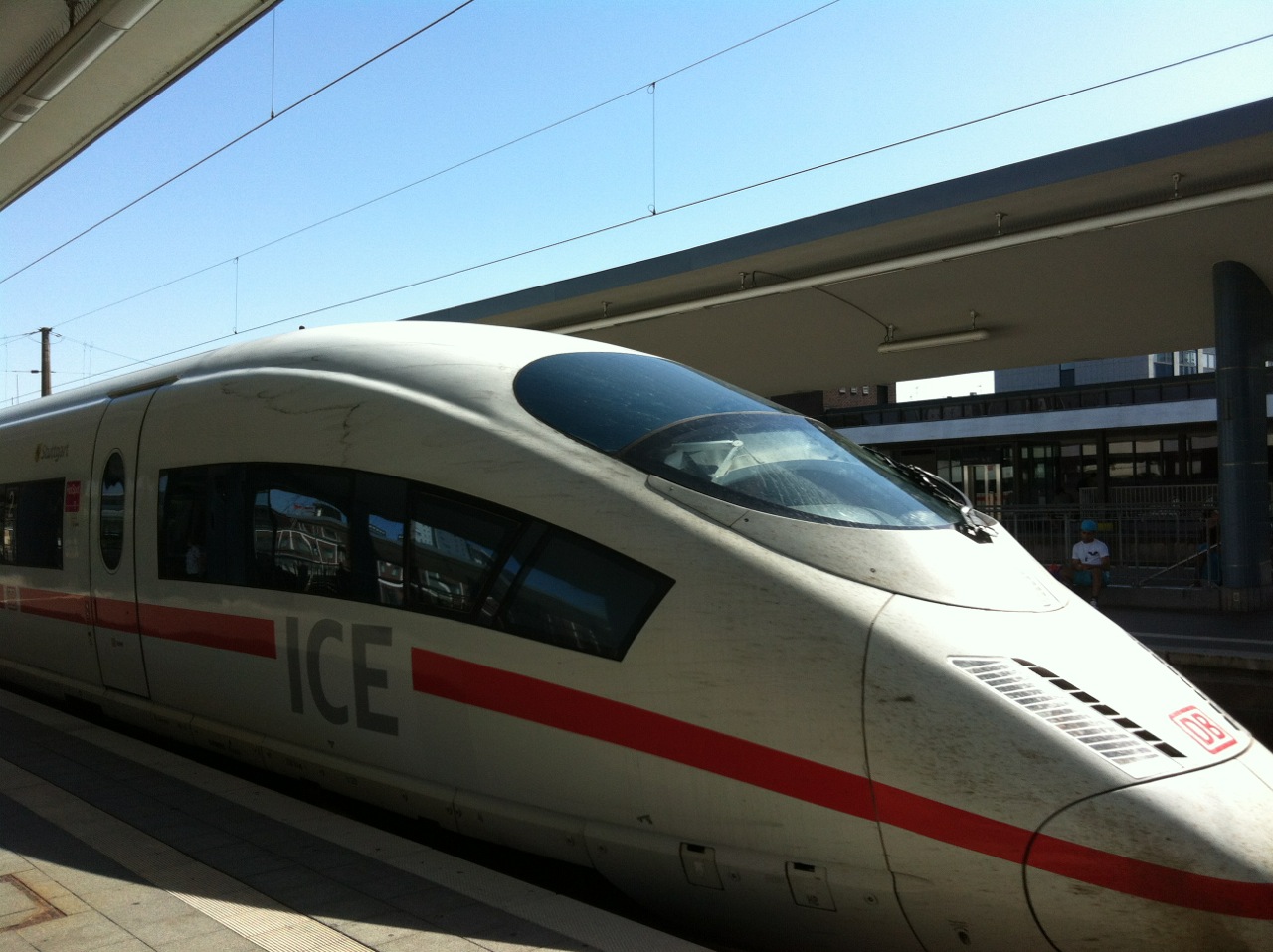
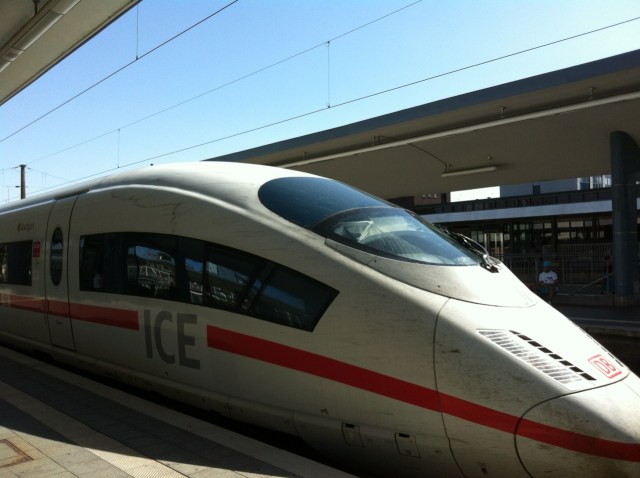
Here’s another close picture of an ICE type three, because they’re amazing.
ice3

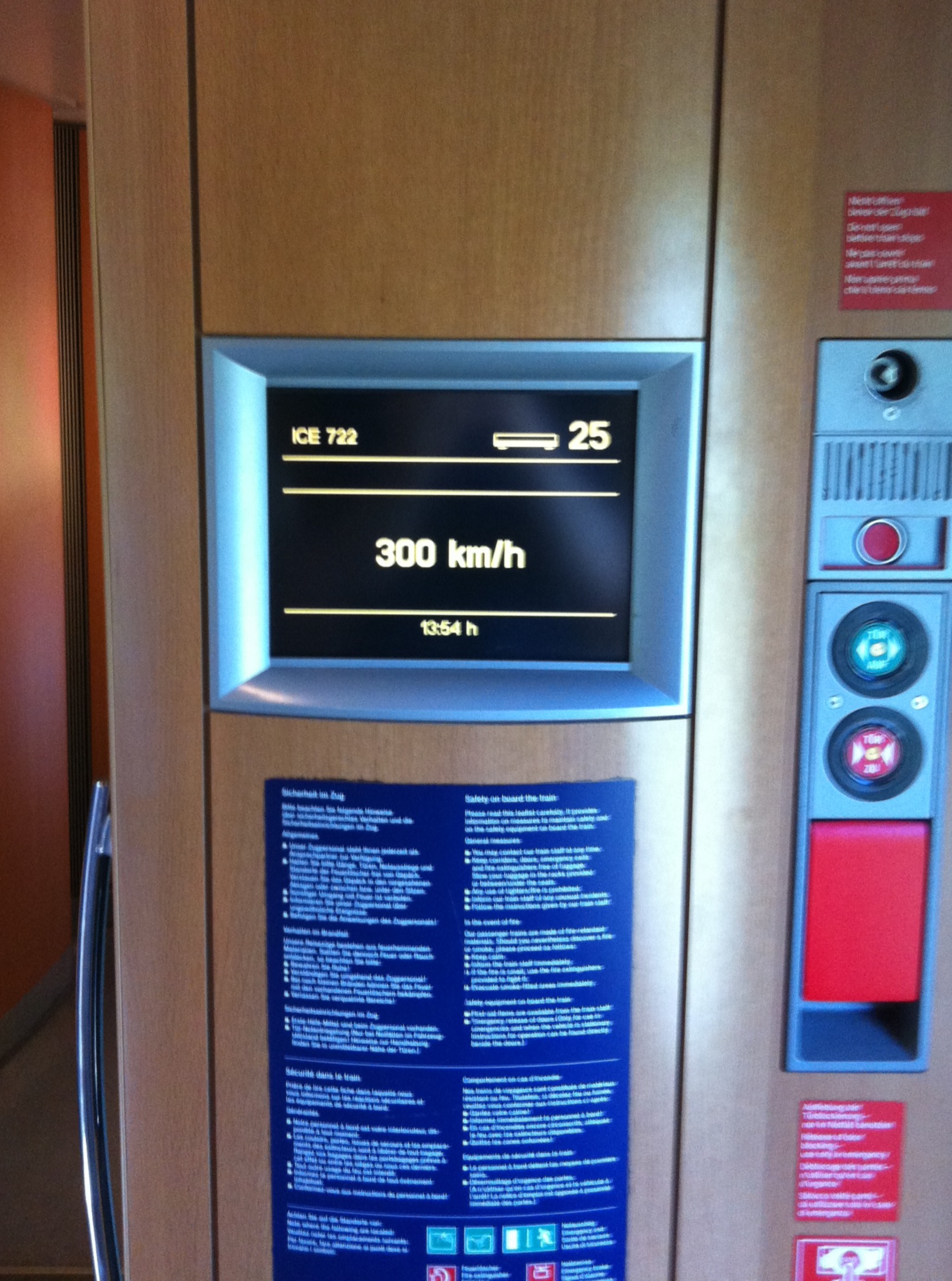
Why do I think they’re amazing? Well, they’re quiet, they’re comfortable, they have power plugs on the seats, and they’re fast. On newer, straighter sections of track, they can do this-

ice-zoom

You read that right- that’s 300 Kilometers per hour. That’s 186 Mph. And they can go even faster, if the track is straight and smooth.

One more thing that’s kind of interesting to me- in the picture of the ICE Type 3 above, the coupling is covered by a white shell. However, sometimes you see them uncovered, like so:ice-coupling1
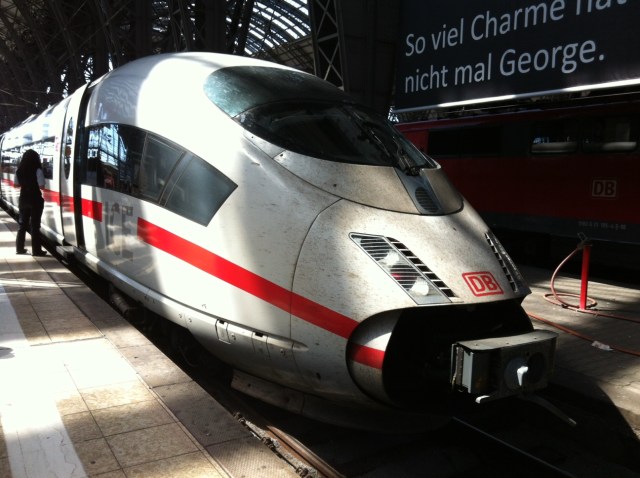
That’s because ICE trains can be coupled together for longer hauls, making the single train double the length of a normal train. This is particularly useful when both trains share half a route, then get uncoupled at a major station before going to separate destinations. Here’s what they look like coupled together:

ice-coupling2

Step Two: Go To The Station

The main train station in any city is called a Bahnhof. In cities that are large enough to have more than one station, the main station is called a Hauptbahnhof. Bahnhofs always have clocks on them, for some reason I haven’t been able to learn. Here’s the front of the Frankfurt Hauptbahnhof:
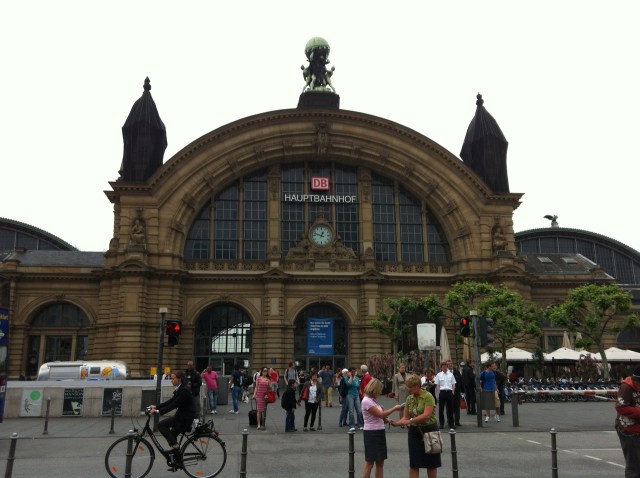
frankfurt-hbf

Step Three: Find Your Platform

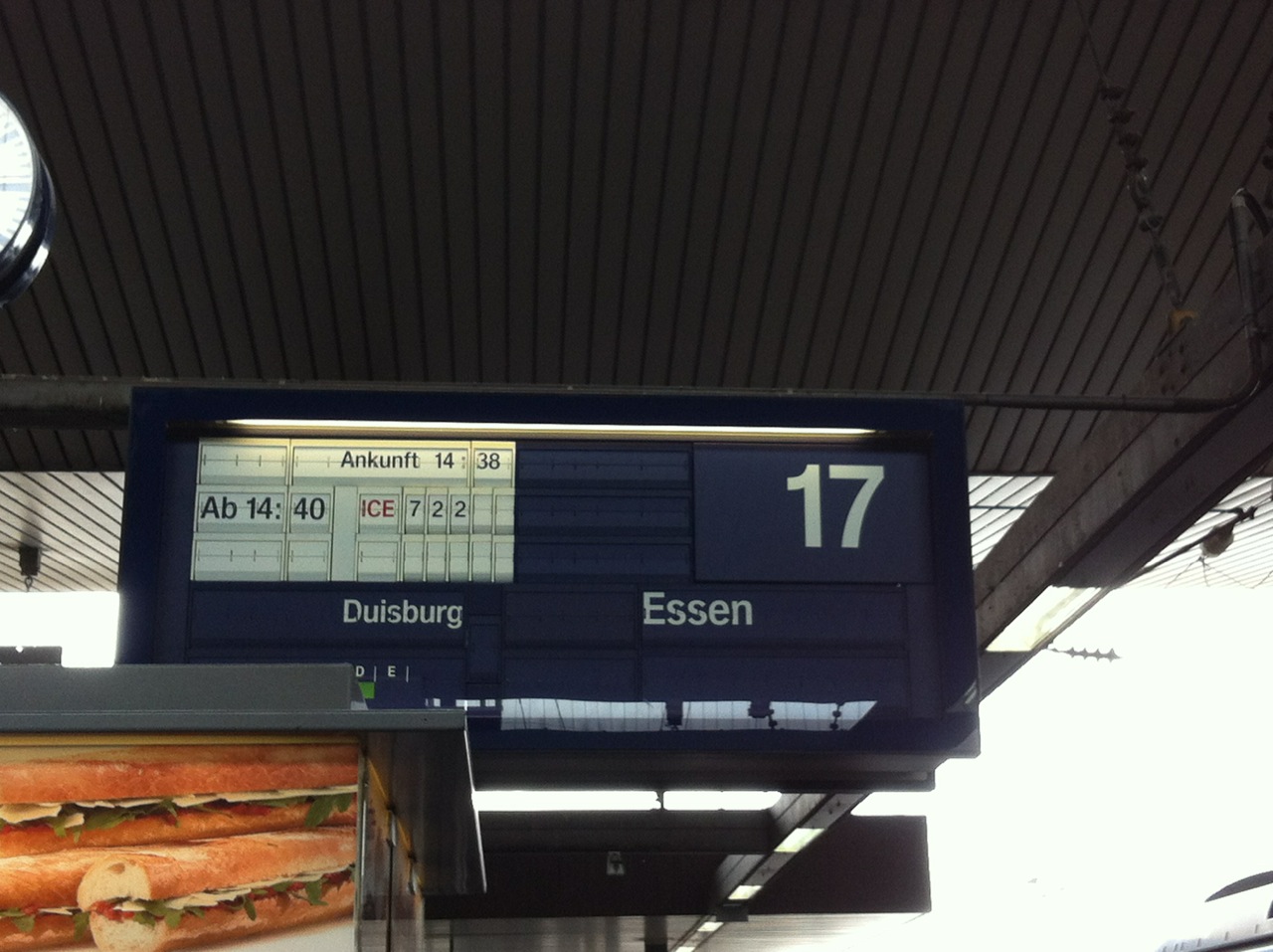
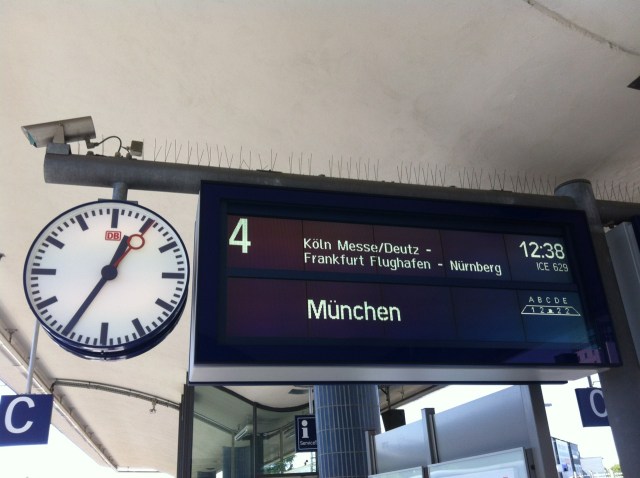
Every Bahnhof has display signs which tell you information about upcoming departures, including the Gleis (track or platform), destination, and departure time. There’s a big departures board inside the Bahnhof, and once you get to the actual platform, there are usually smaller signs to provide more information, like this one:
platform-digital

In the picture above, you have the following information:

  • This is Gleis 4.
  • This train is going to München (Munich). This train also has stops in Köln (Cologne), Frankfurt Flughafen (airport), and Nürnberg (Nuremberg).
  • The train’s identification is ICE 629.
  • This train will stop at stations A through E on the platform. On the left side of the picture, you can see the letter C- this is useful for shorter trains, as it allows you to see roughly where the beginning and end of the train will stop.
  • The train is departing this station at 12:38.

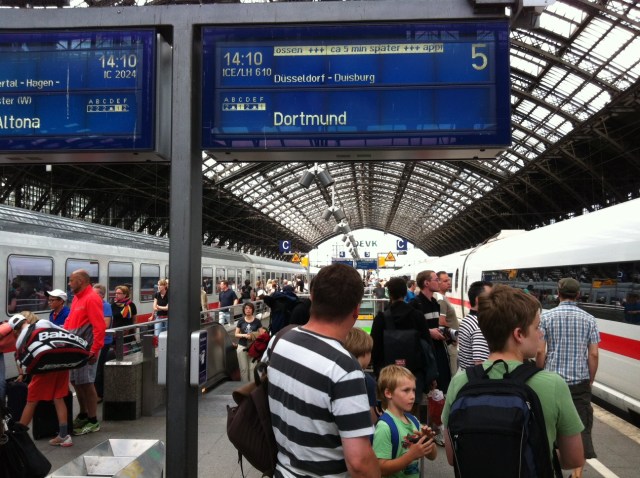
If there are any announcements or indications that your train is late, they’ll generally be notated on the boards. In the picture below, the scrolling text with the white background tells us that the train to Dortmund is actually running five minutes late.
trainbelate

Sometimes, you luck into an older station with the charming flip-board version of this sign. While they don’t have as much information, I think they’re really nifty and I quite like seeing them.

platform-flipstyle

Step Four: Find Your Seat

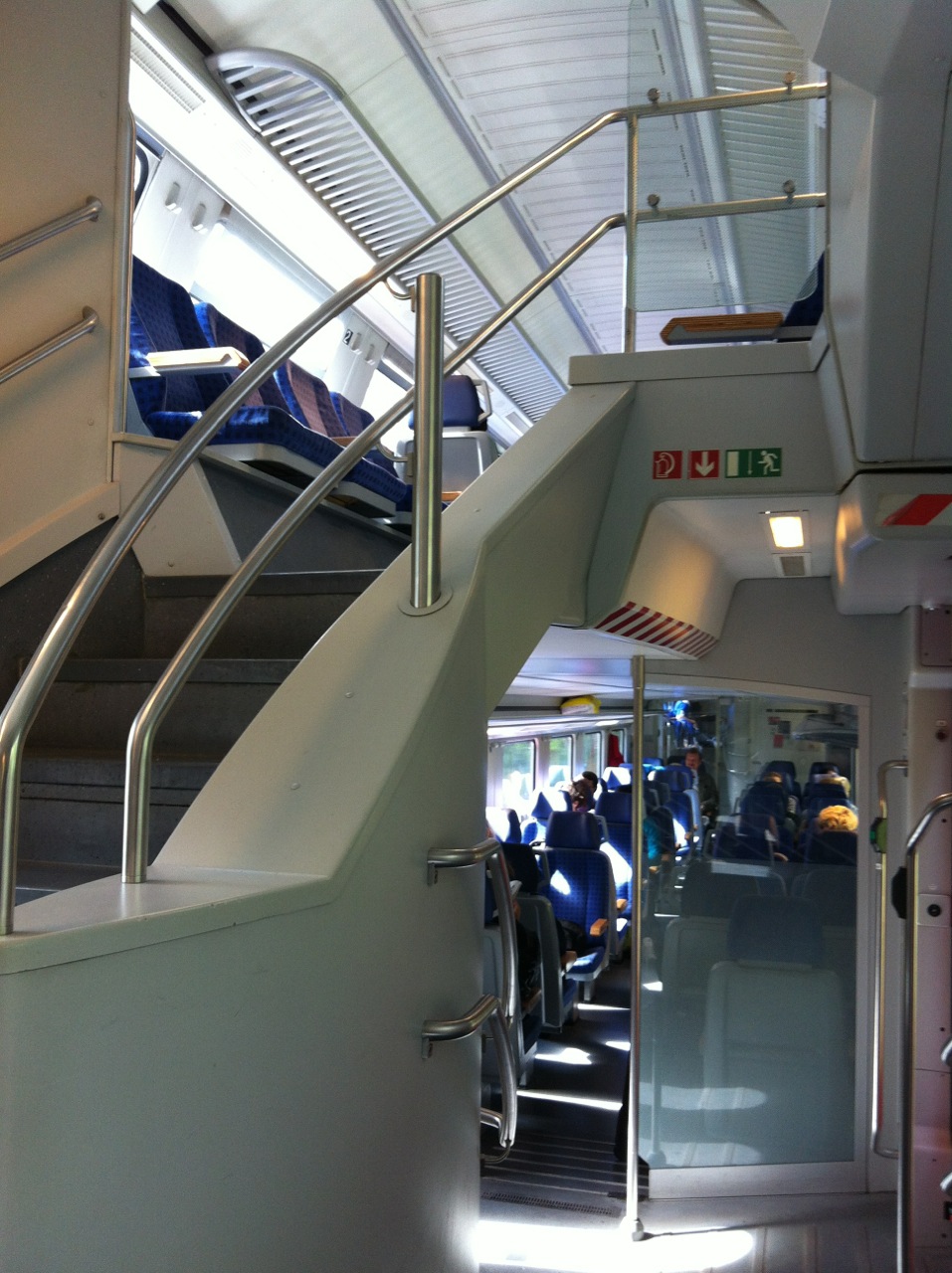
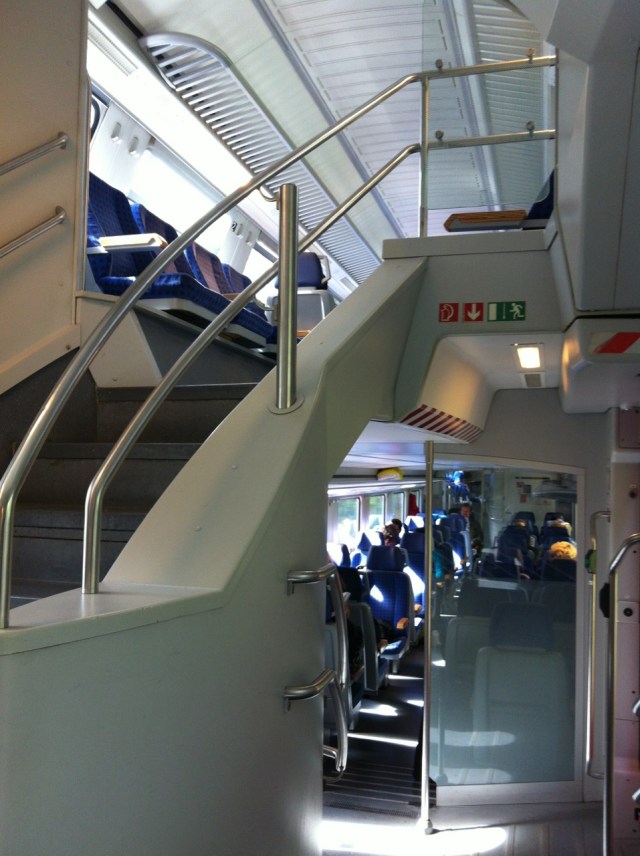
On RE and RB trains, you can’t reserve seats. On those trains, you just have to make sure that you don’t wander into a First Class car with a Second Class ticket. The cars are clearly marked with very large 1 and 2 signs, so that’s pretty straight forward. Some of the RE trains use double-decker cars with a lot of seating, like this next picture.
rb-interior

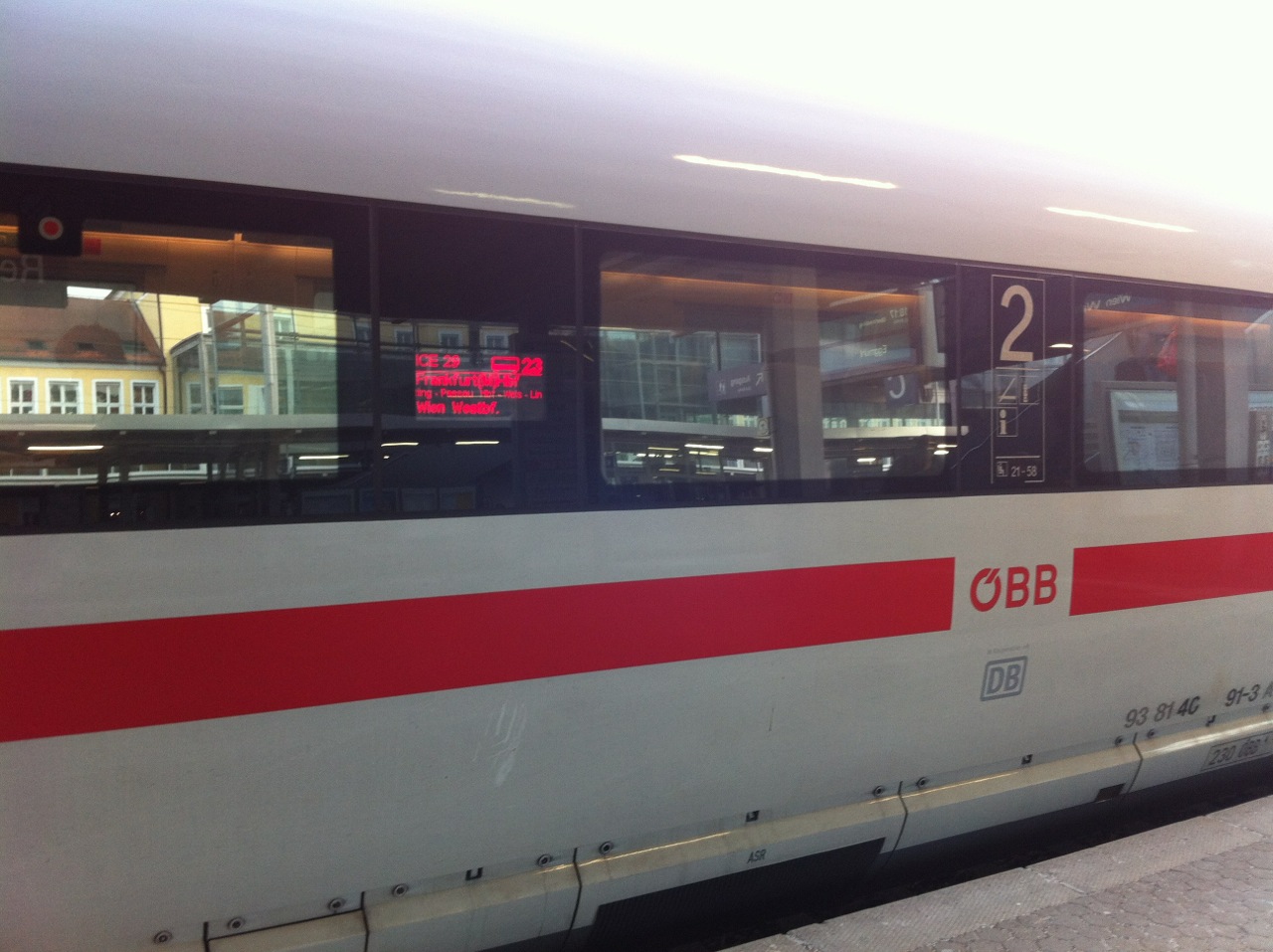
For ICE trains, however, you can usually get reserved seating- this is especially nice on crowded routes. When you have an ICE reservation, your ticket will specify a Wagon and a Seat. That’s where these signs come in handy. It’s difficult to capture this in a clear picture, but the car itself tells you that this is Wagon 23, on ICE 29 between Frankfurt and Wien (Vienna). The giant 2 to the right of that display tells you that this is a second class car.

ice-trains4

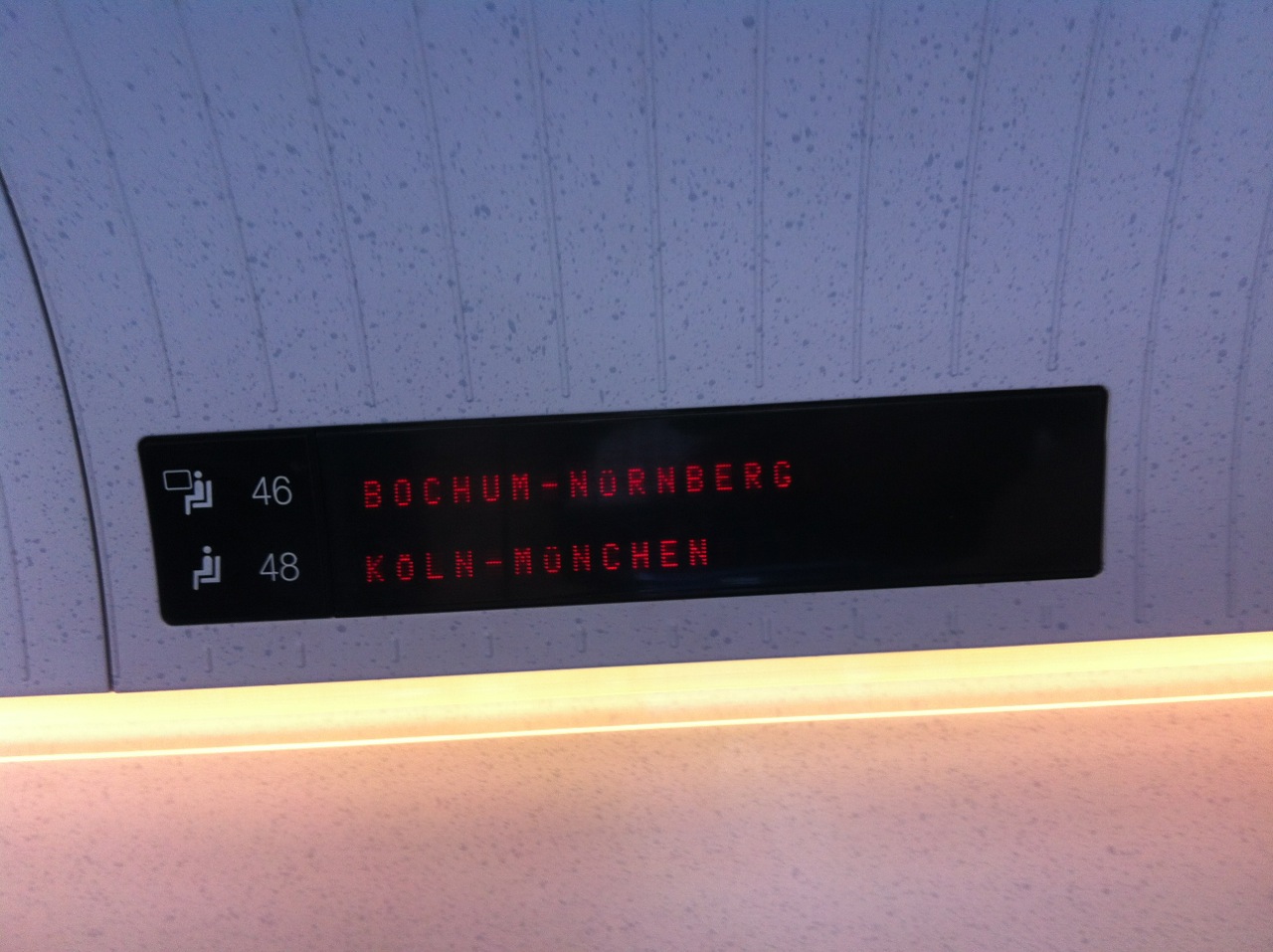
Once inside you’ll need to find your seat. If you do have a reservation, the seats will be marked by a small electronic displays somewhere above each pair of seats. If the display is blank, there’s no active reservation. The reservation display pictured below shows you that the window seat, #46, is reserved from Bochum to Nürnberg, and the aisle seat, #48, is reserved from Köln to München. Hypothetically, if you were planning on getting off the train before Köln, you could use seat #48 without much of a problem since that reservation starts with someone boarding the train in Köln.

ice-reservations

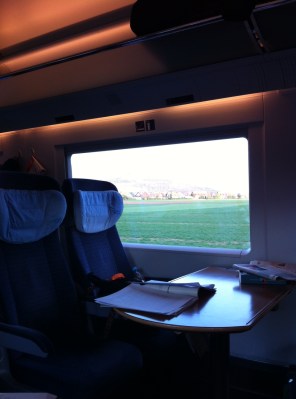
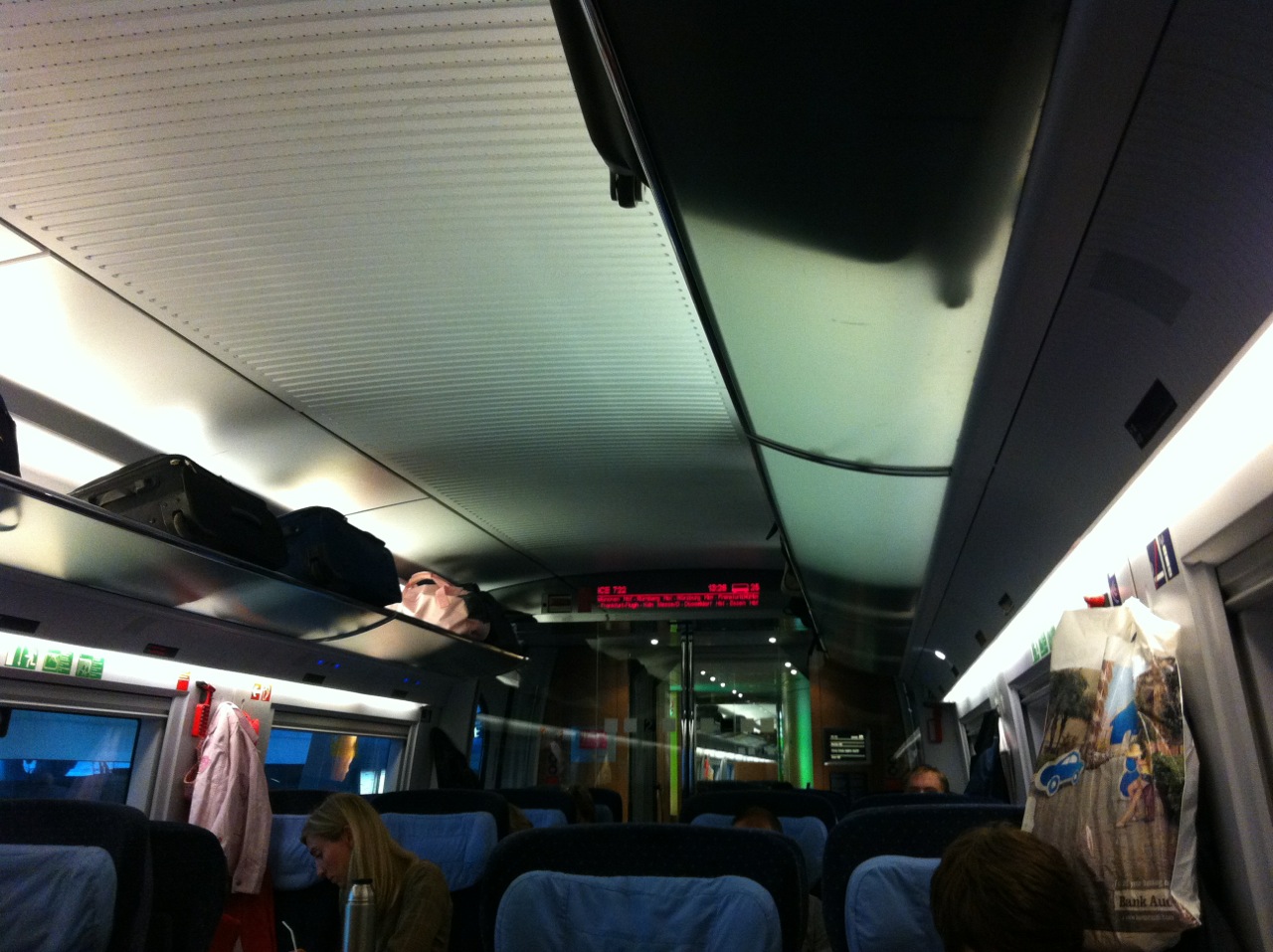
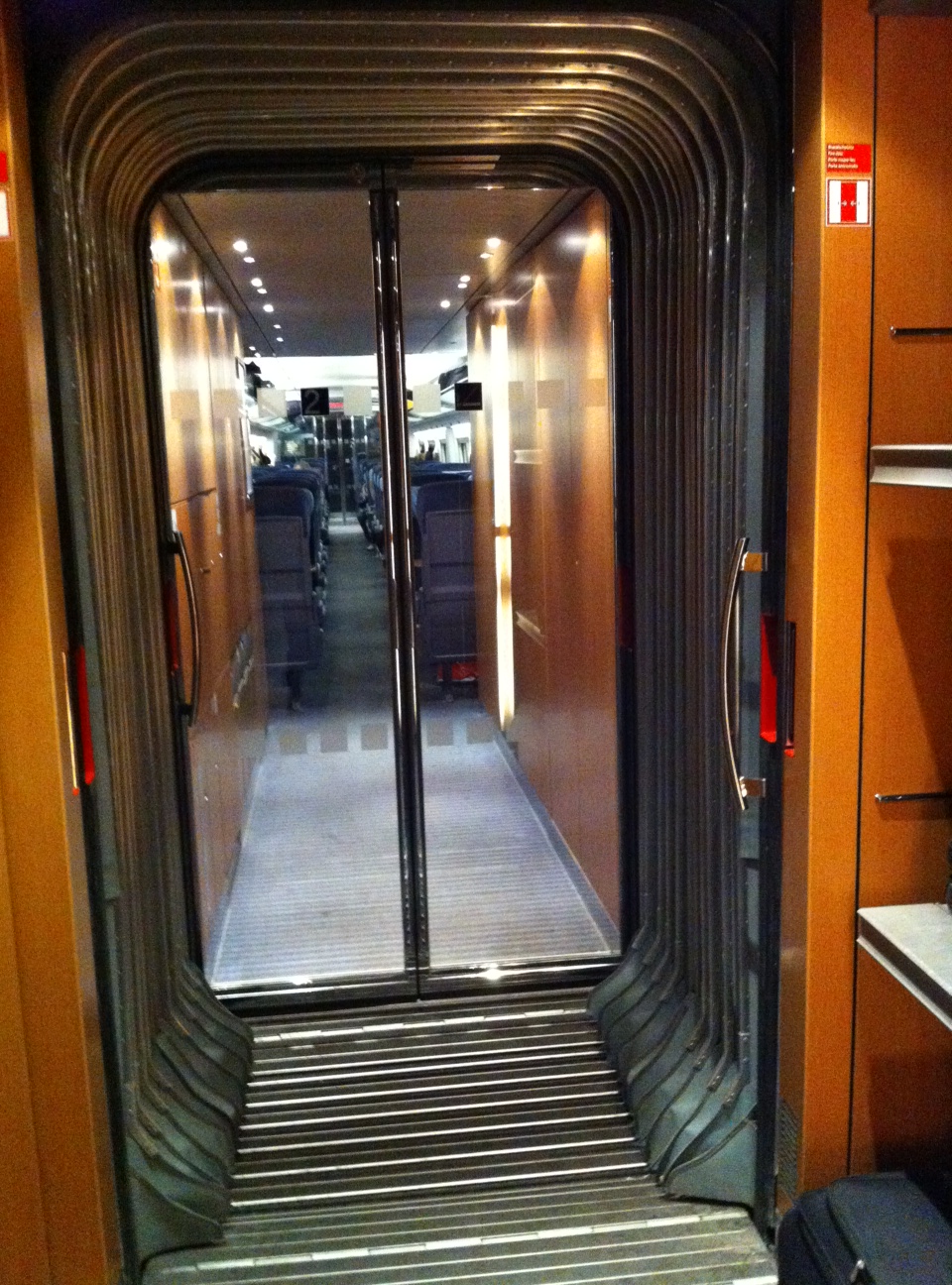
Once you’ve got your seat sorted out, you can try to stash your luggage. Most of the trains have some form of overhead storage, but it’s not always big enough for a regular suitcase. The pictures below are four different views of ICE train interiors.

ice-cabin-1 ice-cabin-2ice-interior1 ice-interior2

Step Five: Enjoy The Ride!

There’s not much else to add, really. DB trains are generally very smooth. Sure, yes, sometimes delays happen and weird things make travel a little more complicated. For the most part, though, this is a great way to travel. You can get from Regensburg to Frankfurt in three or four hours while reading on your Kindle, or you can stare out the window at the countryside passing by.

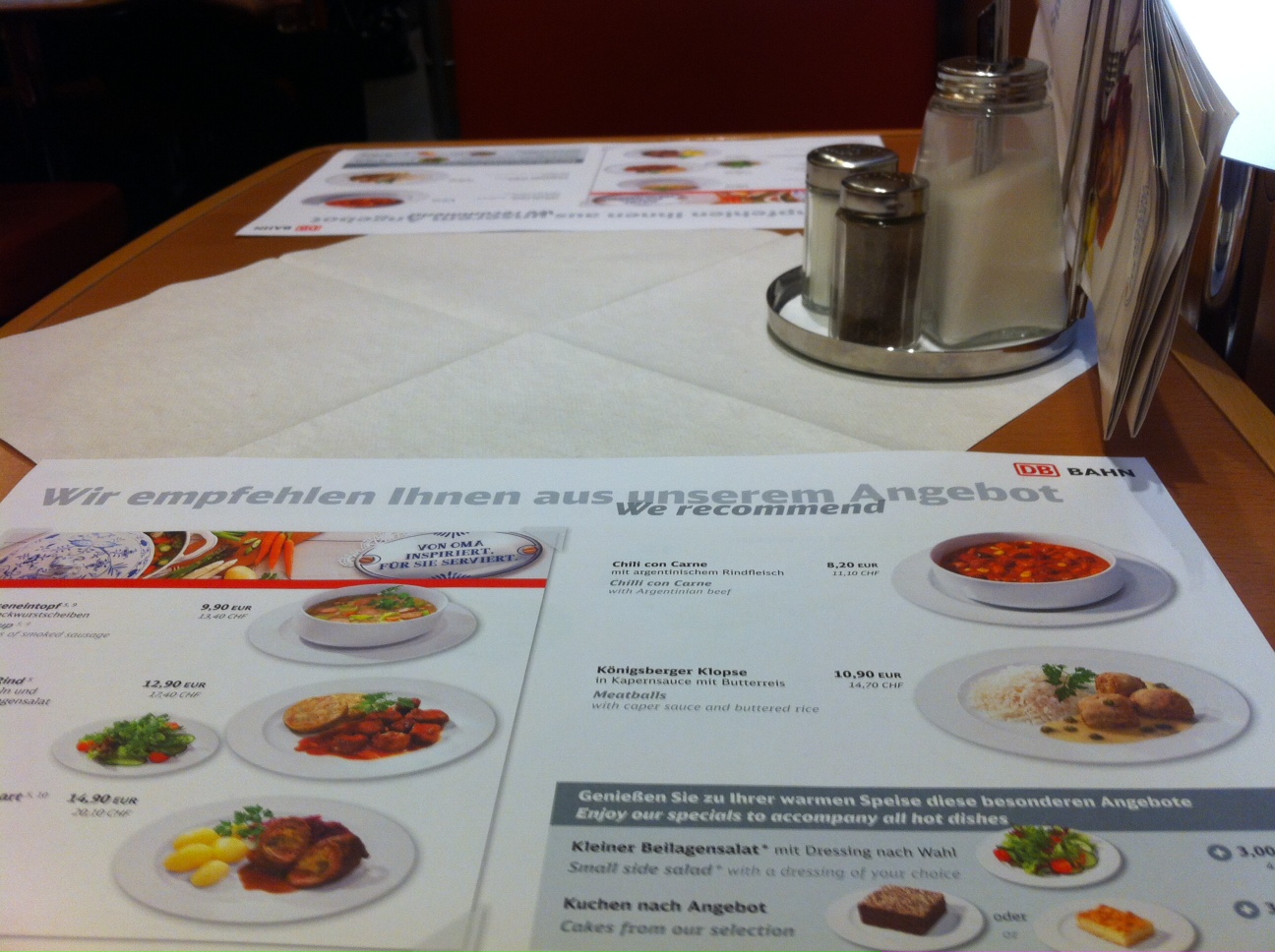
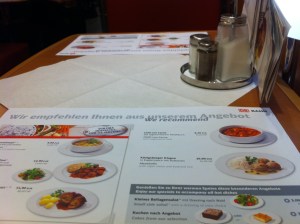
If you get hungry, most ICE trains have either a Bordbistro or a Bordrestaurant, and even the RE trains often have a snack cart passing by periodically so you can get something to eat while in motion. The Bordrestaurants often have hot food available, in a small fixed menu. You can see a few options in the photo below- when this picture was taken, chili, a rice dish, currywurst, a simple salad, and even some desserts were available.
bordbistro1

So there you have it- a beginner’s guide to riding (and enjoying) the Deutsche Bahn. I could go on a great deal longer about this topic, because I love riding the rails I think this is a good place to stop, though- this post should cover the basics. Now go forth and ride! Travel somewhere this weekend! Gute reise!

Which do you prefer- trains, planes, or automobiles? Have you traveled by Deutsche Bahn?

PSA: DST Is Coming, Or Only Flava Flav Really Knows What Time It Is

Most of the time, Germany is six hours ahead of the East coast of the United States.  For the next three weeks, however,  that’s not going to be the case.   This weekend, on March 10th at 2 am, daylight savings time begins in the United States.  On March 31st at 2am local time, Central European Summer Time (CEST) begins in Germany.  There is a span of three weeks between those two dates.

What this means in simple terms is that meetings with my US colleagues are going to be constantly mis-scheduled because every time we have a week or three between our respective time-shifts, Exchange calendar seems to go to hell.

I research everything I write about on this blog, because I always learn cool and interesting stuff.  I didn’t know that Germany was the first country to implement Daylight Savings Time, in 1916.  They did so to conserve coal during World War I.  It made sense at the time.

Even though it’s been a part of my reality for my entire life, I still think it’s kind of ridiculous in modern times.  Studies on whether it saves money or energy expenditure have gone all over the map- some have shown a huge savings, some have shown increased energy consumption, and some have shown very little change at all.    Other studies have shown that it causes disruptions to sleep habits, and one 2008 study showed that changing to DST correlates to an increase in heart attacks.

Do you think we still need Daylight Savings Time?

Q&A Time, Part 2!

A short while back, I posted an ‘Ask Me Anything’ post.  Some folks used that as a chance to ask for advice in advance of their upcoming travels to the area, and I tried to answer what I could of those in regular e-mail.  Some of the remaining questions are really interesting, so I’ve decided to do a series of “You asked, I answer” posts.  Let’s get started!

Here’s a question from Spring:  How long did the beard experiment last? What do you do for your hair? What sort of soap? I’m interested in these things because it wasn’t until I went to Saudi Arabia that my toiletries horizons expanded, starting with sandalwood bath gel.

The beard experiment* only lasted about two weeks-  that’s how long it took to both look more or less complete and itch so much that it bugged the living daylights out of me.  I am not a beardy person, and I prefer to be clean-shaven.

This leads nicely into the rest of your question though, because I started to use a slower and more traditional shaving system when I got here.  I had always wanted to try the old style of shaving with shaving soap and a brush for lather, as opposed to the chemical shaving creams that you can buy at any corner drug store.  In the US, I always found starter kits to be prohibitively expensive to try something I wasn’t sure I would like.  When I got to Germany, I found that both the shaving soap and a shaving brush were affordable, so I tried it.  It turns out that I like it quite a lot.  It gives me a close, smooth shave and the shaving soap lasts a hell of a lot longer than the shaving cream canisters I used to get.  Also, I can pack the disk of shaving soap in carry-on luggage on a plane because it’s solid, so the TSA doesn’t get all panicky.  I still use the disposable blade cartridges though, because I fear blood loss with the straight razor.

As for the soap and haircare, it’s not all that much different for me in Germany than it was in the US.   Some of the brands are even the same.   I’ve seen products from Head & Shoulders, Axe, Redken, and Nivea here.     My body wash and deoderant are both Nivea products.  My shampoos are brands that you can get in the US as well as here.  My conditioner is a Swiss brand, but you could easily get something just like it in the US under another brand name.

*”the beard experiment” that Spring referred to was a two week stretch where I tried to grow a beard.  It started with me being lazy and not wanting to shave, and then became “I wonder how this will look.”   I do this once every few years, because shaving can be a pain in the ass.

Here’s a question from Rarasaur:  Despite their exceptionally long vacations, do Germans still recognize the humor of the Monday Monkey?

While I do not claim to be an expert on Germans in general, my experience has been that German Monkeys also live for the weekend.  I’ve written about this before, but Germans are very fond of taking time off properly, and they’re very good at it.

Do you have anything you’d like to ask?  The Ask Me Anything post is still open!

How Not To Travel

Usually, when I decide to travel to a new place, I do fairly exhaustive research.  I look at information about what other people like to see in the city.  I check for walking tours or hop-on/hop-off tours.  I confirm information about the public transportation.

Most importantly, I do something that I’ve been doing before trips to new places for many years.  I make a list with three categories:

  1. Stuff I absolutely must see while I’m in this new city.  This category is the stuff that I’m most excited about. This category often includes the reason I went to the new city in the first place.
  2. Stuff that I really want to see.  This stuff isn’t quite as important as the MUST SEE category, but it usually includes a lot of interesting things that I’m glad I saw after the trip is done.
  3. Only if there’s time.  This is stuff that seems interesting to me, but if I don’t get to it, I won’t be too sad about it.

I’ve been using this three tier method for a lot of years, and when I’m traveling with a friend, I have them do the same list.  More often than not, we manage to get ALL of the must-see stuff, most of the really-want-to-see stuff, and occasionally, we even get to the only-if-there’s-time level.  Having things tiered this way makes it very easy to figure out a day by day plan without it becoming too overwhelming or stressful.   This planning method has always worked very well for me while traveling, and I should know better than to stray too far from it.

Yesterday, I tried something different.

I’ve been feeling kind of stuck lately- I don’t travel as much in January and February because it’s fricking cold and I don’t usually want to go take pictures of things when the sky is full-gray and I’m bundled up like the Michelin man.  Climbing hills to castles is not fun on snow and ice.

In order to combat the feeling of stuck-ness, I decided recently that I would try to visit some of the really close towns, places that I can get to in about an hour on the train.  A Bavaria Ticket costs me 22 Euros, and that covers the train there and back as well as any bus lines or public transportation in the destination city, anywhere in Bavaria.  The idea here is that if I day-trip to a new place, I don’t need to muck about with getting a hotel, packing a bag, and so forth.  I just go, wander around a new city for the day, then come back.

Why did this backfire?

  • It failed because I chose Ingolstadt as my first foray out this way.  Ingolstadt is perhaps the most boring city in Bavaria.  The most interesting things about Ingolstadt are that the Illuminati was founded there and the monster was created there in Mary Shelley’s Frankenstein.  Neither of these things is easy to see in a touristy way on a day trip.  Oh, and Audi has a factory and tour there, but I didn’t think to get information about that before I left Regensburg.
  • It failed because I went on a Sunday.  Everything is closed on Sundays.  Bus routes are cut down to once in hour in many routes on Sundays, which made getting around town kind of a pain in the ass.
  • Above all else, this little day trip failed because I didn’t prepare for it.  It failed because I didn’t do my list this time.  Ingolstadt doesn’t have many old buildings because it was significantly bombed out in World War II.  The few remaining old buildings look pretty nifty, but since I didn’t do my research before the trip, I didn’t know where to look.

This is the most interesting thing I managed to see in Ingolstadt yesterday:

ingolstadt

That’s directly opposite the Bahnhof.  I spent the rest of the day using the tediously slow Sunday bus routes to try to find cool things to see.  I didn’t even manage to figure out where Ingolstadt’s “Altstadt” or Zentrum (city center) was.

I did have a successful conversation with a passerby who spoke no English, so I feel like that was a win, but I learned a great deal on this trip about what doesn’t work for me when I travel.

What lessons have you learned in your life about what NOT to do when traveling?