Grocery Shopping Revisited: Two more things.

I mentioned in my first grocery store post back in December that I would probably never use the shopping carts here because I can only buy what I can carry home.  That’s not always true, though-  I have friends and co-workers with cars, and I’ve had the opportunity to push one of these four wheeled chaos engines through the grocery store.  The verdict:  I have no idea how anyone can keep these things going straight.  I usually wind up pushing it vaguely sideways.

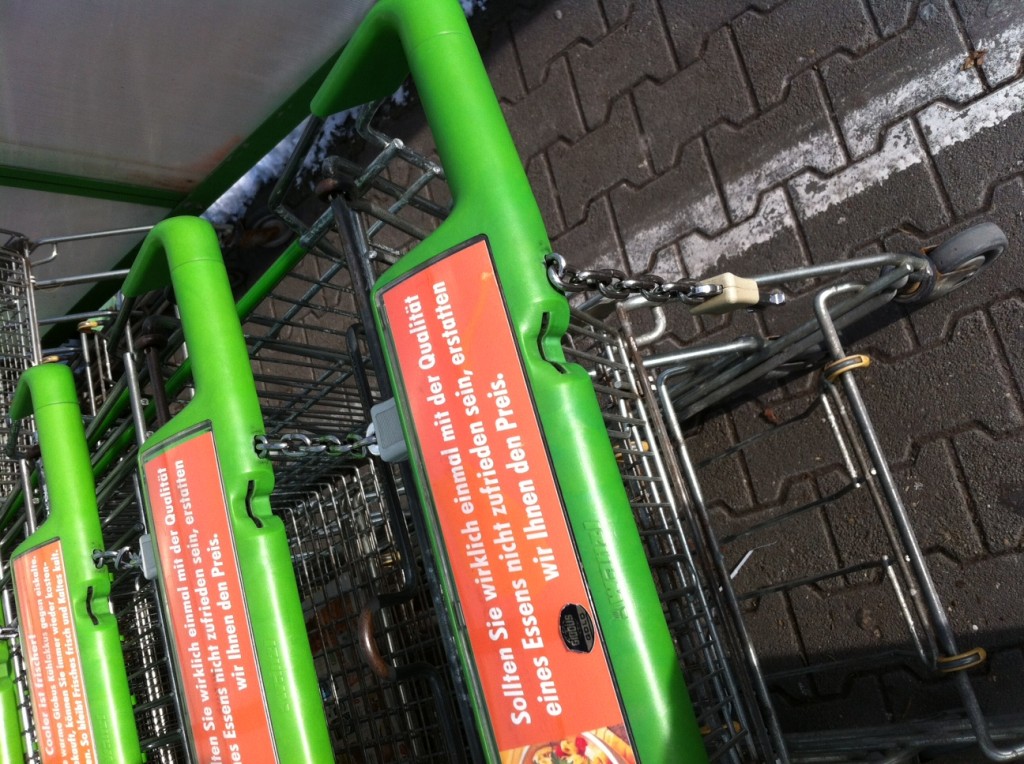
There’s much more to them than I realized at first, though.  Since I wasn’t planning on using them, I didn’t look very closely.  I did notice that there was never a stray cart in a random place in the parking lot though, and now I know why: They’re chained together.  In order to release a cart, you have to either use a one Euro coin or a plastic disk that you’ve paid for.  This is a pretty ingenious way to make sure that carts find their way back to the right place.
There will probably be a post some time in the near future about how Germans deal with waste, trash, and recycling.  The garbage sorting is pretty impressive, and I don’t think I can remember a time in my life that I have been more aware of how much (or how little) trash I produce.   One of the coolest examples of this is the bottle return system.

I also have a tremendous fascination for the bottle return.  I was not aware of this process when I did the first grocery post back in December, but many plastic drink bottles (and some glass bottles) have a pfandflasche, or bottle deposit.  When they do, you’ll see a little decal on them with a curved arrow to suggest returning the bottles.  At the Kaufland, my usual grocery stop, there’s a guy who takes the bottles.  In the Globus and Aldi locations, however, there’s a machine that will take the bottle in, spin it to see the label,  scan it, and crunch it up.  (This has led to an astounding number of “crunch crunch crunch” jokes.)  I love feeding these machines. When you’re finished, they’ll give you a receipt for the amount of credit you get back, which you then have to take to a cash register to get back.
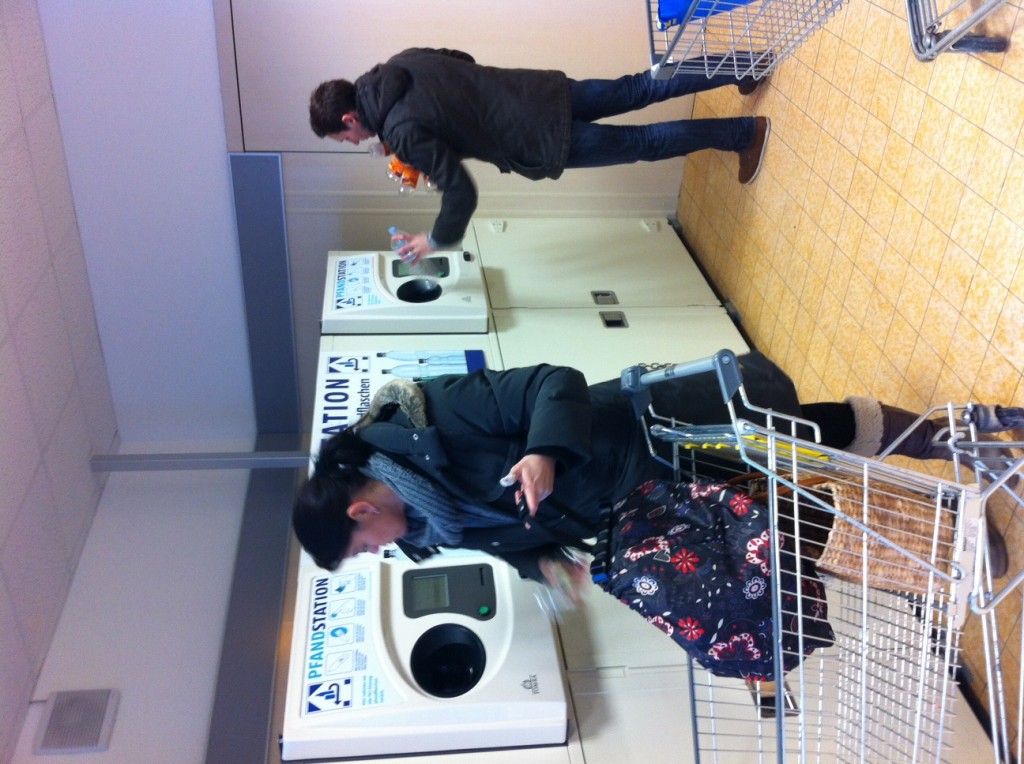
So far, I’ve managed to lose at least two of these receipts before reaching the cash out register.

I would have gotten a good (centi)grade on this topic.

One of the things that has taken some getting used to while living in Germany has been the adjustment of various types of measurements.

Twenty-four hour time is more common here than AM and PM.  Soon after my arrival,  I bought an alarm clock without realizing that the alarm clock is permanently, immutably set to twenty-four hour time.  I still have a panicked moment every time the clock reads 0:01 where I think there might be a bomb counting down.

I still haven’t got the hang of weights and distances.  Air Berlin’s website refers to their baggage allowances in kilograms, instead of pounds.   I learned the metric system in school, but I never really had to use it until I got here.  Distance is meters and kilometers instead of feet, yards, miles.   My furniture is all measured in centimeters!

One of the things that I brought with me was my grandfather’s old fifty foot measuring tape.  I was saddened to realize that it’s useless to me here because it’s was all in inches and feet and has no centimeters or meters.  I sent it to my brother for safe-keeping and put a measuring tape on my shopping list.

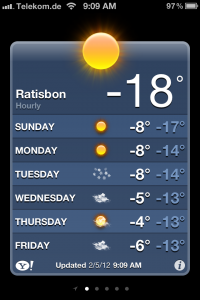
For the last week or so, the temperatures have remained below freezing.  For this life-long Florida resident, this is a very new experience.  I now know that these two temperatures are identical:

The one  on the left is 0 Fahrenheit.  The one on the right is negative 18 Celsius.   (Technically, 0F is -17.7777778C, but let’s not quibble over .0000002 degrees.)

I’ve had to mentally map certain temperatures to one another.  For example, 32F=0C.  That one’s easy to remember, since it’s the freezing point of water.  Below 0C means snow instead of rain.  Or sometimes if it’s really close to 0, rainflakes-  snow that becomes water as soon as it touches the ground.  -11C and 11F are also a nearly identical temperature.

When I started to write this post, it wasn’t intended to be about measurements or weights or distances, it was about what happens when the temperature drops below freezing for a sustained amount of time.   This stuff gets everywhere:

That schmutz you see on the floor of the bus?  It’s s a combination of streusand, streusalz, and mud.  Streusalz is the salt they put down on the roads and sidewalks to keep the snow down on major pathways, and streusand is a sort of gritty gravel that they put down to lend more texture to snow and ice so that you have more grip.

So now people walk around in the snow and salt and grit, and it tracks everywhere.  Spend five minutes on the bus and all the snow on your shoes will melt down into this gritty nasty mud that you see in the photograph.  The gravel is all over the carpet under my desk at work.  It’s also tracked into my front hall at home.   The floors of the train station are horribly nasty right now.  All of my shoes have little tiny stones in their tread.

Honestly, I’m looking forward to warmer weather just so I can keep my floors clean.

Kona and Kepler

This morning started out with breakfast at a little cafe called Kona, which has delicious bagels.  On the walk there and back, I delighted in the snowfall from the last few days.  As a life-long Florida resident, I’ve never really experienced snow on this magnitude.

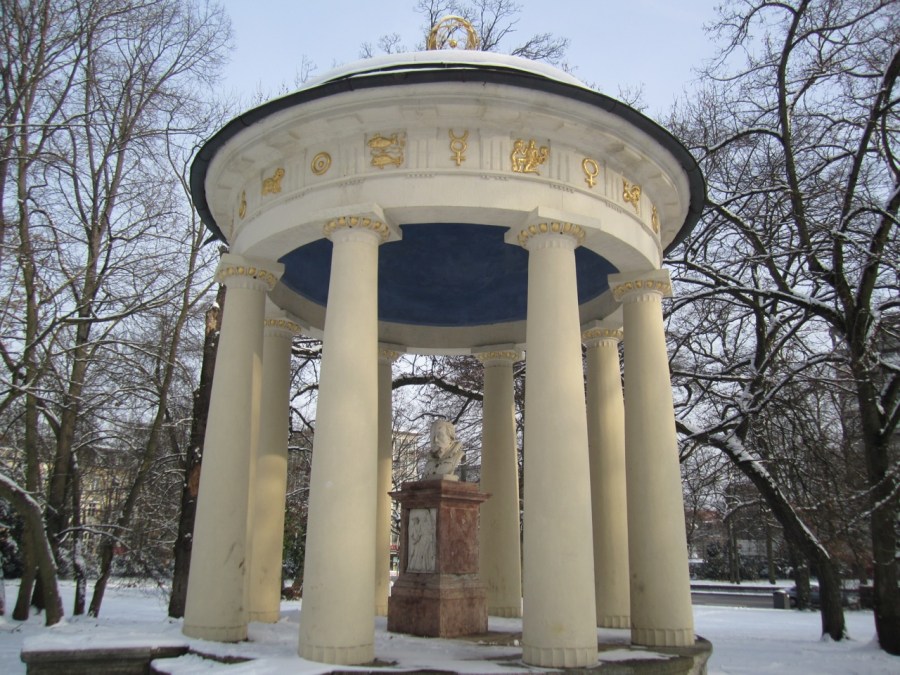
Since I was looking around even more than I normally do, I noticed a structure across the street that I hadn’t noticed before, with some gold leaf around the outer edges and a golden shape on the top.

The structure turned out to be a memorial to someone who lived here in Regensburg-  Johannes Kepler, famed scientist, mathematician, philosopher, and astronomer.  People involved in the sciences might be familiar with Kepler’s Laws Of Planetary Motion.  I had already  noticed that there’s a lot of streets named for scientists here.  There are places named for Kepler, and Copernicus, and Max Planck.

Kepler moved to Regensburg late in his life, and he fell ill and died here.  Kepler’s original burial site was lost during the bombings of World War II, but the structure I noticed today is a newer Kepler memorial.

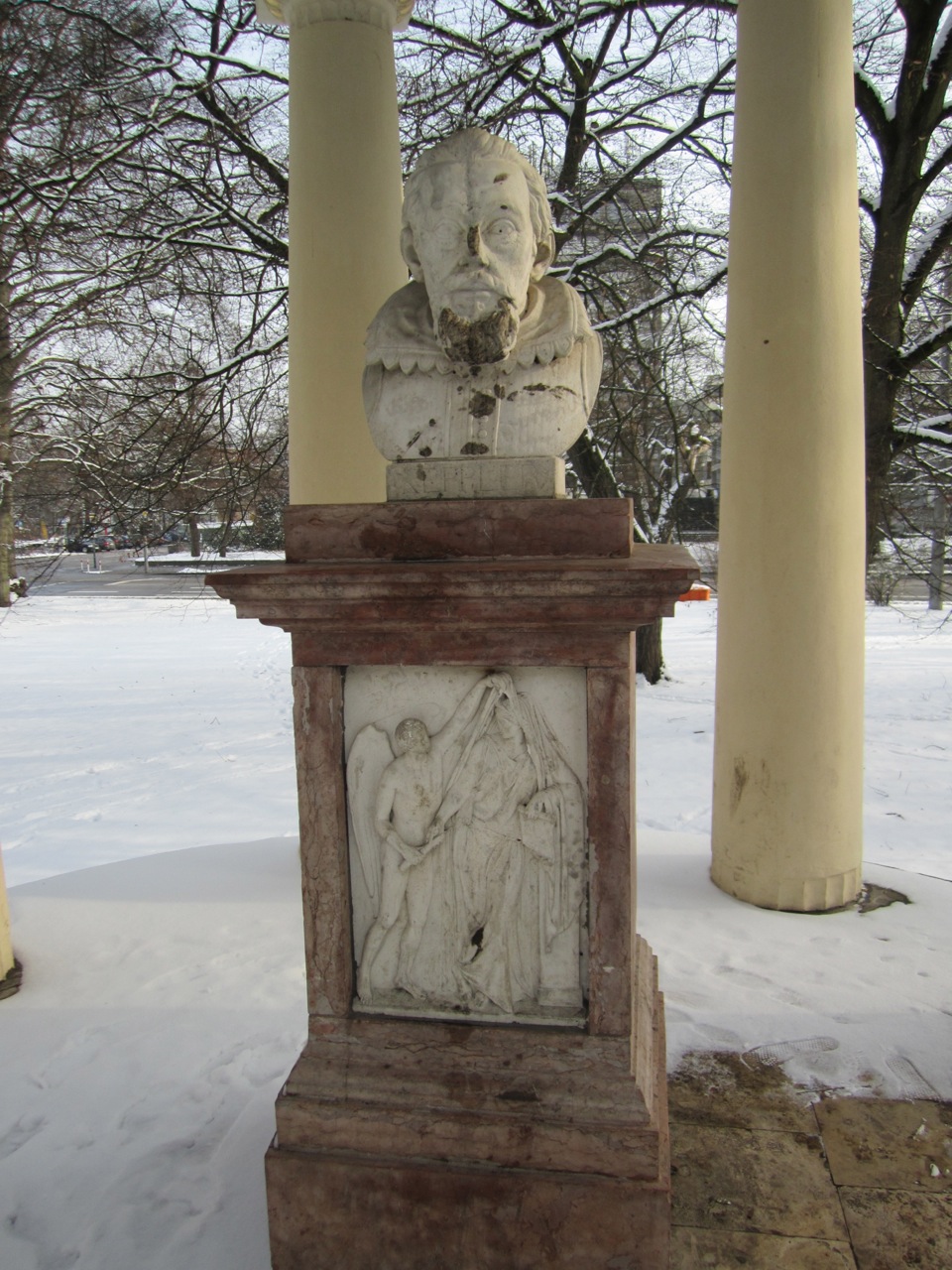
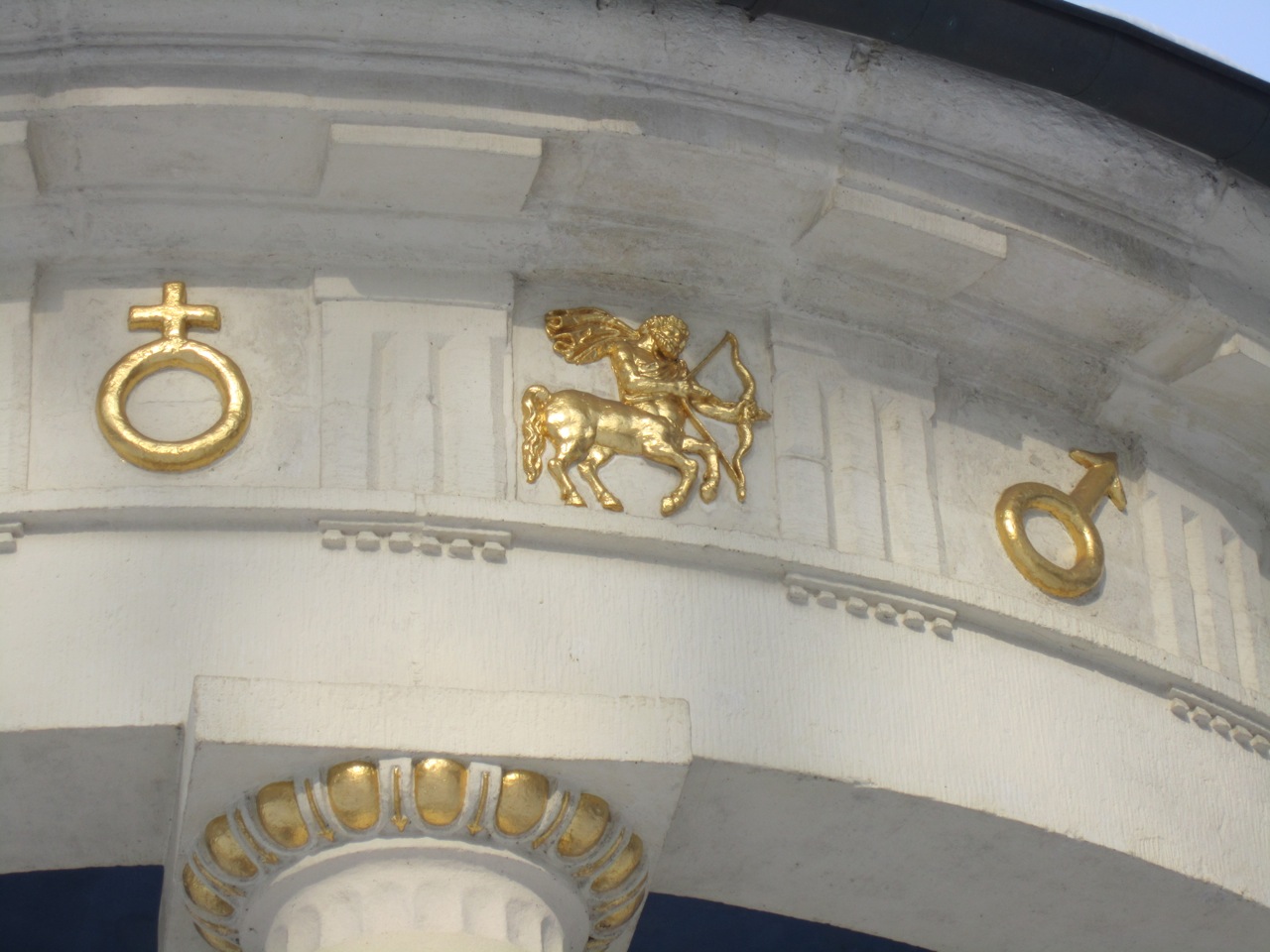
The memorial has a bust of Kepler, with his name misspelled- I’m not at all sure why the bust has two Ps instead of just the one.  There is a piece on the top which I think is supposed to represent the laws of planetary motion, and the outer edge of the canopy is ringed with astrological symbols.

Homeboy needs a new coat of paint.

…and a closer shot of the details on the Sagittarius glyph.

I’m going to have to do some checking to see if there is a definitive guide to all of the different statues and memorials and other interesting antiquities here-  most of the literature I’ve seen has focused on the old churches, but there’s also an ancient Jewish temple which has been razed to the ground some centuries ago, but there’s a memorial which stands on that site.  I walked past that memorial more than a dozen times before somebody told me what it was, and then I found the signs that explain it- one in German, one in English, and one in Hebrew.

Rough translation: "This is where Napoleon the 1st was wounded on 23 April 1809 during the bombardment of the city."

There are lots of that sort of thing here.  As I learn more about my new home, I am constantly astonished at the little bits of history that have happened here.  For example, Napoleon himself spent some time in Regensburg, after receiving a minor wound to his ankle during the Battle Of Regensburg before he moved on to Vienna.  One of my coworkers told me that there is a sculpted throne not far from here that was made for Napoleon to use during his recuperation.

This town is utterly fascinating.