More observations on Germany.

It’s time for another list of random stuff that I find fascinating!  Ready?  Go!

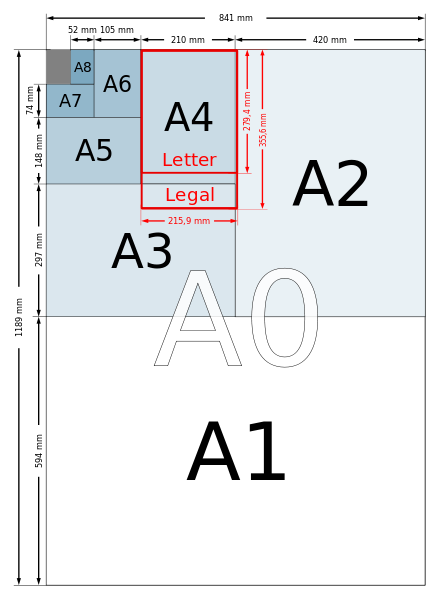
Paper sizes:  In the US, the most well known paper sizes are letter (8.5 x 11 inches) and legal (8.5 x 14 inches), and then there’s a bunch of smaller sizes for envelopes and such.  The sizes here in Germany are metric, and the closest match to what I’m used to would be the A4.  You can see from the chart below that the A4 size is a little larger than Letter, and a little shorter than Legal.  After looking at the chart, I have decided that I will only write notes to people now using A0 sized paper.
papersizes

Mayonnaise and Mustard tubes:  A common mayo and mustard delivery system here is the toothpaste tube style.  While you can get the jar form that Americans are used to, there are lots of brands that show up in this form factor.  I was weirded out by this at first, but I’ve grown to kind of love this-  no more hunting around for a smaller spoon just to get the last bit of mayo out of the jar-  you just roll this down like toothpaste.  And the nozzle is star-cut so it even makes the mayo pretty. A further note about mayo here-  they separate the mayo into two types, deli mayo and salad mayo.  I still haven’t really figured out the difference other than a slight change in consistency.  I prefer deli mustard based entirely on the logic that deli sandwiches are delicious.

thomymayo

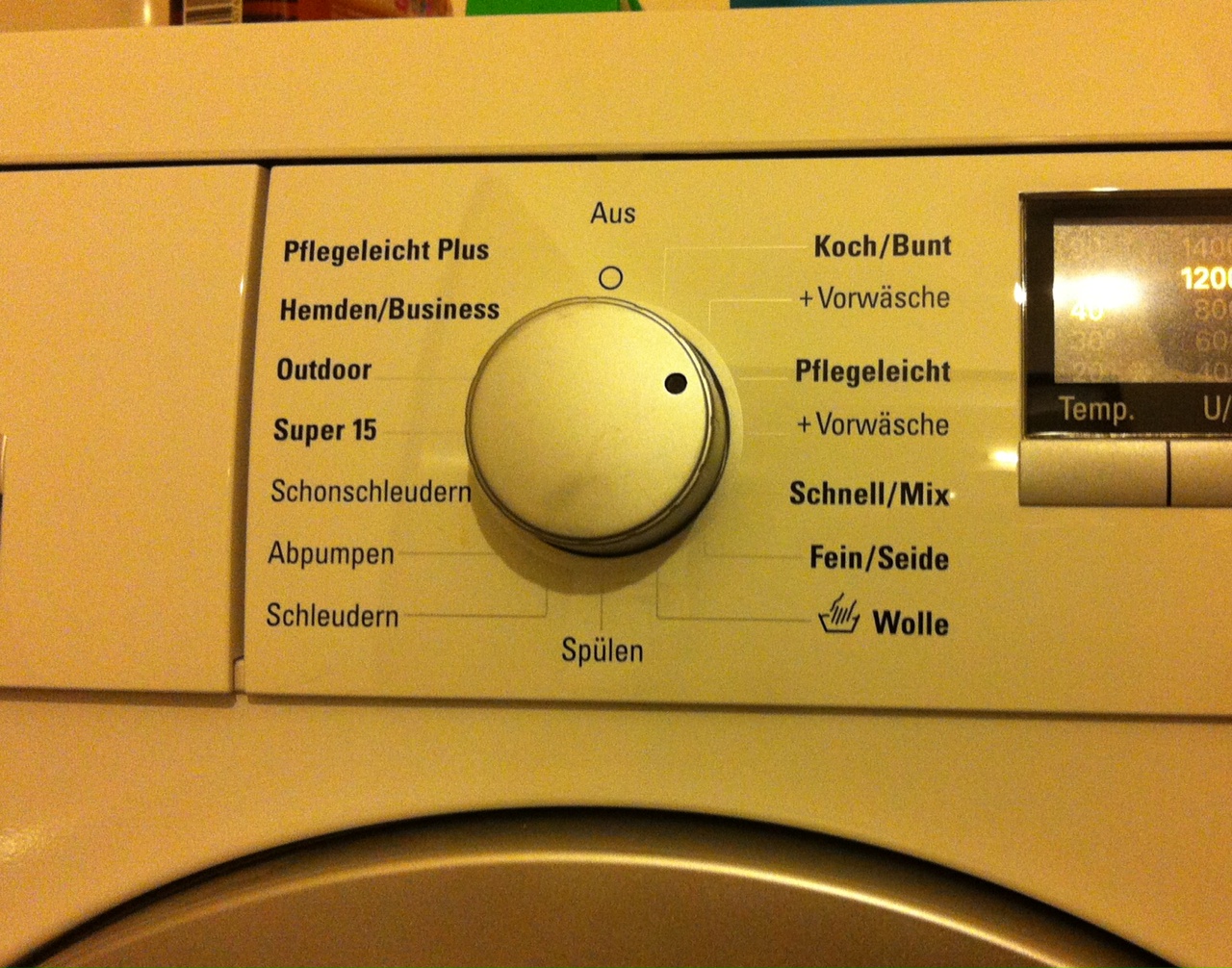
Laundry: I bought a washing machine for my apartment a few months after I arrived, and my friend Jenny promptly named it Gretel.  That’s fine, it seems like a Gretel to me also.  It’s not common to also have a dryer here, and so my laundry  mostly drip dries.  When I do want to use a dryer, I go to a nearby laundromat.  It’s the same basic idea as laundromats in the US- a row of coin-operated washers and dryers in a shop not far from the Altstadt.

The picture below is the main controls for Gretel the washer.  After an entire year with this washer, I still have no idea what most of these functions do.  Although to be fair, I didn’t understand most of the functions on my washer back in the US either.
gretel

Dry cleaning: I don’t know if this is just where I go or if it’s everywhere, but in the US, when I drop off my dry cleaning, they give me a ticket, and then I pay when I pick it up.  Here, I pay when I drop it off.  Aside from that, dry cleaning is pretty much identical here, though.  Hey, it can’t all be strange and unusual, right?

tschiboTchibo:  When I first arrived in Germany, I was thoroughly confused by Tchibo.  I couldn’t tell what their deal was-  they seemed to have coffee, dishes, and lingerie.  I’ve since learned that being a coffee cafe is their main focus, but that they rotate other products through just to be contrary and confusing.  My iPhone is also confused by Tchibo.  I was making a note about it to myself, and the iPhone auto-corrected Tchibo to ‘Tax Hobo.’

Also, their logo is supposed to represent a steaming coffee bean as far as I can tell, but I can’t look at it now without seeing it as a swimming sperm.  (Damn it, Heather, this is your fault!)

plungersPlungers: Ok, there’s nothing really different about plungers here, I just like this picture of a giant bin of plungers for sale in the Globus.  When I first got my apartment, I needed a plunger, and I bought it in the Globus.  I didn’t know how to ask for a plunger in German, and the woman I asked didn’t really speak very much English.  I used the word for plunger that came up in my handy dandy translation app, and it was spectacularly unhelpful.  Undeterred, I mimicked the motion of plunging a toilet, and the recognition on her face was immediate and clear.  She guided me right to where they were in the store.

I still have that plunger, by the way-  it’s in the shower, which is what I bought it for.  My shower drain is occasionally stubborn, and requires a good shower-plunging.
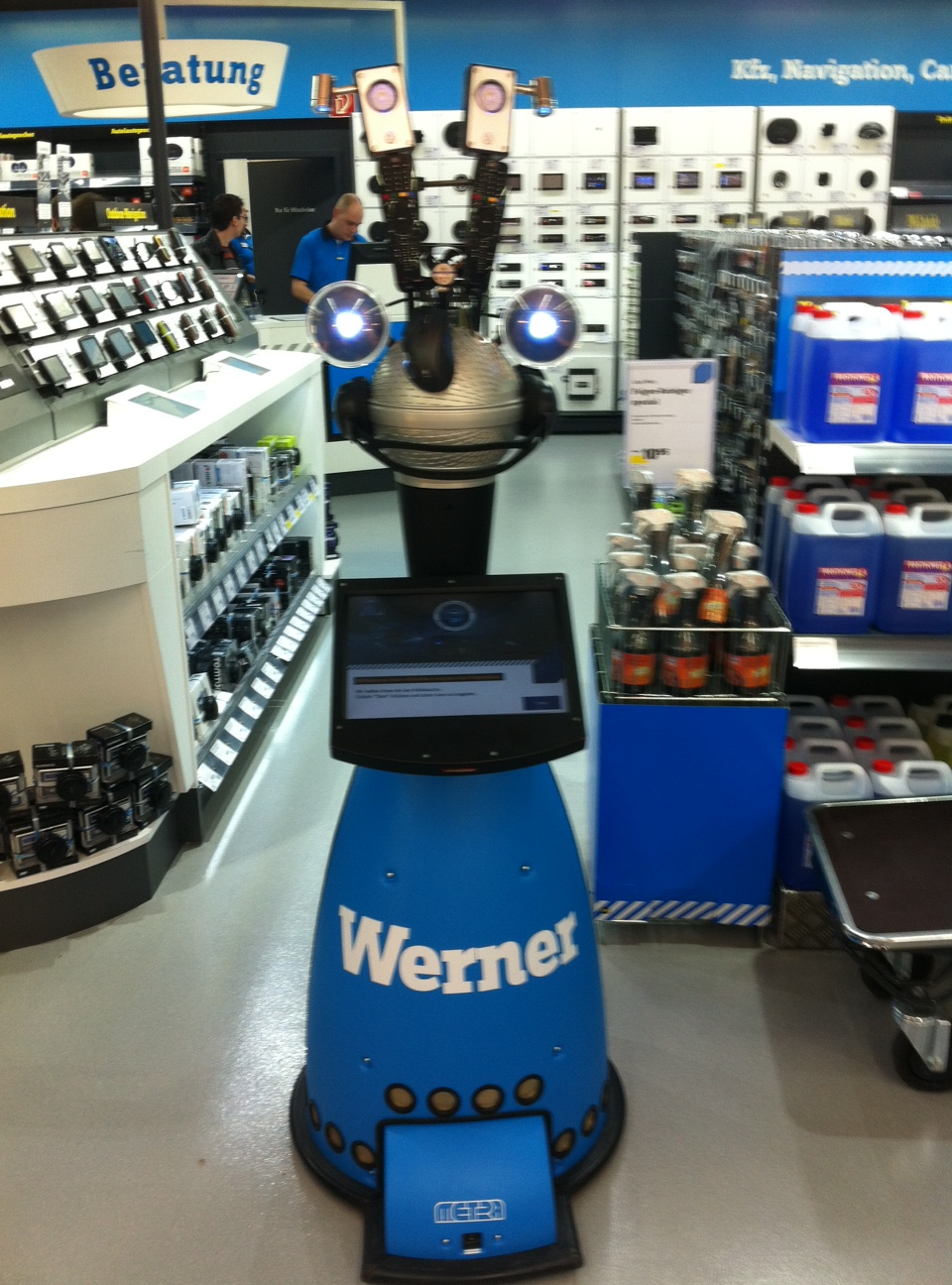
werner Werner: This is Werner.  He’s a robot in a local store called Conrad.   Conrad is sort of like if Radio Shack, Best Buy, a hardware store, and a hobby store all had a freaky four-way and had a child as a result.  I bought my television at Conrad.  I also bought a Mac Mini there.  They sell electronics, power tools, hobby items, remote controlled vehicles, and more.  Their catalog is this enormous thick affair that rivals the Sears catalogs they used to send out once a year.  The reason I wanted to show you guys Werner is that he can help you find stuff in the store.  When he’s not already helping someone, he hangs out near the front doors.  If you use his screen to select a specific type of product, he will guide you there.  The first time I saw a small group of people being led through the store by this friendly fellow, I was kind of enthralled because hey, I’m still basically a ten year old boy.

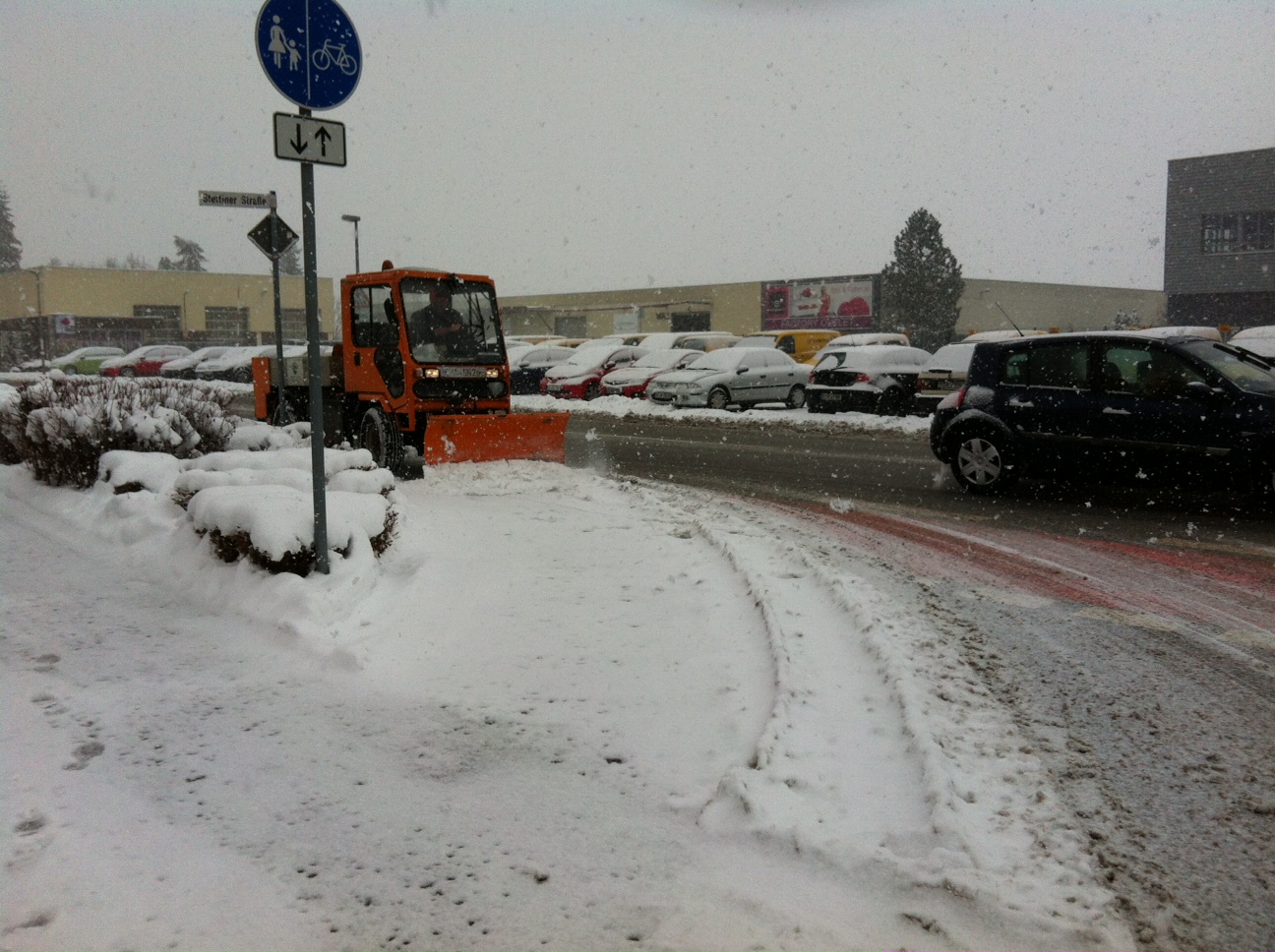
Snow Plows: They have snow plows in the US too, but I’d never seen one outside of a television screen because I lived in Florida.  As a life-long Florida resident, any technology that is used expressly for dealing with cold stuff is just fascinating to me.  They come in all sizes!  Here’s one that’s sidewalk sized and one that’s street sized.
plow1 plow2

Expat Tools

I was having a conversation with Alex of Ifs Ands & Butts about how we get our respective television fixes,and I realized that there’s a good blog post in talking about some of the technological tools that I use to get by in Germany without losing my mind.   I suppose I should post a Disclaimer: I have not been paid, sponsored, or otherwise compensated for endorsing anything in this post.  It’s just stuff I find useful for getting by outside my home country.

This list really falls into three categories-  Websites, Software/Apps, and Hardware.  Let’s start with the software.

iTunes11

iTunes:   Let’s start out with one of the two most important applications for maintaining my sanity.  Not only does this contain my music collection, without which I would be a ravenous, rabid beastie, but it also lets me rent movies from time to time, and it lets me purchase season passes for a few cherished television shows that I would be very sad to miss out on.  I mostly watch these programs and rented movies at home, but if I know I have a very long flight coming up, I sometimes rent a movie or two and load them onto an iOS device just to help pass the time in transit.  I use a variety of other methods to maintain my ridiculous volume of television viewing; this is just one of the methods I use.

SkypeSkype: This is the second important sanity-maintenance application.  Skype is a VoIP (voice over IP) application that lets you talk to people in several different ways.  It has an instant messenger function, for basic text communication, it carries voice, and it also does video chat.  Skype-account to Skype-account calls are always free, but that’s not where the true power of Skype lies.  The real strength of Skype is that it can call out to the existing phone network.  This means you can speak to people on their regular cell phones and land lines for a fraction of the regular telephone cost.  I bought fifty dollars of Skype credit roughly eight months ago and even with regular calls back to family members in the US, I haven’t run out yet.   It’s important to note that this is both a computer app and an iOS application.  I sometimes run Skype just for voice calls from my phone, and the sound quality is every bit as good as a normal phone call.  Lastly, I paid a little bit extra for what is called a Skype-In Number.  This is a local phone number in an area code of your choosing which connects directly to your Skype account.  In my case, I got an area code 561 phone number because the majority of my family and friends are in 561, a South Florida area code.  If they dial that 561 number, it costs them nothing more than any other local phone call, and it dials my Skype account directly.  If I don’t have Skype running, they get sent to voice-mail.   This is a thing of beauty.

A Slingbox:  Some people have access to HBO Go and Showtime Anytime accounts.  For those that don’t, a Slingbox is another useful way to view US-bound television.  The trick with a Slingbox, however, is that you have to have someone back in the US willing to leave it attached to their television.  Preferably someone who doesn’t mind if you occasionally take control of their television to view it remotely.  I no longer have a Sling of my own, but I do have a friend in a town outside of Chicago who lets me access his Sling from time to time.  It can be quite nifty.

Hulu, Netflix, Pandora, and Other Entertainment Websites: Each of these is a source of video or audio entertainment.  Spotify is now accessible in Germany, but it wasn’t when I got here.  There are various entertainment websites out there which help to complete the fabric of my pop culture addiction.  I make daily visits to The Daily Show, The Colbert Report, and The Rachel Maddow Show online.  Of course some of these aren’t visible from outside of the United States, which brings me to…

hidemyassA VPN: A VPN, or “Virtual Private Network,” is a service that can be used in many different ways.  Many companies use them to help a remote worker access an internal network, or to help secure the work being done.  For an Expat, though, a VPN is most valuable as a means of making the Internet at large believe that you’re on an IP in the United States.  Why is this useful?  Many entertainment websites, because of International copyright and licensing laws, restrict access from connections outside of the US.  In order to access Hulu, Netflix, Pandora, and a bevy of other sites, you need to have an IP address that appears to be inside the United States.  There are many different VPN services out there.  The one I use is entirely software, from a company called Hide My Ass.  I’ve also seen hardware VPNs.  These usually consist of a specially programmed router that you purchase, and the VPN connection is handled automatically by that piece of hardware.

There are also several methods to catch up on your television that are of questionable legality.  I do not condone these next two methods, but I’m including them here for completeness:

      1. There are sites that will stream shows, such as watch32.com and movie2k.to
      2. There are torrents.  Sites like showRSS in tandem with a proper BitTorrent client can help you to grab shows as they air.

Google_translateGoogle Translate and Leo: Both of these exist as both mobile apps and Websites.  Google Translate helped me through my first few months, especially in the grocery store.  It has the nifty feature of allowing you to speak a word or phrase in German to your phone, and it will attempt to translate using basic voice recognition.   It will also pronounce things for you using simple speech synthesis, which can also be extremely useful. However, Google Translate isn’t always the most precise translator, which is where Leo comes in.  Leo on the iPhone is just a word translation app.  It will give you a variety of meanings, including pronunciation and the gender of the German word.  For anyone trying to learn the language, this is an incredibly useful tool.

Facebook, Twitter, Instant Messaging, and other Social Networking sites:  While Skype is great for making phone calls to a few people on a regular basis, the time difference between the US and here makes it unrealistic to keep in touch with everyone via phone calls.  That’s where social networking comes in.  As much as I despise Facebook, I can’t deny that it has made it easier than ever to see what’s going on with my nieces, to communicate with friends all over the country, and to make sure that certain technologically challenged family members can still see pictures that I post from my time here.  Without Facebook, I would have significantly less contact with my family.  Without Instant Messaging, I would be massively out of touch with everyone else.

Similarly, a lot of people use What’s App to communicate with other folks on disparate cellular networks using only your data, rather than typical cross-network SMS charges.  Hanley from Pink Parliament swears by TextPlus, which I haven’t used myself.  From her description, she uses TextPlus the way I use Skype: “Textplus is a life saver. I use it every day. You can get 1300 mins for 20 bucks, it works on both 3G and wifi and the other person doesn’t have to have it for you to call. You can call landlines and cell phones.”

plugadapter Electrical Adaptors: It should go without saying that someone like me is going to have a lot of gadgets.   The good news is that most of the important ones can handle the varied voltage.  Most laptop computers, cell phones, and tablets can handle the varied voltage without too much difficulty.  That just leaves the shape of the plugs.  The picture to the left of this paragraph is a set of electrical adapters that I purchased in the local MediaMarkt store for just a few euros.  As you can see, it’s got the US plug style on the front, and the German plug style on the back.  It doesn’t do any voltage conversion, but for most gadgets, that’s all you need.  You always want to read your documentation to be sure, though.  The alarm clock I brought with me from the US?  Utterly useless on this voltage.  I had to buy a new one here.   My electric razor can handle this voltage just fine, but the Water-Pik cannot.  My printer/scanner won’t work on this voltage, but I have a single voltage converter, also purchased in the US, connected to that one device.

By the way, I left my television behind when I moved, and bought one here.  When I move back, I’ll do the same thing-  this one will get sold off  locally for a very good price, and I’ll buy another set when I get into a new apartment in the US.  The reason for this is very simple-  the video systems in these two countries are very different.  Even if you aren’t looking at the electrical plugs, the video has different connectors, different picture types, and so forth.  I suppose it might be possible to use a German television in the US, but there are too many reasons to just start over with a US marketed set.

This list isn’t exhaustive, but it does cover some of the most important things I use.  Fellow expats, what tools do you use to make your life abroad easier?

So You Want To Visit Germany

I posted a while back about Dining Out In Germany, and I realized recently that whenever someone I know visits Germany, there’s a bunch more stuff that I tell them.  As I prepare to head back to the US this week for my first visit home in over a year, I have some observations from my first year here that I think might help an American visitor to Deutschland.

The Bathrooms Are Different.

Not the plumbing.  A toilet is a toilet is a toilet.  The basic size and shape are pretty much the same.   The differences are in other areas.  Here’s what I know:

  • There are almost always stairs to reach the loo.  I’ve been in perhaps three restaurants in all of Germany that didn’t involve a quest down three flights of stairs to reach the bathroom.  I’m pretty sure I saw the guy from Pitfall in one of them.
  • The labels are a little different.  This stands to reason, since it’s not English, but if you don’t know that Damen is Ladies and Herren is Gentlemen, your first trip past that door can be mildly embarrassing.   Sometimes the doors just say H and D, which is even less help if you don’t know the labels ahead of time.  At least the little silhouettes that some places use on their doors are pretty universal.
  • When traveling, hold on to your fifty cent and one Euro (1 €) coins for your bathroom needs.  Europe is very fond of the pay toilet.   Restaurants and airports and trains usually have cost-free restrooms, but pay-to-pee is the norm in lots of other places.  In some train stations, there’s a chain of attended restrooms called McClean which has very nice, well maintained restrooms for a per-use fee.  There are also street level restrooms in many cities that involve fees to get in.  Sometimes there’s a coin plate near the door as if to suggest that a donation would be a good idea.
  • Don’t be surprised if a restroom attendant of a different gender than your own comes in to clean the place, especially in train stations.

Getting Around An Unfamiliar City.

Most cities around Germany have a nice public transit system.  If you’re lucky enough to be in a larger city like Berlin or Frankfurt, you might even have a variety of modes to choose from. Berlin, Hamburg, Munich, and Nuremberg all have underground metro systems, referred to as U-Bahns or Untergrundbahn.  Most cities have a form of S-Bahns, or Stadt-Bahn.  This is just a basic above-ground rail system with trains tying locations together.  Some places have Straßenbahn, or streetcars. And of course they all have bus lines.

In most instances, your best value is going to be a Tagesticket or day ticket.  These are typically good for use on all the forms of public transit in a city, so you can hop between them.  For example, to get from the Berlin HBF to my favorite hotel in Berlin, you need to take the S-Bahn (S5, S7, or S75) to Alexanderplatz, then switch to the U-Bahn (U8) to go one more stop.  Every Bahn station will have kiosks where you can buy tickets for the local transit system, and a full day of unlimited rides is generally more cost effective unless you’re only planning on one or two journeys.

Here Are A Few Words You Might Need To Know.

  • Entschuldigung – Apology/excuse me.  You’ll hear this when someone wants to get past you in a hallway, for example.
  • Ist hier frei? – Is this seat open?  Useful in crowded trains and restaurants.  German pronounciation note:  ‘frei’ is pronounced like fry.
  • Geöffnet – Open.  If a bar or restaurant has this word in front, you can go in.
  • Geschlossen – Closed.
  • 24 Uhr or 24 Stunden – 24 hour.
  • Tankstelle – Gas station.  If you’re driving, you’ll need to know this one.
  • Apotheke – Drug store.  If you need aspirin, paracetamol, cold medicine, skin lotion, or pretty much anything you would get in a pharmacy back home, this is where you’re going to find it.   Unlike the US, aspirin and other pharmaceuticals are generally not available in other types of stores- you’ll have to find an Apotheke.
  • Eingang/Ausgang and Einfahrt/Ausfahrt– These are entrances and exits.  When you’re on foot, eingang means entrance and ausgang means exit.  When the suffix -fahrt is attached, it refers to cars.  This leads to one of my favorite jokes, “Ausfahrt must be the largest city in Germany- there are signs for it all over the Autobahn!”
  • Besucher – This means visitor.  Some form of this word usually appears on visitor’s entrances.
  • Einbahnstraße – One way street.  I thought these were all pointing to a specific highway for my first two months in Germany, and I couldn’t figure out why they all seemed to be pointing in different directions.  I’m not always the sharpest tool in the shed.

Buying Things Is Hard

The process of acculturation in Germany, for me, has been particularly challenging.   Every time I start to feel like I’m making progress, I encounter things which are enormously difficult for me, despite being rudimentary and simple for a native.

Purchasing concert tickets, for example.

For most of the concerts I’ve gone to this year, I’ve used eventim.de for my purchases.  Eventim is a great deal like Ticketmaster, except easier to use.  It also allows you to select English for the Website, so I’ve been able to get by.  However, sometimes the concert I want isn’t available through Eventim and I have to go a different method.

This is where I start to have trouble.  My command of the language isn’t very strong yet, so I use Google Chrome, which translates German to English on the fly.  The only problem is that the translations aren’t always precise, so I really have to employ some educated guesswork.

The word Karte can be a problem.  Karte can refer to a map, a card (such as a credit card,) or a ticket. You can imagine the confusion when you’re being asked to put enter payment information.

Dates are reversed here.  Using the first day of summer as an example, when I arrived, I thought the first day of summer was written as June 21st, 2012.  Here in Germany, it’s written 21 June 2012.  This is also true on Internet forms.  This leads to still more confusion: Is my card’s expiration 11/2 or 2/11?

Many of the line items on order forms don’t translate very well to English.   The idea for this post popped up while I was fighting with an order form for a concert ticket in Mannheim.  It took me three tries to successfully navigate the form to completion.   I was ultimately successful, but I would not have been able to place that order without help a year ago.

I blame the heat.

This week, I made a pretty big mistake.  On Monday, I bought this:

It had been a very warm pair of weeks- at one point, the temperature hit 35 degrees Celsius in the afternoon, which for you Americans is about 95 degrees Fahrenheit.  Since my apartment and my office are both entirely bereft of air conditioning, I was wholly unprepared for this.    One evening last week, it was so warm and sticky that I couldn’t sleep until 2:30 in the morning when a thunderstorm kicked up and started to cool things down slightly.

The portable air conditioner was something that I’d been thinking about on and off for months.  At  just under three hundred Euros, it seemed like a reasonable sacrifice.  I have a fan in the apartment which does great things for making it seem cooler, but it does little to actually cool down the ambient temperature of the apartment.  Plus when you hit the power button, those little shark gill looking flaps in the front open automatically, which is really neat.  I’m a big sucker for “neat!”

Enlisting the help of Jenny and her car, I got the thing on Monday after work.  It took both of us to muscle the thing up into my apartment-  it’s big and awkward so even though I could lift it, carrying it for more than a few feet becomes a logistical impossibility.  Once it’s out of the box, it has nice little wheels to move it from room to room, though.   Once it was unboxed, I set it up in the bedroom, closed the window and the door, and turned it on.  And waited.  Then I waited some more.

After it had been running for about forty minutes, I went into the bedroom to check on it, and I found that two feet directly in front of it were nice and cool, but the rest of the room was pretty much the same temperature.

The reason for this, as anyone who knows air conditioners will tell you, is because I hadn’t put on the exhaust hose and routed the displaced warm air somewhere else.  The exhaust hose that came with this device (not pictured) is wide enough to roll a small honeydew melon through, and this made it difficult to vent the thing properly.  If tried running the exhaust hose out of a doorway first, then a window.  The hose is so wide that in order to vent the hot air, I have to keep the window open so much that it entirely negates the point of having an air conditioner in the first place.   Jenny’s boyfriend Robert suggested duct taping the hose into the window, but that would make it impossible to ever open the window again.

Yesterday, Jenny helped me return the AC to the store. (She’s a very patient friend who is regularly amused by the inability of someone from Florida to cope with the heat.)  I had the thing for less than five days, and by the fourth day, the average temperature had dropped about twenty degrees anyway.   The weather here just isn’t usually all that hot.  I think that’s why this image is so funny:

I think when we hit our hottest days next summer, I’m just going to try putting ice cubes in my underwear or something.