Christkindlmarkt Time

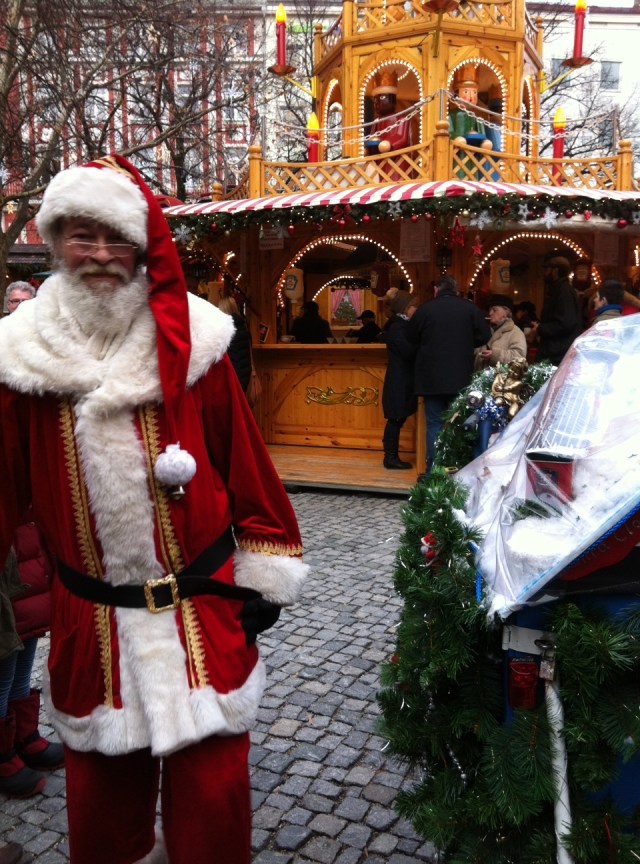
It’s that time of year again. For the month of December, right up until Christmas Eve, the Christkindlmarkt or Christmas Market is open in cities and towns all over Germany and Austria.

Also called Weihnachtsmarkt, the Chrstmas Market is typically held during the four weeks of Advent leading up to Christmas. Nearby Nuremberg has one of the most famous Christmas Markets in the world, although I haven’t been to that one. Perhaps next year. According to The Internets, the Nuremberg and Dresden markets draw about two million people each year; the Stuttgart market attracts more than three million visitors while the Dortmund market can claim to be one of the biggest Christmas markets in Germany with more than three and a half million visitors each year.

Yes, the Christkindlmarkt is a pretty big deal around these parts.
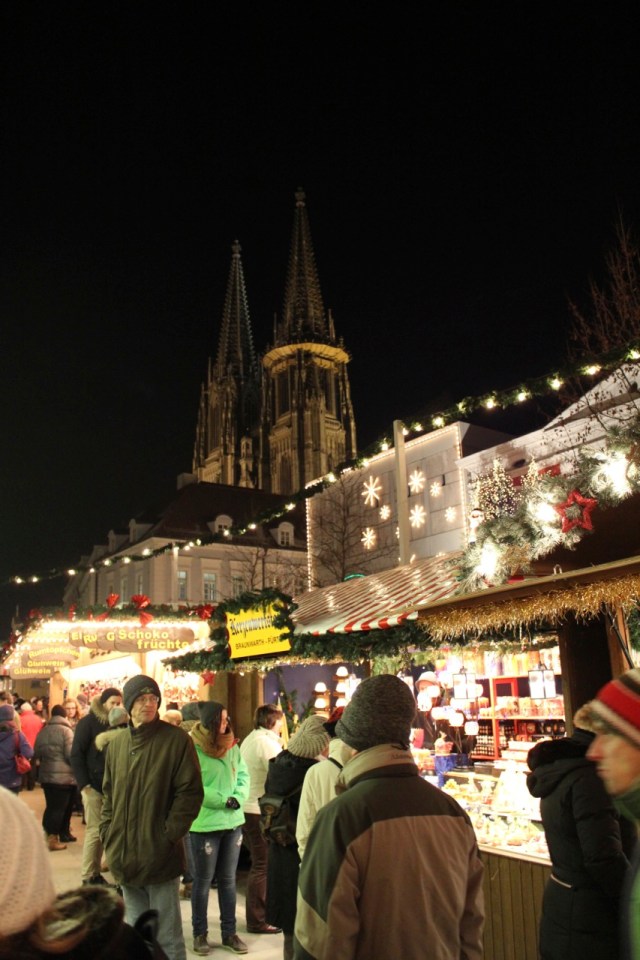
regensburgcmk02regensburgcmk01 regensburgcmk03

There are three types of stalls in a typical Christmas Market:

The first type is for buying things. There are carved wooden nutcrackers, jewelry, and clothing to be found. I didn’t take many pictures of the crafts themselves, but I thought this candle was pretty.
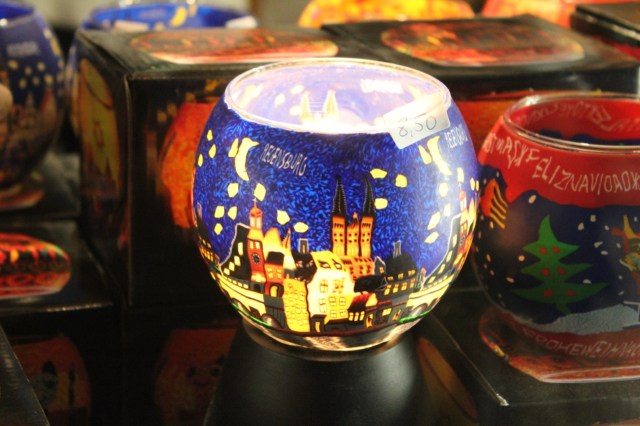
regensburgcmk04

The second type is food- candied and toasted almonds are a staple item. So is Lebkuchen, a soft form of gingerbread. Chocolate is everywhere.

My favorites tend to be the savory, rather than the sweet. The first item here is a simple Regensburger Bratwurst – it contains pickles, sweet mustard, and a dash of horseradish, served on a semmel, or bread roll. Sehr lecker! The second photo is a half-meter bratwurst. The third is a kind of swirly potato thing that has the consistency of a giant french fry and the flavor of BBQ potato chips.

regensburgcmk08 regensburgcmk09 regensburgcmk07

There are stalls for purchasing crafts, food stalls, and the ever-present Glühwein vendors. I’ve mentioned Glühwein on this blog before; it’s hot mulled wine that turns up during this time of year. There’s a regular red wine flavor, and there are often various fruit flavors mixed. I like Apfel (apple) and Blaubeere (blueberry) Glühwein.
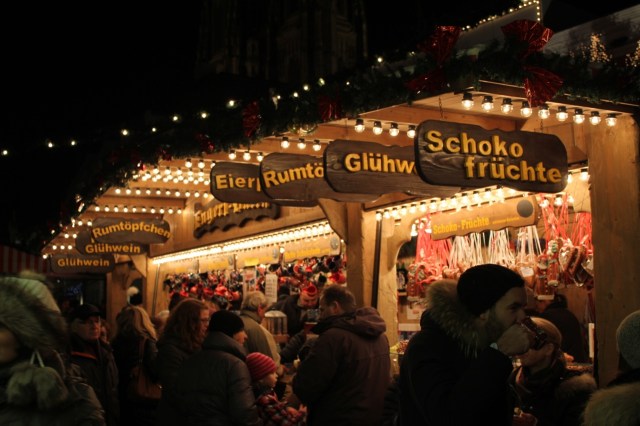
regensburgcmk05

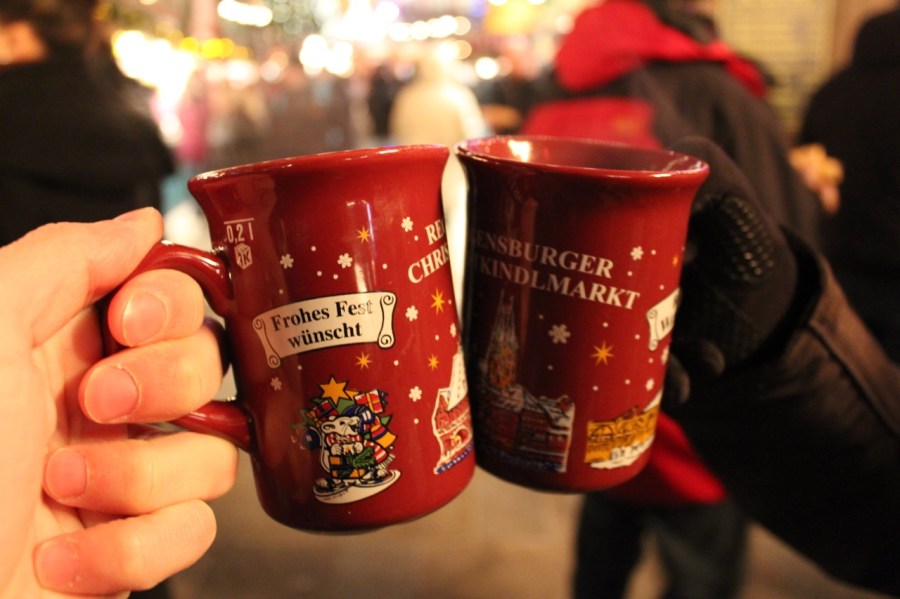
Every Christmas Market has different mugs for their Glühwein. When you get your drink, you pay a Pfand for deposit. Some people collect the mugs instead of returning them to get their Pfand back. The mugs are generally very colorful, and they say a bit about where you got them, so they make excellent souvenirs.
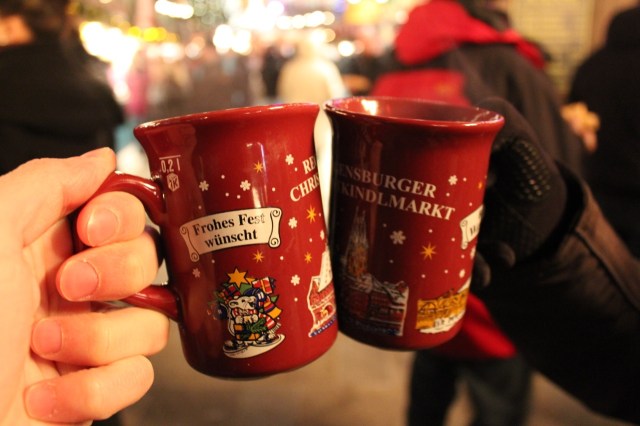
regensburgcmk06

This year, I had the chance to see the Christkindlmarkt in nearby Munich with fellow blogger Hanley. Truth be told, I like the Regensburg market better- the Munich Christkindlmarkt is spread out so that you have to walk for several blocks in each direction to see the entire thing. It’s also significantly more crowded, as cities tend to be.

munich-ckm1 munich-ckm2 munich-ckm3

There’s one more thing- even if you’re just passing through a town and don’t plan on leaving the Bahnhof, you can usually get a taste of that town’s Christkindlmarkt tradition. In Regensburg, they set up a Glühwein stand right in front of the Hauptbahnhof each year. The Glühwein is a little bit rougher there, but it’s still Glühwein. Served in plastic cups. Yeah.

regensburgcmk10

So You Want To Visit Germany

I posted a while back about Dining Out In Germany, and I realized recently that whenever someone I know visits Germany, there’s a bunch more stuff that I tell them.  As I prepare to head back to the US this week for my first visit home in over a year, I have some observations from my first year here that I think might help an American visitor to Deutschland.

The Bathrooms Are Different.

Not the plumbing.  A toilet is a toilet is a toilet.  The basic size and shape are pretty much the same.   The differences are in other areas.  Here’s what I know:

  • There are almost always stairs to reach the loo.  I’ve been in perhaps three restaurants in all of Germany that didn’t involve a quest down three flights of stairs to reach the bathroom.  I’m pretty sure I saw the guy from Pitfall in one of them.
  • The labels are a little different.  This stands to reason, since it’s not English, but if you don’t know that Damen is Ladies and Herren is Gentlemen, your first trip past that door can be mildly embarrassing.   Sometimes the doors just say H and D, which is even less help if you don’t know the labels ahead of time.  At least the little silhouettes that some places use on their doors are pretty universal.
  • When traveling, hold on to your fifty cent and one Euro (1 €) coins for your bathroom needs.  Europe is very fond of the pay toilet.   Restaurants and airports and trains usually have cost-free restrooms, but pay-to-pee is the norm in lots of other places.  In some train stations, there’s a chain of attended restrooms called McClean which has very nice, well maintained restrooms for a per-use fee.  There are also street level restrooms in many cities that involve fees to get in.  Sometimes there’s a coin plate near the door as if to suggest that a donation would be a good idea.
  • Don’t be surprised if a restroom attendant of a different gender than your own comes in to clean the place, especially in train stations.

Getting Around An Unfamiliar City.

Most cities around Germany have a nice public transit system.  If you’re lucky enough to be in a larger city like Berlin or Frankfurt, you might even have a variety of modes to choose from. Berlin, Hamburg, Munich, and Nuremberg all have underground metro systems, referred to as U-Bahns or Untergrundbahn.  Most cities have a form of S-Bahns, or Stadt-Bahn.  This is just a basic above-ground rail system with trains tying locations together.  Some places have Straßenbahn, or streetcars. And of course they all have bus lines.

In most instances, your best value is going to be a Tagesticket or day ticket.  These are typically good for use on all the forms of public transit in a city, so you can hop between them.  For example, to get from the Berlin HBF to my favorite hotel in Berlin, you need to take the S-Bahn (S5, S7, or S75) to Alexanderplatz, then switch to the U-Bahn (U8) to go one more stop.  Every Bahn station will have kiosks where you can buy tickets for the local transit system, and a full day of unlimited rides is generally more cost effective unless you’re only planning on one or two journeys.

Here Are A Few Words You Might Need To Know.

  • Entschuldigung – Apology/excuse me.  You’ll hear this when someone wants to get past you in a hallway, for example.
  • Ist hier frei? – Is this seat open?  Useful in crowded trains and restaurants.  German pronounciation note:  ‘frei’ is pronounced like fry.
  • Geöffnet – Open.  If a bar or restaurant has this word in front, you can go in.
  • Geschlossen – Closed.
  • 24 Uhr or 24 Stunden – 24 hour.
  • Tankstelle – Gas station.  If you’re driving, you’ll need to know this one.
  • Apotheke – Drug store.  If you need aspirin, paracetamol, cold medicine, skin lotion, or pretty much anything you would get in a pharmacy back home, this is where you’re going to find it.   Unlike the US, aspirin and other pharmaceuticals are generally not available in other types of stores- you’ll have to find an Apotheke.
  • Eingang/Ausgang and Einfahrt/Ausfahrt– These are entrances and exits.  When you’re on foot, eingang means entrance and ausgang means exit.  When the suffix -fahrt is attached, it refers to cars.  This leads to one of my favorite jokes, “Ausfahrt must be the largest city in Germany- there are signs for it all over the Autobahn!”
  • Besucher – This means visitor.  Some form of this word usually appears on visitor’s entrances.
  • Einbahnstraße – One way street.  I thought these were all pointing to a specific highway for my first two months in Germany, and I couldn’t figure out why they all seemed to be pointing in different directions.  I’m not always the sharpest tool in the shed.

Ein Jahr

As of today, I’ve been in Germany for one year of a three year commitment.   It’s been a hell of a year.  When I posted about being here for four months back in March, I had a few items that I listed as to-do items.  Let’s see how I did:

Have basic conversations in German:  On a very basic level, I can do this.  I can introduce myself, ask where someone is from, and inquire about basic information.  I have the vocabulary of a two year old native, but I’ve learned a lot.

File my German taxes from 2011: I did this in late March.  In July, the Finance Authority sent me a letter asking for more documentation, and I returned the requested document right away.  In October, they finally sent me a followup, and a small refund a few days later.  I am now the proud owner of a German Steuernummer (tax ID number.)  It only took seven months!

More blogging: I’ve settled into a pattern of posting every Monday.  Coming up with ideas for new posts is difficult sometimes, but for the most part I’ve always got something new to say.  Sometimes I have a rush of ideas and I post a little bit more frequently, but I post at least one new entry every week, always on Monday mornings.   WordPress.com’s scheduled post feature is a tremendous boon for the frequent traveler.

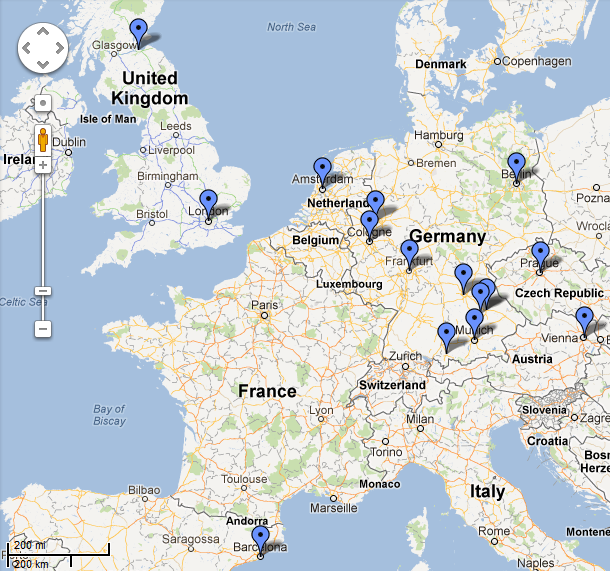
More travel:  Holy hell, success!  Of the thirteen cities I mentioned back in March, I’ve been to seven of them.  This year has been an amazing year for travel.   Every new city is logged as a ‘Category’ on this blog.  There’s a dropdown on the right-hand column to view entries about them.  In 2012, I’ve gone to seven new countries and countless German cities.

  • Edinburgh, Scotland
  • London, England (Seeing London has been a goal of mine for more years than I can recall.)
  • Barcelona, Spain
  • Amsterdam, Netherlands
  • Prague, Czech Republic
  • Vienna, Austria
  • …and so much of Germany already:  Berlin, Bochum, Bruhl, Cologne, Erfurt, Frankfurt, Kempten, Mannheim, Munich, Nuremberg, and of course, Regensburg.

Eat Less McDonald’s:  Mild failure.  It’s still far too easy to slip into McD’s when I’ve been out late or have to eat something after German class.  I try my best to keep it to a minimum, but I still eat far too much of this because of the convenience.

Acquire a traditional Bavarian outfit complete with Lederhosen: Yup, I did this.

I originally wanted to list a whole lot of the things that I’ve accomplished this year, but I did that on the Four Months post and again on the Six Months post, so I won’t do that.   Here’s a few other highlights that I wanted to mention though:

I Went To WEBMU: WEBMU is the “Whiny Expatriate Blogger MeetUp.”  The rules for membership are that you have to live in Germany and blog in English.  The people in the group are a heap of fun, and we had a great weekend in Berlin.

I Met Other Bloggers: Expatriate blogging is a very social thing. Between WEBMU and my naturally social nature, I met many other bloggers (and their non-blogging spouses) in person this year. Here’s an incomplete list of them:
Riayn in Hamburg, Heather in Nürnberg, Mandy in Berlin, Sarah in Hamburg, Snooker In Berlin, Ian in Hamburg, CN in Heidelberg, and last but not least, Cliff and Sarah here in Regensburg.  (Alex, you’re totally on my “Want to meet this person” list for 2013.)

I Tried A German Theme Park: I went to Phantasialand, a pretty well known German theme park.  Living in Florida spoiled me for theme parks, but this was still a lot of fun.

I Listened To  A Percussion Show In A Cave: The header on this one is pretty self explanatory.  The cave, the Tropfsteinhöhle Schulerloch, is near Kelheim.

I Drank Beer Brewed By Monks:  The Weltenburg Abbey is not far away.  The dark beer is delicious,  the grounds are beautiful, and the boat ride up the Donau river from Kelheim is picturesque.  Not a bad way to spend a Saturday.

I Watched More TV and Movies In German:  I have been trying to learn German, and one of the things that helps this is to use German television, radio, and movies.   I’m quite fond of watching How I Met Your Mother and Futurama in German.  I also watched The Lion King, The Muppets, Men In Black 3, and Ice Age 4 all auf Deutsch.  I was even able to clearly follow the plots of all of them, even though I missed quite a few of the verbal jokes.

It’s pretty hard to sum up an entire year in a single post- that’s what the entire Blog has done.  It’s mind-bending to think that I’ve been here for a year already, and that I’m a third of the way done with my time here.

I wonder what my next year has waiting for me!

The Five Restaurants You Meet In Regensburg

Some of the other expat bloggers I read are part of a Blogger Stammtisch that I’m not involved with, and they have really neat ideas for posts sometimes.  In September, they had a ‘favorite restaurants in your town’ topic, and Grounded Traveler did a post about their top five favorites in Freiburg.   I love to eat, so this really got me thinking.

Regensburg has truly embraced cafe culture, so much so that some people refer to Regensburg as Italy’s northernmost city. There are so many bars and restaurants here that it’s probably not possible to eat at every single one.  The sheer logistical impossibility has not stopped me from trying, though. For the relatively short time that I’ve been here, I’ve actually eaten in a very large number of restaurants.  I really like so many of them that it was difficult to narrow a list down to just five.  For example, do I include the better of the two local Irish Pubs? (Murphy’s Law.)  How about the best of the bajillion traditional Bavarian places in town? (I’ve eaten at many, and I found the Regensburger Weissbräuhaus to be the tastiest.) Do I include the tastiest of the four (that I know about) Indian restaurants?  (Maharadscha, with Taj Mahal a close contender for the Flavor Throne.)  What about steak houses? (Just kidding, there are no good steakhouses in Germany. I’ll have to eat steak when I visit the United Steaks.. er, States again in a few weeks.)

Here are my selections, in no particular order:

Continue reading “The Five Restaurants You Meet In Regensburg”

Halloween In Germany

Halloween isn’t really a traditional German celebration, but it has become more popular in recent years, especially with children.  Most people seem to think this is partially from seeing it depicted in American television and movies, and I suspect that’s a big factor.  Here, costumes are more commonly seen around Fasching.

German youngsters only go trick-or-treating (“Süßes oder Saures!”) in certain areas.  Yesterday, I saw only three children running around with pillowcases, and that might not have been for candy-  they might have just been running around with pillowcases.

I did find that there are a few traditions that are similar to Halloween’s origins in Europe, without being exactly Halloween.

  • In the regions of Bavaria and Austria in Southern Germany, Catholics celebrate the entire period between October 30 and November 8 as Seleenwoche or All Souls’ Week.
  • November 1st is Allerheiligen, or All Saints’ Day. Catholics attend church services in honor of the saints, the martyrs and those who have died for the Catholic faith. People may also visit their family’s graves to beautify them with wreaths and small lanterns. Sometimes a mass is said at the gravesite and the grave sprinkled with holy water.
  • In some areas, November 2 is observed as All Souls’ Day. Catholics attend a special Requiem masses, where they remember those who may be close to them that have died. Prayers for the dead are said and votive candles are lit to honor their memory.
  • In Austria, there’s an entire pumpkin (Kürbis) festival in late October, Kürbisfest.
  • Jack O’Lantern decorations have become more common in Austria and Germany in late October.

Meanwhile, those of us who grew up with Halloween look for places to observe the holiday, and most of those places turn out to be bars and pubs.

Last night, I visited two in particular.  Murphy’s Law, the better of Regensburg’s two Irish pubs, was having a Halloween event.  The Piratenhöhle (Pirate’s Cave) was having a Zombie Halloween party.

In both locations, I saw lots of vampires, zombies, and pirates.  There were a few people dressed as Warcraft characters, one amazing Peter Jackson styled Orc, and more people with random fake bloodstains than I can shake a stick at.

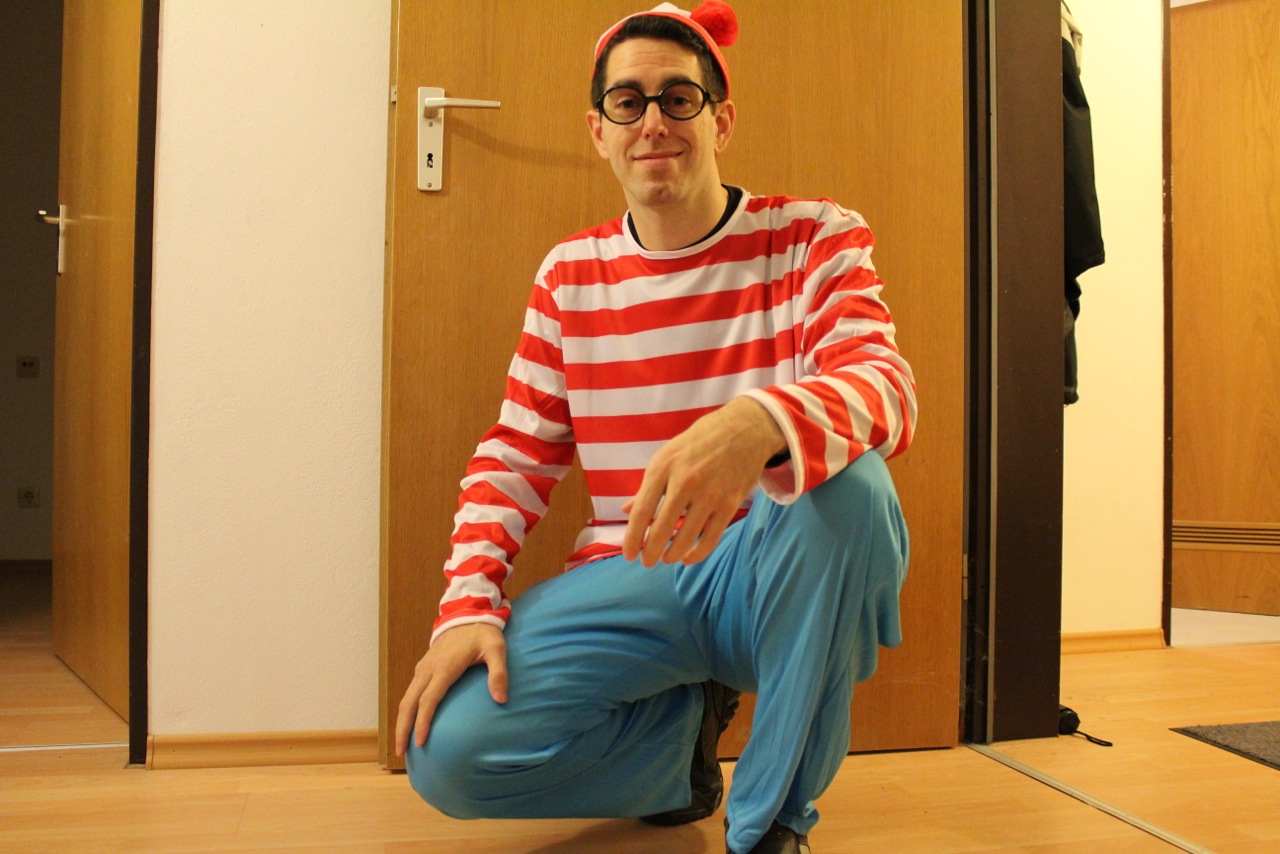
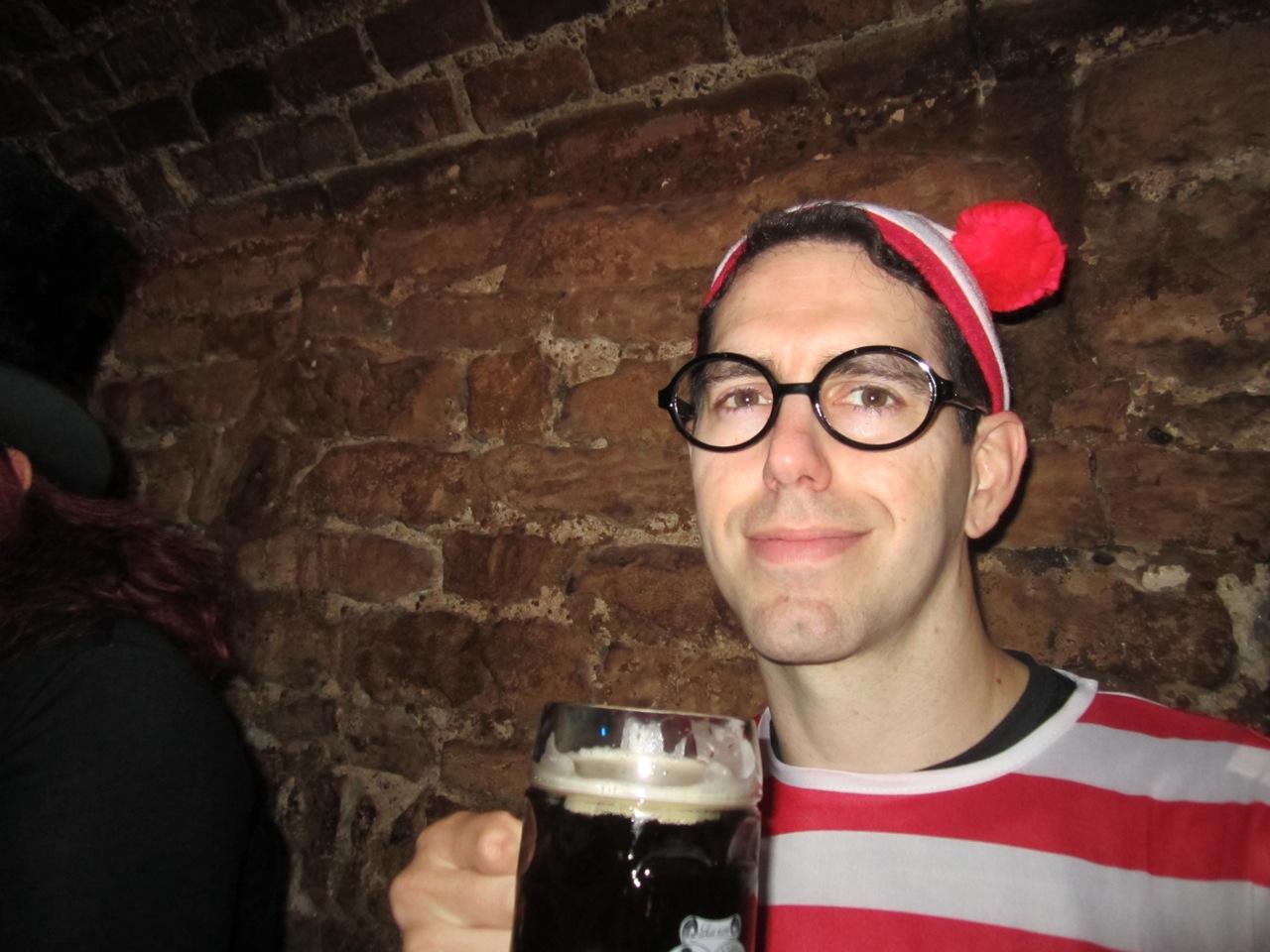
My costume was not as well known as I expected-  roughly 90% of the Germans I ran into had no idea what I was dressed as.  Amusingly enough, only Americans and Canadians call him Waldo.  In the rest of the world, he’s Walter or Wally.  I also learned last night that I can walk around the Altstadt in powder blue pants, and nobody will bat an eye.  Oh, Germany, you make me laugh.

A few people I passed exclaimed “Hab dich gefunden!” (Found you!) as I walked past, so that was gratifying.  And kind of hilarious.