Getting High In Bavaria

Long time friends of me know that I’m a big fan of tall stuff.  My friend Gabrielle has been with me to revolving restaurants atop towers in two different cities, as well as an observation deck on the Stratosphere in Las Vegas .   My favorite part of my 2006 Chicago visit was the observation deck in the John Hancock Center.  In Prague last month, I loved the miniature Eiffel Tower lookalike, the Petrin Lookout Tower.

I like observation decks, revolving restaurants, and television towers.  A lot.

Here in Bavaria, most of the tallest things aren’t quite as tall as the John Hancock Center, but there are still some amazing views to be seen.   Back in March, I posted about Walhalla, and included some pretty spectacular photographs of the view.

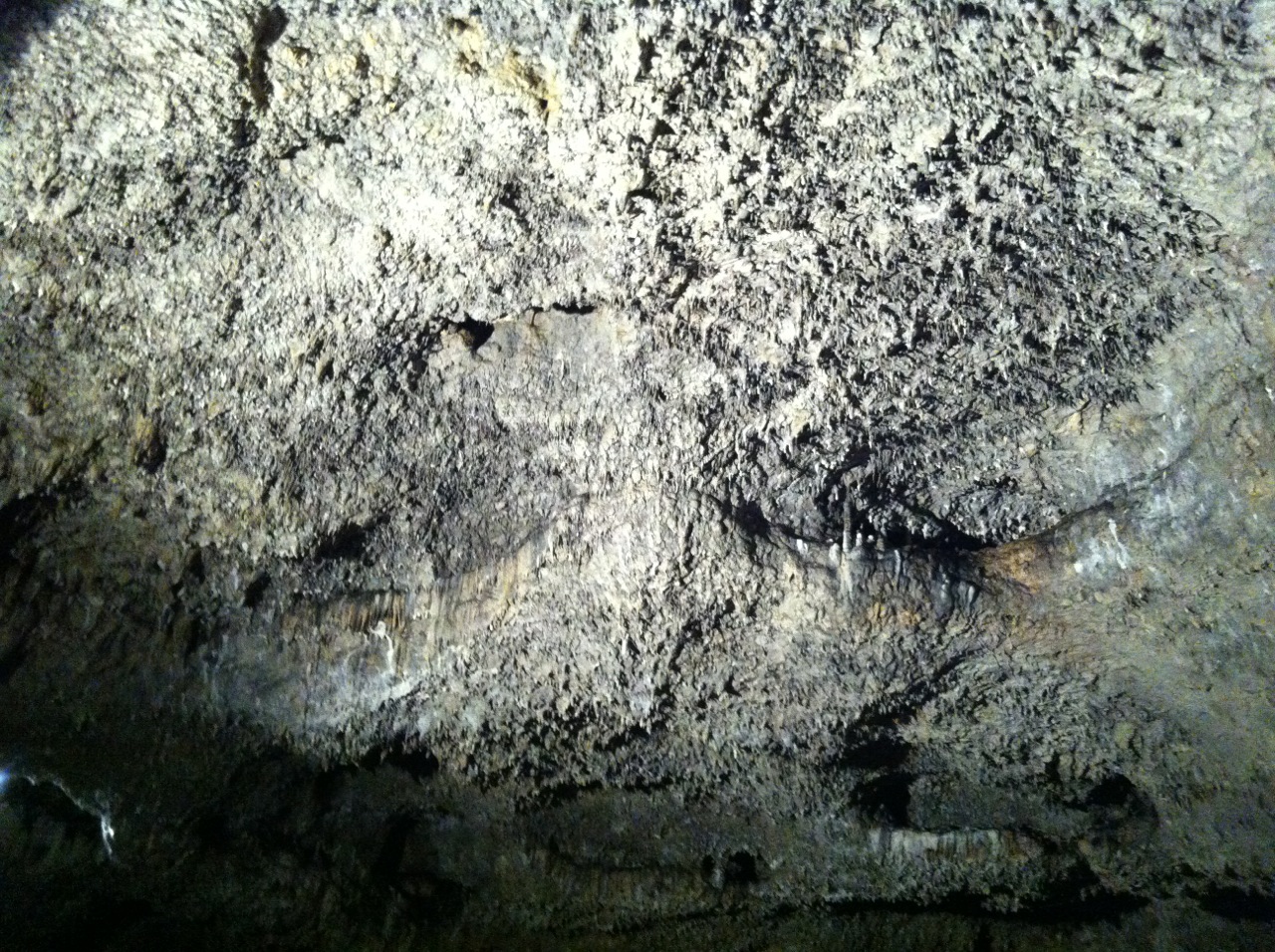
Since then, I’ve been to three more pretty tall places.  The first was Tropfsteinhöhle Schulerloch, a show cave near Kelheim.   The cave is a stalactite cave, and it’s closed during the winter because it’s full of bats during colder weather.    Regrettably, I saw no bats on this visit.

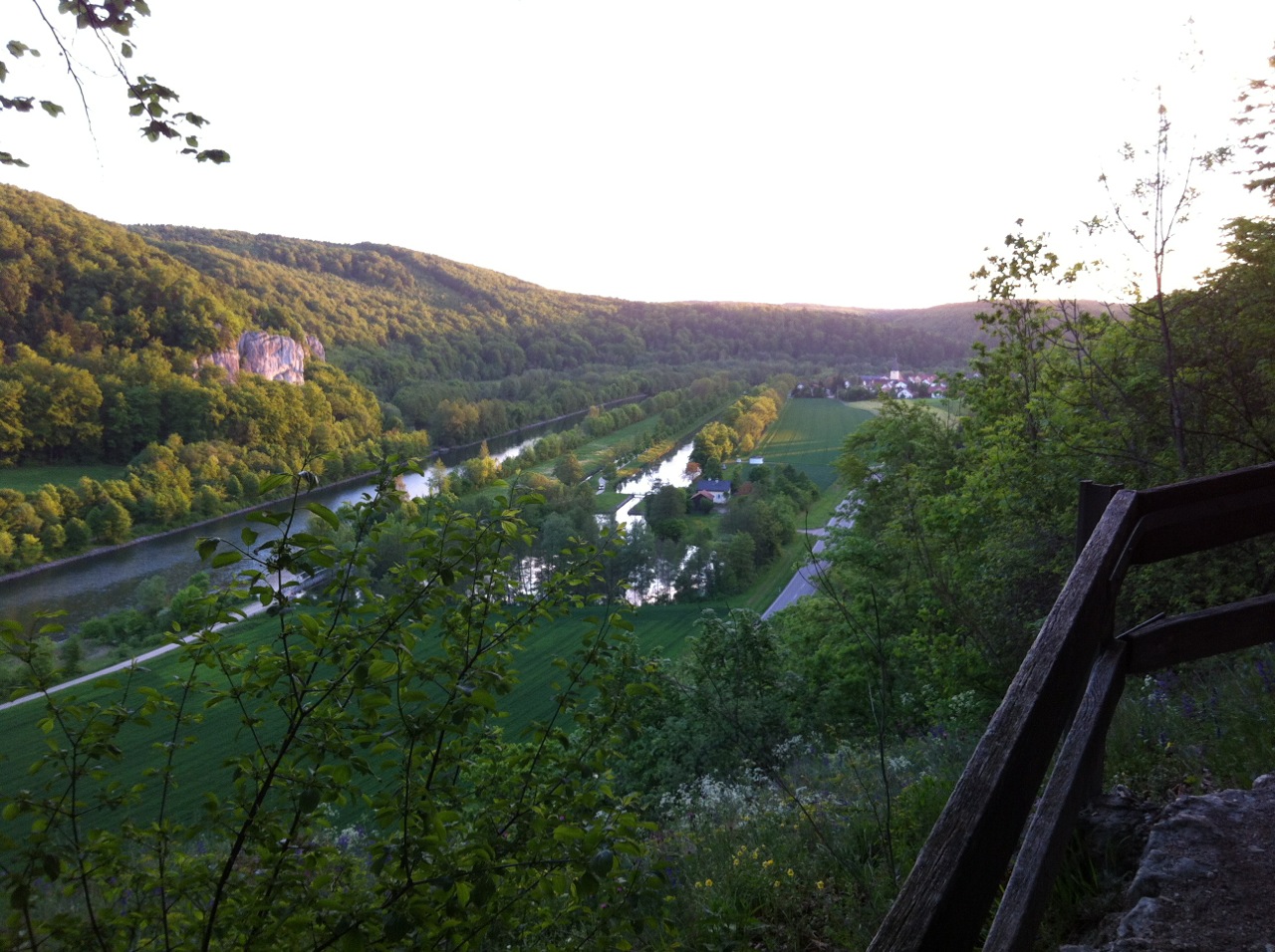
The path to get up to the cave is a pretty steep one, though, and just before you get to the main entrance of the visitors center, you’re treated to this view at roughly 1272 feet above sea level:
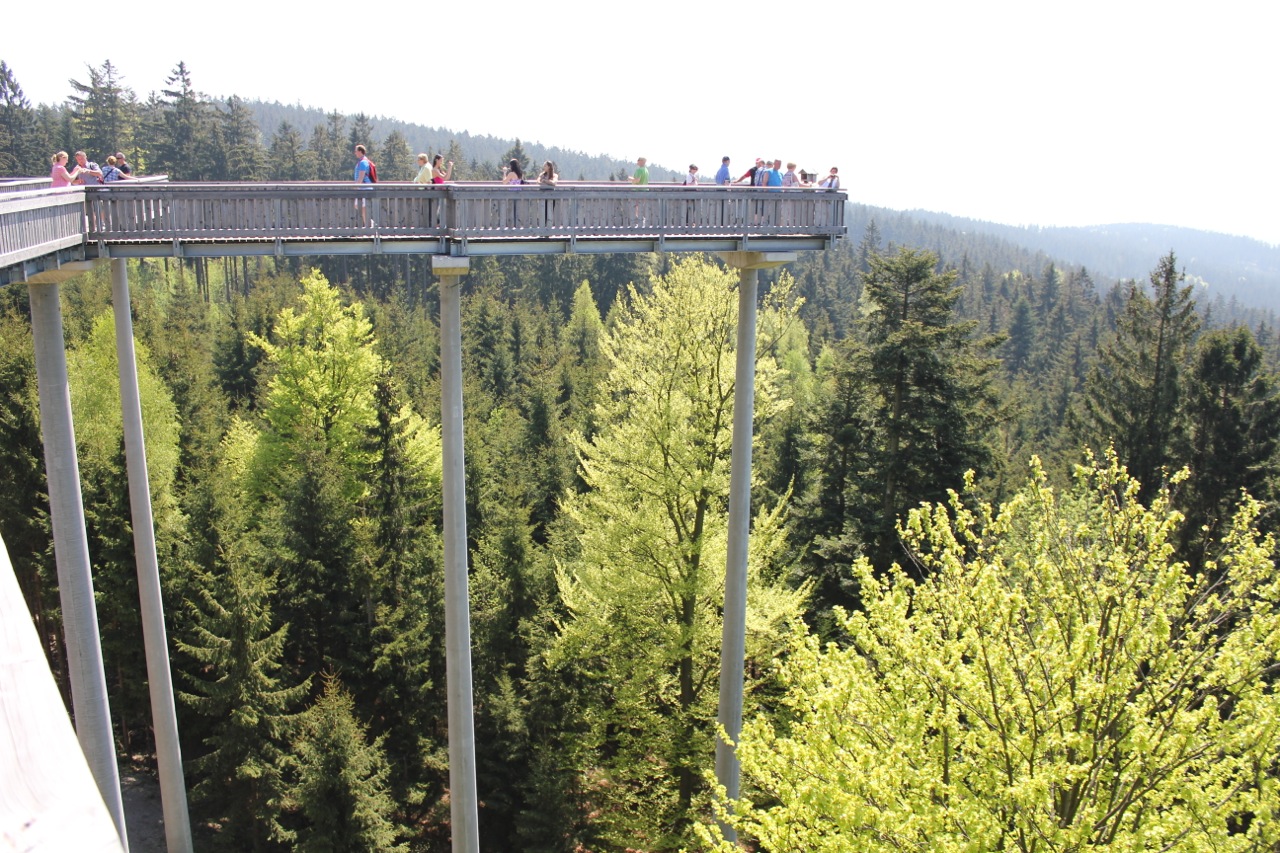
The second tall place I visited is Waldwipfelweg.    The centerpiece of this educational destination is a boardwalk that overlooks a particularly picturesque stretch of Bavarian forest.  It’s a very tall boardwalk, though.  I don’t think I would have wanted to be up there on a super windy day.

The third tall place I visited recently was the Befreiungshalle  (“Hall of Liberation”).  This is a sort of companion piece to the Walhalla- there’s a third monument near Munich that I have to go see now that I know that it exixts.  The Befreiungshalle was constructed on the orders of King Ludwig I of Bavaria, with a ceremonial opening in October of 1863.  The Befreiungshalle sits on Mount Michelsberg above the city of Kelheim, upstream from Regensburg on the Danube river.
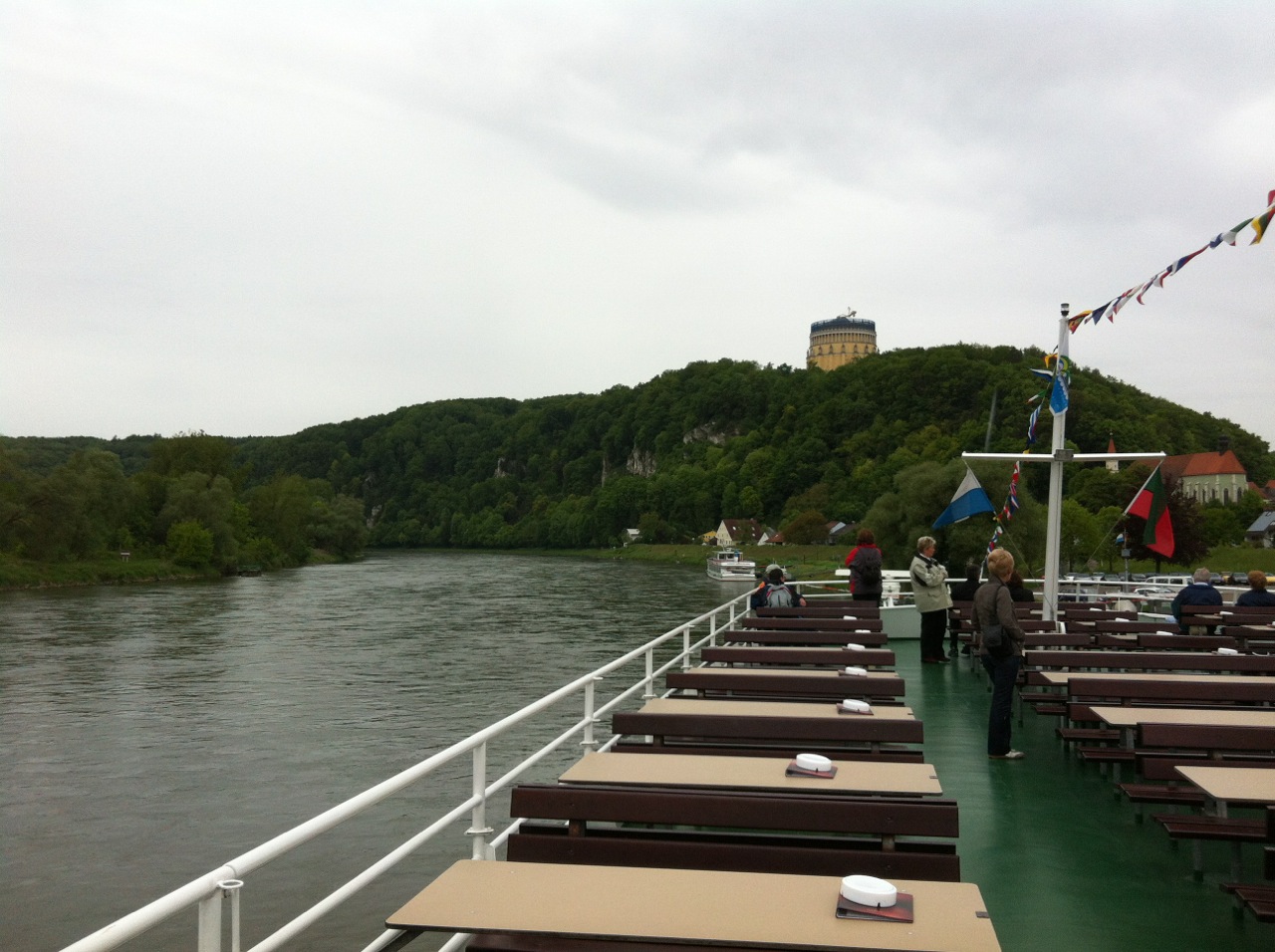
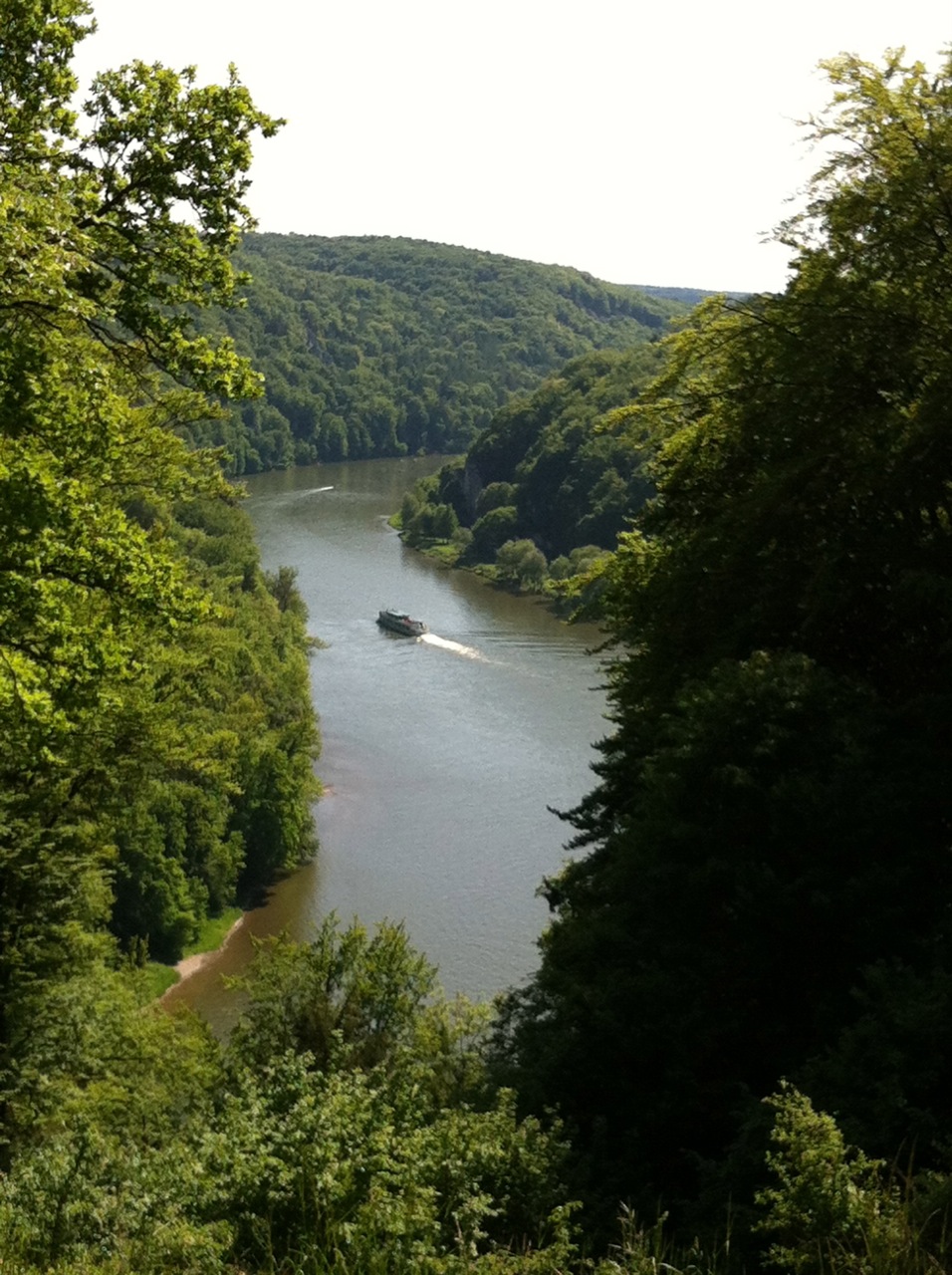
On the walk up to the Befreiungshalle, you can get an amazing view of the Danube river, including the boats that run between Kelheim and the Weltenburg Kloister Brewery.   I’ll talk about Weltenburg in another upcoming post.
The structure itself is pretty amazing.  It’s ringed by eighteen huge statues which are allegories of the German tribes. The number 18 also symbolizes the date of the Battle of the Nations at Leipzig (October 18, 1813), when the Coalition defeated Napoleon’s troops.

As with the Walhalla, however, the view is best from the stairs in front of the main entrance.  You can see all of Kelheim, and some of the surrounding countryside.

There are still some other tall places in Regensburg and Berlin that I haven’t been to yet.  They’re on my list.  Yep, I have a list of tall stuff to climb, all over Europe.  I’d better get to it.

Short Post: American Style

One of the things that has been continually and steadfastly amusing to me since my arrival is the German marketing gimmick of referring to something as American Style to drum up interest.  Here’s a couple of examples that made me laugh.

The only place I’ve actually seen pancakes besides the grocery store is at an “American” diner.
Very few foods are less German than plain white bread. Real German bread has a lot more varieties- and a lot more flavor.
I’ve had long conversations with the guys in the office about “American style pizza,” during which I explained the differences between New York style, Chicago style, deep dish, pan, and a few other varieties of good old American pizza. None of them really resembled this “American Style” pizza. The first time I saw this, I knew I had to try it. It was edible, but wasn’t all that great.
American hot dog style? Germans put a lot of strange things on their pizza, but this one is actually kind of appealing.

Observations At Six Months

As of today, I have been in Germany for six months- I arrived on Saturday, November 12th. During that time, I’ve been keeping a list of things that I wanted to mention on the blog, but that aren’t long enough to carry their own blog post. Here’s what I’ve got so far:

  • In German, Kerze means candle. Katze means cat. Mishearing one or the other can lead to a very silly conversation.
  • They sell the perfect size Coke here. .2 Liters is enough to accompany most meals without being as small as a shot glass.
  • Movie theatre popcorn here is not salty by default, it’s sweet. Not all theatres even sell the salty version that I’m used to. I was very surprised the first time I took a bite of movie theatre popcorn here.
  • Many Germans are very, very tall. I’m still convinced that someone boinked a Frost Giant at some point in the past.
  • There is one German word, Entschuldigen, which can be used for both excuse and apology. This is yet another way that conversations between native English speakers and those for whom German is a second language can be very complicated.
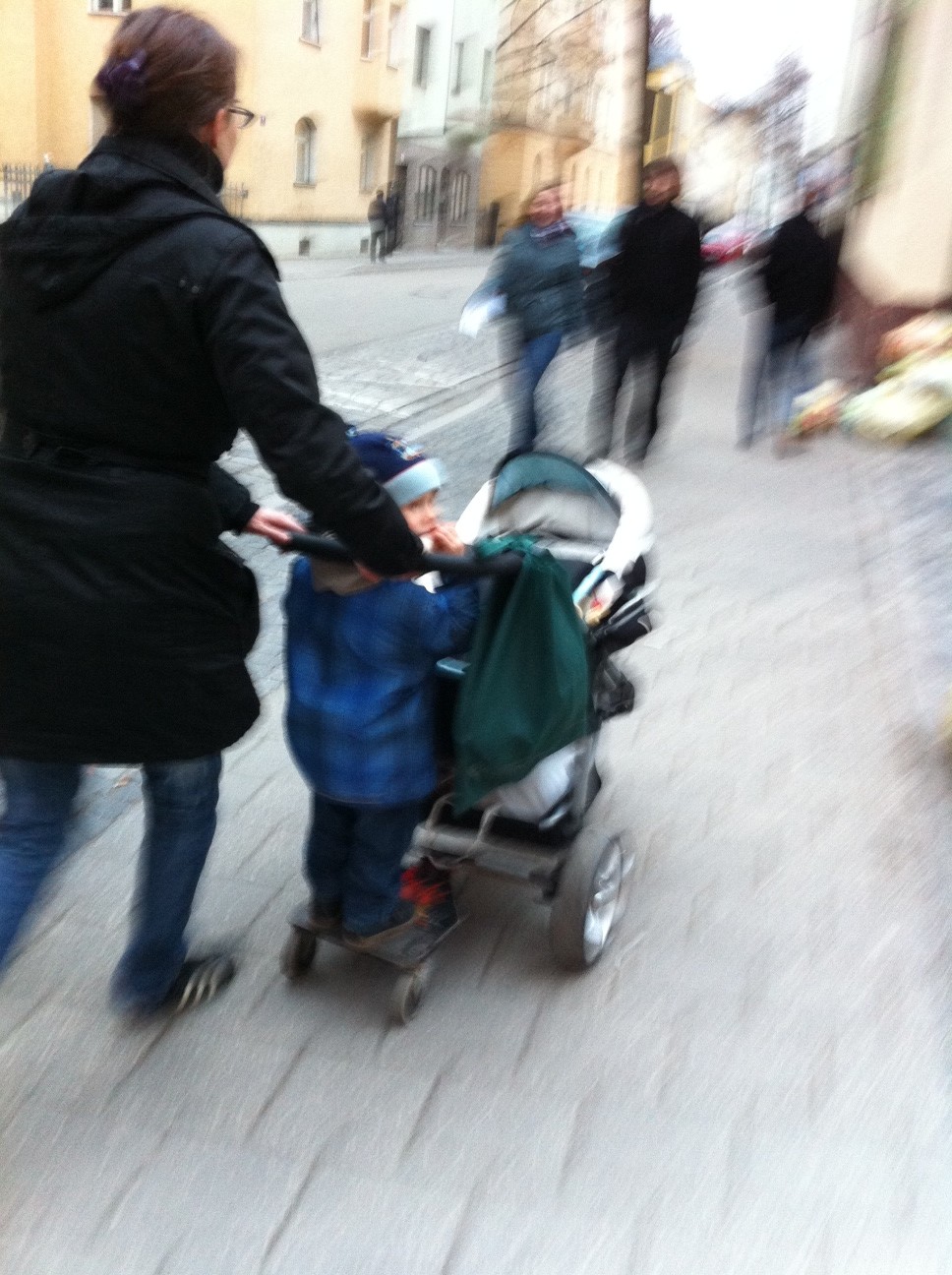
  • The German approach to child-rearing is a little bit different. The American “stranger-danger” paranoia doesn’t exist here, so it’s not uncommon to see a list of children’s names on the back of a proud parent’s vehicle. They also rig up these ingenious skateboardy things that are attached to the back of their strollers with a little hinge like the one pictured at right- this woman is pushing the stroller with the infant, and the smaller kid stands on the little board with the wheels, so he gets a ride as well. I think it kind of looks like fun.
  • Where an American would say “I’m crossing my fingers for you,” a German would say “I’m pressing my thumbs.” It means basically the same thing- wishing luck or good fortune. It is done with the thumb of one hand only, bending it inside the index finger and pressing on the outer joint of the thumb with the fingers curled around it.
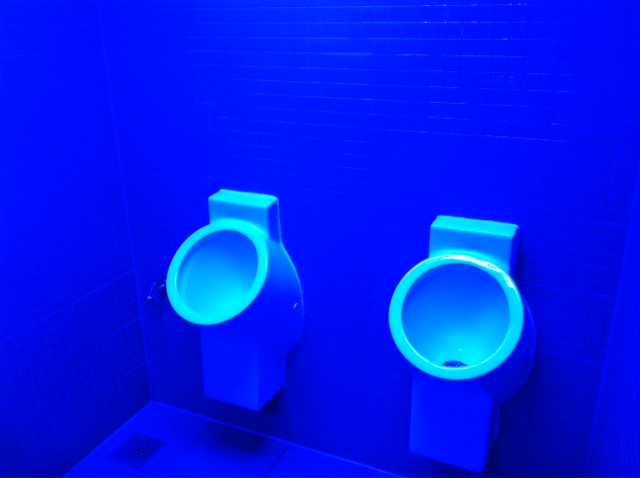
  • It’s a small difference, but I’ve noticed that public restrooms here are not constructed the same way that they are in the US. The area where toilets and urinals stand is usually separated by the area with the sink and hand dryers by a door, so each restroom is actually two smaller connected rooms. This is not the case in private bathrooms or very small restaurants, but most of the restrooms that I’ve been in here outside of my own apartment are built this way.
  • Germany uses the letter ß. The letter is pronounced as ‘ss’ and that is an acceptable alternate spelling. This is especially common on street signs. For example, one of the main streets downtown is Maximilianstraße. This can also be typed as Maximilianstrasse, or abbreviated as Maximilianstr. The reason I bring up the letter ß is that it comes up several times in the next bullet point.
  • Elevator buttons are different here. The ground floor is usually labelled EG, which means Erdgeschoß, the German word for the ground floor. I first thought it had something to do with ‘Entrance.’ A parking level below the first level is often labelled with UG. I thought at first that it meant ‘Underground,’ but it really means Untergeschoß. An upper level would be OG for Obergeschoß. A parking garage is usually called a tiefgarage, but don’t expect to see that listed on the elevator buttons. Sometimes, the ground floor is labelled with 0 and a level below that is marked as -1. The first level above the ground floor is labelled 1 because Germans consider the first level up to be the first floor. In other words, I climb a flight of stairs every day to go to my first floor apartment, but in the US I’d call it a second story apartment.
  • Speaking of things being different underground, the duplex parking here can be a little nerve-wracking. This may exist in the US, but I’d never seen it until I got here- underground parking where a space can have multiple stacked vehicles. Each person who uses a parking space has a key to raise and lower the parking ramp. I would be constantly worried that I would drop my keys down into the Pit Of Souls beneath the lowest cars. Still, it’s an impressive use of space. And hydraulics.

Stumbling Blocks

On the corner of Maximilianstraße and Königsstraße in the Altstadt, I stumbled across nine gold colored blocks on the ground with names and dates.  They’re obviously a memorial of some sort, and I’ve taken pictures of them on several occasions with the intent to find out the story behind them.

Today, I found five more at the place where Pfarrergasse intersects Neupfarrplatz, and in a fit of amazingly coincidental timing, I’ve also found an explanation and a history of these blocks.

The blocks are called Stolpersteine.  The German word Stolperstein literally means “stumbling block” or “obstacle” and Stolpersteine is the plural.    They were created by artist Gunter Demnig in 1993 and the first installation was in Cologne, Germany, in 1994.

Today, there are more than thirty thousand Stolpersteine in at least ten countries.  I first learned what they are because of a blog entry about them on andBerlin.com.  That post led led me to the official site about them as well as http://stolpersteine-regensburg.de/.

(Edited to add:  Fiona was able to witness the installation of some Stolpersteine and posted about it on her own blog recently.)

The Stolpersteine blocks are designed as memorials to commemorate individuals who were sent by the Nazis to prisons and concentration camps, as well as those who emigrated or committed suicide to escape the Nazis.  Some of the blocks represent those killed by the Nazis and some represent survivors.    The Stolpersteine are not limited to Jews, either.  The vast majority were Jews, but there have also been blocks placed for various other types of people, including Romani people, homosexuals, blacks, and even Christians who opposed the Nazis.

The actual block is a ten centimeter concrete cube covered with a sheet of brass.  Demnig then stamps the details of the individual, the name, year of birth, and the fate as well as the dates of deportation and death, if known.  Each block begins with “Hier wohnte,” which is German for “Here lived.”  Most are set at the last residence of the victim, but some are set near workplaces.

These tiny little memorials are an amazing idea.  Since I started researching this, I’ve seen countless instances of people commenting, “so that’s what those are.  I was wondering.”  That’s how the Stolpersteine got me curious, and I’m sure I won’t be the last person to hunt down this information.

More importantly, though, people are still visiting the memorials and remembering.  One evening, while I was walking through the Altstadt, I noticed that someone had left flowers and a Yartzeit (bereavement) candle at the first set of Stolpersteine I had stumbled across.

When I walked home a few hours later, the candle was still burning.   I think that’s kind of fitting.

Did Someone Say Lederhosen?

If you say “Germany” to most Americans and then ask them to list everything they know about the culture, you’ll probably get a response that starts with two words: Lederhosen and Oktoberfest.

Oktoberfest is just one of many, many festivals here.   I posted a gallery back at the beginning of April from a smaller festival when Palmator was tapped for the first time, back on Palm Sunday.  There’s one coming up here in Regensburg called Dult.  Mai Dult, in this case, because it’s in May.  There’s another Dult in September.  This has all the trappings of an Oktoberfest, though, including rides, crowds, tents with live music, people in traditional outfits, and, of course, beer.

As for the traditional clothing, there are many different types of tracht. While the word tracht translates to costume, this isn’t just a costume for those who wear it, it’s a part of their cultural heritage and tradition. However, tracht is not traditional for all of Germany- it’s regional.  It is mostly found in Austria and here in Bavaria.  Tracht is often worn for festivals, but it’s not at all uncommon to see it worn here for bachelor and bachelorette parties and other festive occasions.

Read more