One of the more amusing customs I’ve seen since I moved to Germany is the usage of the word Mahlzeit. Loosely translated, the word means “meal time,” but it’s used in a few different ways. Some people use it as a greeting even away from food, but I haven’t seen that as much.
The most common usage, and the one that I see every day, is that when someone goes to eat lunch, most people who see them say ‘malhzeit.’ This seems to happen any time in the afternoon, and I’ve seen references that say that any meal after about 11am but before late afternoon qualifies. Once you get to early evening, it shifts to guten abend.
The first time I ran across this, I was mildly incredulous. When you leave the office to get some food, it’s not uncommon for everyone in the room to say mahlzeit to me. The person leaving is supposed to say mahlzeit as well. When someone else is leaving, everyone says mahlzeit to them. When you’re already sitting and eating, people who wander into the kitchen to get coffee also reflexively say mahlzeit. I’ve had days where four or five people have walked by and said mahlzeit in a row- the desire for privacy is actually a pretty good incentive to leave the office for lunch.
Some, just to be contrary, say ‘guten appetit.’ I always want to say “marsite,’ which sounds similar enough that most people wouldn’t notice, but references pool decking instead.
I’ve always wanted to see Europe. Lots and lots of Europe. Up until I moved to Germany, however, I had never actually been to Europe. When I was given the chance to work in Germany for Mr. Company, one of the biggest draws was that I would be here for a long period of time- exploring Europe from Europe is a great deal simpler than trying to do it in a series of shorter trips from the US.
To add to my wonderment, Regensburg sits on a major rail line. The Regensburg Bahnhof is a five minute walk from my apartment. From there, I can be to Munich in just under 90 minutes. In five hours I can be to Vienna, Salzburg, or Prague. In less than seven hours, I can reach Berlin or Zurich. In eight hours, I can reach Amsterdam, Budapest, or Paris. If I have ten or twelve hours, I can reach Venice, Rome, or London. That’s just rail- if I take a 75 minute train to Munich, I can hop a flight to just about anywhere in no time at all.
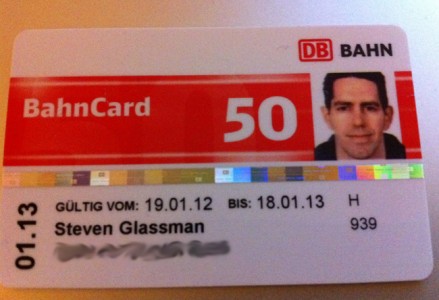
I just got my BahnCard, too. The BahnCard system is a wonderful boost to someone like me. For a yearly fee up front, you get a percentage of all of your rail travel discounted within Germany. The BahnCard 25 is less than sixty Euros up front, and is 25% off your rail for that year. The BahnCard 50, which I purchased, is 240 Euros per year, but it provides a 50% discount. I’ve already made back 20% of the expense, and I just got the card last week. There’s also a BahnCard 100, which is an obscene amount of money up front, but BC100 holders do not pay anything additional for their German rail travel for that year. It’s the Black Card of the EuroRail system, literally- it’s actually a black card. Regular BahnCards arrive in a flat white envelope, but the BC100 arrives in a presentation box, pictured below. (And shamelessly stolen from http://blog.mahrko.de/.)
To add to the seven layer burrito of awesome that is the BahnCard, RailPlus is automatically granted on every BahnCard, which grants 25% off of ticket prices for another 24 countries. From here, I can start planning on little rail trip weekends whenever I feel like it.
When I first found out that I would be moving to Germany, I was convinced I would need a car here. One of my co-workers spent a few months here doing pretty much the same job that I’m doing now, and he rented a car for the duration.
The more I researched the area and the more I learned about life in Regensburg, the more I realized that I didn’t want a car here if I could avoid it. While I do have an International Driving Permit, I didn’t want the expense. To own a car here means insurance, a probable car payment, winter tires, fuel with a hefty per-liter price- no gallons here. On top of that, I would need a new set of skills- there are road signs here that I’m not familiar with. The traffic patterns are different. The stop lights are set before the intersection instead of across it, so that’s another thing to get used to.
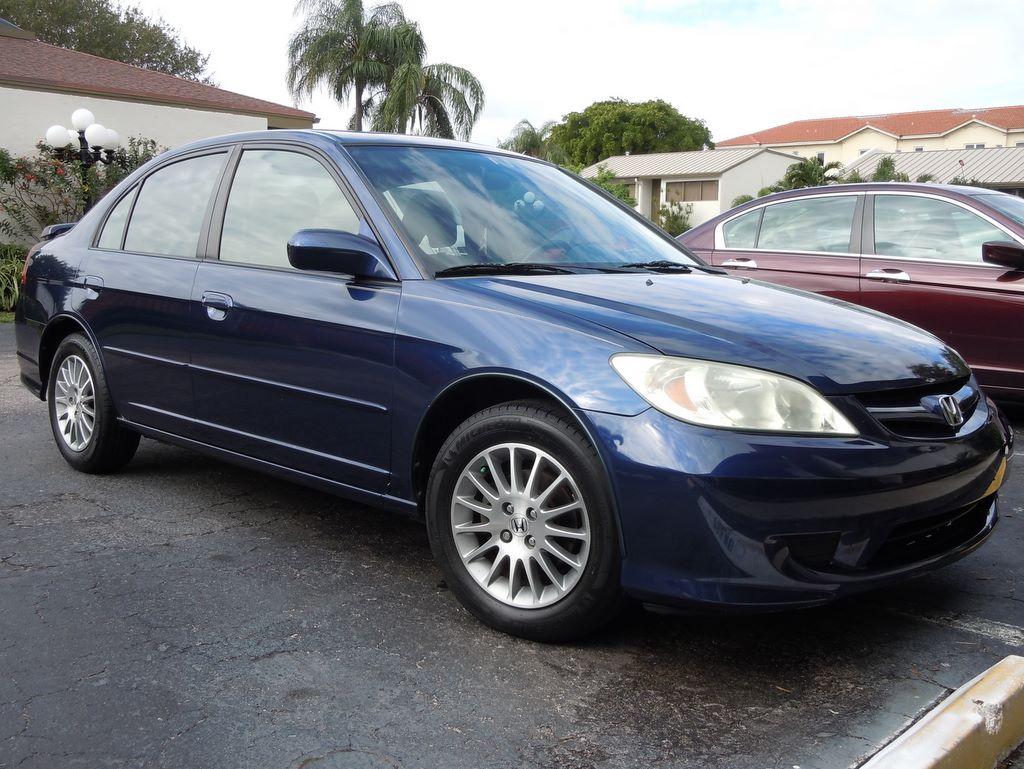
I could have had my car shipped over here, but that would have cost thousands of dollars for a vehicle that’s already six years old. Her mileage is low, but I don’t know if the cold would have agreed with a car that spent its entire life in Florida.
For those rare occasions that I might need a car for other reasons, there are always options. When I got my bed from Ikea back in November, I rented a van at an hourly rate with which to transport the bed and a co-worker did the driving. If I find a need for a car for a longer journey, there are many car rental places around such as Europcar.
Goodbye, little blue friend.
When I left the country, I handed off my car keys to my brother and gave him instructions to offload the car. I’m going to be here for a few years and it made more sense to sell the car than to try to store it. This week, my car was successfully sold back in Florida. I’m sad to see the Civic go, but it’s better this way. I last drove her on November 11th, the morning that I left the United States.
That’s also the last time that I’ve driven anything though, and for the most part I don’t miss it. For the last three months, I’ve been a regular rider of public transportation. I’ll talk more about the awesomeness that is the German train system in a future post; for now I just want to talk bus riding.
Before I took the bus for the first time, I nearly had an aneurysm trying to read the bus schedule. The way the schedules are formatted is extremely easy to read, but only after someone explains it to you. Without that explanation, it’s easily the most confusing document I’ve ever seen. If you haven’t had a headache already today, go look at http://www.rvv.de/Linie-9-Haltestellenfahrplan-ab-11.12.2011.d1757.pdf. Go ahead, I’ll wait.
In my time here, I feel like I’ve already become a veteran bus rider. I’ve run full-tilt for a bus, only to see it pull away from the curb at the last minute. I’ve been on a bus where someone very close smells like they just ran a marathon through a sewer. Oh, the joys of public transportation.
Those frustrations are small, though, compared to the benefits. The bus system here is excellent and I take that to and from work every weekday. I’ve also learned to find my way around to a number of great specialty stores for home goods and the like. The first time I was on the bus ride home from work and I saw the blue flashing lights of a traffic snarl, I just leaned back, sighed happily, and turned to the next page on my Kindle book.
Each month, I go to an automated machine to get my monthly ticket. I pay a fee of roughly fifty Euros a month for unlimited rides within zones one and two. Zone one is the city center of Regensburg, and zone two contains several of the surrounding towns, including Neutraubling, where the office is located. That’s a small amount of money compared to what I paid back in Florida for gasoline, insurance, and so forth.
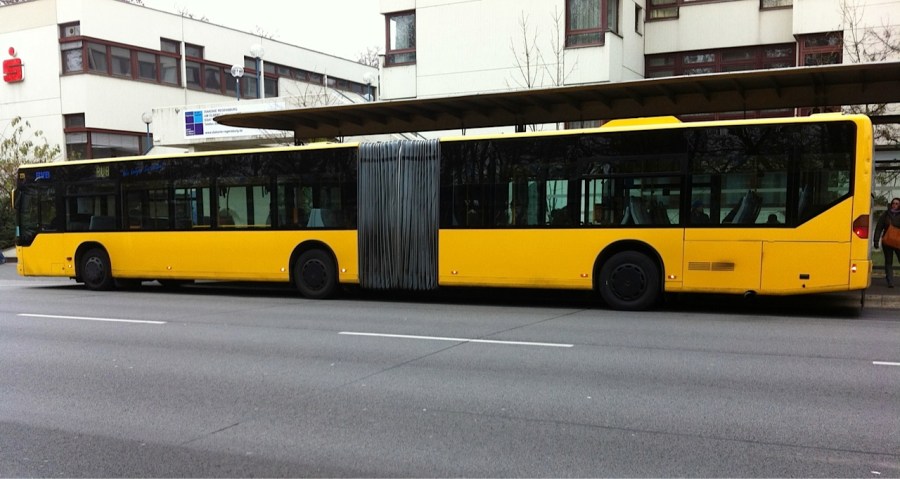
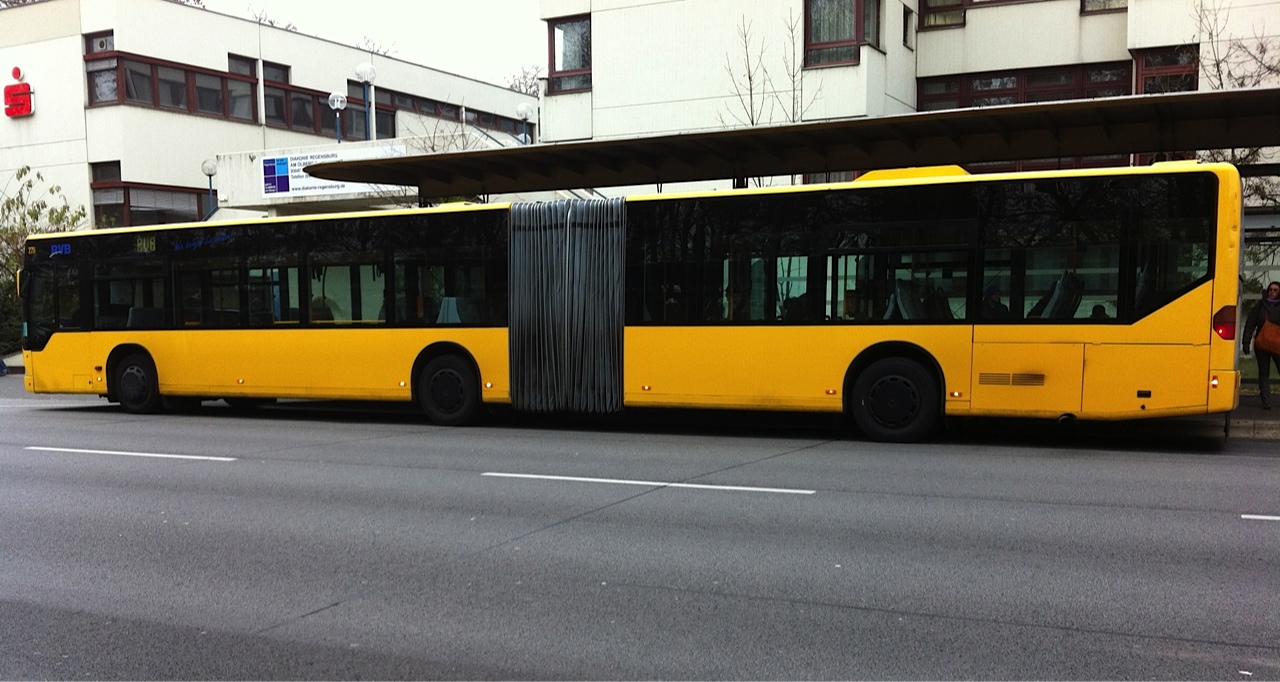
There’s several different types of vehicles in use here- some of the more frequented lines like the 1 and the 11 to the University have double-length buses with an accordion thing between the sections. It’s really pretty astonishing. There are certain buses that are red and seem to be affixed to specific lines, and others that are yellow- I’m not sure if there’s a specific reason for that, or if the colors represent anything other than the region the bus travels through.
I’ve also found that the bus lines have their own personalities. It’s hard to describe, but they really do. I even have a favorite bus line, although that might change over time; I’ve only actually been on five or six of the different lines. There are three that will take me to work. There’s one line that runs hourly to Ikea- pretty handy if you want to go eat meatballs on a Saturday afternoon.
I just realized that I wrote an entire post about buses without including a picture of a bus. Here’s one of those nifty double-length accordion buses I was talking about to make up for that.
This picture makes me laugh so much, for one reason:
The presence of the warning sign on the glass partition- “Caution- Glass!” – means that somebody, probably several somebodies, have already walked into it. Heck, I almost walked into it myself, and I saw the sign.
Just before the end of January, I was in the grocery store with a friend when we passed an aisle filled with costumes- the exact same sorts of costume gear that you would normally see in a Target or a Walgreens just before Halloween. Naturally, I asked what the deal was.
It turns out that there’s another holiday here that involves dressing up. It’s called Fasching, and it’s this month. Fasching is Carnival, a.k.a. the local version of Mardi Gras, and it happens roughly seven weeks before Easter. It spans several different days, with a variety of different events.
The Thursday before Ash Wednesday is known as “Weiberfastnacht”, or “Women’s carnival night”. On this day tradition dictates that women are allowed to cut off the tie of any man within reach. The women are also allowed to kiss any man they like, according to some versions of tradition. (Not one to waste an opportunity, I bought four cheap neckties. And some ChapStick.)
The following Monday is known as Rosenmontag (Rose Monday). On Rosenmontag there are various street processions involving lots of costumes and carnival floats. Faschingsdienstag (Carnival Tuesday) is the last day of Fasching and when most of the festivities happen. Faschingsdienstag is not an official public holiday in Bavaria, but it’s still celebrated.
The traditional food of Carnival season is Krapfen, or donuts. They’re available in every bakery, in all sorts of different flavors. I’ve heard of varieties containing sweets such as vanilla, marmelade, or chocolate.
According to legend, it used to be customary to choose a man to be the “sacred king” of the tribe for a year. The method of choosing the sacred king was the King’s Cake. A coin or bean would be placed in the cake before baking and whoever got the slice with the coin was the chosen one. Another version of the King’s Cake story says that it’s just a king for a day scenario. I haven’t found any reference works that I trust to be completely authoritative so far, but I’ve seen numerous references indicating that the King’s Cake idea has evolved into the donuts that we’re familiar with today.
My favorite part of this, so far,is the costumes though. So far today, I’ve only seen three people dressed in costume so far, and two of them worked in the bakery where I get my morning pretzel. I’ve also seen posters for Kinder-Fasching, which is basically for the kids. (Kinder = children.) I suspect I’ll see a bunch more costumes after work, but I expect to see more when I go out this evening for my usual bi-weekly Stammtisch. The word doesn’t translate easily to English, but a stammtisch is just a meeting group. This particular stammtisch is the Regensburg English Stammtisch, which is a group that meets every other Thursday to drink and chat in English. I try not to miss it because it’s a heap of fun.
Naturally, I’ll have another tie on for that part of my evening.



 Whimsy. Tacos. The DMV.