By the end of July, I’ll have been to Prague, Barcelona, Amsterdam, London, and Edinburgh, all within a four month span. In September I’m visiting Berlin again, and possibly Vienna. I’m also planning on trying to spend two weeks back in the US much later in the year.
I was talking about my copious travel plans with a friend back in the US, and their next question was “How? How do you have that much time off?”
The answer to that question is very simple- Europeans just have more vacation than Americans. Whenever this topic comes up with friends and family, I say more or less the following: Americans may talk a good game about having a proper work-life balance, but Europeans actually do it.
My benefits at Mr. Company** changed significantly when I moved to Germany. I am officially “localized” here, which means that my US benefits ceased and I was brought into the same package of benefits that our European office uses. This means that my 401k got a giant pause button, for example, and my health insurance switched over to a German health insurance plan. It also means that my available vacation time increased quite a bit.
Germany mandates that employees have four working weeks off, minimum. Plus public holidays. For a five day work week, that’s twenty days off plus the holidays, and some employers give more time off than the mandated minimum. In other words, I have significantly more time away from the office here than I did in the US, despite working consistently longer hours.
I keep a list of things that will suck when I leave Germany to return to the US, and having my vacation time revert back to US levels is definitely on that list.
This weekend on Real Time, Bill Maher did a New Rule about this very topic- I’ve included part of the video below. He mentions in the clip that 138 countries mandate the amount of vacation that employees receive. The US is not one of them. Studyafterstudyhas shown that people who take their vacations come back more focused and more productive, with lower instances of burnout.
And you know what? It’s all completely true. I’ve taken the time off now, and I’m a believer.
Here’s Bill Maher to preach the gospel:
*Urlaub is the German word for vacation or holiday.
**Any reference to my employer on this blog will be said as “Mr. Company.” The opinions expressed in this blog may or may not reflect the views of Mr. Company. Probably they don’t, because Mr. Company is a multinational corporation and is not, strictly speaking, a sentient entity.
American Idol and similar vocal performance shows are all the rage back in the US, but I didn’t know until last month that they all have roots you can trace back to Europe. I first started to hear mentions of Eurovision during trivia quiz night at the pub, but I had no idea just how big it was until the competition aired last month. That’s when all the blog posts started- I follow a lot of blogs from other folks who live in Germany, and after the finals were aired, there were lots of wrap up posts.
I wasn’t going to write about this, because so many other people have, but then I started to read up on the history of the contest, and I started to listen to the music.
It started in 1956. After Europe started to rebuild itself following World War 2, the European Broadcasting Union based in Switzerland tried to come up with ways of bringing together their member nations. They came up with Eurovision, an experiment in live broadcasting of a music contest that was based on an existing music festival from Italy. I say experiment because a multinational live television broadcast in 1956 was kind of a big deal.
The first Eurovision was held in Lugano, Switzerland in May of 1956 and it included just seven countries- Belgium, France, Germany, Italy, Luxembourg, Netherlands, and Switzerland. 2012 was the 57th year of the Eurovision contest, and 42 nations competed.
The format is simple- each competing nation presents a live song, often with elaborate choreography, and the winner is decided by vote. The winning country typically hosts the following year’s competition.
Sometimes, the competition launches careers. ABBA won the contest for Sweden in 1974 with “Waterloo.” Celine Dion won the contest for Switzerland in 1988, so blame them for her continued presence.
Speaking of Celine Dion, the winner this year sounded a bit like her. Loreen, representing Sweden, performed “Euphoria.” With her jumpy choreography, it’s kind of like watching Celine Dion having seizures.
Before last month, whenever anyone mentioned Barcelona to me, this is what came to mind:
Last month, a long-time friend of mine and her husband were visiting Barcelona for a family birthday event last month. I love exploring new cities, but I always have more fun if I’m doing so with another person, so this was a great chance for me to see Barcelona while catching up with Christina. On the Tuesday of that week, headed over to the Munich Airport. From there, Lufthansa took me to Barcelona for a very reasonable fee. The flight time from Munich to Barcelona? About 90 minutes. Easy peasy.
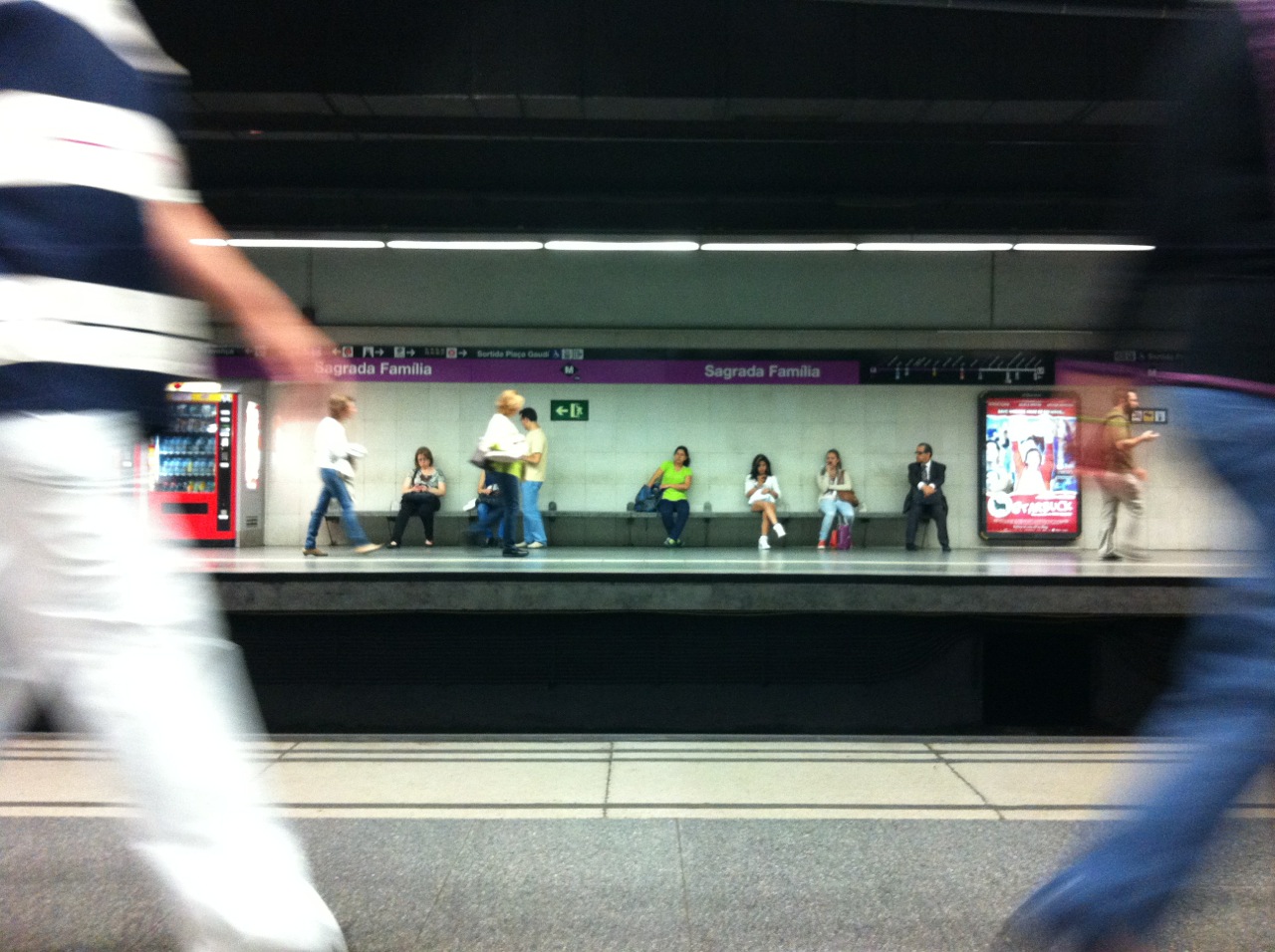
Getting around in Barcelona is also pretty great. The Aerobus takes you from the airport to the city center. It runs every five minutes during most of the day. Once you’re in the city itself, the taxicabs are very affordable, and there’s an extensive underground Subway system. A four-day/unlimited rides pass was just over 20 Euros. You can also rent bikes, if that’s your thing. I got around for the entire trip using just public transportation and two or three cab rides.
A quick note about technology: Whenever I leave the borders of Germany, I lose the ability to use my phone for mapping and location stuff- roaming data is absurdly expensive, so I just turn it all off. On this trip, I managed to get around for the entire stay using just two apps regularly.
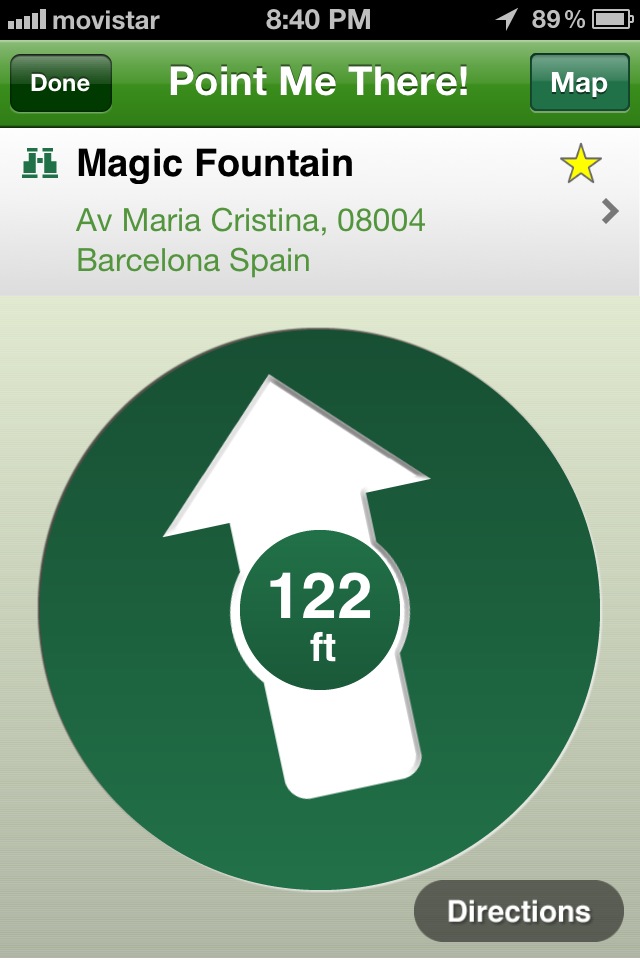
The first app is a simple Metro app that uses your GPS to figure out the nearest train station, and it plots a route using the subway. The second app was the TripAdvisor app. This one has a huge list of attractions, hotels, and restaurants, and it uses the GPS to locate you on a pre-loaded map- no roaming data required. It also combines the GPS with the phone’s compass to make a really nifty “Point Me There” feature. Without this feature, I would never have found my hotel, and I would have gotten lost over and over and over again.
I won’t bore my six and a half readers with the day by day travelogue styled post that I originally wanted to write. Instead, I’ll give you the highlights.
Gaudí, Gaudí, Gaudí!
Antoni Gaudí was an architect and certified crazy genius who was responsible for a slew of Barcelona’s most famous sites. I’m going to nutshell them here, because I could easily write pages and pages and pages about these structures.
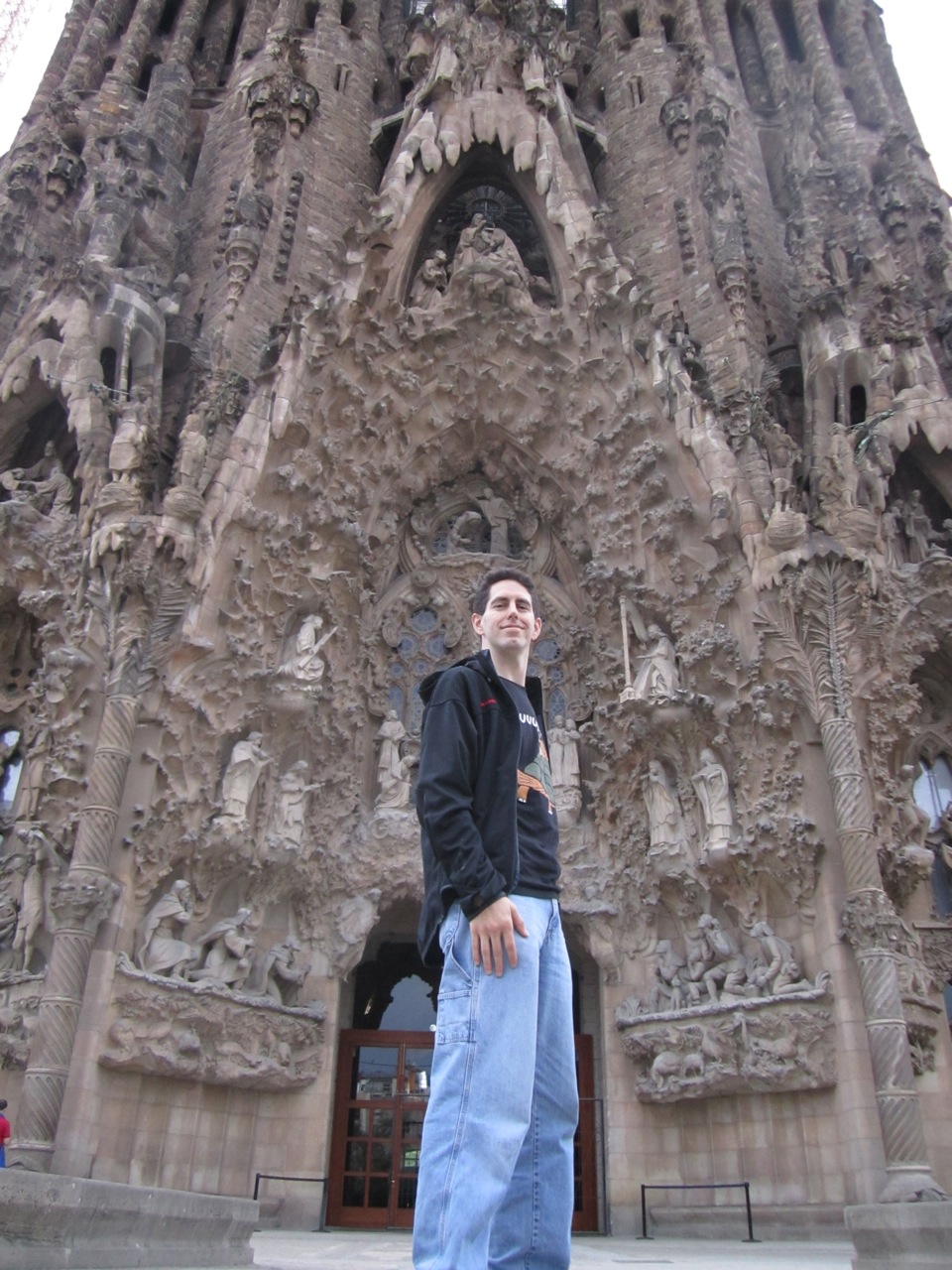
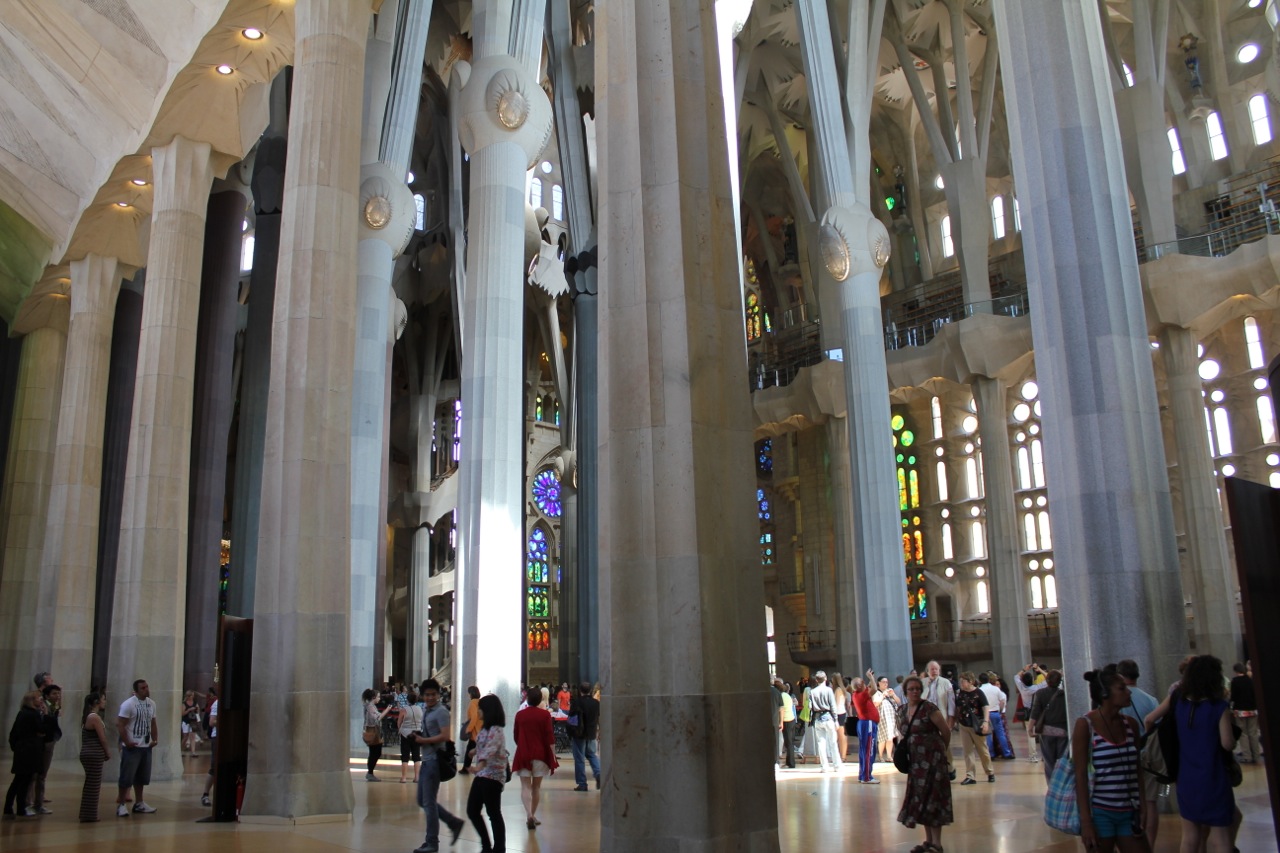
La Sagrada Familia – This enormous church has been under nearly continuous construction since 1882, and it’s expected to be finished sometime around 2028 using Gaudí’s original plans. One side very ornately shows the Nativity and the life of Christ. I’m standing in front of that side of the building in the picture below. The other side is more austere and it shows the Passion, the death of Christ. The columns inside were designed to resemble trees and branches.
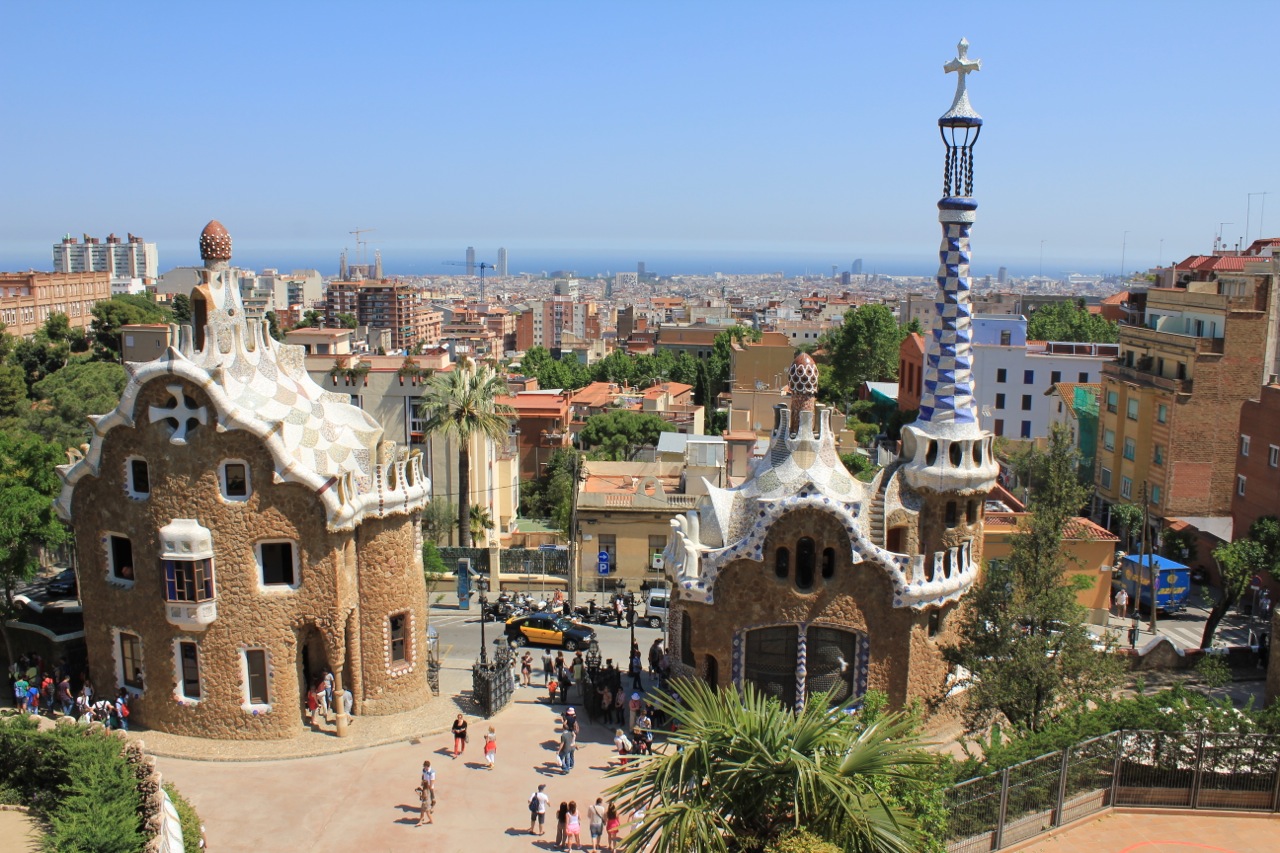
Parc Güell – This is what happens when you set Antoni Gaudí loose on a park and garden complex. I only saw a fraction of this park, because it’s enormously huge and I was on foot and kind of turned around.
La Padrera – An apartment building designed by Gaudí, this is now part museum and part office space. You can go up on the roof, tour the attic, and even visit a sample apartment.
Casa Batlló – This building has a skeletal, fish-scale appearance. This was originally designed as housing for rich Barcelona folk.
Not Gaudí, But Still Impressive And/Or Interesting.
Arc De Triomf – Built for 1888 Universal Exposition, this is your typical enormous stone gateway. Very eye-catching, don’t you think?
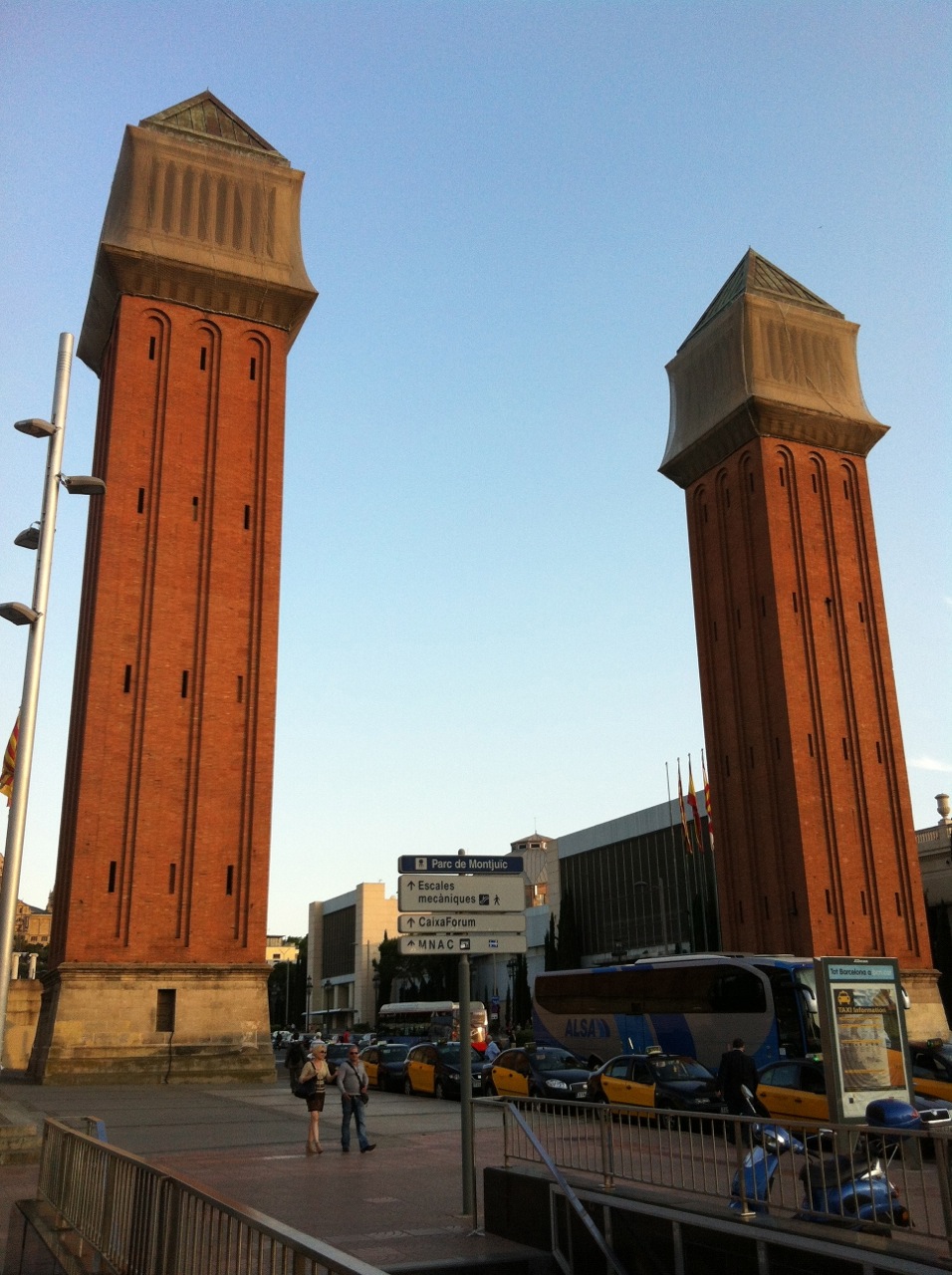
Placa Espanya – Placa Espanya holds several very impressive structures. First of all, this is where the Font Màgica (Magic Fountain) is located. Thursday through Sunday nights, after about 9pm, there’s a water show set to music. If you’ve ever seen dancing fountains at Disney or the Bellagio, then this is nothing new to you, but it’s still fun to watch. Also in the Placa Espanya are Venetian Towers, a scale replica of the originals from Venice which were a gift to Barcelona for the 1929 Universal Exposition.
Palau de la Música Catalana (Palace of Catalan Music) – Often referred to by travel writers as the most beautiful concert hall in the world, this amazing space seats about 2200 people, and during the day it’s illuminated entirely by natural light. The sculptures behind the main stage are the figures of 18 muses. Their lower bodies are depicted in mosaic, and their upper bodies protrude from the wall. Each muse is playing a different musical instrument. If you take the tour, you get a lot of background about the decorations, the lighting, and the acoustics, as well as a demonstration of the pipe organ.
Flamenco – While flamenco didn’t actually originate in Barcelona, it’s still a long-running tradition; there are several Flamenco shows in Barcelona. We went to a dinner and show off Las Ramblas at an establishment which has been there since 1970. Dinner was at 10:00 PM and the show began at 11:30 PM, so it was a pretty late night. They have earlier shows, though. The food was spectacular, and the show was amazing.
There was a lot more. There is so much more to do than what I’ve shown here. I was there for four days and took over 600 photographs. Many of those photographs are visible in my Barcelona Flickr gallery, including many more detailed pictures of La Sagrada Familia and everyplace else I went in the city.
If you do visit Barcelona, you should try the tapas. The food was excellent almost everywhere I went. I particularly enjoyed my meal at Cafe del la Princesa in the old gothic quarter (Barri Gotic) near El Born.
I’ll close out this post with a few more photographs of things that I thought were interesting.
During our visit, we took a guided tour of the city, and it was pointed out that people who are frustrated with the Euro-zone financial crisis have “redecorated” the facade of the city’s main stock exchange.
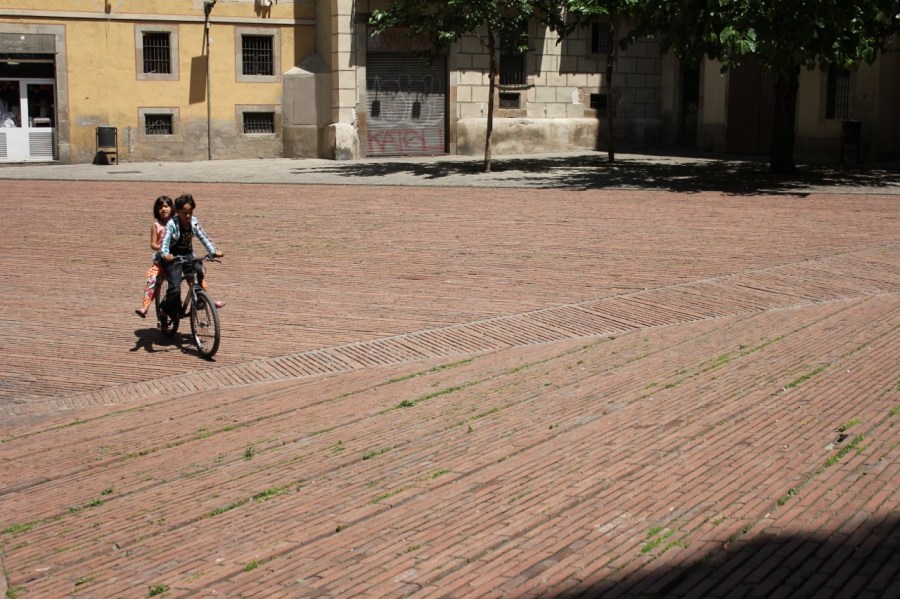
Wandering around the city, playful children and live street music were everywhere. In that order:
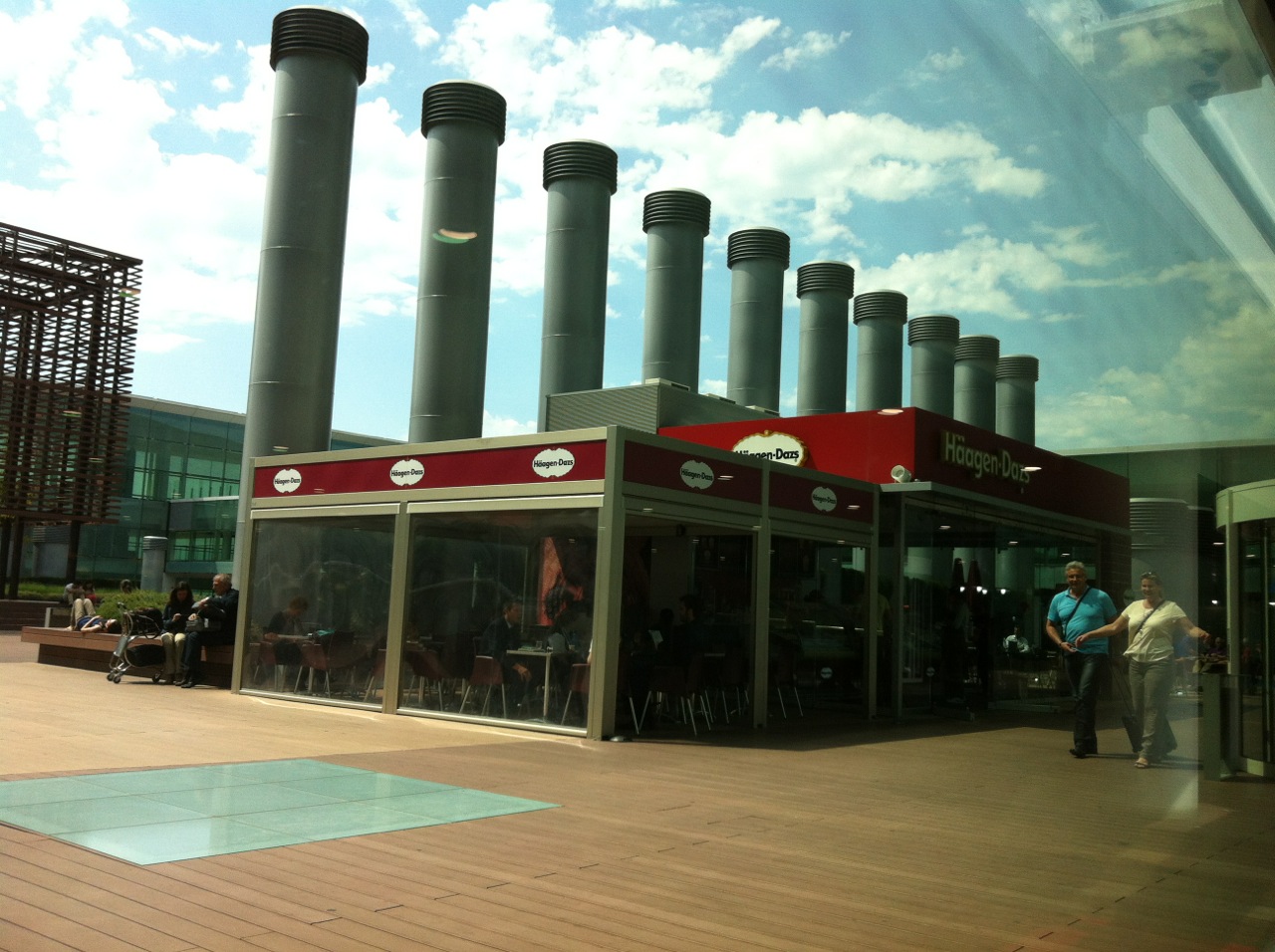
And lastly, the Barcelona airport has a rather interesting feature- from the gate, inside security, you can walk out onto a sun deck and get some ice cream while waiting for your flight. This is brilliant.
On the corner of Maximilianstraße and Königsstraße in the Altstadt, I stumbled across nine gold colored blocks on the ground with names and dates. They’re obviously a memorial of some sort, and I’ve taken pictures of them on several occasions with the intent to find out the story behind them.
Today, I found five more at the place where Pfarrergasse intersects Neupfarrplatz, and in a fit of amazingly coincidental timing, I’ve also found an explanation and a history of these blocks.
The blocks are called Stolpersteine. The German word Stolperstein literally means “stumbling block” or “obstacle” and Stolpersteine is the plural. They were created by artist Gunter Demnig in 1993 and the first installation was in Cologne, Germany, in 1994.
The Stolpersteine blocks are designed as memorials to commemorate individuals who were sent by the Nazis to prisons and concentration camps, as well as those who emigrated or committed suicide to escape the Nazis. Some of the blocks represent those killed by the Nazis and some represent survivors. The Stolpersteine are not limited to Jews, either. The vast majority were Jews, but there have also been blocks placed for various other types of people, including Romani people, homosexuals, blacks, and even Christians who opposed the Nazis.
The actual block is a ten centimeter concrete cube covered with a sheet of brass. Demnig then stamps the details of the individual, the name, year of birth, and the fate as well as the dates of deportation and death, if known. Each block begins with “Hier wohnte,” which is German for “Here lived.” Most are set at the last residence of the victim, but some are set near workplaces.
These tiny little memorials are an amazing idea. Since I started researching this, I’ve seen countless instances of people commenting, “so that’s what those are. I was wondering.” That’s how the Stolpersteine got me curious, and I’m sure I won’t be the last person to hunt down this information.
More importantly, though, people are still visiting the memorials and remembering. One evening, while I was walking through the Altstadt, I noticed that someone had left flowers and a Yartzeit (bereavement) candle at the first set of Stolpersteine I had stumbled across.
When I walked home a few hours later, the candle was still burning. I think that’s kind of fitting.
One of the many things I had to learn when I got to Germany was the different holidays. Many of the holidays that I’m used to from the US just aren’t a holiday here.
Thanksgiving is a great example of this. Most of the Germans I’ve met don’t know anything at all about Thanksgiving. I got here in the middle of November, and I was fortunate enough to meet a lot of folks in the local ex-patriate crowd right away. This allowed me to attend a Thanksgiving dinner in the local Irish pub. As one of the actual Americans in attendance, I spent a fair amount of time explaining what the foods represented, and what little I could remember from grade school about the background and story of the holiday. I also fielded questions like “how on earth do you eat this cranberry sauce goop?” It was a highly entertaining time. Plus, there were twinkies.
But I digress. The first of May is a public holiday here in Bavaria. It’s a holiday in much of Europe, actually, but the Bavarian holiday schedule doesn’t always match up to the rest of Europe. It does today, though, which means that most business are closed, and everyone goes out and enjoys the newly minted sunshine for a change.
May Day, first observed as a public holiday here in 1933, is also referred to as Labour Day here, and I’ve been told that sometimes there are activities related to work and employment, but I haven’t seen any.
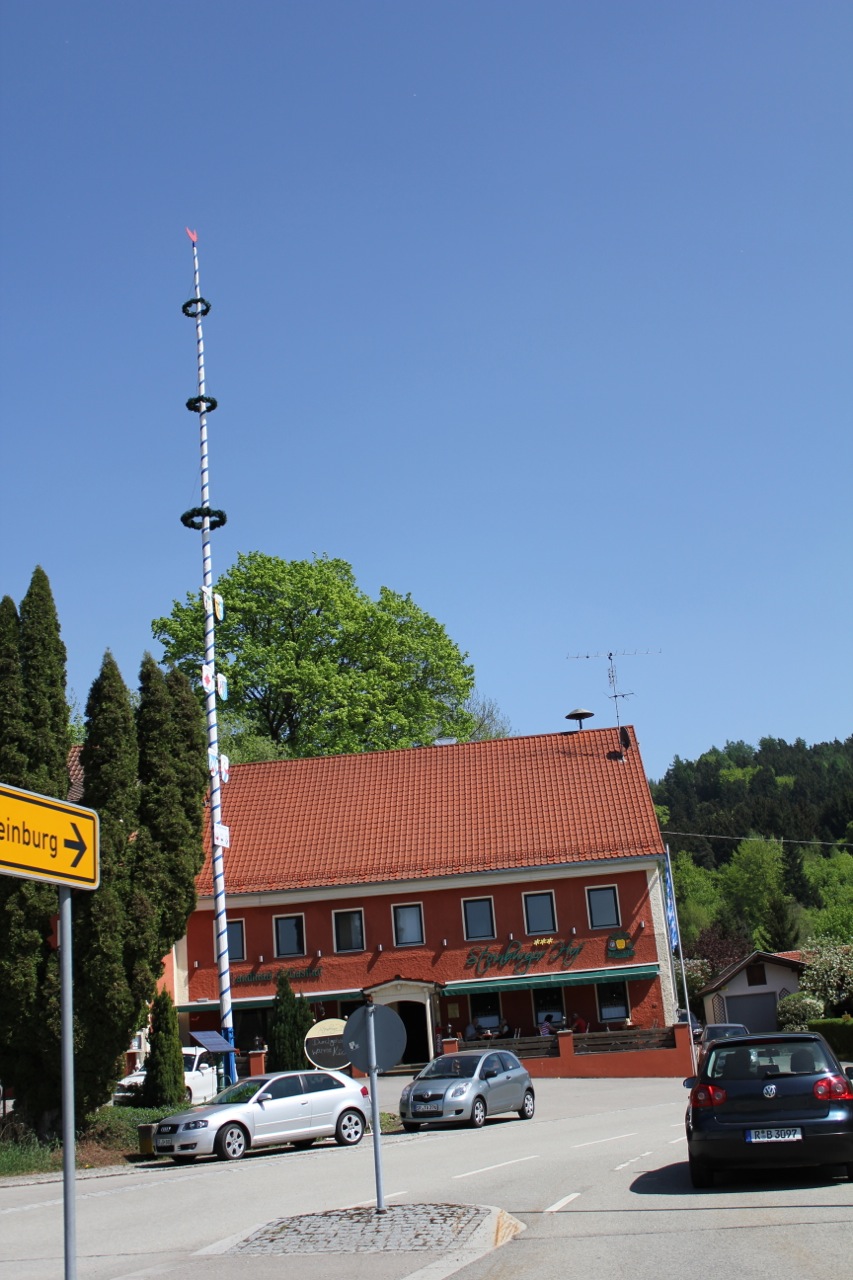
What I have seen is a lot of Maibäume, or maypoles. These started to turn up at the beginning of April, and they usually show up near churches or main village squares from what I’ve seen. I’ve done a bit of research, and the date that it goes up varies- in some instances, it’s put up on May 1st, and might be left up for the duration of the month. In some cases, the pole itself is left up year round, but without the decorations. The placing of the maypole is often followed by a dance, or Tanz in den Mai (Dance into May).
There is a wealth of information online about maypole customs and decorations in other countries, but I’m focusing on what I’ve seen here in Germany. The poles I’ve seen have been blue and white, which is the colors of the Bavarian flag. They’re also covered in wreaths and some other decorations which, according to The Google, usually depict local crafts and industry.
There’s another element to this tradition though, which I quite like. On the night of the last day of April, many men erect small decorated maypoles in front of the houses of their sweethearts, with a decoration attached in the shape of a red heart with the name of the girl. The genders reverse on leap years and women leave the maypoles in front of their sweetie’s house. This is often done in secret, and it’s up to the person leaving the maypole to decide whether to remain anonymous or give a hint to their identity.







 Whimsy. Tacos. The DMV.