Easter Weekend 2013, Part Three: Zurich, Switzerland

The Friday and Monday surrounding Easter weekend this year were public holidays in Bavaria.  Since I had a long weekend, I decided to do a whirlwind tour through Strasbourg France, Freiburg Germany, Zurich Switzerland, and the Rhine Falls near the Swiss-German border.  I’m going to write about them one at a time, though.  Next up is Zurich!

Sunday morning, I grabbed an early train from Freiburg into Zurich.  If you arrive by train, you will find yourself in one of the  busiest train stations in the world, with nearly three thousand trains a day.  Hanging overhead in the main hall, you’ll see L’Ange Protecteur by French artist and sculptor Niki de Saint Phalle, a French sculptor.   I hadn’t heard of her sculptures, called Nanas, until I saw this one.  There’s a bunch more in in various places around Europe.

zurich-1

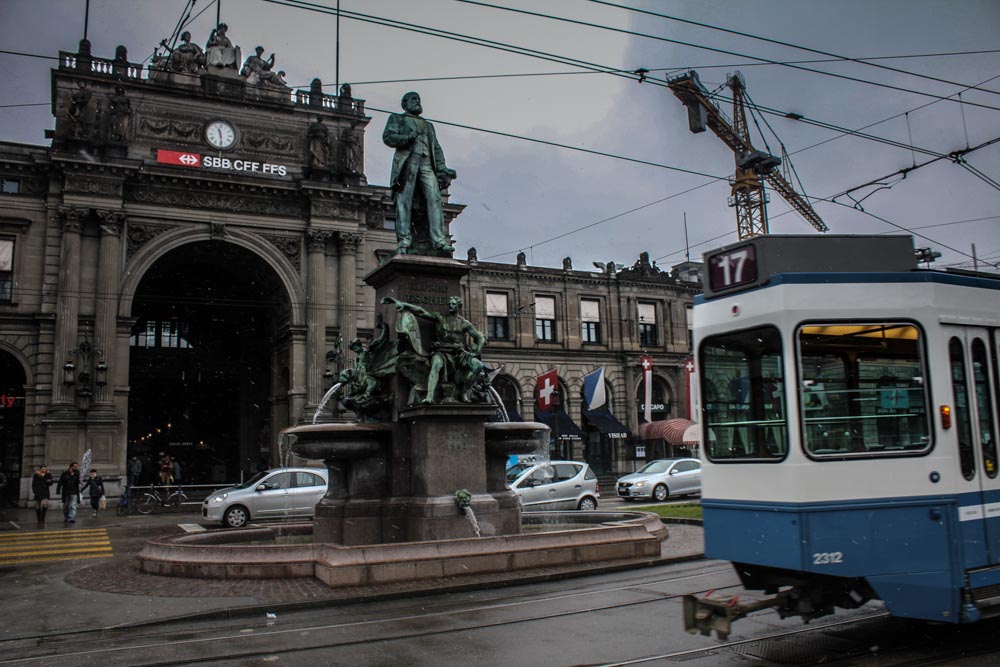
In front of the train station, there is easy access to the street tram system, and from there you can get almost anywhere else in the city.  The street directly opposite, Bahnhofstrasse, is a very busy and fairly well known shopping street.  I spent some time in the evening walking down this street trying to find the source of a tantalizingly delicious smelling food smell-  I never figured out where it was coming from.
zurich-2

I took the tram to the Rathaus stop in order to see some of the more well known sights in Zurich, and that let me out in front of this building:

zurich-3

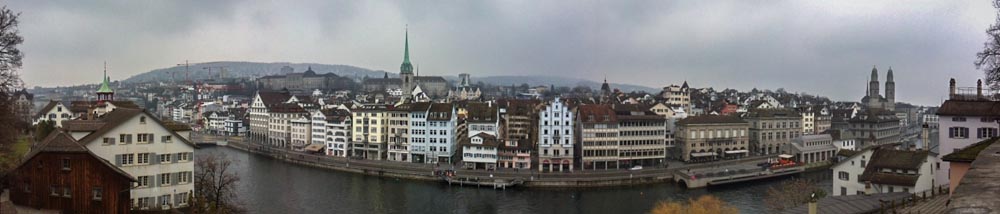
From there, it was a very short walk to most of what I wanted to see.  First I walked up the hill to Lindenhof.  This is a hill in the middle of the city, with a really spectacular view.  Apparently it used to be a Roman fort, but honestly, this is Europe- what wasn’t a part of an old Roman fort?  You can see Grossmünster, the church with the two dome-shaped spires on the right side there.  That’s the next place I walked.
zurich-4

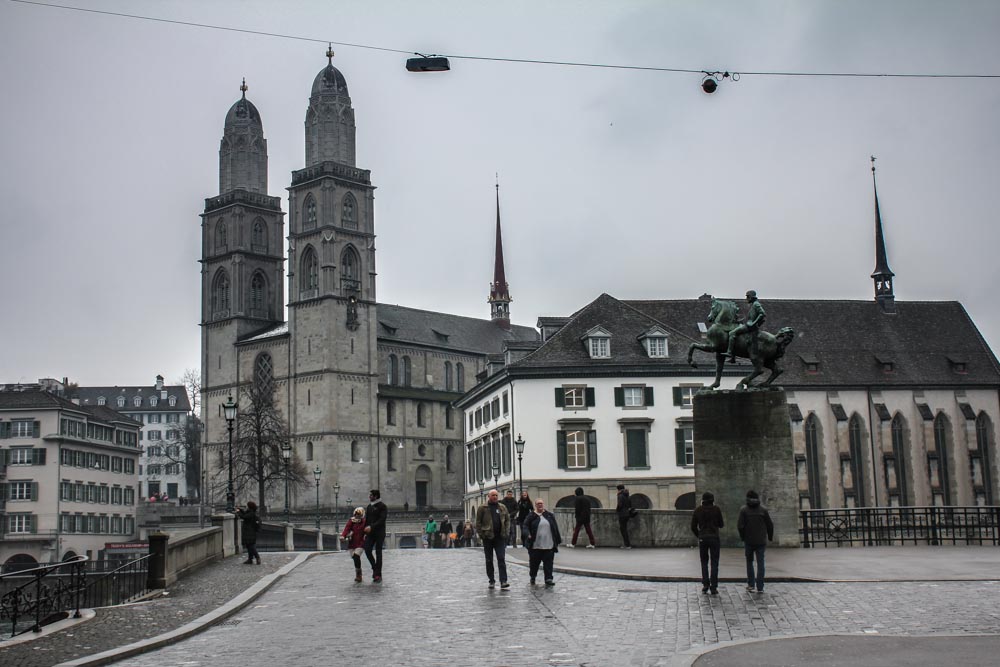
Grossmünster was a very impressive structure.  I didn’t know until after I was gone that you can actually climb the tower.  Blast!  I missed a chance to go into a tall thing!  I’m sure I’ll be back there in the near future, though.
zurich-5

The door of Grossmünster is ornate and fascinating.

zurich-6

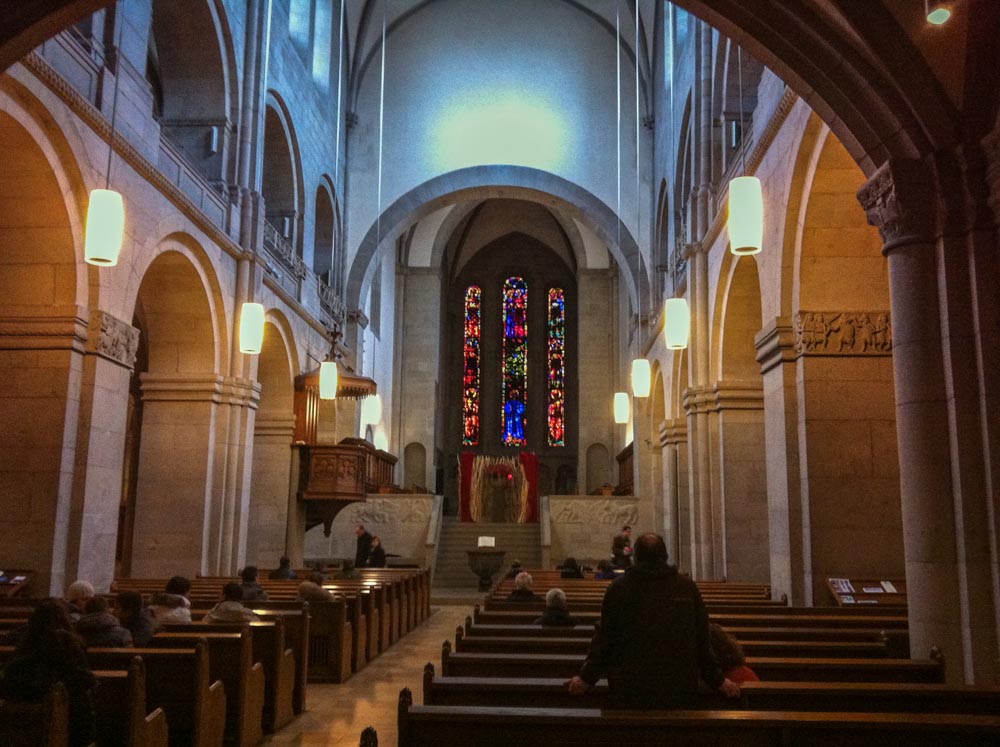
Grossmünster is quite pretty inside, also.
zurich-7

Across the river from Grossmünster is a courtyard area that connects shopping streets (and the climb to Lindenhof) to Fraumünster.  There are a lot of clocks in Zurich.   I wonder how often one of them is wrong.

zurich-8

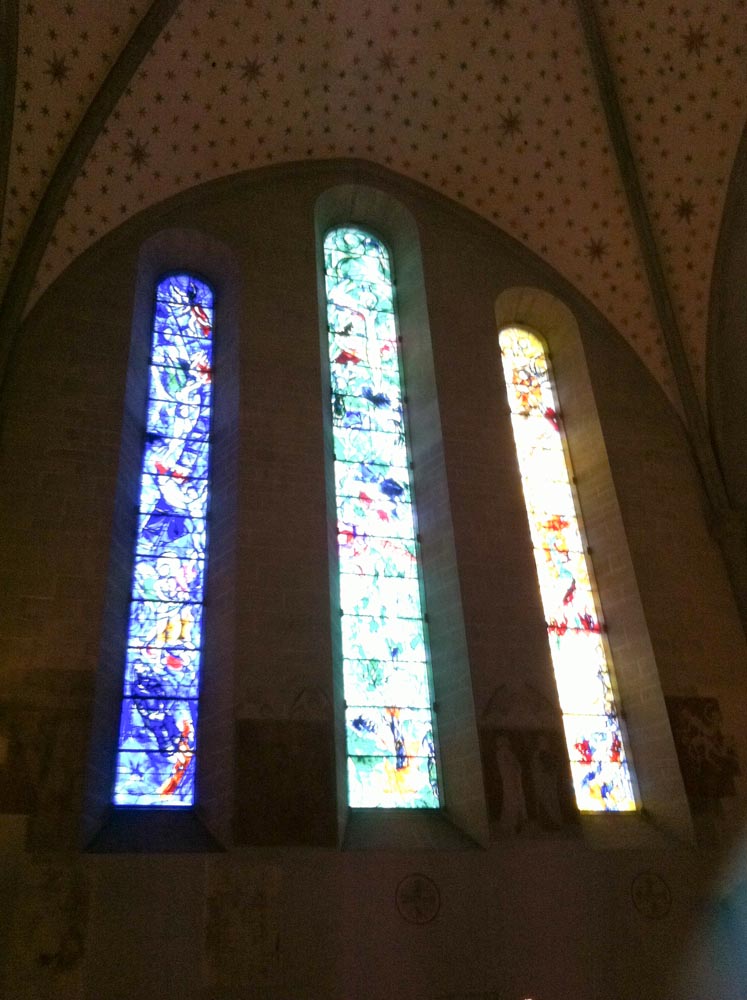
Inside Fraumünster there are four glass windows which were painted by Marc Chagall.  You’re not supposed to take pictures of them from inside the church, so pretend you didn’t see this.
zurich-9

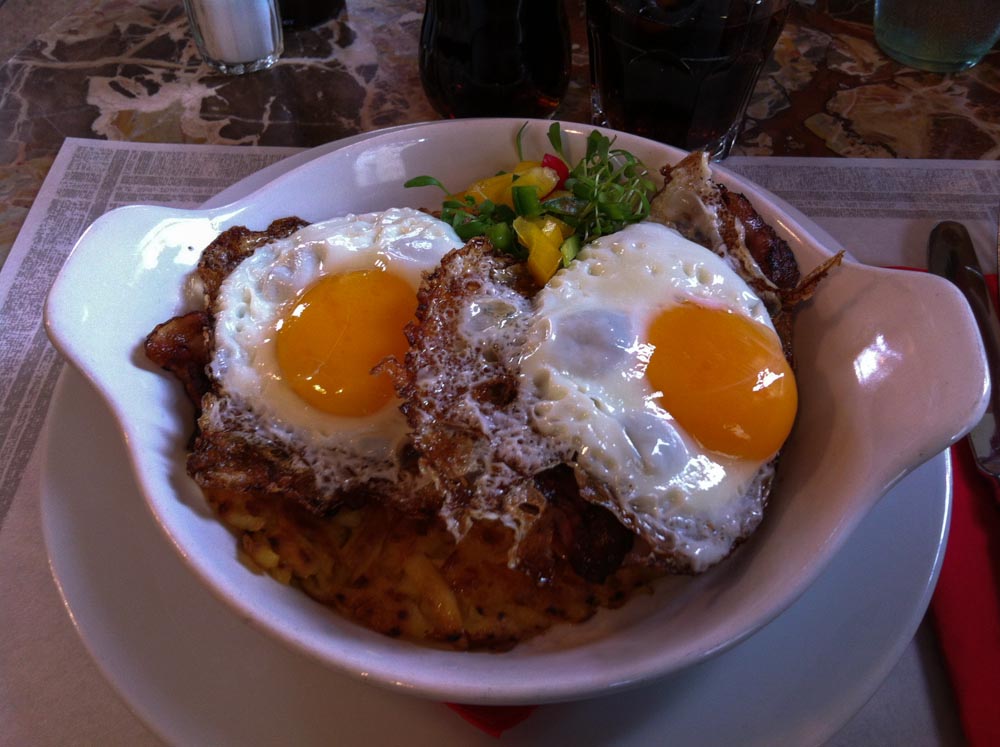
After a busy day of seeing churches and not climbing them, I stopped for lunch in a tasty place called Cafe Odeon, which has apparently been open for more than 100 years.

I had the Rösti, which is a common food in Switzerland, a fried potato dish which is somewhat similar to hash browns.  In this case, I had it with fried eggs and a some vegetables.  It was quite delicious.
zurich-10

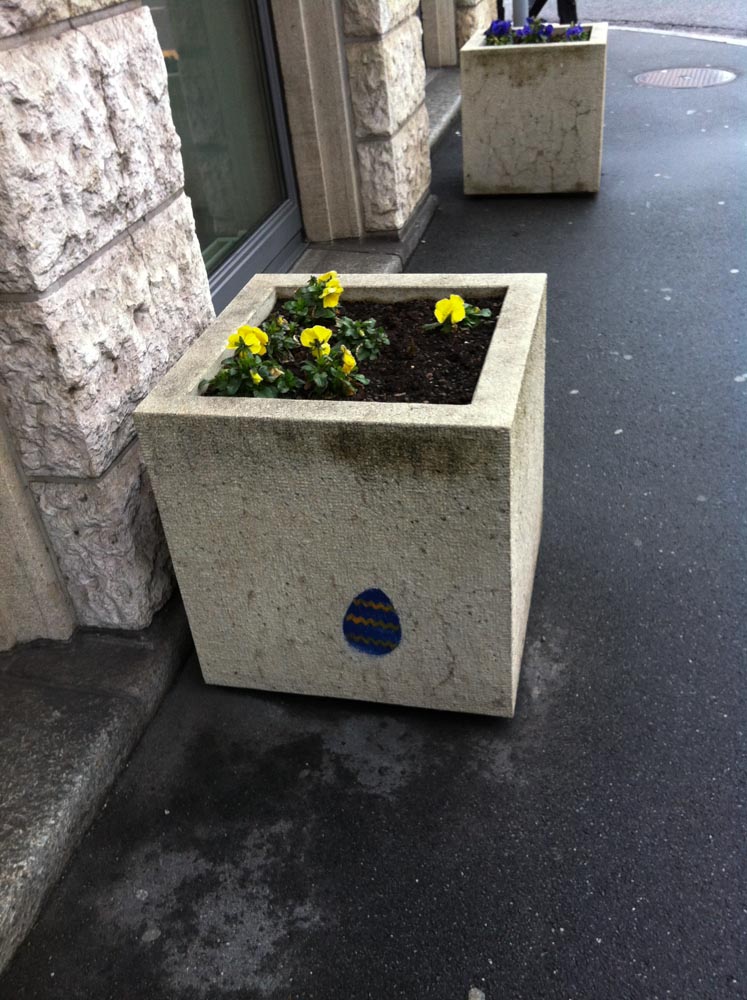
Easter graffiti!  I saw this while I was walking to where the Jacob Coffee Museum is.  Unfortunately, the Coffee Museum is closed for renovation.  The information I read said that it would be open in March of 2013, but it was most definitely not finished with renovations.   Oops!
zurich-11

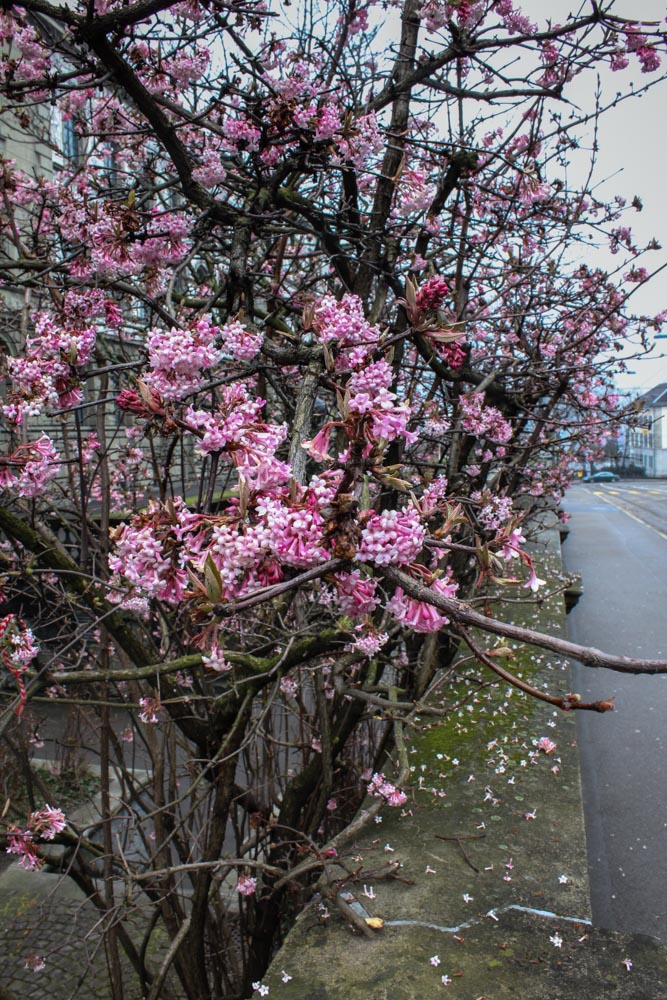
While I was walking to yet another closed attraction (stupid holiday weekend), I saw this lovely flowering tree.  Someone tricked this plant into thinking it was already springtime.
zurich-12

The aforementioned closed attraction-  This is the Polybahn, a 19th century funicular that goes steeply up and down one of the hills near the center.  I like funiculars, naturally, but this one wasn’t running.  Stupid holiday weekend.

zurich-13

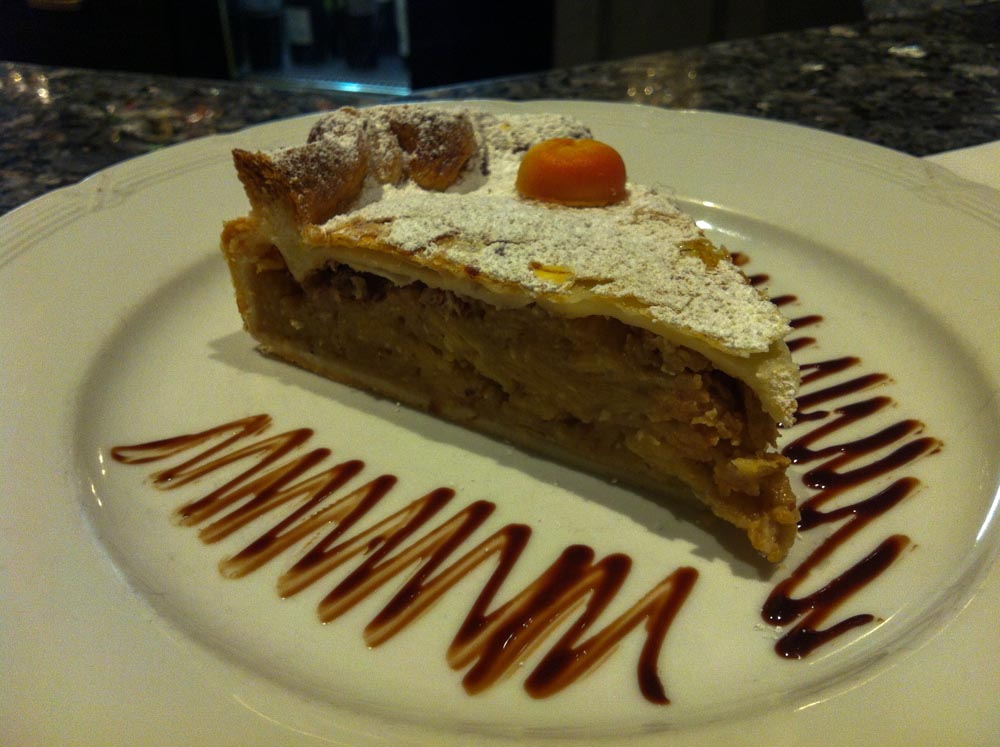
That was the bulk of my sightseeing for the day.  I went back to the hotel room for a little while to shake off a headache in the late afternoon, and didn’t go out again except for dinner, a little more wandering, and some dessert.  Dessert was this amazing piece of apple pie at Hotel Schweizerhof’s Café Gourmet, a nifty little place for a snack across the street from the Bahnhof.
zurich-14

Have you been to Zurich?
Easter Weekend 2013, Part Two: Freiburg, Germany

The Friday and Monday surrounding Easter weekend this year were public holidays in Bavaria.  Since I had a long weekend, I decided to do a whirlwind tour through Strasbourg France, Freiburg Germany, Zurich Switzerland, and the Rhine Falls near the Swiss-German border.  I’m going to write about them one at a time, though.  Next up, Freiburg!

After spending Friday in Strasbourg, I got up early the next morning to grab a quick train into Freiburg.  The weather had turned, so much of this day was moist and cold and overcast.  I had been looking forward to some of the nicer views from hiking up the Schlossberg or taking the Schauinsland cable car, but since the weather didn’t cooperate, those will have to wait until the next time.

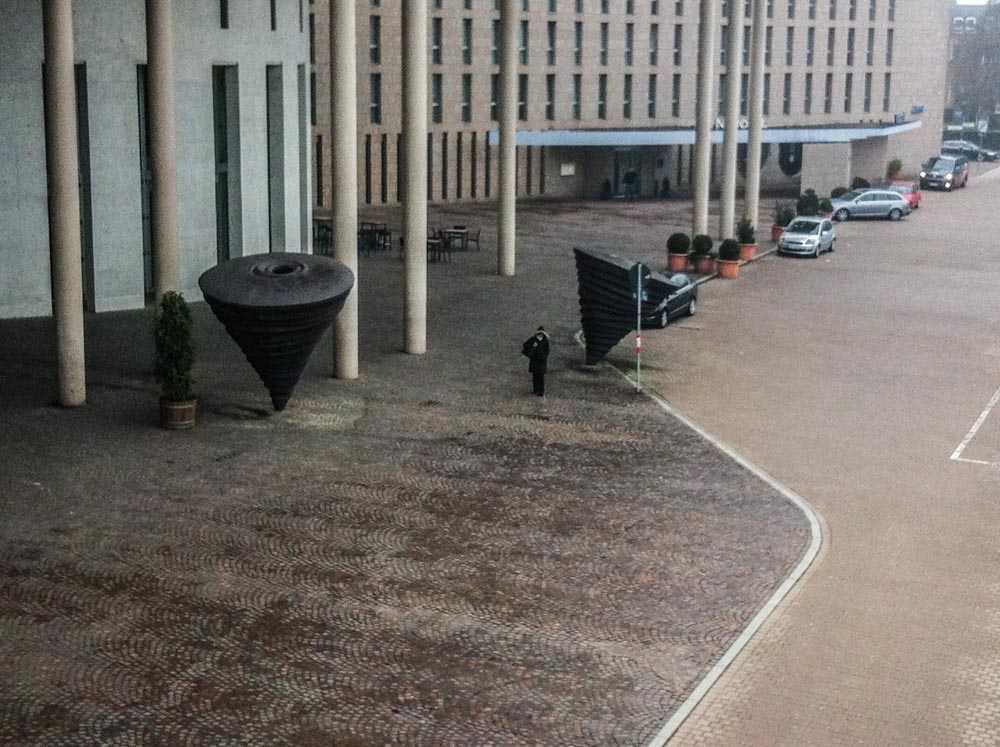
I did get to meet Andrew from Grounded Traveler– we had lunch together and he showed me around town a little bit. While walking to the town center to meet him, I passed by these fun little tornado statues:

freiburg-1

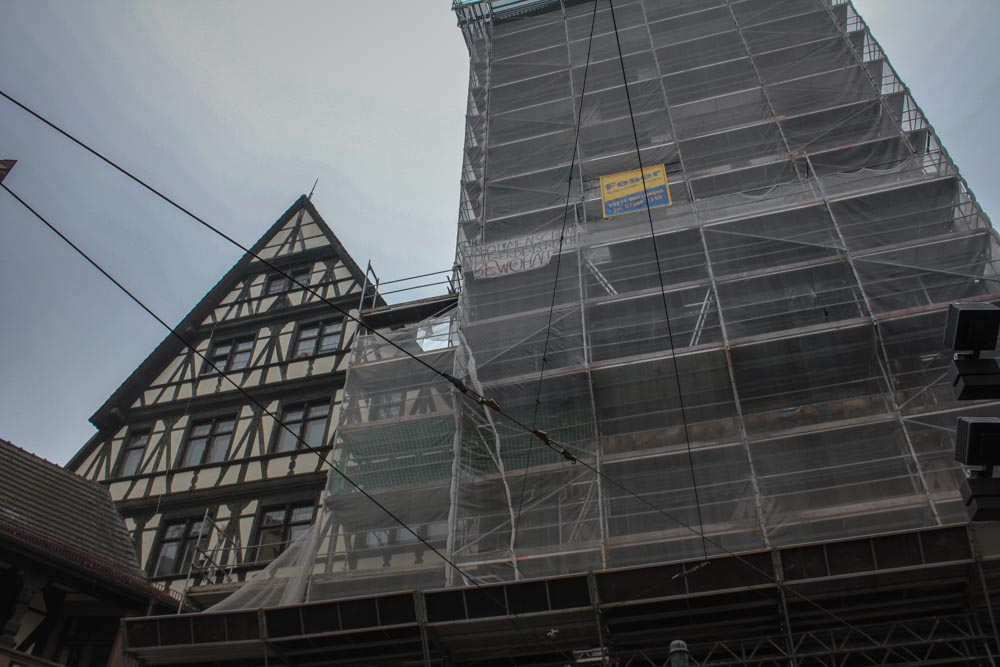
During my minitour, we walked by one of the town gates, the Schwabentor.  It was all scaffolded for construction.  This happens a lot.

freiburg-2

This is just a regular street in the town center.  Freiburg is quite charming, and I’d love to see it again some time in the sunlight.

freiburg-3

This is the other city gate, the Martinstor.  While not in scaffolding, the McDonald’s logo on the gate has drawn criticism.  (McFreiburg?)

freiburg-4

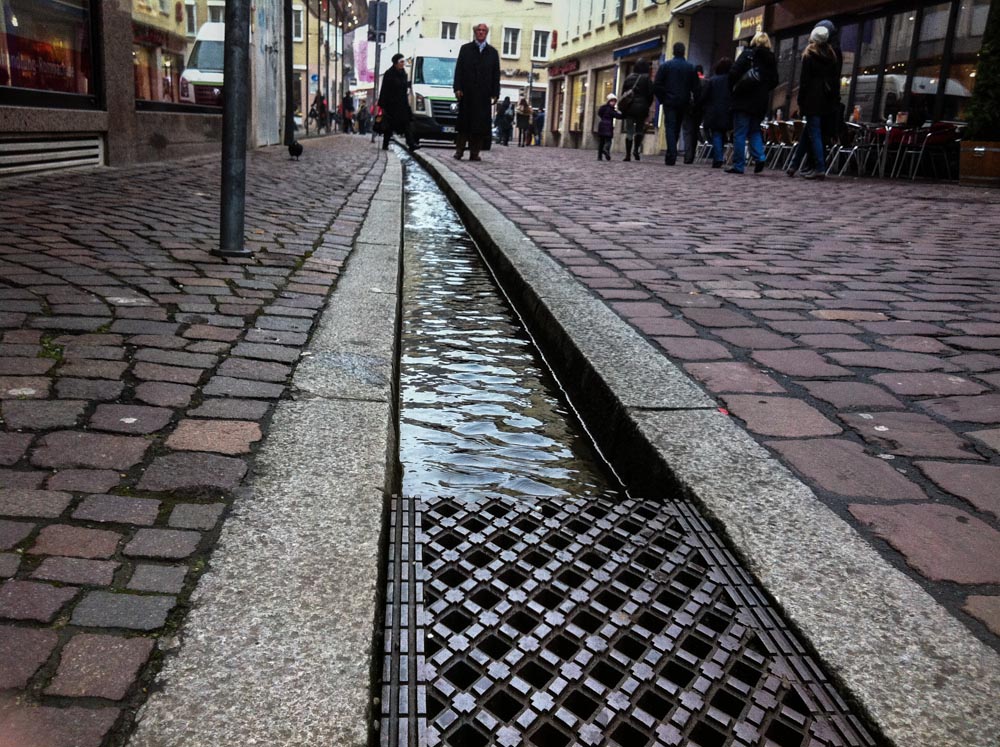
My favorite part of Freiburg, to be honest, is the Bächle.  These are small canals all over the city.  The locals say that if you accidentally step into one, you will marry a Freiburg resident.  Andrew says he’s stepped in them many times and he wound up with an American anyway.

freiburg-5 freiburg-6

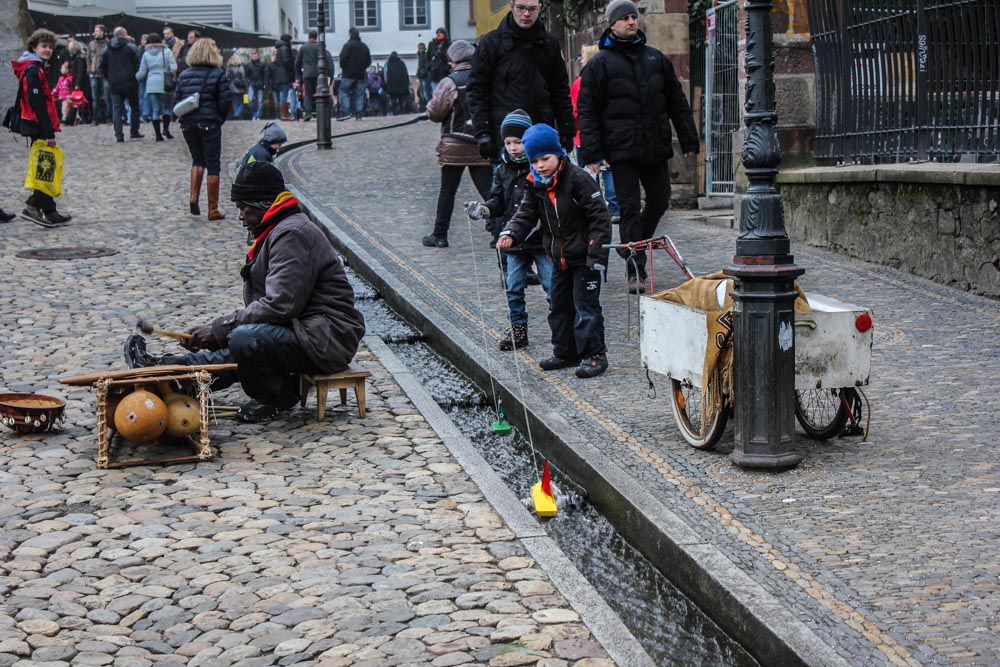
One of the cool things about the Bächle, in my opinion, is that the locals have integrated them into their entertainment.  I saw lots of kids with little toy boats on strings like these two.  Incidentally, this is my favorite picture from the entire day in Freiburg.

freiburg-7

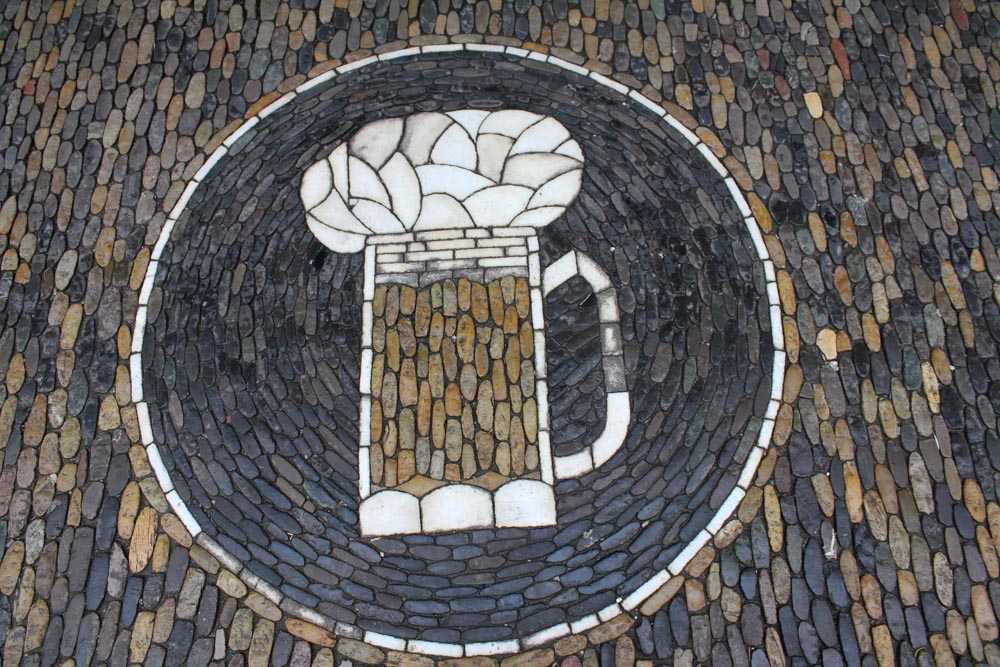
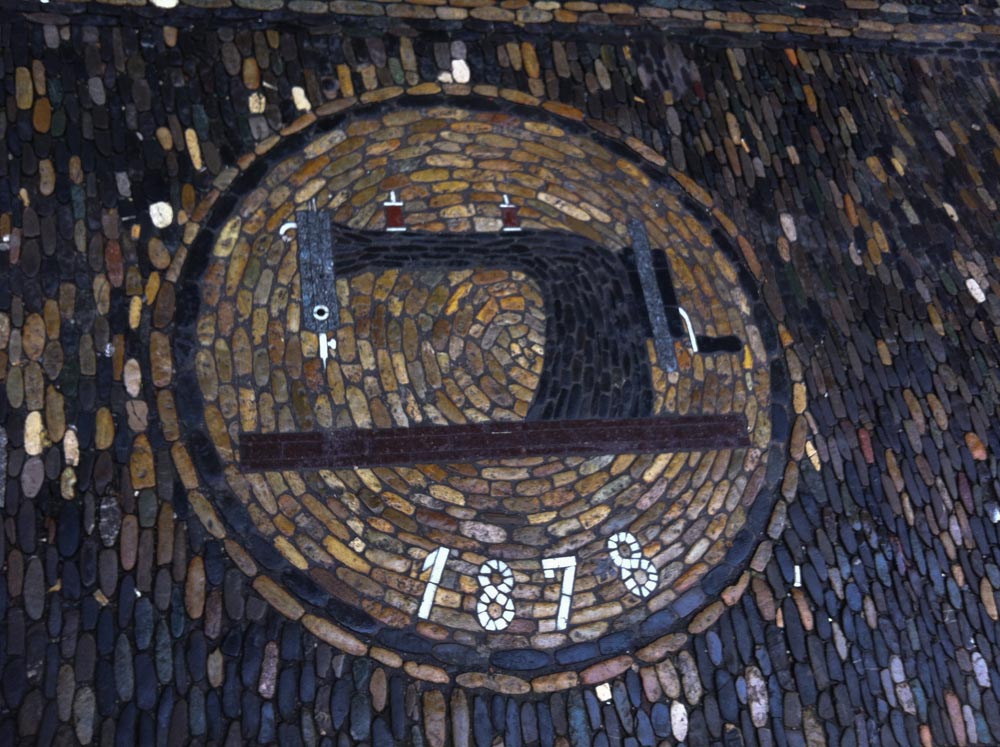
My second favorite thing about Freiburg is the stonework in front of various shops around the old city.  For the most part, the stonework is indicative of the business it sits in front of, although there were a few places where the business was relocated and the stonework remained.  Even so, it’s pretty easy by the stonework to figure out what kind of business you’re looking at.  Here’s three examples:

freiburg-9 freiburg-8 freiburg-10

Another general shot of the city, with one of the church towers in the background for perspective of what the weather was like.

freiburg-11

The Roter Bären is one of the oldest buildings in Freiburg, and is a well known hotel.

freiburg-12

The front of the Rathäuser, the history city halls.

freiburg-13

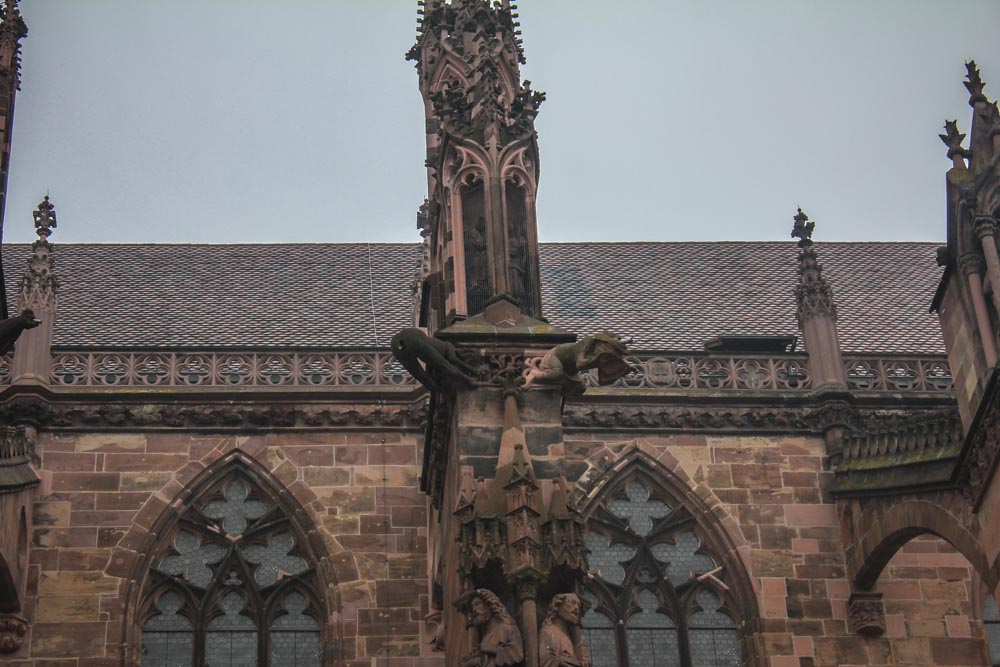
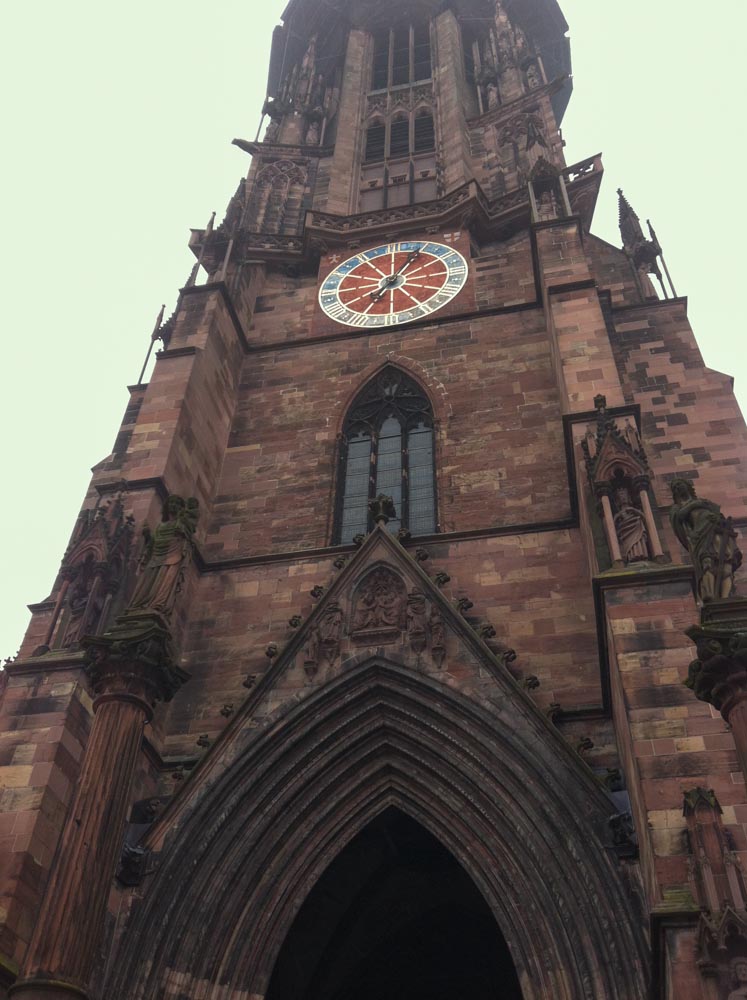
The Münster cathedral, with amazing gargoyles all over the structure.  You can climb the tower, but I didn’t want to do that unless it was a clear day- the view just isn’t the same when you can only see a few buildings away.

freiburg-16freiburg-14

Note the gargoyles in the center-  the one on the left is just sticking his butt out.  Hilarious!

freiburg-15

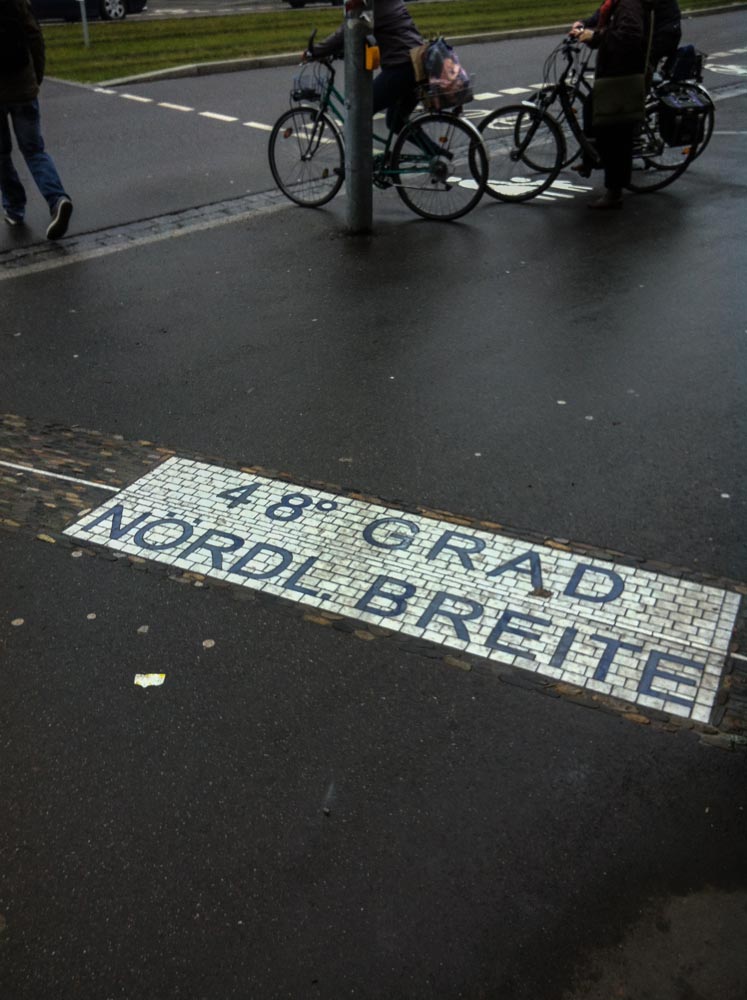
Lastly, a short walk away from the cathedral is the 48th Parallel.  I live close to the 49th parallel, and I know you can see the 49th in Karlsruhe, but I haven’t been there.  I was also unable to see the Prime Meridian when I was in London because the observatory was closed due to the Olympics.  But here, there’s a bar on the corner called 48 Degrees.  And right in front of that bar, is the 48th Parallel.  This is fascinating to me:

freiburg-17

How many parallels or meridians have you seen?
Easter Weekend 2013, Part One: Strasbourg, France

The Friday and Monday surrounding Easter weekend this year were public holidays in Bavaria.  Since I had a long weekend, I decided to do a whirlwind tour through Strasbourg France, Freiburg Germany, Zurich Switzerland, and the Rhine Falls near the Swiss-German border.  I’m going to write about them one at a time, though.  First up, Strasbourg!

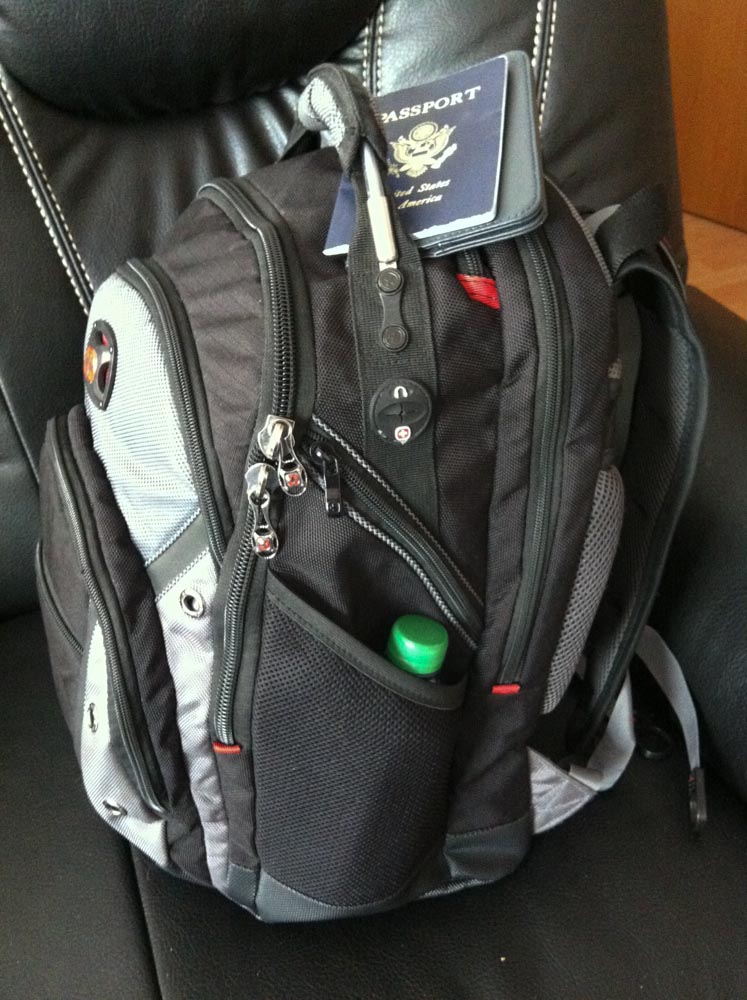
I’ve been trying to perfect the art of packing light for my travels, and I think I did very well on this trip.  For a four day, nine train journey to all of the aforementioned places, this was my entire pack, including my DSLR.

strasbourg-1

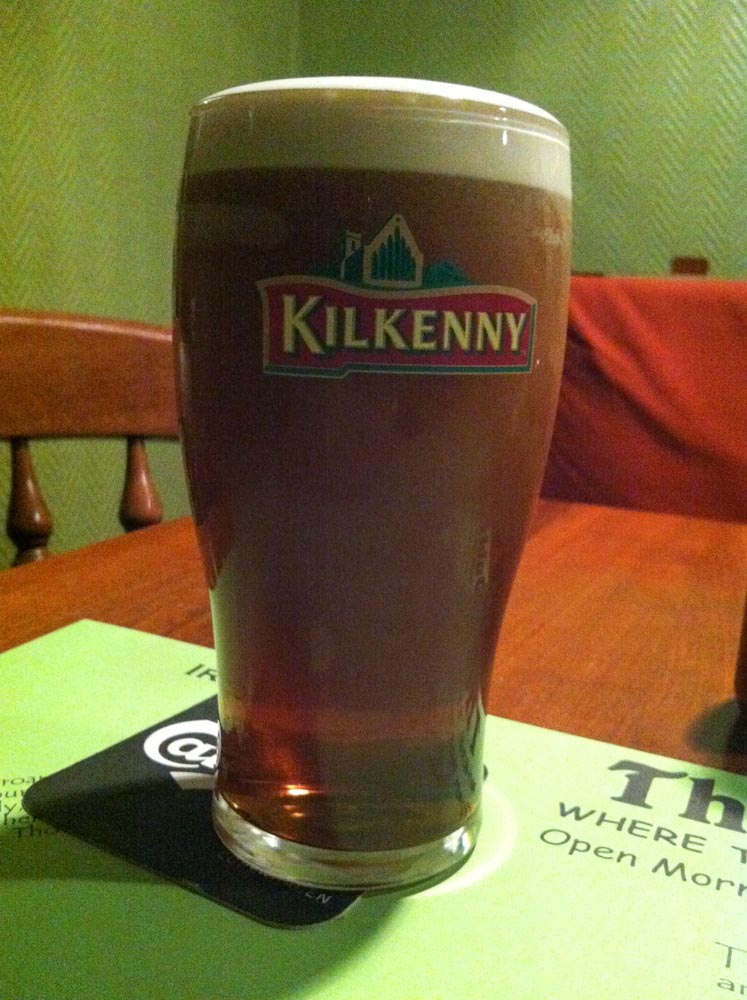
I arrived in Strasbourg around 9pm, and made my way to the hotel first to drop off my belongings.  I stayed at the Hotel Cathedrale, and was quite surprised when I arrived to see just how close the hotel was to the Cathédrale Notre Dame.  The entrance to the hotel is just across a courtyard from the Cathedrale, which made my sightseeing the next day quite easy to plan.  Since I arrived into town quite late, I grabbed a quick dinner at The Dubliner’s Irish Pub, a few blocks from the hotel.  I saw the pub on my walk to the hotel, and while I wasn’t in the mood to try local cuisine right away, I know I can always count on tasty food in an Irish pub.  Plus, this is a great way to start the holiday weekend:

strasbourg-2

Walking back to the hotel from the pub, I snapped this picture.  The entranceway to the Cathedrale is just like one of the large churches I saw in Barcelona, very typical of the time period in which it was constructed.

strasbourg-3

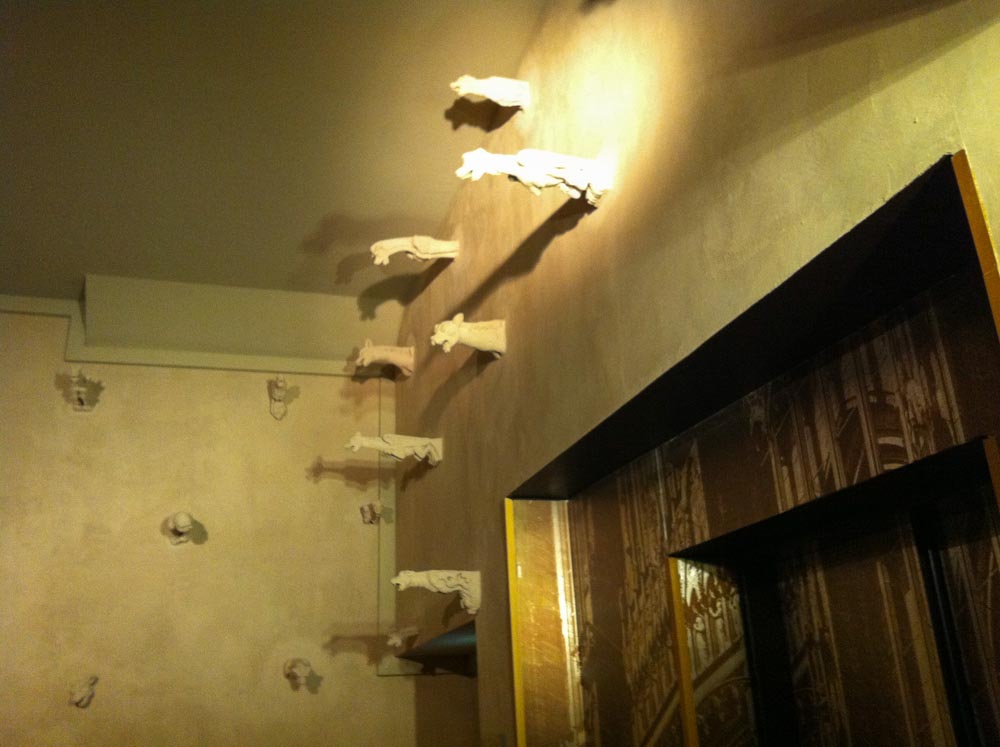
The hotel also had a variety of gargoyles around the elevators and stairways, to watch over you and protect you while you slept.  I slept very well.

strasbourg-4

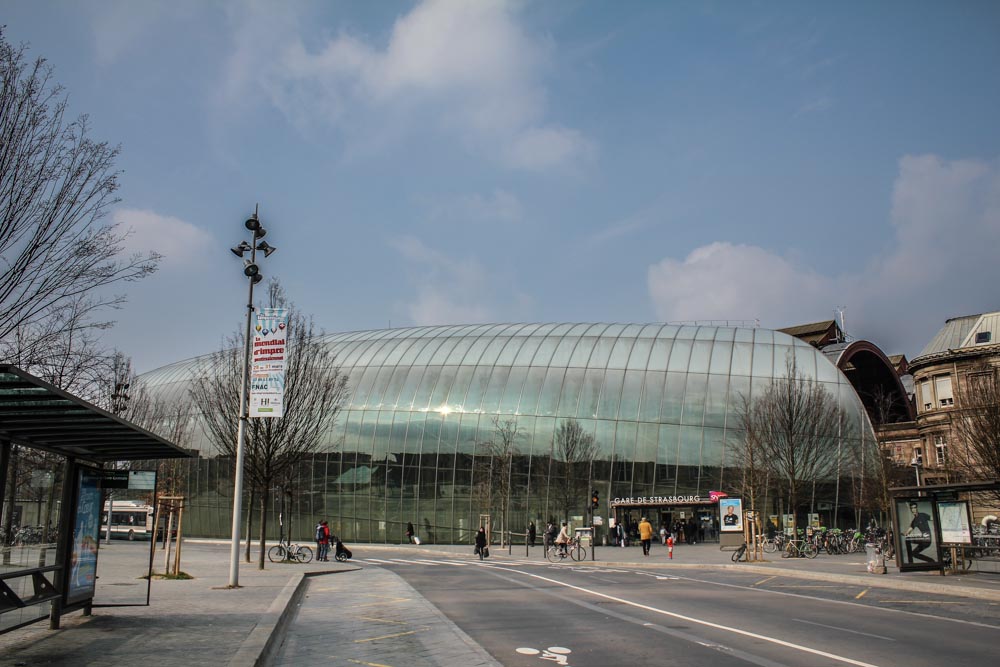
The next morning, I had the hotel breakfast (not bad), and walked out to find the nearest tram station.  From there, I went back to the main train station, because it has an amazing glass dome in front, and I wanted to get a picture.

strasbourg-5

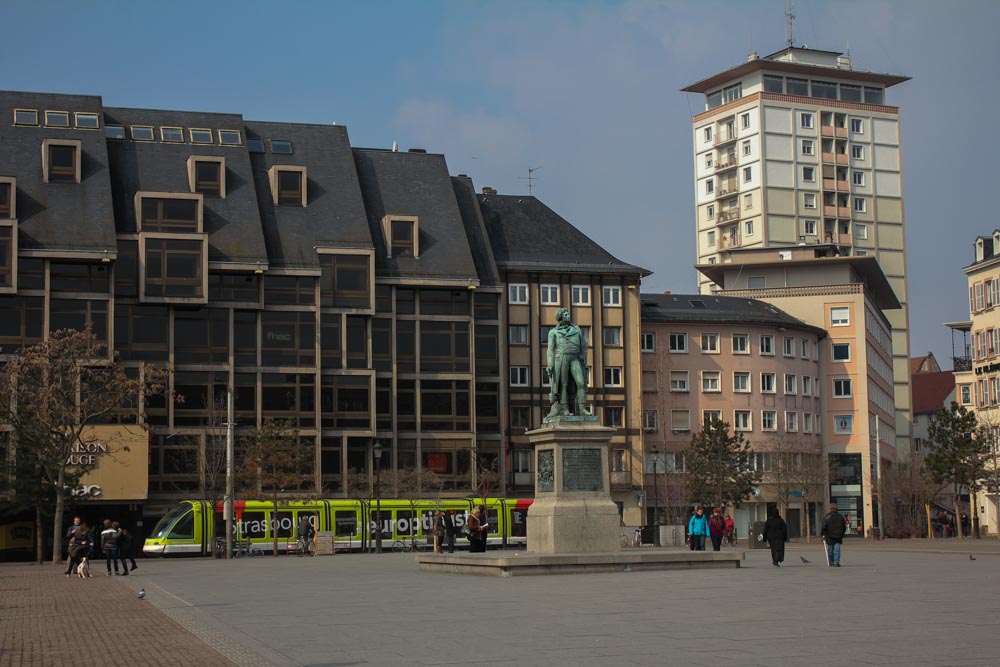
From there, I made my way back into the center of town, partially by tram and partially on foot.  You can see the tram in the background of this picture of a rather pretty town square.

strasbourg-6

This building was on my path back to the center of town, and I was utterly fascinated by the giant barrel in front.

strasbourg-7

After my walk back toward the hotel, I finally went into the Cathedrale.    It’s enormous-  you can get a sense of scale from the people in this photograph.

strasbourg-8

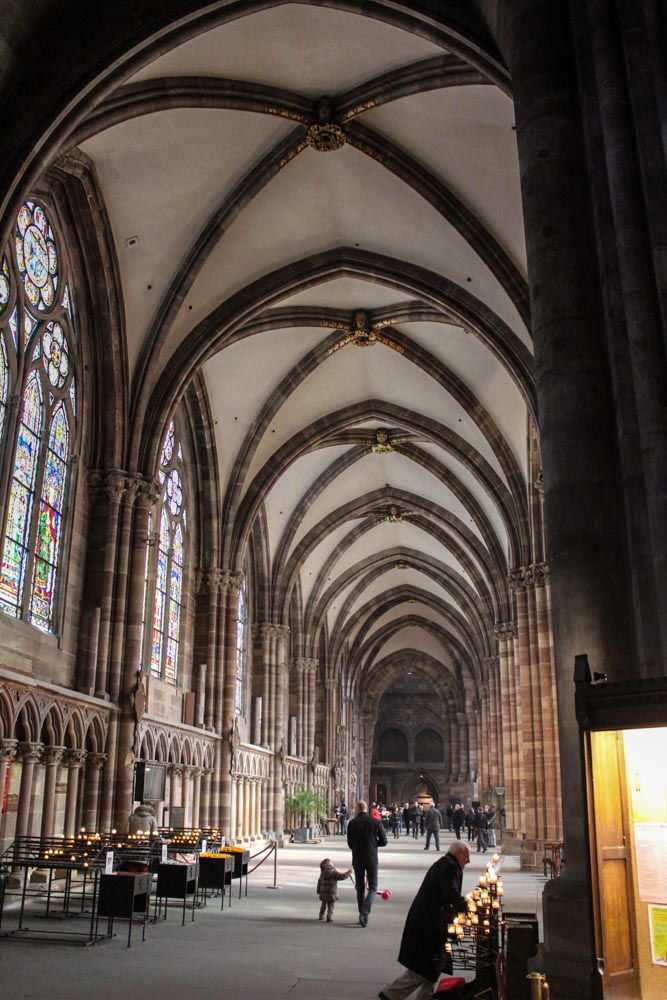
Inside, the arched roof is amazing.

strasbourg-9

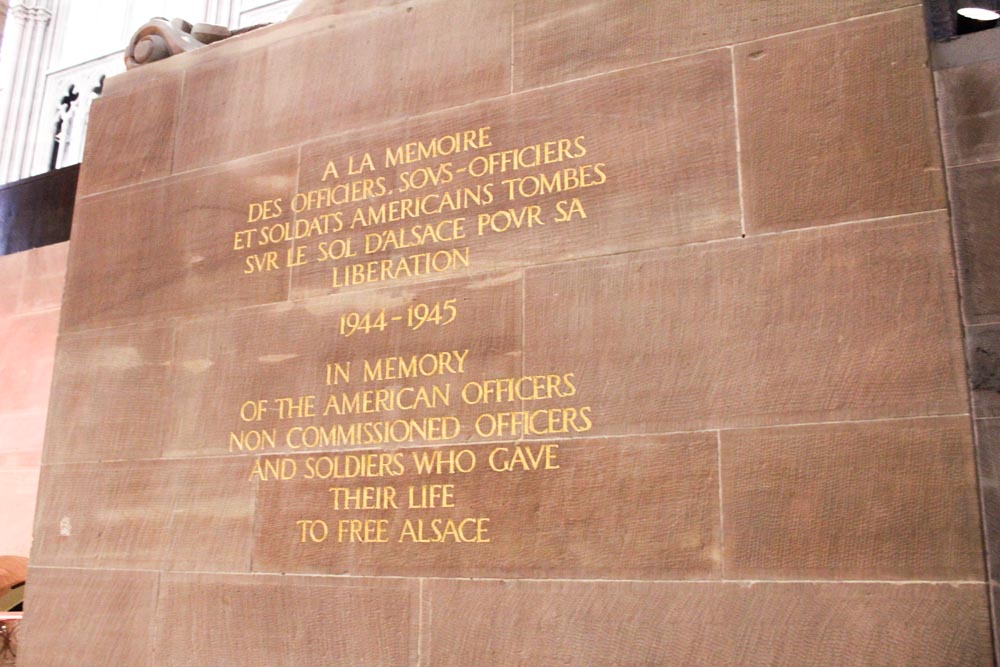
I’ve noticed memorials to fallen American soldiers in various places around Europe- it’s rather strange (but heartwarming) to see tributes to Americans in all these other random places.

strasbourg-10

Inside the Cathedrale, there is an astrometric clock that was built in 1838.  There are various moving pieces  on the quarter and half hours.  At 12:30, there is a “procession of the Apostles” on the upper level, and the mechanical roosters even crow.  I’m really not sure how they reproduced the sound of a rooster using mechanical means in the 1800s, but it’s there.

strasbourg-11

The upper level is Christ-  the Apostles move past him at 12:30.  The lower level shows mankind at different ages, walking past Death.  You can see the old man figure to the right of death in this photo.

strasbourg-12

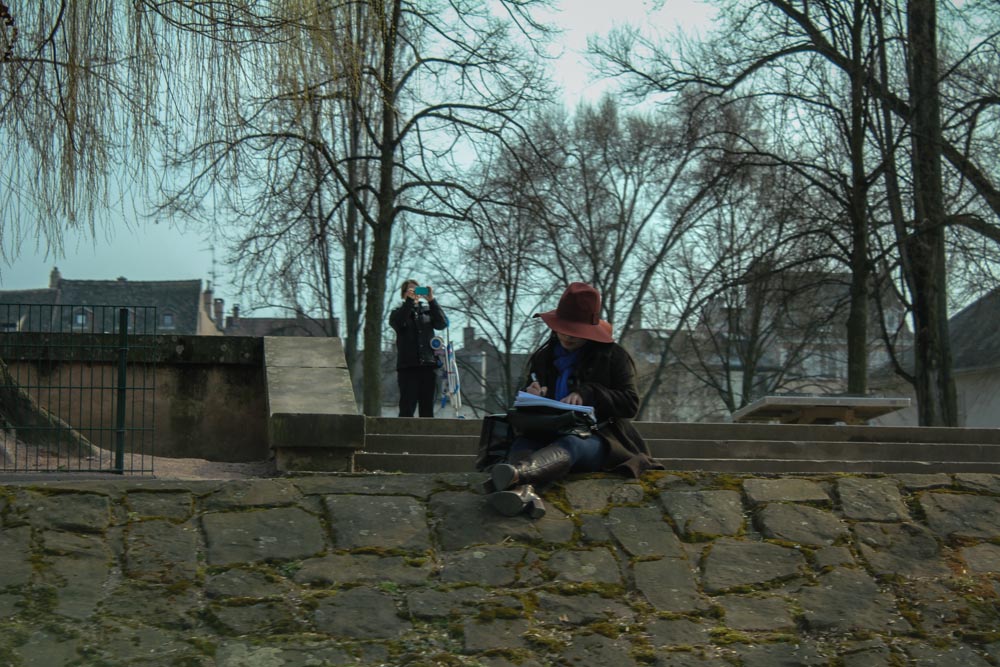
In the courtyard outside the Cathedrale, street artists try to get tourists to stop for a sketch.  I saw a lot of these on Charles Bridge in Prague, too.

strasbourg-13

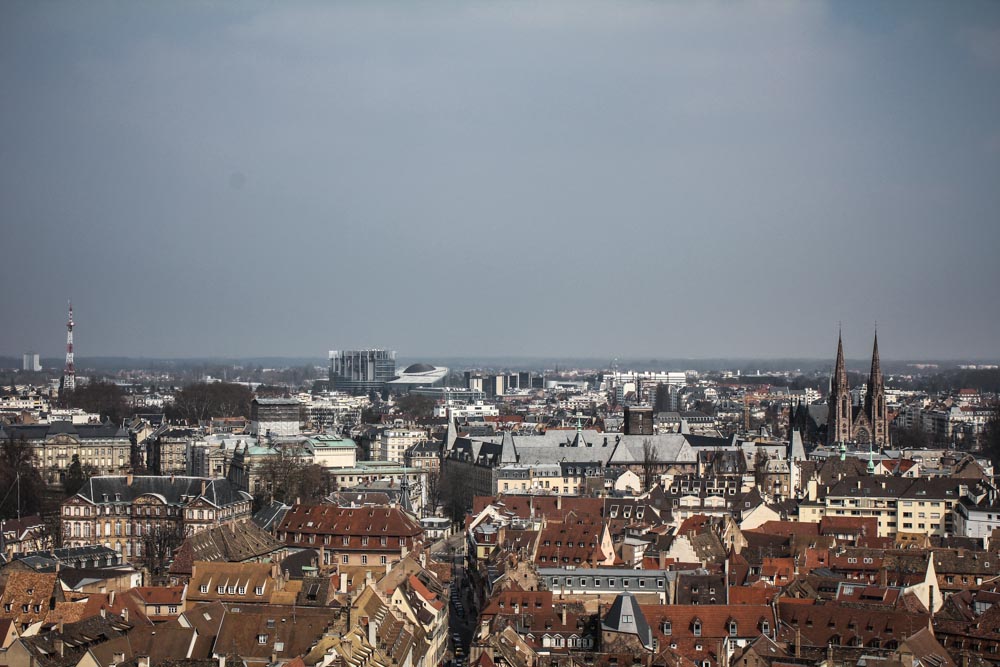
For a small fee, you can also climb up the 332 steps to the tower platform if you like to see things from tall places, which I really and truly do.  Here’s what the view is like on a mostly clear day:

strasbourg-14 strasbourg-15 strasbourg-16

Climbing back down the other side, there are some nifty gargoyles keeping watch.  I especially liked this fellow:

strasbourg-17

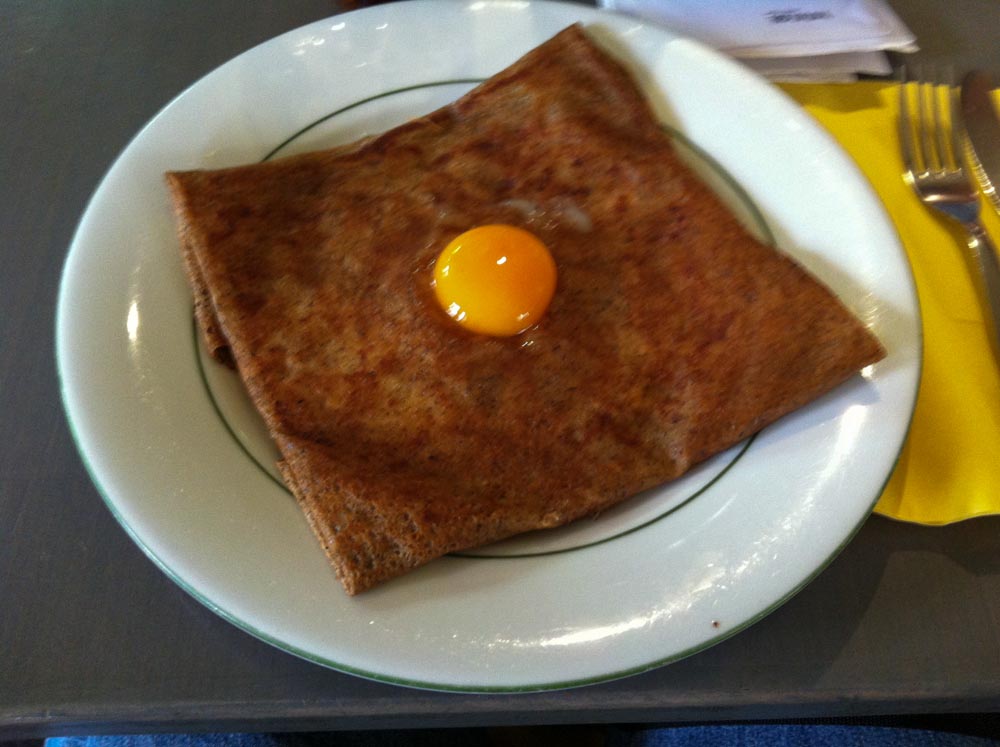
After the tower climb, I was good and hungry for some lunch.  I went back to a place I’d spotted earlier, La Crepe Gourmande, on a side street a short walk from the Cathedrale.  I had “Galette Paysanne,” which is a buckwheat crepe or pancake with onions and bacon inside.   Oh, and an egg on top.  It was delicious.

strasbourg-18

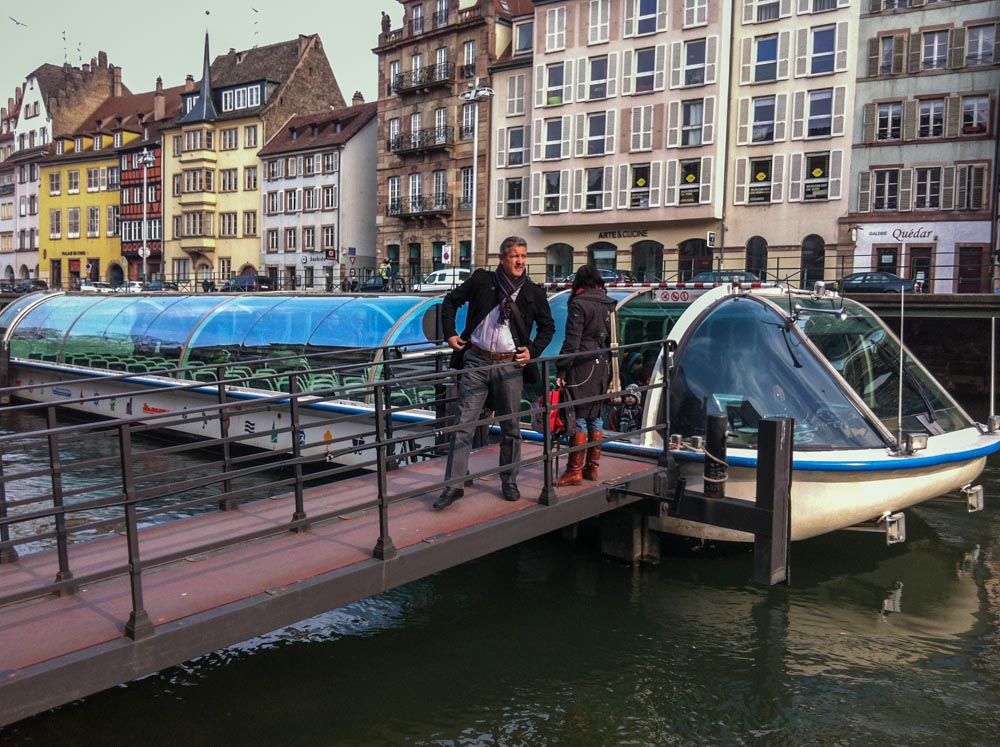
After lunch, I took a boat tour on the river, in these glass topped tour boats.  The audio portion is available in many different languages, including English.  The tour goes through two locks, which is a fascinating experience if you like transportation technology as much as I do.  The tour went past the ARTE headquarters as well as the European parliament, neither of which are pictured here because I didn’t take very many pictures from the boat. I did get a few nice shots, though, and they follow this one.

strasbourg-19 strasbourg-20 strasbourg-21

Also, since it was a sunny day a lot of people were out on the banks of the L’ill river.  People were reading, walking, holding hands, picnicking.  It was a nice day for that sort of thing.

strasbourg-22

All that was left after my day of sightseeing in Strasbourg was a nice dinner- I went to Cafe Rohan near the Cathedrale, and had some local Alsace cuisine.  I had Baeckeoffe in a crock pot, which is a beef, lamb and pork stew cooked with potatoes and carrots.  It was delicious, and hearty-  I’m glad I didn’t skip the regional food entirely while I was in Alsace.

Have you ever been to Strasbourg?

Dachau Concentration Camp

Dachau was the first of the Nazi concentration camps.  It was opened in March of 1933 and it was used as a model for the other camps to follow.  The camp served as a training center for SS guards, as well as a forced-labor camp for what Heinrich Himmler called “political prisoners.”   Dachau was built to hold about 5,000 prisoners, but by the time the camp was liberated by American soldiers in 1945, the number of prisoners held there was more than double that number.  In its twelve years as a concentration camp, over 200,000 prisoners were taken to Dachau, and nearly 32,000 deaths were recorded there.  When US troops liberated the camp in 1945, soldiers reported seeing a row of cement structures that contained rooms full of hundreds of dead bodies piled floor to ceiling.

Tdachau01oday, the camp is a memorial site.  Most of the barracks have been razed to the ground, but two of them have been maintained so that visitors can see the living conditions of the prisoners.   I visited the camp last Sunday, and the weather was suitably bleak and oppressive for the visit.  I think I would have felt a little strange if it had been a sunny, warm, cheerful day.

To visit the Dachau Concentration Camp Memorial site from Munich, you must take the S2 line of the S-Bahn to the Dachau Bahnhof.  From there, a regular bus runs directly to and from the “KZ-Gedenkstätte” stop.   KZ is short for Konzentrationslager (concentration camp) and Gedenkstätte means ‘memorial.’  From the Munich main train station, the entire travel to the memorial site took us about 45 minutes.

At the memorial site, admission to the memorial is free, but there is a visitor’s center where you can pay a small fee for an audio tour guide.  You also get a map of the site which guides you through the path an incoming prisoner would have taken.  It starts with the main gate, pictured at right.   The German phrase written in the metalwork of the gate, Arbeit Macht Frei, means “Work makes you free.”  This phrase was used at the gates to many of the concentration camps, famously including Auschwitz.

After you pass through the main gate, you find yourself in an enormous open area, with one set of buildings to the right (currently a museum) and baracks off to the  left.  The giant field is the roll-call square.  Prisoners would stand here for roll call each morning, sometimes standing in place for up to an hour.  The dead would often be dragged into the roll call square to be counted as well.  This picture is looking across the roll call square towards the still standing barracks.

dachau02

Inside the barracks, you can see what the living conditions were like for the prisoners.  Privacy was nonexistent.

dachau06

These sleeping racks were overfull by the time of the camp’s liberation in 1945.   The single structure below contains sleeping space for 54 prisoners.  This is one structure at the end of one portion of one of the 32 separate barracks buildings.  In 1945, the camp was up to more than 12,000 prisoners.

dachau05

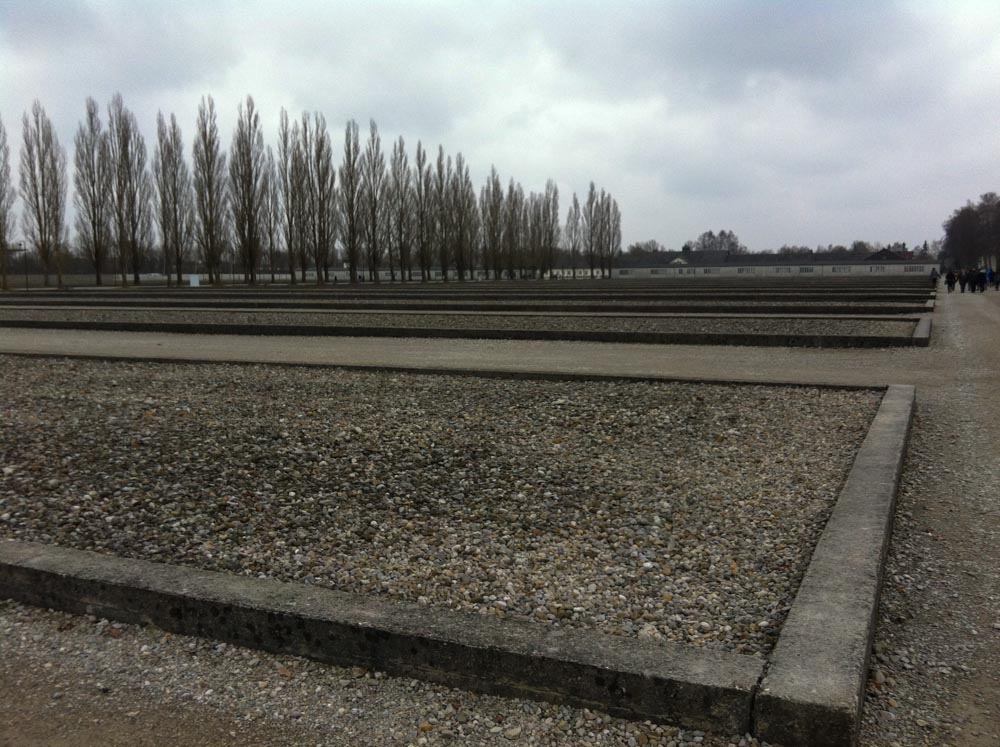
Today, most of the barracks are gone, but there are gravel outlines where they stood:

dachau03

Walking up the road alongside the barracks, you can see one of the remaining guard towers.   Prisoners who ventured too close to the fence were shot on sight, and it is said that some prisoners ran to the fence as a means of committing suicide.

dachau04

At the end of the walkway, there is a small gate leading to the old and new crematoriums. From the outside, it looks fairly inoffensive.

dachau07

When you walk inside, though, it’s a very sobering reminder of the atrocities of the Holocaust.  The room below is a gas chamber.  Up to 150 prisoners at a time could be forced to disrobe in the room next to this. False shower heads were installed into the ceiling so that the prisoners would believe that it was merely a large group shower room.  Once they were sealed inside, Zyklon B (prussic acid poison gas) would be used to suffocate the prisoners to death in fifteen to twenty minutes.

I was not surprised to note that nobody lingered in this room at the memorial.

Despite the presence of a gas chamber in Dachau, there is no evidence to support the idea that the gas chamber was used for mass murder there – most of the known deaths in Dachau were by gunshot or by hanging.  This model of gas chamber was used heavily in many extermination camps, however-   Auschwitz, Belzec, Chełmno, Jasenovac, Majdanek, Maly Trostenets, Sobibor, and Treblinka.

dachau08

The room adjacent to the gas chamber is a crematorium.  Each of these furnaces was capable of incinerating two or three corpses at a time.

dachau09

I usually try to end my posts with a question to spark discussion, but I honestly don’t know what to say on this one.  The entire experience of visiting Dachau is horrifying.  It’s important to be aware of the Holocaust and to know what happened in Nazi concentration camps, but I don’t think I really want to talk about it any more.

Senckenberg Frankfurt – More Dinosaurs!

I’m really not much of a museum-goer.  I like some of them, to be sure, but not all of them.  I’ve talked before about the Deutches Museum before, and I probably mentioned the local historical museum here in Regensburg, but that’s likely it.

That being said, one surefire way for a museum to entice me to come inside is to put giant dinosaurs out front.  For example, the Senckenberg in Frankfurt.  Across the street from the front door, helping you find the way, is this fellow:

senckenberg01

…and in front of the main building is this friendly critter:

senckenberg02

Once inside, the style settles down a bit, but this is the sort of museum that has skeletons of things and has various animals represented.  There’s a giant hall with a T-Rex, a Triceratops, and some other well known dinos.

senckenberg03

The amount of animal life represented in the museum is staggering, and I could easily have posted a gallery of dozens of pictures, but I decided to represent the museum with three dinosaurs and an ancestor of man.  There’s a very nice area about the evolution of hominids with various hominidae skulls, and at the center, a rather nice display of Lucy the Australopithecus.

senckenberg04

You might consider this a small amendment to the ‘killing time in Frankfurt‘ post.  The museum is easily reachable by public transportation, and it’s a great way to kill a few hours in the city.

What type of museum do you like the most?  What’s your favorite museum?