This is coming to Munich. (Also Leipzig, Stuttgart, Frankfurt, and other places, but Munich is closest.)
http://www.dinosaurier-live.de/
The life and times of a pop-culture junkie and music addict living in Arlington, Virginia
This is coming to Munich. (Also Leipzig, Stuttgart, Frankfurt, and other places, but Munich is closest.)
http://www.dinosaurier-live.de/
After seeing how much the locals get into the Eurovision song competition, I thought I understood how the locals responded to competition. That was before the UEFA European Football Championship started.
UEFA, or the Union of European Football Associations, is an organization that coordinates the national football associations throughout Europe. Much like Eurovision, UEFA was founded in Switzerland in the 1950s.
A brief digression to translate for my American friends: Whenever I say football in this blog, I’m talking about the game that Americans know as soccer. If I’m talking about the big crashy game with the helmets and the pigskin, I’ll refer to that as “American Football,” or “Big Guys Running Into Each Other Really Fast In Between Beer Commercials.” Here’s John Cleese to explain the differences further:
Just before Euro 2012 started, people began to decorate their cars, and in some cases, their homes with national colors. Here’s two examples in Germany to give you a sense of this. Even the lei hanging from the rear-view mirror is in German colors.
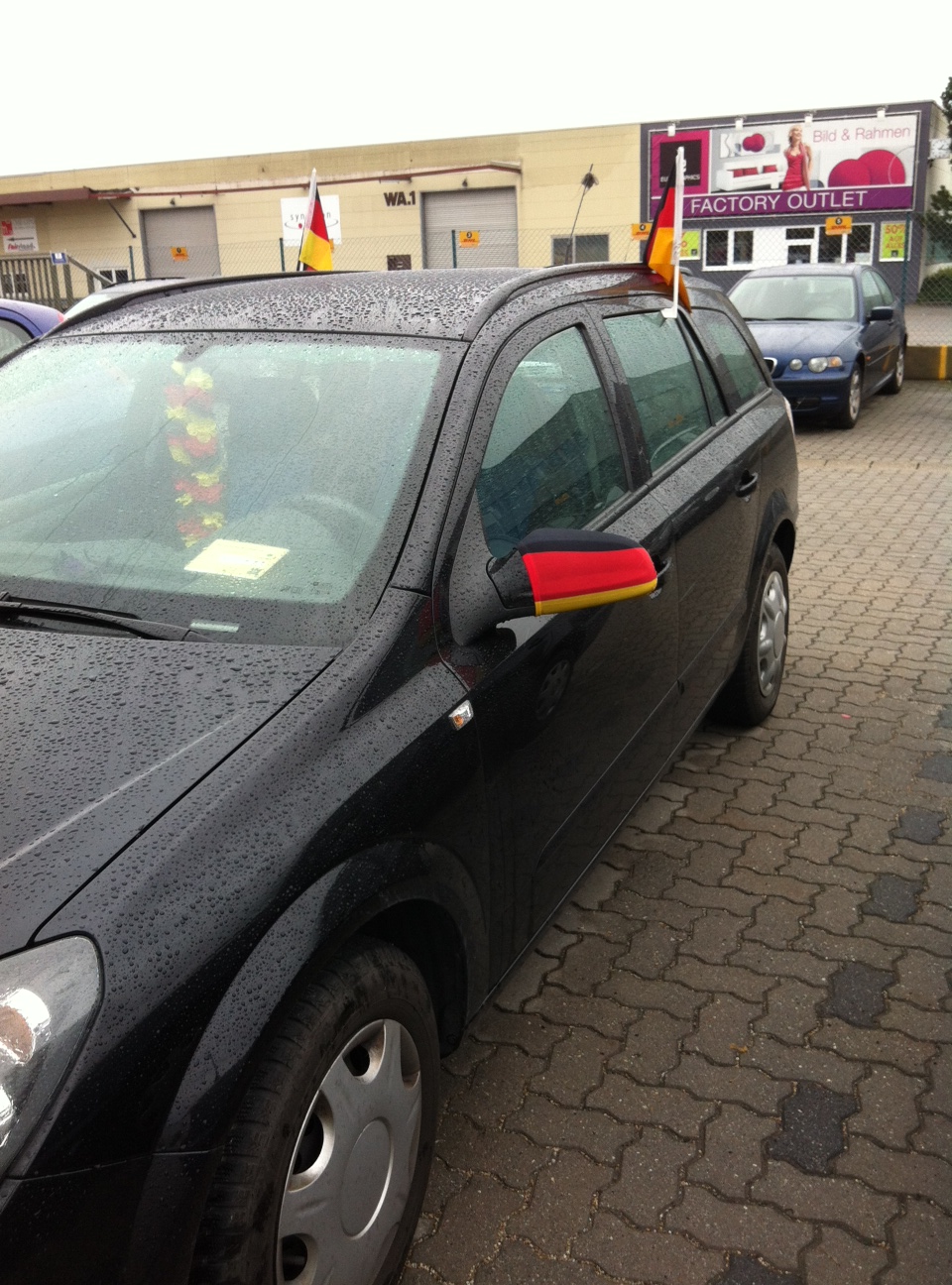

When your team wins, the celebrations are boisterous and jubilant. Germany won their match the other night, and there was honking horns and celebrations for hours afterward throughout the city, much of it audible from my apartment.
The opening rounds of Euro 2012 started when I was in Amsterdam a few weekends ago. I was in Holland when their team was playing, and I was not prepared for just how invested people are into their national teams. The Dutch fans went all out. Buildings were decked out in the team colors, and some had giant inflatable balls:

People wore amazingly orange costumes throughout the city- I saw full orange business suits, orange wigs, orange cowboy hats, orange wooden-clog-shaped shoes, and more. I’m not even sure what to call this outfit:
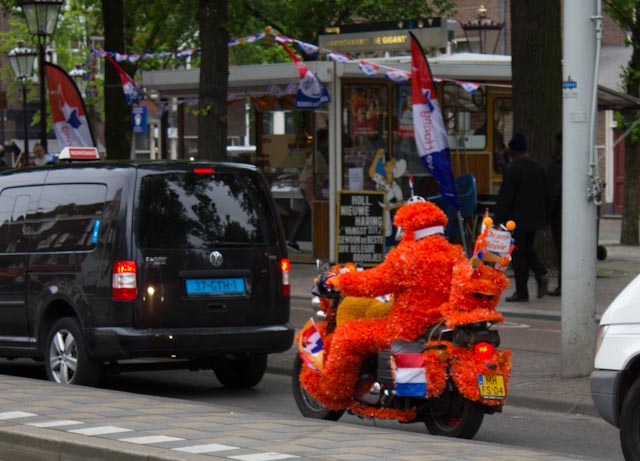
The team spirit is so inclusive that even the furry folk get dressed up in their team colors:

Unfortunately for the Dutch fans, Holland has not done well this year. I think that’s why this pup looks so sad!
We’re in the quarter-finals now, with Germany facing Greece tonight. If Germany makes it into the semi-finals, then they’ll be playing either England or Italy next. I’m hopeful they’ll make it into the finals, but all the remaining teams are very good so it should be an entertaining next few days.
As a temporary German, I feel obligated to show team spirit by wearing their colors on my lanyard at work.

By the end of July, I’ll have been to Prague, Barcelona, Amsterdam, London, and Edinburgh, all within a four month span. In September I’m visiting Berlin again, and possibly Vienna. I’m also planning on trying to spend two weeks back in the US much later in the year.
I was talking about my copious travel plans with a friend back in the US, and their next question was “How? How do you have that much time off?”
The answer to that question is very simple- Europeans just have more vacation than Americans. Whenever this topic comes up with friends and family, I say more or less the following: Americans may talk a good game about having a proper work-life balance, but Europeans actually do it.
My benefits at Mr. Company** changed significantly when I moved to Germany. I am officially “localized” here, which means that my US benefits ceased and I was brought into the same package of benefits that our European office uses. This means that my 401k got a giant pause button, for example, and my health insurance switched over to a German health insurance plan. It also means that my available vacation time increased quite a bit.
Germany mandates that employees have four working weeks off, minimum. Plus public holidays. For a five day work week, that’s twenty days off plus the holidays, and some employers give more time off than the mandated minimum. In other words, I have significantly more time away from the office here than I did in the US, despite working consistently longer hours.
I keep a list of things that will suck when I leave Germany to return to the US, and having my vacation time revert back to US levels is definitely on that list.
This weekend on Real Time, Bill Maher did a New Rule about this very topic- I’ve included part of the video below. He mentions in the clip that 138 countries mandate the amount of vacation that employees receive. The US is not one of them. Study after study has shown that people who take their vacations come back more focused and more productive, with lower instances of burnout.
And you know what? It’s all completely true. I’ve taken the time off now, and I’m a believer.
Here’s Bill Maher to preach the gospel:
*Urlaub is the German word for vacation or holiday.
**Any reference to my employer on this blog will be said as “Mr. Company.” The opinions expressed in this blog may or may not reflect the views of Mr. Company. Probably they don’t, because Mr. Company is a multinational corporation and is not, strictly speaking, a sentient entity.
American Idol and similar vocal performance shows are all the rage back in the US, but I didn’t know until last month that they all have roots you can trace back to Europe. I first started to hear mentions of Eurovision during trivia quiz night at the pub, but I had no idea just how big it was until the competition aired last month. That’s when all the blog posts started- I follow a lot of blogs from other folks who live in Germany, and after the finals were aired, there were lots of wrap up posts.
I wasn’t going to write about this, because so many other people have, but then I started to read up on the history of the contest, and I started to listen to the music.
 It started in 1956. After Europe started to rebuild itself following World War 2, the European Broadcasting Union based in Switzerland tried to come up with ways of bringing together their member nations. They came up with Eurovision, an experiment in live broadcasting of a music contest that was based on an existing music festival from Italy. I say experiment because a multinational live television broadcast in 1956 was kind of a big deal.
The first Eurovision was held in Lugano, Switzerland in May of 1956 and it included just seven countries- Belgium, France, Germany, Italy, Luxembourg, Netherlands, and Switzerland. 2012 was the 57th year of the Eurovision contest, and 42 nations competed.
The format is simple- each competing nation presents a live song, often with elaborate choreography, and the winner is decided by vote. The winning country typically hosts the following year’s competition.
Sometimes, the competition launches careers. ABBA won the contest for Sweden in 1974 with “Waterloo.” Celine Dion won the contest for Switzerland in 1988, so blame them for her continued presence.
Speaking of Celine Dion, the winner this year sounded a bit like her. Loreen, representing Sweden, performed “Euphoria.” With her jumpy choreography, it’s kind of like watching Celine Dion having seizures.

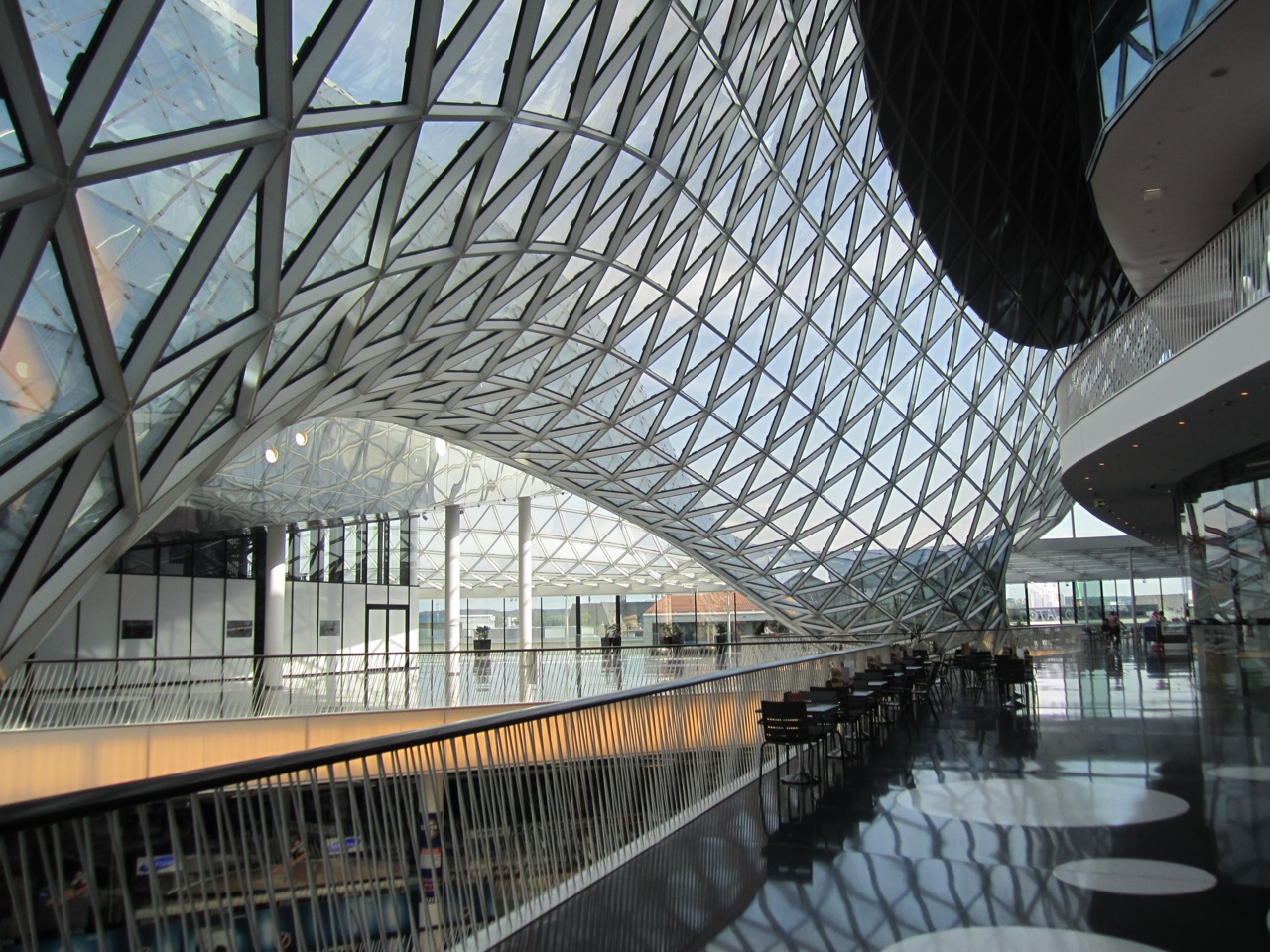
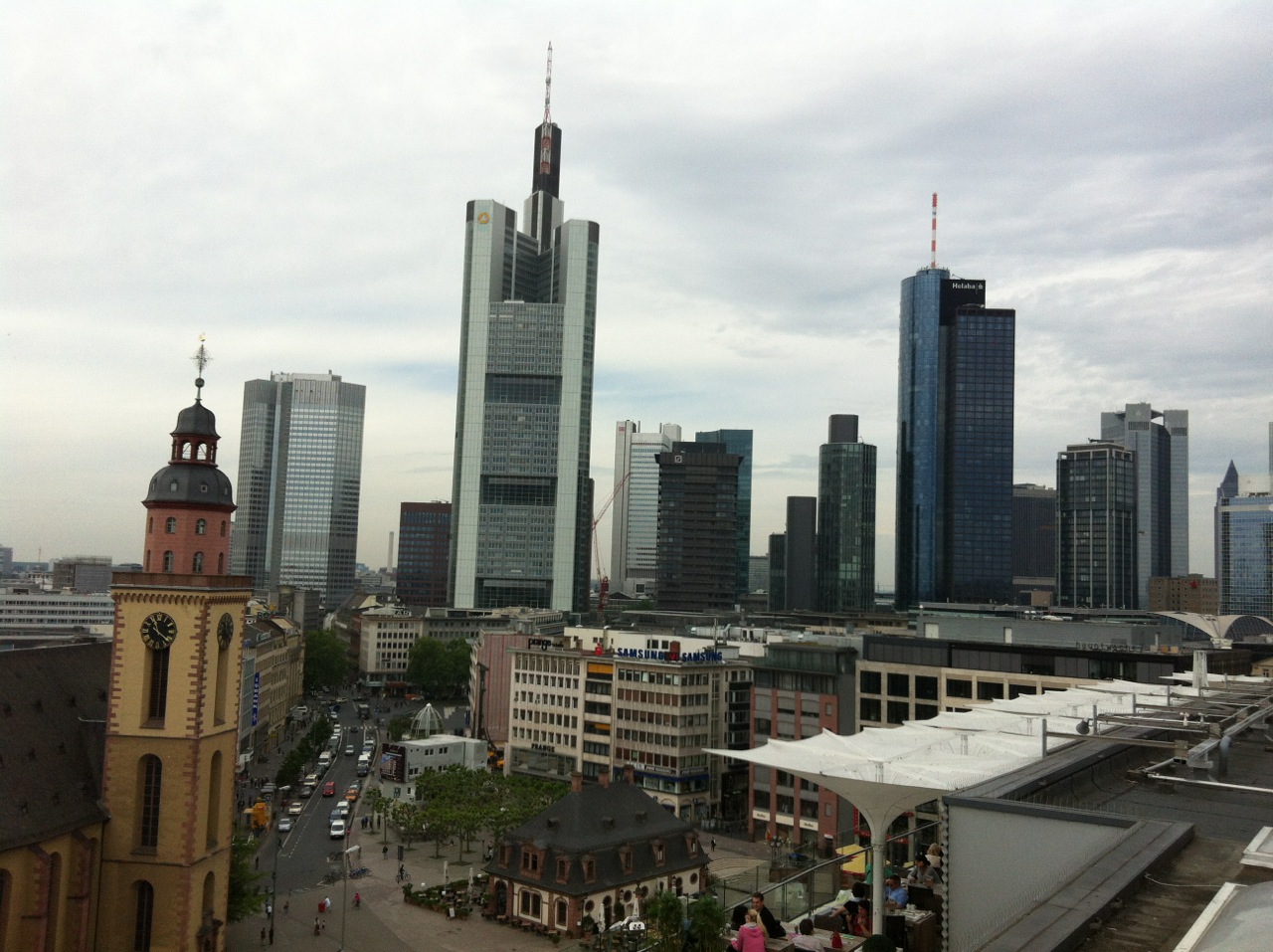
A few weeks ago, I took an overnight trip to Frankfurt to attend a Thomas Dolby concert. The concert was excellent, but my train rides into and out of Frankfurt left me with plenty of time to do a quick exploration around the core of the city.



 Whimsy. Tacos. The DMV.