This post is trashy.

Let’s talk about trash.

Back in February, I talked a little bit about Pfandflasche.  The bottle returns are just one tiny piece of the enormous tapestry that is German waste separation. When I moved into my apartment, I was given a garbage pickup schedule for all of 2012 and a roll of green garbage bags, which I’ll explain in a little while.

Here’s a cartoon from The Oatmeal that pretty much sums it up. (Editor’s Note: You should follow that there link to theoatmeal.com; it’s hilariously funny stuff.)

Ok, so maybe it’s not quite as involved as The Oatmeal would have you believe, but it’s pretty close.  Most German households have at least three separate waste bins.  Some have more.

Here’s the sorting bins that I have:

  1. Paper.  Any paper, cardboard, non-glossy packaging materials, receipts, newspapers, and so forth.  This goes into the green bins downstairs for regular pickup.
  2. Packaging Material.  This is anything with the  Grüne Punkt (Green Dot) logo, which is the signifier of packaging that conforms to the rules of the Green Dot system, to comply with the European “Packaging and Packaging Waste Directive – 94/62/EC.”   Manufacturers have to pay for the privilege of using the Green Dot, and they’ve reduced their packaging as a result. The whole system is hugely complicated, but to the consumer, it just means, “Hey, this thing is recyclable.”  This is the stuff that food comes in, mostly, but any consumer item can fit this classification.   Also, there are lots of packaging materials that can be put in this bin, even without the Green Dot.  These items get put into yellow or green plastic bags for separate pickup.  In some places, the yellow and green bags are separate subcategories, but where I live they’re both the same thing.
  3. Everything Else. This is restmüll, the rubbish that doesn’t fit into the other recyclable categories.  This is food waste and other types of household rubbish, and it goes into the grey bins downstairs.  The grey bins are the closest thing to a dumpster that I’ve seen in Germany, and almost everything that goes into them ultimately gets incinerated or placed in a landfill.

While I only have the three categories listed here, some places in Germany have brown bins for “bio” waste- in other words, anything that could be composted.  Some places use blue bins for yet another category.

The pickup schedule is pretty tight- there’s one pickup of the green paper bin each month, and two pickups per month for each of the other categories.    The bins can fill up pretty fast in between pickups.

On top of the garbage categories I mentioned here, and the Pfand that I spoke of, there are also places to drop off glass bottles and jars.  The glass collection points are also subclassified-  there’s individual slots for green, brown, and clear glass.   There are separate dropoff locations for batteries and light bulbs; they go into little bins in local stores that are designated for just that purpose.
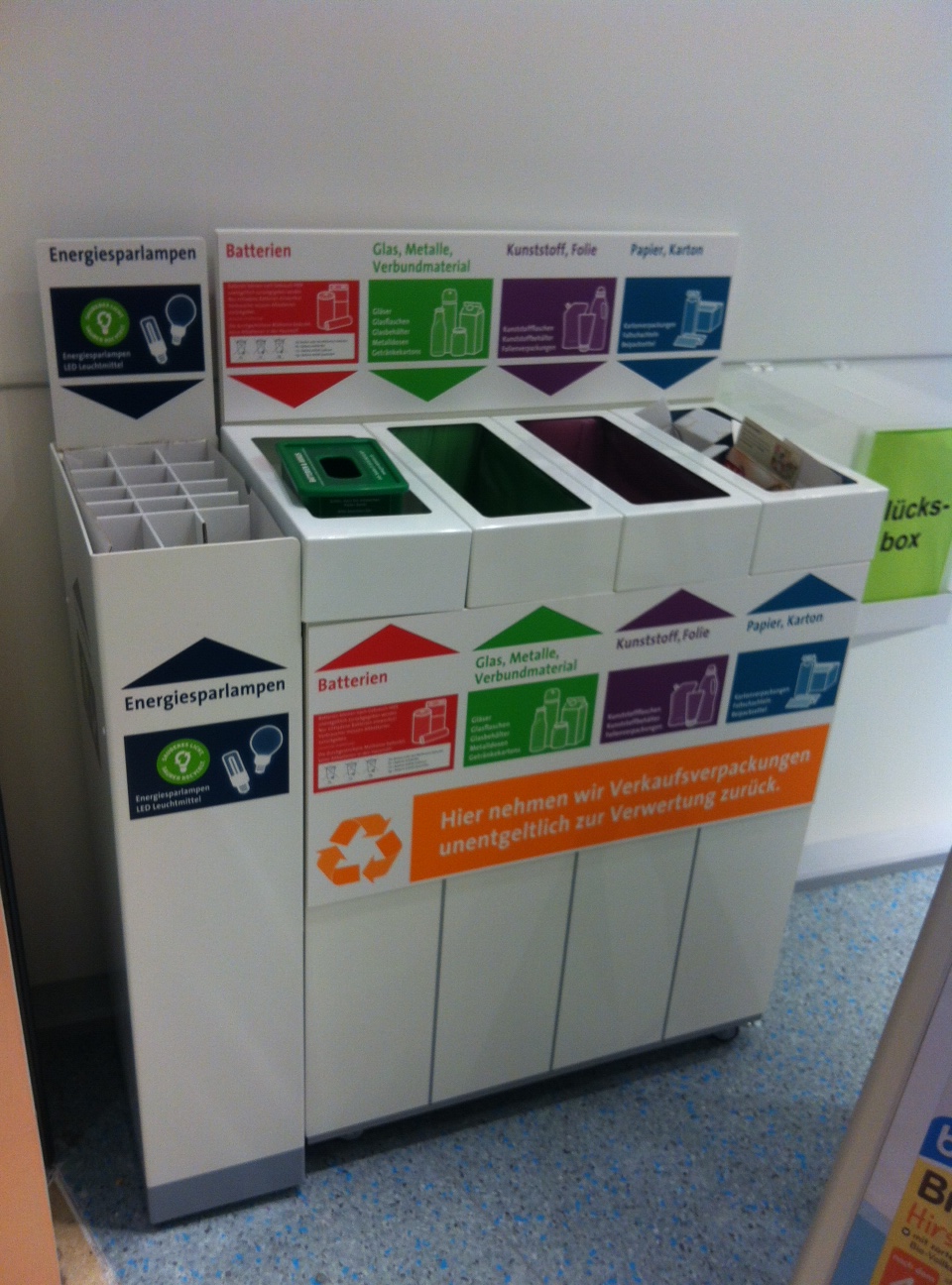
This level of trash separation is even present in public places.  For example, these are from train stations:

So what do you do if you have something that falls outside normal day to day household waste?  What if you want to get rid of a mattress.  Or a refrigerator.  Or an old computer.  What then?

Well you go to the Recyclinghof, of course!  A Recyclinghof is a drive through facility with enormous bins for different types of stuff.  Old televisions, computers, mattresses, furniture-  you name it, there’s a category for it.  There is staff on hand to help you sort your stuff into the right bin.   Here’s just a few of the labels.
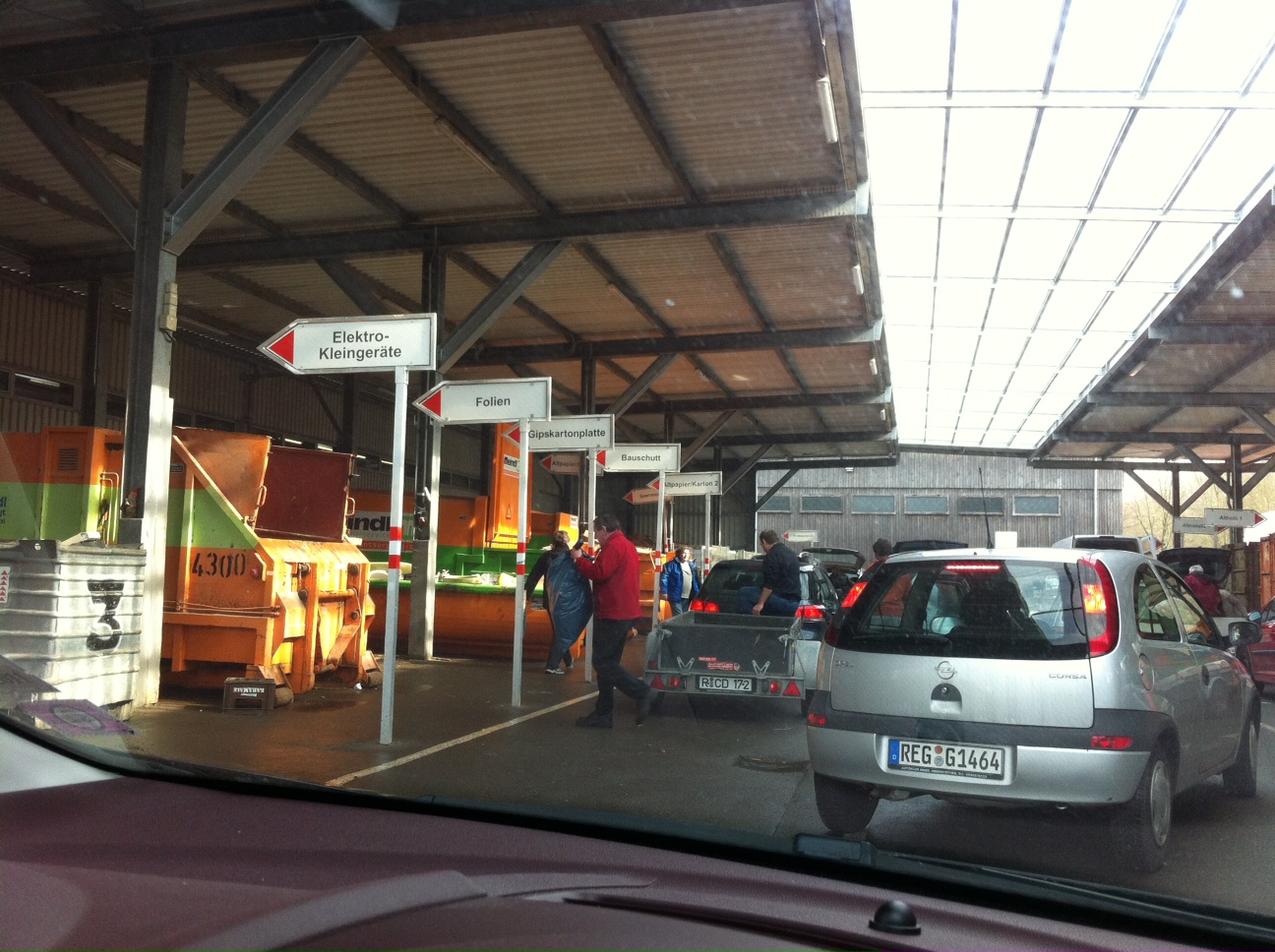
This stuff is literally hauled away by the truckload.

As you can imagine, this level of trash sorting is somewhat overwhelming for a newly arrived American.  It took me a while to get the hang of it, and I’m still not entirely sure that I’ve got all the details sorted out.

One thing I have noticed though- doing this level of sorting has made me significantly more aware of the waste I produce.  It’s also reduced that waste by an order of magnitude.   Since I moved into my apartment, I probably only generate enough trash to take out once or twice a month, not counting emergency evacuation for stinky food waste.   Back in the US, I was taking out a load or two of garbage per week.   Every week.

That’s quite a difference.

The Same Procedure As Every Year, James.

I am often amazed at the ways in which common pop culture differs between countries.  Before my arrival here, I had never heard of Winnetou.  I also learned recently of  “Dinner For One”, sometimes known in German as “Der 90. Geburtstag.”

The piece was written for the theatre in the 1920s, and was recorded by a German television station in a single take in 1963 with British comedians Freddie Frinton and May Warden in the starring roles.  The piece was recorded in English, with a short German introduction.

Here’s where it gets weird.

Since 1972, “Dinner For One” has been a regular part of the broadcast schedule of German, Danish, and Swedish television stations around Christmas and New Year’s Eve.  Some stations play it repeatedly, the same way that American stations play A Christmas Story over and over each year.    “Dinner For One” is well known in other countries as well, and has become a regular part of the pop culture of Europe.    The program’s catchphrase, “Same procedure as every year, James,” has become the in-joke of an entire nation.  It has even made it onto t-shirts, as seen to the right.

The skit has been repeated on air so often that it actually won the Guinness World Record for most repeated television program.

Except in North America, where it has never been aired.

We’ve never heard of it.

I aim to change that.  Here’s an English language recording of “Dinner For One.”  It’s not the full 18 minute original version, but you’ll get the idea.

Winnetou, Apache Knight

A while back, Jenny and I saw Winnetou on the train.

Jenny was fascinated and amused by this live-action version of Winnetou.

I, on the other hand, had no idea what she was talking about.

J: That man looks like Winnetou
S: Like who?
J: Winnetou
S: Spell it?
J: WINNETOU
S: Spell it again?
J: W I N N E T O U!!!!
S: Never heard of him.

Winnetou is a fictional Native American hero who is well known in Germany.  He was created by Karl May, one of the bestselling German authors of all time.  Winnetou is the fictional chief of the Mescalero tribe of the Apache.    There have been books and children’s stories, all written between 1875 and 1910.  There was a series of eleven films between 1962 and 1968, filmed in what is now Croatia.  There are even two television miniseries, from 1980 and 1998 respectively.

I bought an English translation of the first novel and read it on my Kindle.  I am utterly fascinated by a Native American hero created by a German author.  I am even more fascinated by the fact that Karl May never actually visited the places he wrote about until late in his life, long after he wrote these stories of the old West.  The Winnetou stories are immensely popular here.

In subsequent conversations about Winnetou, I have come to realize that while most Americans have never heard of Winnetou and Old Shatterhand, most Germans have never heard of the Lone Ranger and Tonto.

That seems fair, I guess.

Sehnsucht, I Has It.

Over the last several months, I’ve read some fascinating information and theories on homesickness and culture shock/cultural adjustment. I didn’t know before I moved to Germany that there was even a cycle. It goes something like this:

  • Honeymoon Phase – This is what I like to call the “ooh, shiny!” phase. To borrow from Berkeley, “This phase is best described by feelings of excitement, optimism and wonder often experienced when you enter into a new environment or culture.” Anyone who knows me well understands that I actually spend roughly 70% of my life in this state.
  • Crisis Phase – This is where the acute homesickness comes in. Changes in eating and sleeping habits, irritability or sadness, calling home much more frequently, and a host of other depression-like symptoms can be attributed to this stage. This is the time when the different stuff feels a little too different, and you just wish you could be back in more familiar surroundings.
  • Recovery and Adjustment Phases – These are exactly what they sound like. You get used to things and you even out. Everything that seemed bad during the Crisis Phase doesn’t seem so bad any more. You start to integrate with your new locale a bit more. Some people adjust so well that they never leave. Some don’t really integrate at all, and become anti-social and reclusive.

Some variations on the so-called “cultural adjustment curve” use slightly different labels – Honeymoon/Negotiation/Adjustment/Mastery – but the basic cycle is the same.

According to the Great and Powerful Google, most people hit their Crisis Phase at around three months. Now that I think about it, I recall that I was definitely calling home a lot more frequently at three months than I do now, but I don’t remember feeling especially homesick at the time. Perhaps my cultural adjustment curve is just slower than most. The reason I bring this up now is because I saw the new Spider-Man movie tonight.

There is no time that I feel more lonely than when I’m in a movie theater filled with other geeks who I can’t talk to. In the US, I usually see this type of movie with some friends- people who speak my language.

I’m not just talking about English here, although that’s a big part of it. Whenever I hear someone speaking English in town, I always want to be part of the conversation, even if they’re going the opposite direction and I have no idea what they’re really talking about. I hear the language, and there’s a tiny part of me jumping up and down and screaming in a tiny voice, “me! me! talk to me! I want to speak English to you!” Yes, sitting in a crowded movie theatre with four German conversations around me that I can’t follow is kind of disheartening. That’s not precisely what I mean, though.

What I mean by “people who speak my language” in this instance is people who can dissect the movie with me afterward. When I see a geek oriented film like this, I want to nitpick in a geeky way. I want to have conversations with people who know the source material, the back story, the universe that film is set in. I want to talk about whether the mechanical web shooters are better than the organic ones, or whether we’ll see Original Recipe Spock in the Star Trek sequel or whether Smaug will look as cool in the upcoming Hobbit films as the Balrog looked in LotR. I want to talk about whether the sequel to this movie will cover a specific story arc, I want to discuss incidental characters and tiny for-the-fans details that not everyone will catch, and I want to gush about the things the movie got right.

I realized while I was walking home in the lovely cooling rain tonight that I have been profoundly missing this type of interaction. I’ve felt it to varying degrees every time I’ve gone to a genre movie here- superheroes, science fiction, Muppets, Sherlock Holmes- when I see these movies, I’m surrounded by a crowd of people who share my interests, and yet I am very much alone. I don’t know any geeky types here in Regensburg to join me for this level of obsession. Not in town around Regensburg, anyway. I have friends here in Regensburg, but nobody that seems to be as deeply into geeky pop culture as I am.

I wasn’t sure how to wrap this up, so I’ll close the post with an explanation of the title.

Sehnsucht isn’t only a well-known Rammstein song. It is a German word which roughly translates to longing, yearning, deeply missing something, or nostalgia. It’s a word which seems to be difficult to pin down or translate clearly because it describes an emotional state rather than something concrete. Sometimes it’s used to refer to a longing for a homeland. CS Lewis described Sehnsucht as an insatiable or inconsolable longing in the human heart for “we know not what.”

I do know what I long for, though- a specific type of friendship and interaction that has been missing for me here.

In its absence, I suppose I could be consoled by some tater tots. And a nice tasty Cola-Weizen.

Ludicrous Speed!

I am amazingly, ridiculously fond of German television.

For one thing, you never know  what you’re going to find.  I was flipping channels the other night and I stumbled across an honest-to-goodness ‘you got served’ style multinational dance-off.  The Israeli dance crew’s name is- and I’m not making this up- Kosher Flava.    Also, break-dancing is back in style.  I’m not really sure when that happened; nobody sent me a memo.

A few weeks before that, I was flipping through the channels, and I stumbled across a form of soccer that was played with two small cars and a giant inflatable ball.  This was also supposedly multinational, with the competing nation’s flags painted on the roof of the car.  German television is always full of surprises.

Another thing I love about German television is how much of it is dubbed American television.  There are shows airing here for the first time that have already concluded on other networks-  the recent BBC shows Robin Hood and Merlin started here a few months ago.

There’s also a lot of the shows that I watch in English, also dubbed-  Community, Big Bang Theory, How I Met Your Mother, the Mentalist, the Simpsons, Family Guy, at least four different CSI/NCIS style shows.  The Vampire Diaries.  It’s all on here, dubbed with German voices.

Some of the voices are very good.  The German dub actor for Neil Patrick Harris sounds just like the original.  For that matter, the entire How I Met Your Mother voice cast is pretty brilliant.

The night before last, I stumbled across a masterpiece of German television:  Traumschiff Surprise.

Traumschiff is a hodgepodge word-  a raumschiff is a spaceship and a traum is a dream.  And the movie is a hodgepodge as well-  a parody of Star Trek and Star Wars and several other genre movies, and most randomly, Cyrano de Bergerac. The movie is a healthy dose of camp and sillyness.  The three main Trek-styled characters are played as campy and gay.  Here they are:

I think that I must learn more fluent German, if only to truly understand this brilliant and breathtaking masterwork.    Here’s the trailer for Traumschiff Surprise- it really has to be seen.