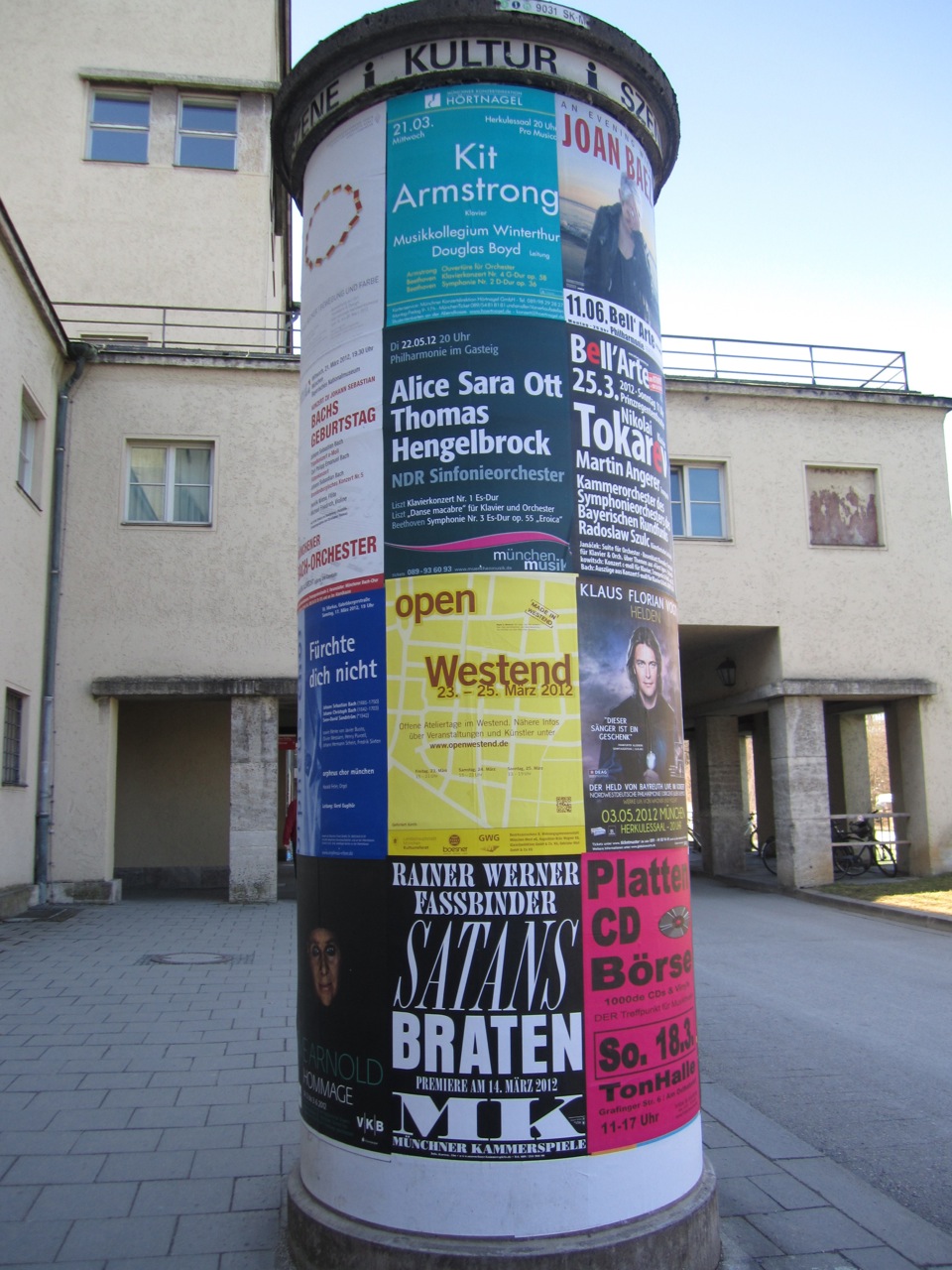
There’s A Signpost Up Ahead

Over the last year, I’ve noticed that you don’t see as much posted advertising in Germany as you do in the US.   Certainly you almost never see a full sized billboard along a highway here.  Sure, there’s advertisements on bus stops and benches, and posted on buildings near major roadways, but the big billboard sign isn’t a thriving species here.

The cylinder of advertisement, however, is everywhere:

signpost02 IMG_0826

I find the cylinders to be fascinating, because they contain so much information, and yet they’re still wildly ineffective for advertising.  If you’re driving past in a car, would you really catch more than a word or two off of this ad-pole?

Is the advertising where you live different or unusual than what you’re used to?

PSA: DST Is Coming, Or Only Flava Flav Really Knows What Time It Is

Most of the time, Germany is six hours ahead of the East coast of the United States.  For the next three weeks, however,  that’s not going to be the case.   This weekend, on March 10th at 2 am, daylight savings time begins in the United States.  On March 31st at 2am local time, Central European Summer Time (CEST) begins in Germany.  There is a span of three weeks between those two dates.

What this means in simple terms is that meetings with my US colleagues are going to be constantly mis-scheduled because every time we have a week or three between our respective time-shifts, Exchange calendar seems to go to hell.

I research everything I write about on this blog, because I always learn cool and interesting stuff.  I didn’t know that Germany was the first country to implement Daylight Savings Time, in 1916.  They did so to conserve coal during World War I.  It made sense at the time.

Even though it’s been a part of my reality for my entire life, I still think it’s kind of ridiculous in modern times.  Studies on whether it saves money or energy expenditure have gone all over the map- some have shown a huge savings, some have shown increased energy consumption, and some have shown very little change at all.    Other studies have shown that it causes disruptions to sleep habits, and one 2008 study showed that changing to DST correlates to an increase in heart attacks.

Do you think we still need Daylight Savings Time?

Sick And Tired Of Being Sick And Tired

In the first week of 2013, I got sick.  It was on Wednesday that I started to feel tired and cold.  When I went home after work, I got into my bed, fully clothed, pulled the blanket up over my head, and slept for a while.  Over the next few days, there was a lot of shivering, a lot of sleeping, and a lot of randomly weird body aches.  I still don’t understand why being sick means you have to feel like someone has been continuously throwing oranges at you.

After my first round of sleeping off the fever, I had to start using pharmaceuticals.  In order to get what you need for a cold in Germany,  you have to go to an Apotheke.  You can’t buy over the counter cold medicine in grocery stores here like you can in the US; you must go to an Apotheke for your medicinal needs.  They all use either a variant of this red ‘A’ logo, as seen on this receipt, or in some cases, an internationally recognized green cross.
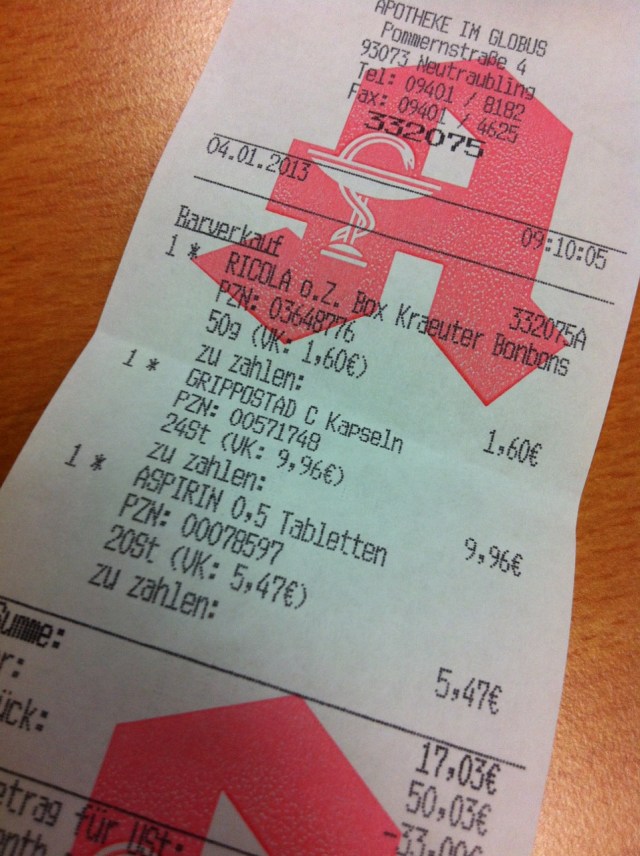
apotheke

What I purchased this time around is pictured below, except the Ricola cough drops.  Those are the same here as they are in the US.

Aspirin – This is pretty much the same as it is in the US.  The packaging is different, to meet Germany’s exacting packaging and trash rules, but aspirin is aspirin.  I grew up having Bayer aspirin all my life, and didn’t realize until I got to Germany that Bayer is a German company.  They’re a very big name in medicine here.

Grippostad – This is a multi-symptom cold medicine.  It has components for head and body aches, runny nose, cough, and fever.   It also has a boost of vitamin c, and it’s pretty effective at masking the rest of those symptoms for a little while.

Lemoncin – This is for sore throats.  It’s a lemony losenge.  It tastes pretty good.

pharma

Aside from that, I just fight being sick with lots of water, eating when I need to, and taking lots of rest.

How do you cope when you’re sick?

Buying Things Is Hard

The process of acculturation in Germany, for me, has been particularly challenging.   Every time I start to feel like I’m making progress, I encounter things which are enormously difficult for me, despite being rudimentary and simple for a native.

Purchasing concert tickets, for example.

For most of the concerts I’ve gone to this year, I’ve used eventim.de for my purchases.  Eventim is a great deal like Ticketmaster, except easier to use.  It also allows you to select English for the Website, so I’ve been able to get by.  However, sometimes the concert I want isn’t available through Eventim and I have to go a different method.

This is where I start to have trouble.  My command of the language isn’t very strong yet, so I use Google Chrome, which translates German to English on the fly.  The only problem is that the translations aren’t always precise, so I really have to employ some educated guesswork.

The word Karte can be a problem.  Karte can refer to a map, a card (such as a credit card,) or a ticket. You can imagine the confusion when you’re being asked to put enter payment information.

Dates are reversed here.  Using the first day of summer as an example, when I arrived, I thought the first day of summer was written as June 21st, 2012.  Here in Germany, it’s written 21 June 2012.  This is also true on Internet forms.  This leads to still more confusion: Is my card’s expiration 11/2 or 2/11?

Many of the line items on order forms don’t translate very well to English.   The idea for this post popped up while I was fighting with an order form for a concert ticket in Mannheim.  It took me three tries to successfully navigate the form to completion.   I was ultimately successful, but I would not have been able to place that order without help a year ago.

Things You Can Do With A Pfand Chip

I have this little blue Pfand chip.

These chips come in all shapes, sizes, materials, and colors, but this one is pretty simple.  It’s the same size as a one Euro coin.  At outdoor events, you pay an extra fee for your beverage, and these chips are commonly handed out at the same time.  When you finish your drink, you bring the empty back, along with the chip, and you get your deposit back.Some people collect the chips from different events.  That’s another story, though.

Grocery stores use them also-  the shopping carts are locked together outside, and you need a one Euro coin to unlock a cart.   Grocery stores sometimes sell their own little chips that are the same size and shape to fill this function.  When you re-lock the cart to its brethren, your original coin or chip pops right out into your hand.

Those are some of the most common uses for a Pfand chip.  I use it differently, though.  Since my arrival in Regensburg, I’ve dined out quite often with Jenny- she rapidly became my closest friend in Germany.  In the early days, we would forget pretty easily who payed for the meal last because it’s just easy to lose track.

Enter the chip.

We have joking nicknames for it: The Debt Chip.  The Payment Turn Designation Device.   We use it as a marker-  the person holding the chip pays for the meal, and the chip changes hands when we’re done.  There’s a mild amount of silly pomp and circumstance to the handing off of the chip at the end of a meal, but it’s all in good fun.  We don’t include other people in the hand-off of the chip.  If her boyfriend is with us, we pay separately by unspoken agreement.

I’ve always believed that when you’re friends with someone, you eventually forget who has paid for more of your shared meals.  This little blue chip is challenging that long-held belief, but I don’t think I mind.  Our friendship isn’t ever diminished in the slightest by knowing who paid last.