Regensburg’s Greatest Mystery (That I’m Aware Of)

After I’d been in Regensburg for a month or two, I started to notice certain signs.  I don’t know what precisely they represent or who put them up, and nobody I’ve asked (including the desk clerk at the local tourism office) seems to know.  They look like this.

They’re on historical buildings, storefronts, restaurants, and gates to open green areas. I’ve seen them on hotels, churches, museums, and in one case, on a wall adjacent to a courtyard.

I figured out pretty quickly that the shape in the large square is the outline of the building or park the sign is attached to.   The other shapes are obviously other buildings or parks.  Sometimes, only the right half of the sign appears, but usually they appear like this.

There are different color groupings.  Blue and yellow.  Red and yellow.  Pink and blue. Pink and a sort of sea-foam green.    I think each color grouping is a collection, a set containing one type of landmark, but I don’t know that for certain.
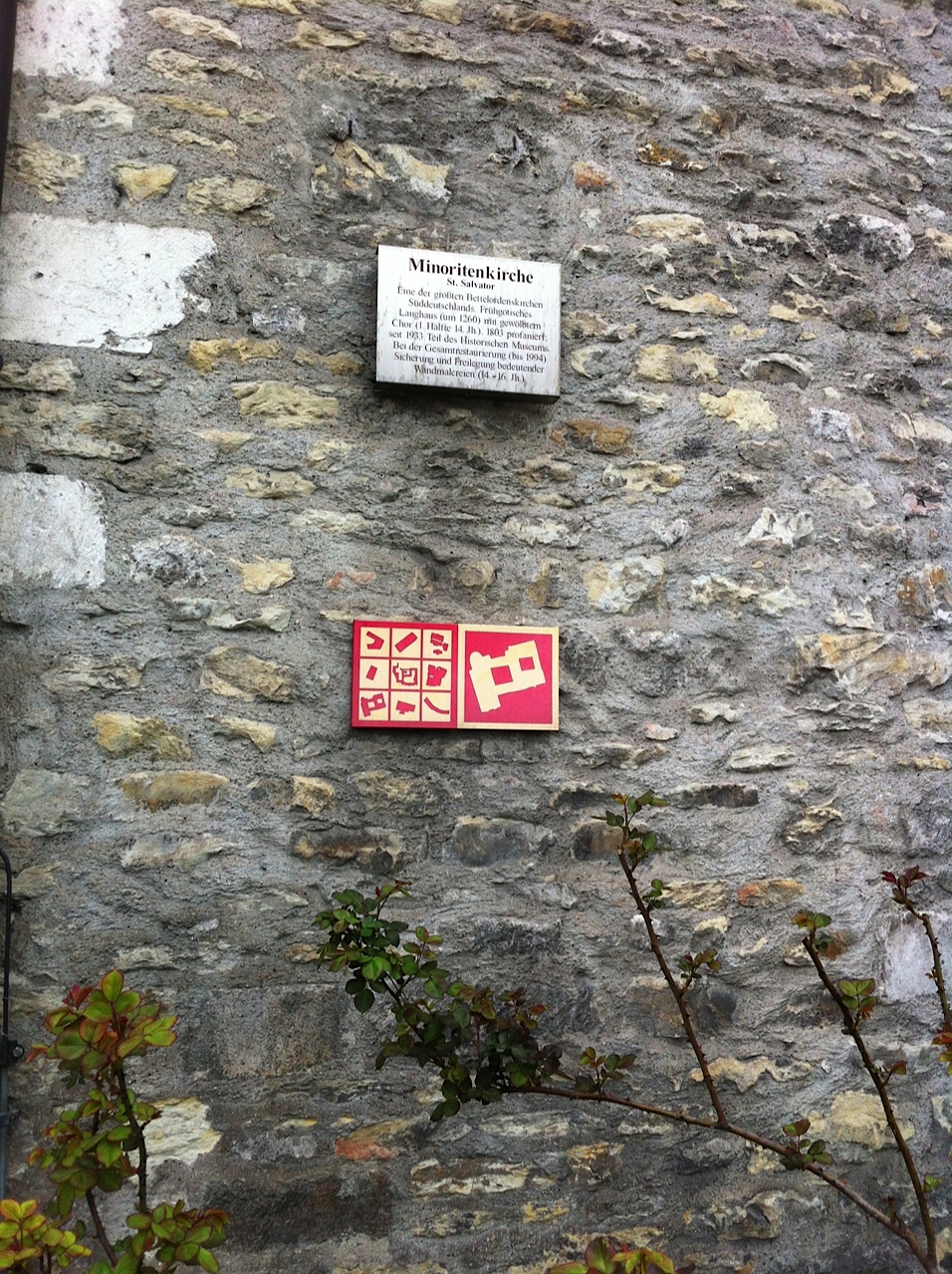
I’ve taken pictures of more than two dozen of them.  I’ve tried dozens of Google searches to find out precisely what they mean, but so far I haven’t found the right combination of search terms to solve the mystery.

I thought for a time that perhaps they were from the UNESCO World Heritage Centre since Regensburg is a World Heritage city, but there’s no mention of them on the UNESCO Website.

In my more frustrated moments, I like to think that they’re actually a dialing address for a Stargate, but I haven’t seen a DHD since I got to Germany.

I probably won’t figure out the mystery of the signs until it’s time to move back to the US.

Doors Become Windows

On most of my trips into the Altstadt, I walk past this wall.

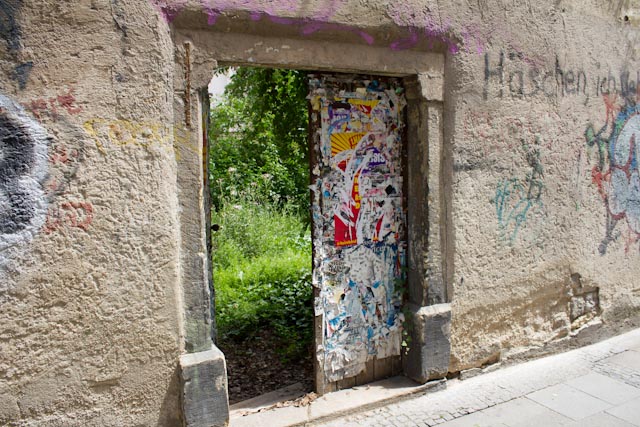
It’s an old wall, older than the buildings around it.  It’s covered in graffiti. (I especially like the script along the top, which says, “Bunny, I love you!”)

Set in the wall is a door.  An old, wooden door with metal doorknobs.  The door is covered in old stickers and concert posters and still more graffiti.  I always imagined that behind the door was something like a broom closet, or the entrance to a tiny dungeon.

One day this weekend, I noticed some people had stopped at the door, and were peering inside.   They closed the door again before I got to it, and I didn’t look further.

When I came back later in the weekend, though, I pushed the door open gently, and this is what I saw on the other side.

In the middle of the old city, between churches and clothing stores, surrounded by cobblestone, is a lush green overgrown glade.  There’s even a very large tree inside.

If this were True Blood, there would be faeries.  I’m just sayin’.

Freude am Fahren

Every week-day, I ride a bus from my home near the Altstadt of Regensburg to a bus stop a short walk from my office in nearby Neutraubling.  That bus rides past BMW’s Regensburg factory.

I have always known that BMW is a Bavarian company, but I forgot about it until I got here. BMW stands for Bayerische Motoren Werke, which roughly translates in English to Bavarian Motor Works.  The blue and white in the logo roundel match the blue and white of the Bavarian flag.  The logo is also stylized to evoke a spinning propeller.   The company goes back about a hundred years, but they started out as two different companies.  Bayerische Flugzeugwerke made airplane engines, and Rapp Motorenwerke was a motor company.  When they merged, the BMW name was born.  The first BMW branded vehicle is a motorcycle; the cars actually came a little bit later.

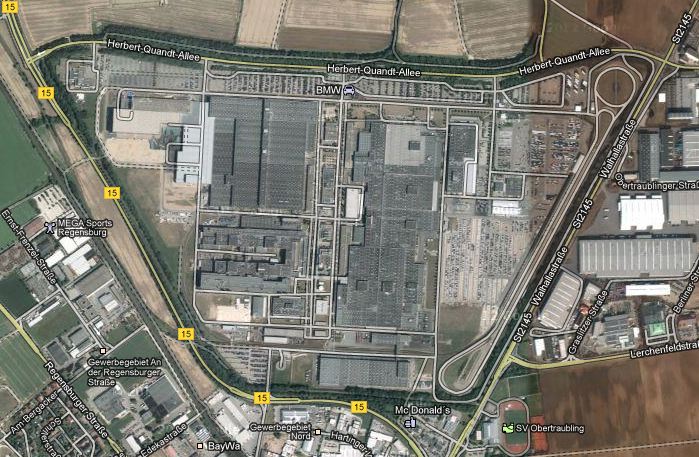
As you can see from the overhead view, it’s an enormous sprawling facility with a test track.

Up until the week before last, I’d only ever seen the gates and the high fences that surround the compound.   There’s a tour available to the public, however.  You just have to schedule it.   Here’s some of the interesting things I learned on the tour:

  • This facility produces several models of BMW, but ALL of the BMW Z4 line cars are made here.
  • The facility is a complete production line including enormous (and very loud) metal presses that convert huge rolls of steel into car doors, hoods, trunks, and bodies.
  • The seats are manufactured in a nearby town, and are driven to this facility less than an hour before they’re installed into new cars- this means that a traffic snarl on the Autobahn can back up production quite easily.
  • The factory produces one car every minute.  They make 1100 cars a day.
  • Much of the transport of cars from one end of the factory to the other is completely automated-  lots of robots and sparks and giant tracks.   There are forklifts, but there are also automatic robot cargo things that would look right at home in any Weyland-Yutani cargo deck.
  • Robots handle welding and bolting and all kinds of other precision work.
  • There are four layers in the painting process: a base primer, a protective layer, the color paint, and clear coat.  The paint work is all done by robots, and the paint is electrostatically charged during the painting process so that the paint will adhere more easily.
  • While the seats and engines are installed by robots,  a lot of fine installation work is done by humans- the Regensburg facility employs nine thousand people.
  • Ten percent of the finished cars are sent out to the test track for quality control.  I suspect that would probably be a fun job.

The video is a little bit older, but you can get a sense of the Regensburg facility in this Youtube clip.

This next video was taken in the Munich factory, but it clearly shows the metal press machinery, the paint robots, and more.  I’m quite fond of how the robot arms open and close the car doors during the painting process.

Dinner Was Fabulous

This town consistently does little things to remind me just how awesome it is.  For example, we wanted to go to dinner tonight at Pam Pam, a great little Italian restaurant in the Altstadt.  Dinner was fabulous, and so was the event we found when we got to Haidplatz.

As we rounded the corner, we walked into the midst of an enormous crowd.  There were tents, kiosks, and a small stage.  A band had just started playing the classic Toto song, “Hold The Line.”

As I looked around, I noticed some other things-  lots of rainbow flags, for one thing.  And a lot of same-sex couples holding hands, which is not all that unusual here, but is still nice to see.  One of the kiosks was about HIV prevention.   There was one guy wearing a head to toe black leather biker outfit, looking suspiciously like he was auditioning for the Village People.  All of these visual clues together could mean only one thing-   we had just stumbled into a Gay Pride event.

Specifically, this was Christopher Street Day, which is apparently Germany and Switzerland’s answer to Gay Pride Days.  The Christopher Street Day event is held as an anniversary to the LGBT uprisings in the Stonewall Riots on June 28, 1969.  The Stonewall Inn was on Christopher Street, hence the name.  The event isn’t always held on the actual anniversary for organizational reasons, but it usually turns up in June.

This is a huge event in Berlin and Cologne, but the day is celebrated in major cities all over the country.  Normally, there’s a parade but Regensburg didn’t have one this year.   I had no idea that CSD was happening at all, or I probably would have tried to get a good seat for the live music.  I’ll need to make a note on my calendar for next year- I love a good parade.

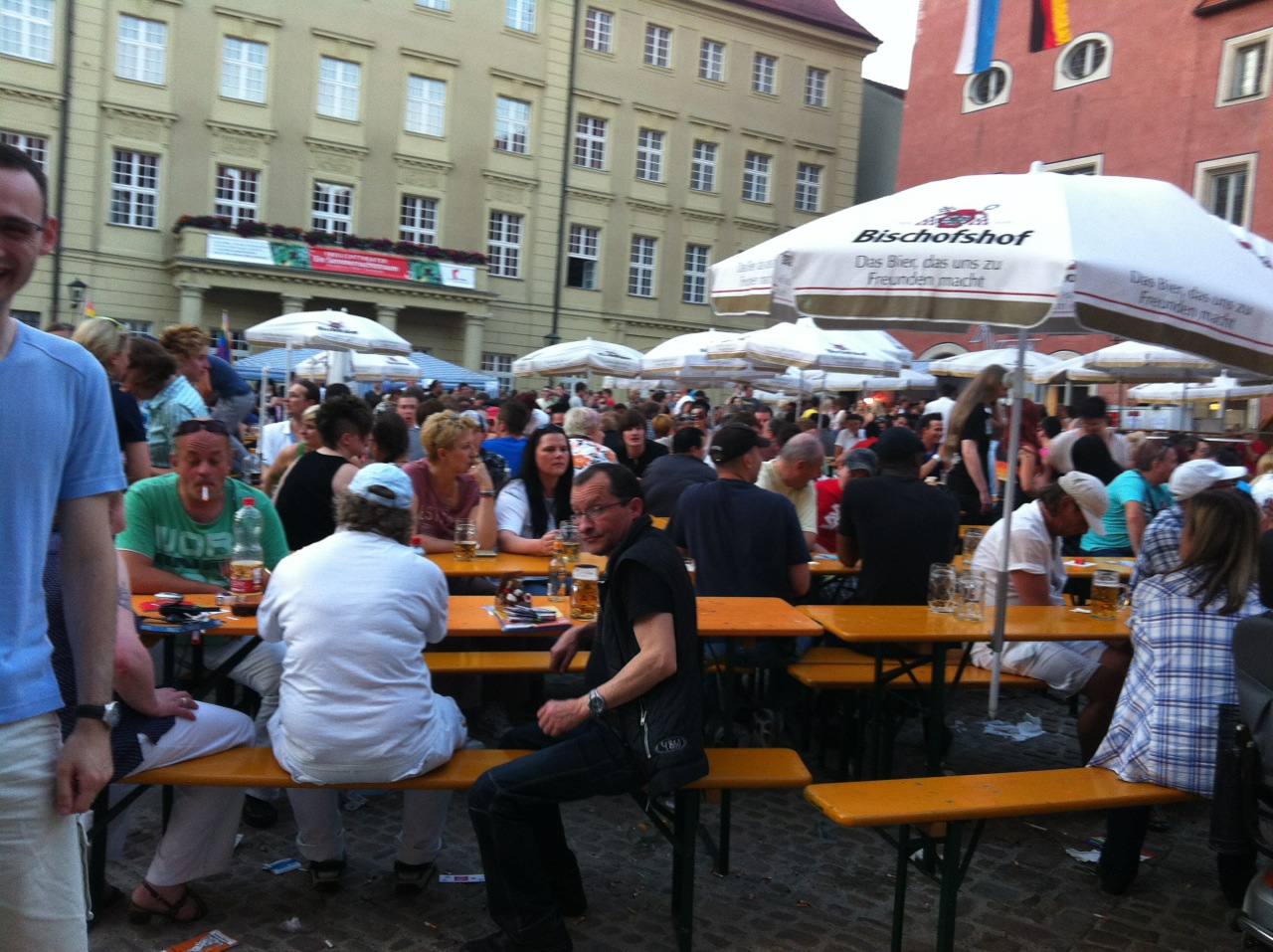
I didn’t get any pictures of the rainbow flags or the adorable hand-holding couples or even the black leather guy I mentioned earlier, because I didn’t know they’d be there.  I did snap a picture of the band though, and one generic crowd photo, so I’ll include those here.

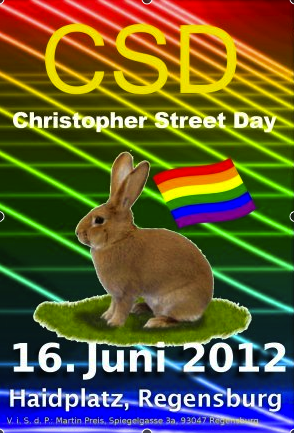
I didn’t make this last picture.  I’m only including it because it always makes me laugh.