ICE, ICE, Baby! (A Beginner’s Guide To The Deutsche Bahn)

December 2020 Update:  This post still gets a lot of visits, so I feel the need to say this:  The post that follows was written in March of 2013, while I was still living in Germany.  I moved back to the US at the end of 2014, and while I still ride the DB when I’m visiting, I cannot say with any certainty that this seven-year-old post is still accurate.    Please also bear in mind that I do not work for, and have never worked for, the Deutsche Bahn.  I am merely a happy passenger on their trains when I’m in Germany.  Happy travels, friends!

I love trains.

One of my favorite things about living in Regensburg is that we’re situated on a major rail line. From here, there are direct lines to Munich, Nuremberg, Frankfurt, Vienna, and Prague. That’s just without changing trains. If you don’t mind changing trains once or twice, you can go nearly anywhere on the continent. It’s a great way to travel.

Step One: Book Your Trip

appWhile you can get your train tickets from automated machines in the train station, or from a Deutsche Bahn counter, it’s generally advisable to do this ahead of time. The DB has a very excellent website in multiple languages, as well as a series of great apps to serve this purpose. It’s not much different than arranging air travel at this point- You can search with criteria like arrival or departure time, number of connections, and so forth.

The Website has also recently added a seat selection option to the booking process. The brown bars in the screen capture below are tables, so you’ll be sitting facing someone else. The boxed off sections toward the right are compartments with a door between you and the aisle. Click for a bigger view.

seatselector

Step One Point Five: Choose Your Type Of Train

rb-alexWhile you book your trip, you should bear in mind that there are a number of different types of trains in use on Deutsche Bahn rail lines.

  • There are a few non-DB carriers that operate on German rail lines, like the Alex trains pictured on the right, and Agilis just below that. I’m not going to get into the specifics of them in this post, but I’ve used Alex trains for trips to Prague and Munich. The Prague trip was horrible, but the Munich run was smooth as glass. The Agilis trains tend to be run on local routes. For example, the one pictured here runs between Ingolstadt and Regensburg, on an almost hourly schedule.

    Agilis train
  • Regio-DB or RB (Regional Bahn) tend to be highly localized. These trains are usually painted red.
  • RE (Regional Express) lines are for slightly longer distances than the RB. For example, there are RE lines between Regensburg and Munich. You can travel throughout the entire country using only RE lines, but it will take you a while. RE trains are also painted red.
  • IC (Inter City) trains.  IC trains are the middle step between the RE and ICE trains.  They are typically mostly white with red stripes, like the ICE trains, and they are generally faster than the RE trains.
  • ICE (Inter City Express) lines are my personal favorite. These are the trains that look like monorails. ICE trains are always pronounced Eye See Eee, never like the word ‘ice’ despite my bad joke in the subject line of this post. ICE trains are painted white with a red stripe, and they’re fantastic.
  • When your trip moves you between countries, sometimes you’ll wind up on the rail network from another country. For example, the train below is Railjet, a high speed Austrian line. This train was going to Vienna.
    austrianrailjet

In the picture below, you can see four different DB train types. The trains are, from left to right, an ICE type one, an ICE type two, an RE, a RB, and an ICE type three. The type three is the newest and fastest type.

ice-123-3types-munich

I’m a huge fan of the ICE trains. Here’s two more pictures of them. First, an ICE-T train. The T stands for ‘Tilt.’ All the newer models do this, actually. The upper portion of the train is designed to tilt to allow for high speed navigation, even on curves. The practical result of this for me is that my trips to and from the bathroom on an ICE train while the body of the train is tilting back and forth are often high comedy.

icet

Here’s another close picture of an ICE type three, because they’re amazing.

ice3

Why do I think they’re amazing? Well, they’re quiet, they’re comfortable, they have power plugs on the seats, and they’re fast. On newer, straighter sections of track, they can do this-

ice-zoom

You read that right- that’s 300 Kilometers per hour. That’s 186 Mph. And they can go even faster, if the track is straight and smooth.

One more thing that’s kind of interesting to me- in the picture of the ICE Type 3 above, the coupling is covered by a white shell. However, sometimes you see them uncovered, like so:ice-coupling1

That’s because ICE trains can be coupled together for longer hauls, making the single train double the length of a normal train. This is particularly useful when both trains share half a route, then get uncoupled at a major station before going to separate destinations. Here’s what they look like coupled together:

ice-coupling2

Step Two: Go To The Station

The main train station in any city is called a Bahnhof. In cities that are large enough to have more than one station, the main station is called a Hauptbahnhof. Bahnhofs always have clocks on them, for some reason I haven’t been able to learn. Here’s the front of the Frankfurt Hauptbahnhof:

frankfurt-hbf

Step Three: Find Your Platform

Every Bahnhof has display signs which tell you information about upcoming departures, including the Gleis (track or platform), destination, and departure time. There’s a big departures board inside the Bahnhof, and once you get to the actual platform, there are usually smaller signs to provide more information, like this one:

platform-digital

In the picture above, you have the following information:

  • This is Gleis 4.
  • This train is going to München (Munich). This train also has stops in Köln (Cologne), Frankfurt Flughafen (airport), and Nürnberg (Nuremberg).
  • The train’s identification is ICE 629.
  • This train will stop at stations A through E on the platform. On the left side of the picture, you can see the letter C- this is useful for shorter trains, as it allows you to see roughly where the beginning and end of the train will stop.
  • The train is departing this station at 12:38.

If there are any announcements or indications that your train is late, they’ll generally be notated on the boards. In the picture below, the scrolling text with the white background tells us that the train to Dortmund is actually running five minutes late.

trainbelate

Sometimes, you luck into an older station with the charming flip-board version of this sign. While they don’t have as much information, I think they’re really nifty and I quite like seeing them.
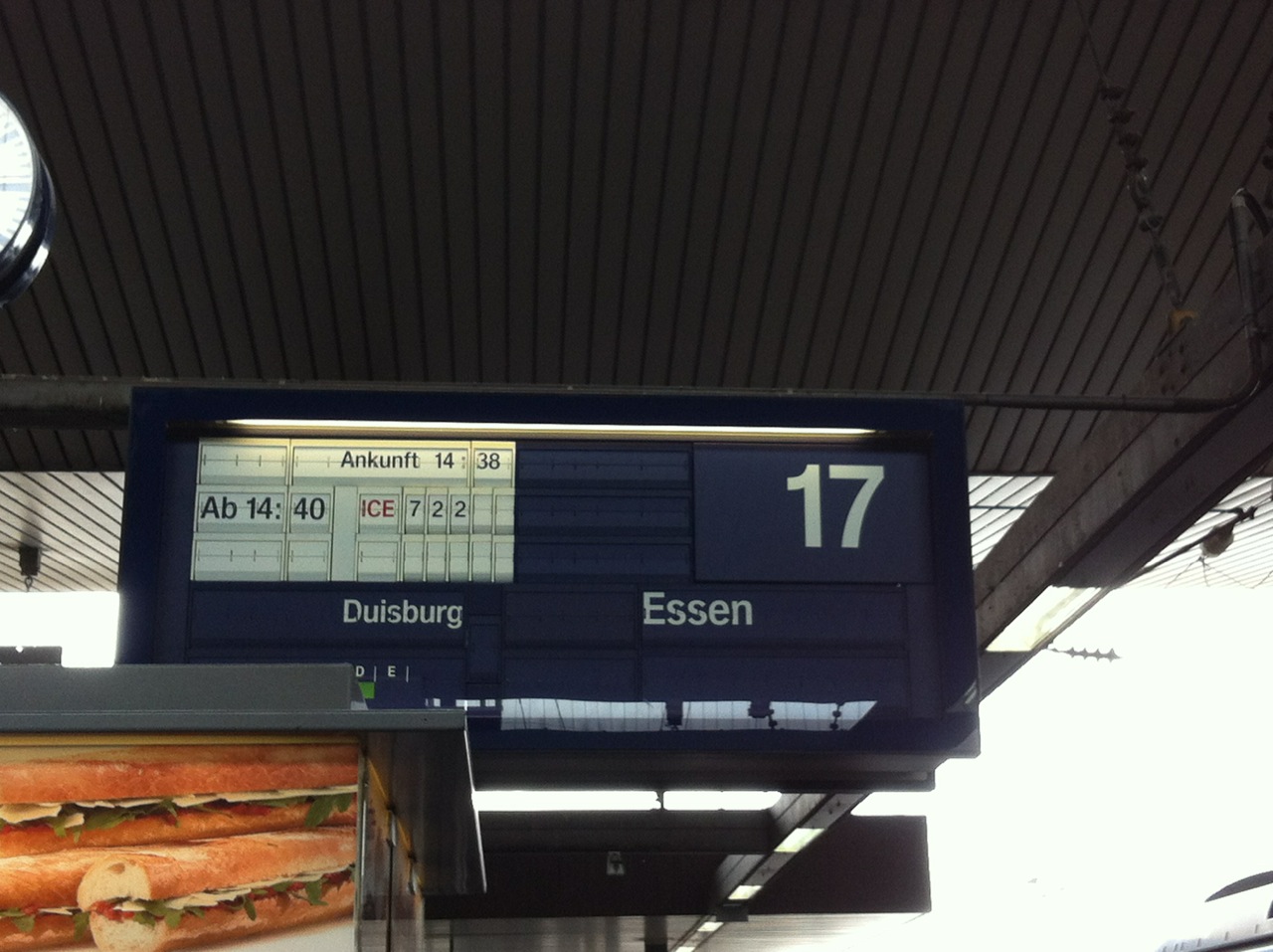
platform-flipstyle

Step Four: Find Your Seat

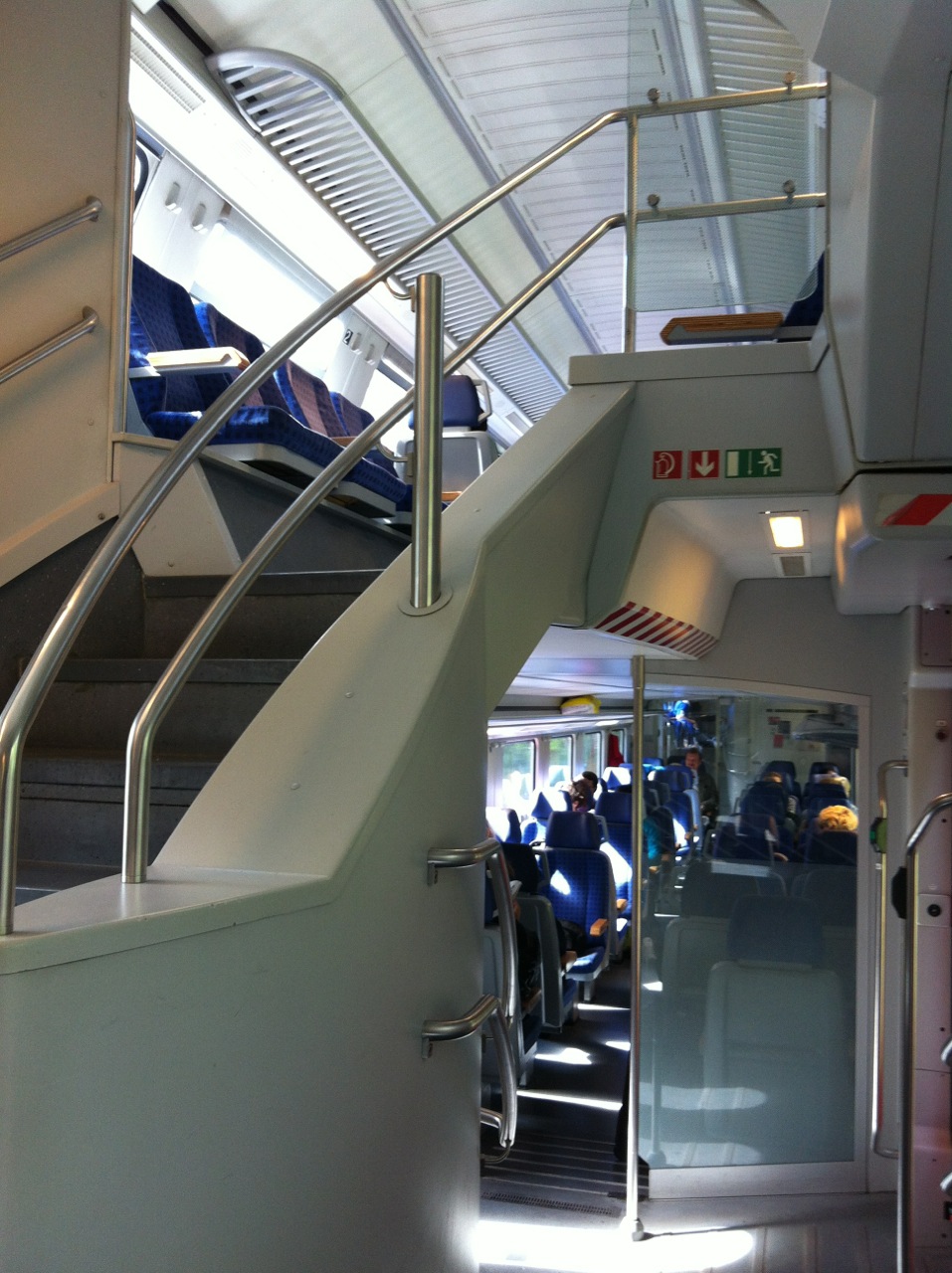
On RE and RB trains, you can’t reserve seats. On those trains, you just have to make sure that you don’t wander into a First Class car with a Second Class ticket. The cars are clearly marked with very large 1 and 2 signs, so that’s pretty straight forward. Some of the RE trains use double-decker cars with a lot of seating, like this next picture.
rb-interior

For ICE trains, however, you can usually get reserved seating- this is especially nice on crowded routes. When you have an ICE reservation, your ticket will specify a Wagon and a Seat. That’s where these signs come in handy. It’s difficult to capture this in a clear picture, but the car itself tells you that this is Wagon 23, on ICE 29 between Frankfurt and Wien (Vienna). The giant 2 to the right of that display tells you that this is a second class car.

ice-trains4

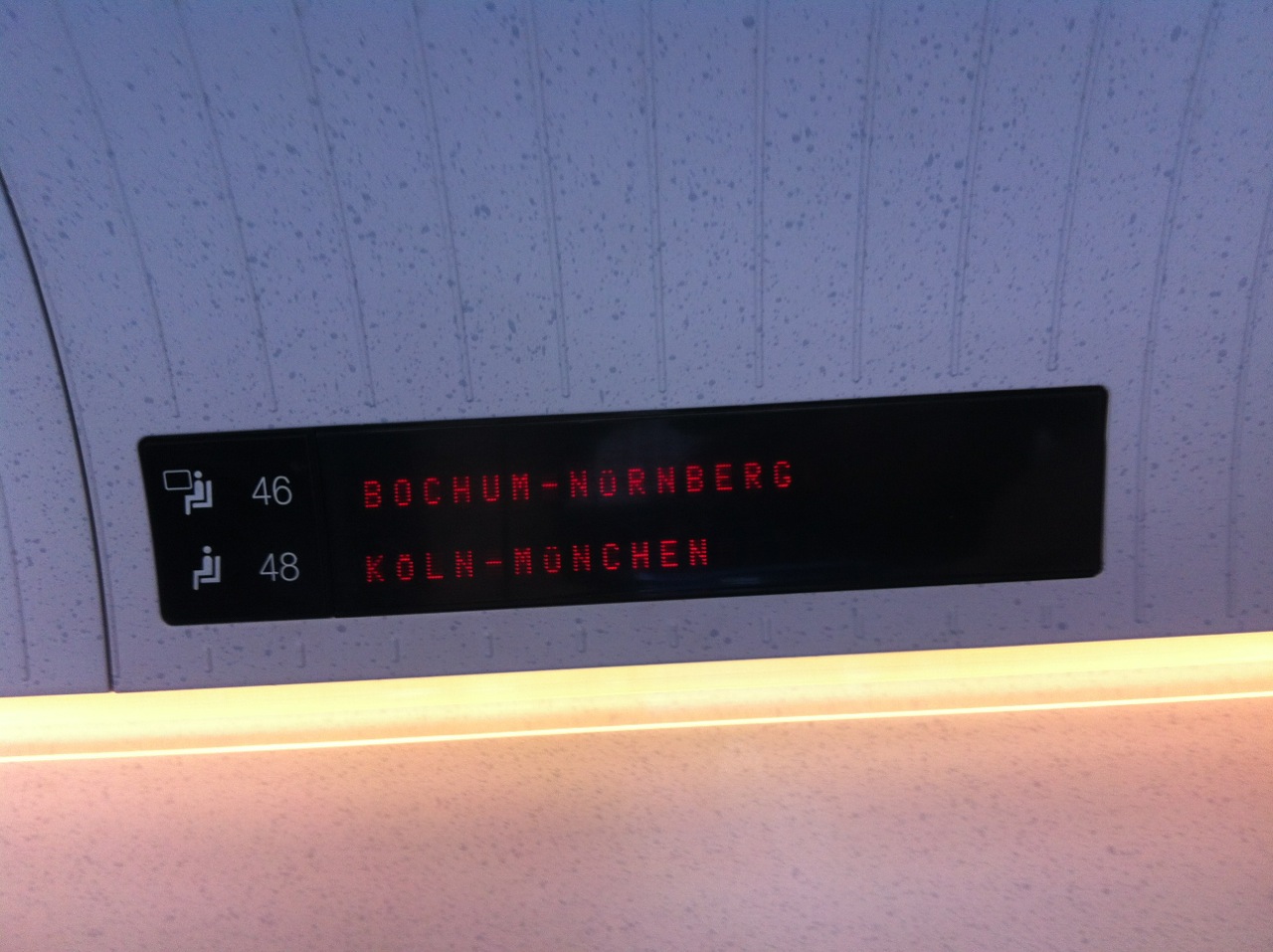
Once inside you’ll need to find your seat. If you do have a reservation, the seats will be marked by a small electronic displays somewhere above each pair of seats. If the display is blank, there’s no active reservation. The reservation display pictured below shows you that the window seat, #46, is reserved from Bochum to Nürnberg, and the aisle seat, #48, is reserved from Köln to München. Hypothetically, if you were planning on getting off the train before Köln, you could use seat #48 without much of a problem since that reservation starts with someone boarding the train in Köln.
ice-reservations

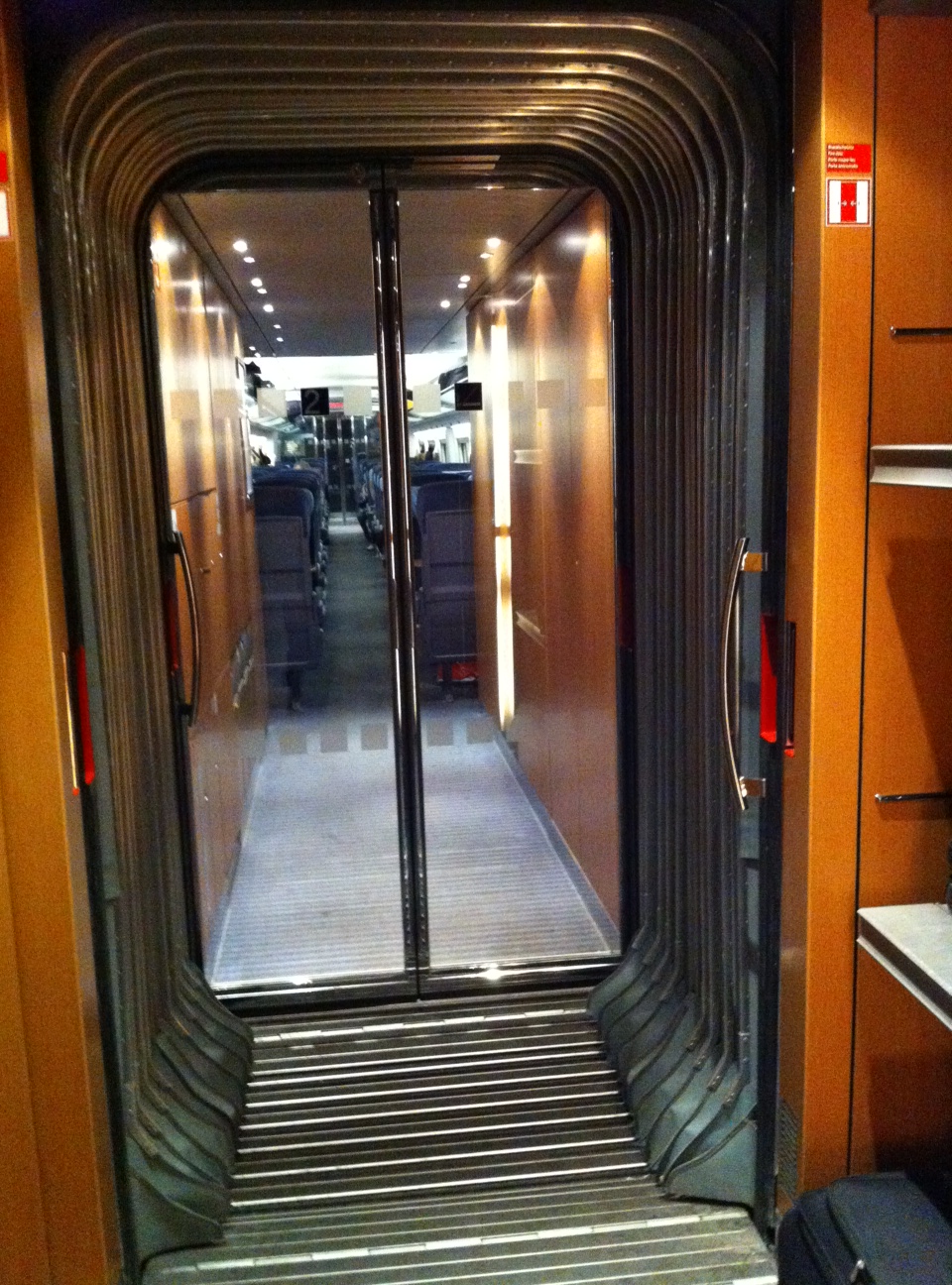
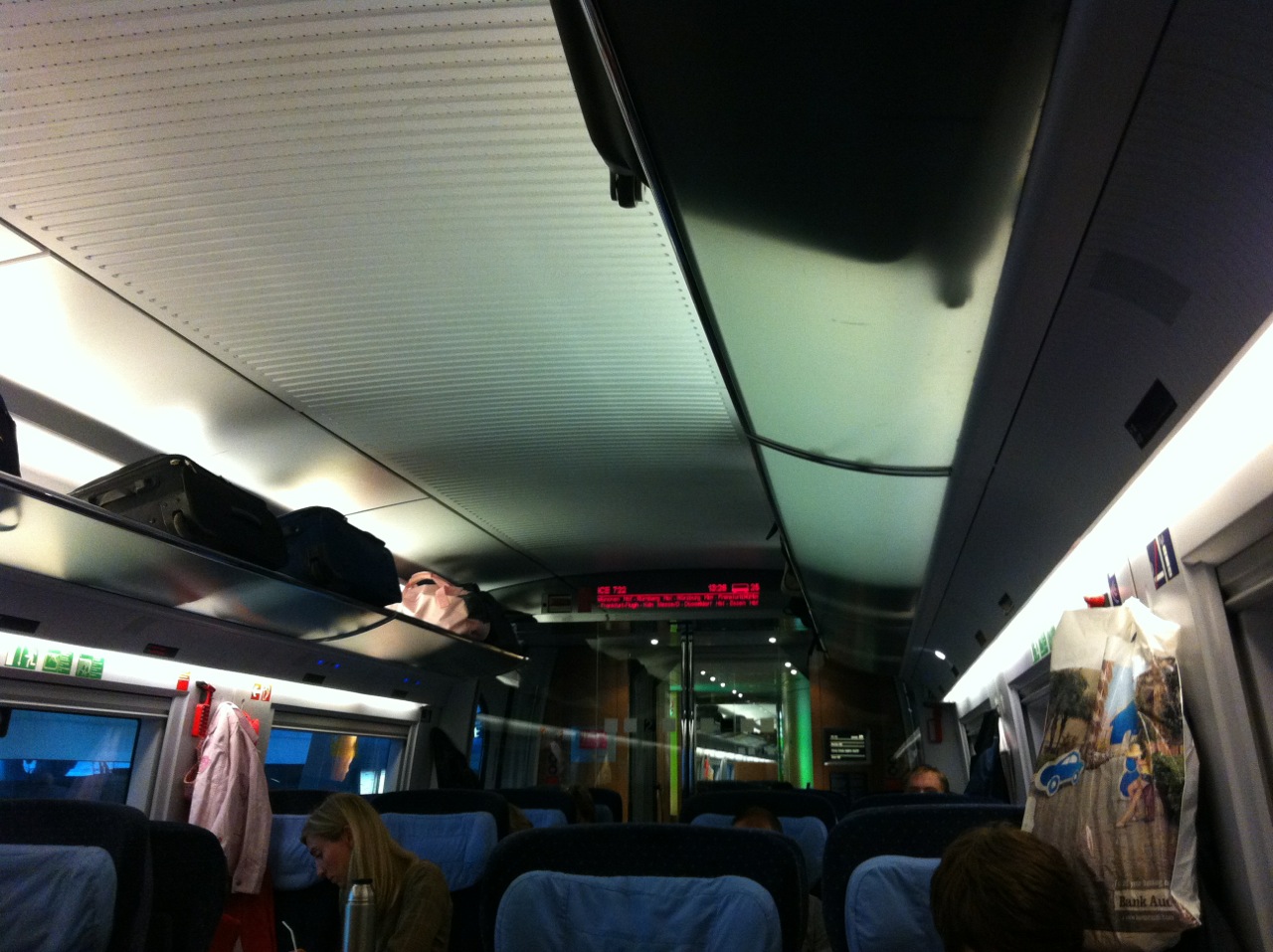
Once you’ve got your seat sorted out, you can try to stash your luggage. Most of the trains have some form of overhead storage, but it’s not always big enough for a regular suitcase. The pictures below are four different views of ICE train interiors.

ice-cabin-1 ice-cabin-2ice-interior1 ice-interior2

Step Five: Enjoy The Ride!

There’s not much else to add, really. DB trains are generally very smooth. Sure, yes, sometimes delays happen and weird things make travel a little more complicated. For the most part, though, this is a great way to travel. You can get from Regensburg to Frankfurt in three or four hours while reading on your Kindle, or you can stare out the window at the countryside passing by.

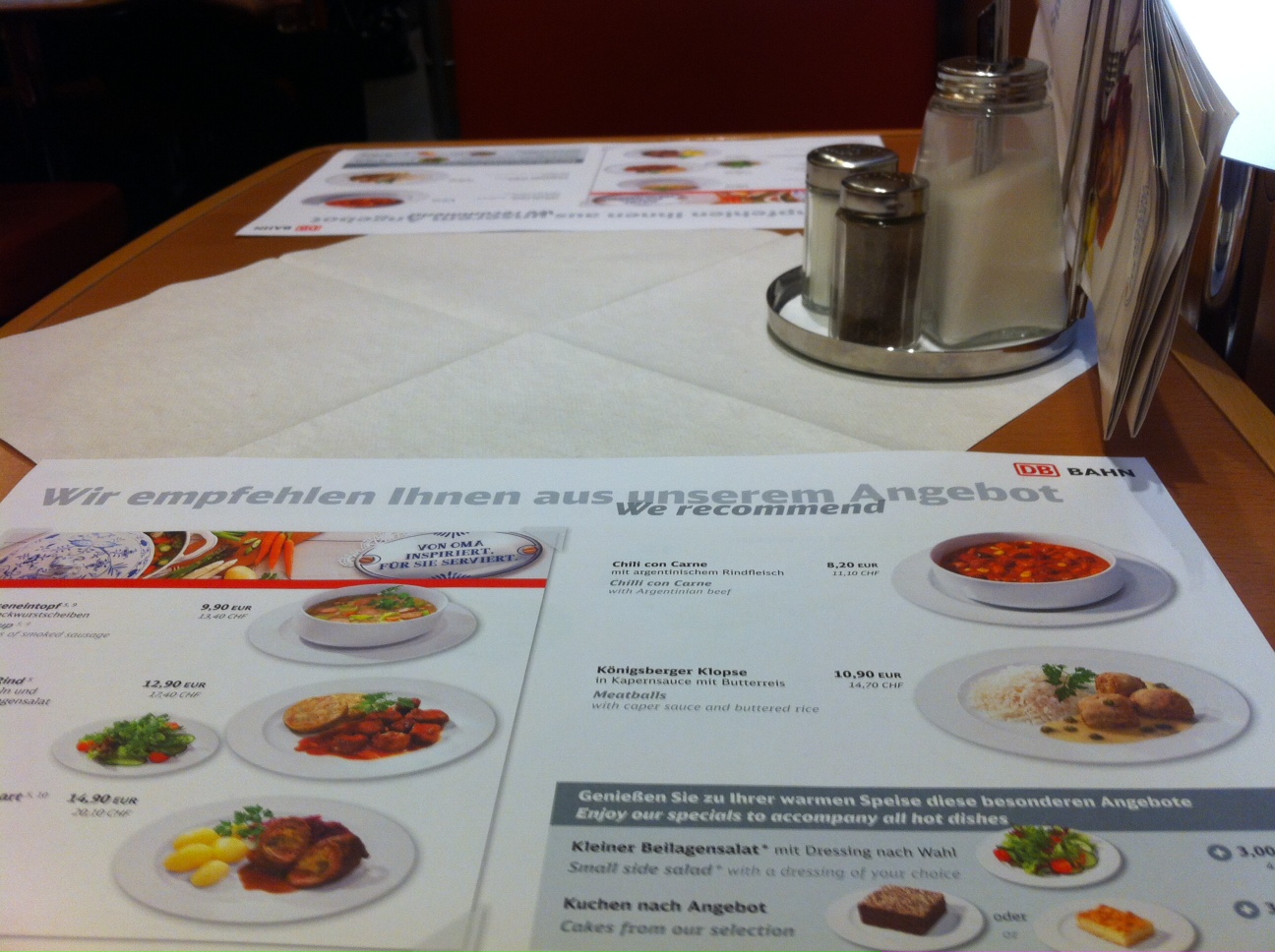
If you get hungry, most ICE trains have either a Bordbistro or a Bordrestaurant, and even the RE trains often have a snack cart passing by periodically so you can get something to eat while in motion. The Bordrestaurants often have hot food available, in a small fixed menu. You can see a few options in the photo below- when this picture was taken, chili, a rice dish, currywurst, a simple salad, and even some desserts were available.
bordbistro1

So there you have it- a beginner’s guide to riding (and enjoying) the Deutsche Bahn. I could go on a great deal longer about this topic, because I love riding the rails I think this is a good place to stop, though- this post should cover the basics. Now go forth and ride! Travel somewhere this weekend! Gute reise!

Which do you prefer- trains, planes, or automobiles? Have you traveled by Deutsche Bahn?

Hello, I’ll Be Right Back.

I want to say a big hello to all the folks that have stopped by since I was Freshly Pressed.

Hello!

This is the first time I’ve ever been Pressed, and I’m pretty stoked about the whole thing.    I have two things I wanted to mention, though.

Thing the first:  My posts aren’t usually so oriented in geek culture as that last one.  I do reference genre television and movies from time to time, like in this post over here, but most of the time it’s a little more general.  I write about life in Germany, about my travels, about the cool things I see in other cities and countries, and about whatever happens to pop up in my head.

Thing the second:   When I scheduled my posts for this week and next, I wasn’t counting on the influx of traffic that you get from being Freshly Pressed.  I’m really not used to having a lot of traffic at all.  Even my post about the European Dog Sled Championships got more views than my sci-fi post before I got Freshly Pressed.

I have a cool post about trains set to post on Monday while I’m in an airplane, but I’m not sure yet what I’ll post after that, because I generally only have one or two posts ready ahead of time.  My expats-in-scifi post went up right before two insanely busy weeks where I’m not really going to be at a computer.  so there might be a little bit of a lull in the next two weeks.

That being said, if you’re the sort of blog reader who doesn’t mind if a blog only gives you new material once or twice a week, I’m probably your guy.  Please come in, make yourself comfortable, and have a nice cuppa tea!  I’ll be back soon, I promise!

byeee

Grokking Expatriates In Sci-Fi*

I was having a conversation with Spring about Doctor Who, as we often do, and it occurred to me that The Doctor is actually an expatriate.

That’s really what this blog is about-  I started to write here originally just to tell my family and close friends what I was up to during my time in Germany.  Over time, however, my blog evolved into more than that-  I talk about life as an expat, and I talk about things that are different from life back in the US, different from the life I knew before last year.

Every third or fourth time I use the word expatriate, or expat for short, someone asks me what it means.  An expatriate is just somebody who lives outside of their native country, whether that be temporary or permanent.  The original meaning of the word referred to people who were permanently exiled or who had renounced their homes, but the word is used much  more generically now to describe anyone living outside their home country.

Doctor WhoIf you broaden the definition slightly of expatriate from country to planet, you can posit that the Doctor is actually an expat.   His homeworld is Gallifrey, a planet that is lost forever in time, but he spends an awful lot of time on Earth, hanging out with humans and generally getting involved with the culture.  That, my friends, is what an expatriate does.  Most of us don’t spend quite as much time running as the Doctor, though.

Talking about the Doctor as an expatriate got me thinking about all the other expats scattered throughout geeky pop culture, and there are hundreds upon hundreds of them.  Since I’m a huge list-making nerd, this naturally led to me making a list of some of my favorite sci-fi and fantasy expats from movies, television, comics, and books.  There are far too many to include in one sitting, but these are some of my favorites.  I separate most of them into one of four basic categories: Last Of My Kind, Stranded, Out Of Time, and Expat By Choice.

The Doctor falls into the Last Of My Kind grouping.

jonnjonnzAnother memorable example of the last of his kind is J’onn J’onnz, the Martian Manhunter.  J’onn has taken on the human secret identity of John Jones, and he works as a police detective.  Here we encounter a major genre caveat:  Almost all comic book characters have had their story told and retold so many times that there are numerous versions, numerous origins, and numerous backstories.  J’onn was not always the last of his kind, and certain versions of him have other martians around.  In current continuity, there are green martians and white martians- J’onn is a green.  In most of the versions though, J’onn spends much of his non-crimefighting time observing and trying to understand humanity.

bigblueContinuing on in comics, we have perhaps one of the most famous expatriates of all time:  Kal-El of Krypton. Sent to earth by his father to escape a dying planet, baby Kal is adopted by Jonathan and Martha Kent, and is raised as their son, Clark Kent.  The story of Superman is so well known in our shared popular culture that even people who don’t read comics tend to have at least some knowledge of the story.  One interesting question where Superman is concerned, however:  In most versions of his story, Kal-El really knows very little of the cultural heritage of Krypton.  He was raised on Earth, as an Earth child.  Does this mean he’s not really an expatriate?

I could go on and on about expats in comics, since many of the comic book heroes are living outside their home countries.   As my friend Frank Fradella put it when I bounced the idea for this post off of him, “…and geez… the entire “new” X-Men were expats. Storm, Colossus, Banshee, Sunfire, Nightcrawler.”  Frank is right-  if I keep listing comic book expats, we’ll never get around to other fun characters.  Let’s move on to the Stranded expats.

While most expat stories in the sci-fi/fantasy genre tend to be fish out of water stories, it’s a pretty common trope to have people stuck somewhere, trying to get home.  Heck, that’s the entire premise of Star Trek: Voyager.  I don’t count them as expatriates, though, because they’re living in a community of their own kind (i.e. on board Voyager) and they’re not really integrating into the society around them as much as they’re just passing  through.  Star Trek: Voyager is the sci-fi equivalent of an American Army base in Germany- just passing through, folks.

farscapeOften, however, the characters who fit this category are stuck.  They want to go home, but don’t know a way.  Like John Crichton in Farscape.  John is an astronaut and test pilot.  In the first episode of the series, he’s flying his module, Farscape One, and he is pulled into a suddenly appearing wormhole.  When he exits the other side, he’s in the middle of a battle between the Peacekeepers, a human-looking species called the Sebacean, and a group of escaped prisoners of various alien species aboard Moya, a living ship.  He’s pulled onboard Moya, and the rest of the series is a combination of his adventures with that group and his attempts to get home.

flashgordonFlash Gordon‘s story is not all that different than John Crichton, although in the wonderfully campy 1980 movie version, he’s not an astronaut, he’s a professional football player. (The original 1930s version had him as a polo player.)   During a series of pretty ludicrous events, he gets launched into space, and crash-lands on Mongo, before getting into a series of adventures with the various peoples of that world.  Flash adapts amazingly well, and ultimately winds up saving the various different nations of Mongo from their evil overlord, Ming The Merciless.  There have been other versions of Flash’s story, but the 1980 version is my favorite, partially because of the amazing Queen rock-score for the film, but mostly for the amazing cast, including Timothy Dalton as Prince Barin, Max von Sydow as Ming, and the amazing Brian Blessed as Prince Vultan:

Gordon's alive?

Moving on, then.  The television series Land Of The Lost counts as a Stranded expat story, because the Marshall family (father Rick, children Will and Holly) accidentally moves through a dimensional portal and spends the rest of their time dodging dinosaurs and Sleestaks (humanoid reptilian bad guys) and trying to get back home.  I have no particular fondness for this series, but I like saying “Sleestak.”

Another great expatriate character who is stuck away from his home is Oscar Zoroaster Phadrig Isaac Norman Henkel Emmannuel Ambroise Diggs, known to most as the Wizard of Oz.  As with comics, there are many different versions of this character.  In some versions, he’s fairly benificent.  In the original book version, he really just wanted to go home.  In the musical Wicked, (my favorite version, incidentally,) he’s actually kind of a dick.

kevinflynnIn another of my all time favorites, the TRON series, Kevin Flynn has a rather interesting version of being stuck in another place. Since 1989, Flynn has been living in the Grid, a fictional virtual reality world.  We don’t really see much of Flynn’s life on the Grid, because the movie follows his son, Sam Flynn.  Still, it’s evident from what you do see that he has established a remarkable life for himself there.

fordprefectUp until this point, all of my Stranded examples have been humans.  However, one of my favorite expatriate characters isn’t human at all.  He is, in fact, from a small planet somewhere in the vicinity of Betelgeuse.   Ford Prefect, from the Hitchhiker’s Guide To The Galaxy series, has been in many formats-  books, television shows, radio shows, a movie, comic books, trading cards-  the version pictured to the right is the movie Ford, played by Mos Def.  I prefer the book and radio show versions of Ford, but it was much easier to find a picture of the movie version.   Ford is a roving researcher for the titular Hitchhiker’s Guide.  He came to Earth to research it for the book, and got stuck for fifteen years.

We can go in with the Stranded examples for pages and pages, but I think it’s Time to move onto the Out Of Time category.  (See what I did there?)  These are characters who wind up stuck outside of their own time, like Booster Gold.  I said I wouldn’t do any more comic book heroes in this list, though.

fryI didn’t say anything about cartoons, though.  Take Philip J. Fry, in Futurama for example.  In the pilot episode of the series, Fry is a pizza delivery man who gets accidentally (ish) frozen in a cryogenic tube for one thousand years.  He wakes up in the future, and starts working as a delivery boy (naturally) at Planet Express, a delivery company owned as a side-business by Fry’s distant, distant, very distant nephew, Professor Hubert J. Farnsworth.  A quick side-note about Futurama-  this show is insanely smart at times.  From the earliest episodes, the creators plotted out certain things that get threaded throughout the series.  For example, in the future world of Futurama, owls have become vermin and pests, not unlike city rats of the present day.  Don’t believe me?  Watch the show again from the beginning, and watch for owls.

Bidi-bidi-bidi.Getting back to our expats in time, we have Buck Rogers.  Buck is another old character who has been in movies, television shows, comics, and even video games.  The version most people know about is the 1979-1981 television show Buck Rogers, in which he’s a shuttle pilot who accidentally gets frozen for roughly 500 years. Once revived, he joins the Earth Defense Directorate, finds love, and gains a pet ambuquad named Twiki, a little robot who seems to have been designed to cash in on the popularity of C3PO and R2-D2 from the newly released film Star Wars.

I can’t believe it never occurred to me before right now as I write this sentence that Buck Rogers + Flash Gordon = Farscape.  Hmm.

Enhance your calm, John Spartan!As with all my other examples of expats stuck out of time, John Spartan of Demolition Man was cryogenically frozen.  Whatever happened to a good old time machine?  John Spartan is a cop, sent to CryoPrison in 1996.  They wake him up about forty years later to stop another escaped cryoprisoner, the dastardly Simon Phoenix.  You can tell that Simon is the bad guy because his hair is an unnatural yellow-white color.

Let’s move on to the Expat By Choice category.  I could reference Wonder Woman’s decision to leave Themyscira, but dang it, I said no more comic book heroes.

chewbaccaIn the Star Wars universe, Chewbacca could loosely be considered an expat.  He isn’t hanging out on Kashyyyk with the other Wookiees.  However, expanded universe canon states that he fled his home-world when the Empire enslaved the rest of the Wookiees to get construction of the Death Star back on schedule.  This means that technically, Chewie is more of a refugee than an expatriate.  Additionally, since he travels with his friend and business partner Han Solo to fulfill his life-debt (long story), Chewbacca isn’t really embracing the culture of any specific new place.

While I would love to say that Babylon 5 is full of expatriate characters, it really only has two:  Sinclair and Sheridan.  Both of them go to live on Minbar at different points in the series.   The rest don’t quite match the definition of expatriate because the different species on board Babylon 5 all have their own groupings.  You rarely see a Pak’mara hanging out with the Gaim, for example, and you would never see a Drazi living on the Vorlon homeworld.  It just isn’t done.   Babylon 5 is a merchant outpost and a travel hub, and although it’s referred to as a city in space in the opening credits, it really isn’t.  B5 is run primarily by EarthForce, and it has no predominant single culture.

spockSimilarly, Star Trek is full of characters who seem to fit the role of expat at first, but perhaps aren’t textbook examples.  We have characters like Quark on Deep Space Nine, and Worf on board the Enterprise (and later, Deep Space Nine.)  Quark is a merchant, and since the station is a trading post, he’s not really adopting the culture of a new home-world.  As for Worf, he has Kal-El’s problem.  Worf may have been born a Klingon, but he was adopted by and raised by humans.  His primary culture is the one that he’s most commonly in touch with.  Worf isn’t an expatriate at all.  He falls into a slightly different category though, and I’ll touch on that a little bit later on.  Lastly, from my Star Trek examples, there’s Spock.  Spock was raised on Vulcan, but one of his parents was human.  He chooses to live in Starfleet, which is mostly populated by humans.  Even later in his timeline, when he becomes an Ambassador, he mostly sticks around Earth until his eventual trip to Romulus for reunification efforts between the Vulcans and Romulans.

teal'cNow that we’ve covered Star Wars and Star Trek, I would be remiss to leave out the third Star* franchise, Stargate.  Teal’c is another character that looks human, but isn’t quite human.  He is a Jaffa, which is a genetically modified human with an abdominal pouch so that he can serve as an incubator for a larval Goa’uld symbiote.  It’s not as icky as it sounds, because the symbiote grants its host Jaffa enhanced strength, health, and longevity as well as rapid healing.  The Jaffa are also an enslaved race at the beginning of the series, serving as military forces to the System Lords, who are the initial run of bad guys in the show.  I’m vastly oversimplifying the sequence of events here, but Teal’c defects to the SG1 team and goes back to Earth in the pilot episode of the series.    He becomes a valuable member of the team, and he even tries to live outside of Stargate Command in a regular apartment at one point in the series.  Naturally, he wears a hat to cover up the gold embossed tattoo on his forehead whenever he’s out in public.

spikegilesMeanwhile, back in Sunnydale, we have a couple of Brits living in America.  One of them is Giles, a Watcher, and the other is Spike, a vampire.  (I won’t get into Liam… sorry, Angelus here, because his Irish accent was just too horrific for words.)  The expats in Buffy The Vampire Slayer tend to be much more like the textbook definition of expatriate.  Giles is sent to Sunnydale by the Watcher’s Council, and that’s not all that different than me being sent to Germany for my job.  As for Spike, I suppose when you’ve lived for a hundred years or more, it makes sense to try to live somewhere different.

travelinmattAlso in the Expat By Choice category is Uncle Traveling Matt, a Fraggle who spends most of his time exploring “Outer Space,” his term for the normal human world the rest of us inhabit.  Matthew is the quintessential exploring expatriate, constantly evaluating the culture and norms around him, even if his observations are more Jane Goodall than Terry Gilliam.  (For those of you that know me well, you know I couldn’t do a list like this without including at least one Muppet.)

A few paragraphs back, I mentioned that Worf isn’t an expatriate, and that he falls into a different category than the rest of this list.  That category is Third-Culture Kids. A third-culture kid, or trans-culture kid, in the real world is usually the child of an expatriate.  For example, an American couple has a child while living in Germany.  The child is American-born, but German by culture.  When the family relocates back to the country of their passports, the child has to deal with this cultural divide.  Third-Culture Kids are often multilingual, and are very often accomplished.  However, adjusting to their passport country after years of living in other cultures can be incredibly difficult and can take a great deal of time.  This is Worf in a nutshell, although he didn’t reintegrate with Klingon culture until very late in his life.

valentinemichaelsmithMy favorite literary Third-Culture Kid would have to be Valentine Michael Smith, the man from Mars, in Heinlein’s amazing novel, Stranger In A Strange Land.  Mike to his friends, Smith is the biological child of Mary Jane Lyle Smith and Captain Michael Brant of the Envoythe first ship to travel to Mars.  The fate of the Envoy crew is unknown for twenty years, and when another ship finally arrives to investigate, they find that Mike is the Envoy’s only survivorSince Mike was raised by Martians, he went the first twenty years of his life never seeing any other human, and he spoke and thought in Martian at the beginning of the story.  Michael Smith is an incredibly intelligent character, and it didn’t take him long to pick up most of the language, but the first two thirds of the novel deal with his adaptation to a completely alien culture- that of Earth- in a very detailed and fascinating way.

These are some of my favorite expatriates from Sci-Fi, Fantasy, and Comic Book culture. What are some of your favorites?

*Don’t know what Grokking means?  I guess you should read Stranger In A Strange Land, then.  I’m off to MegaCon in Orlando this weekend, so you can tell me what you thought of it after I get back.

PSA: DST Is Coming, Or Only Flava Flav Really Knows What Time It Is

Most of the time, Germany is six hours ahead of the East coast of the United States.  For the next three weeks, however,  that’s not going to be the case.   This weekend, on March 10th at 2 am, daylight savings time begins in the United States.  On March 31st at 2am local time, Central European Summer Time (CEST) begins in Germany.  There is a span of three weeks between those two dates.

What this means in simple terms is that meetings with my US colleagues are going to be constantly mis-scheduled because every time we have a week or three between our respective time-shifts, Exchange calendar seems to go to hell.

I research everything I write about on this blog, because I always learn cool and interesting stuff.  I didn’t know that Germany was the first country to implement Daylight Savings Time, in 1916.  They did so to conserve coal during World War I.  It made sense at the time.

Even though it’s been a part of my reality for my entire life, I still think it’s kind of ridiculous in modern times.  Studies on whether it saves money or energy expenditure have gone all over the map- some have shown a huge savings, some have shown increased energy consumption, and some have shown very little change at all.    Other studies have shown that it causes disruptions to sleep habits, and one 2008 study showed that changing to DST correlates to an increase in heart attacks.

Do you think we still need Daylight Savings Time?

A Perfect Day

I travelled into Munich on Saturday afternoon.  Compared to last weekend’s total bust of an Ingolstadt day trip,  this weekend’s trip resulted an absolutely perfect day.  It helps that I had a specific goal in mind.  I had acquired a ticket to see Dinosaurier: Im Reich Der Giganten.  I gave myself a little bit of padding time before and after the show, and that extra time is where the day became really successful.

It also helps that Munich is a vibrant and amazing city, with a lot of really cool stuff going on.  There’s so much cool stuff in Munich that even after repeated trips to the city, I’m still ticking things off my “Ooh, I’ve gotta see that sometime!” list.

I went a little bit early today with the intent of finally getting to see the Ruhmeshalle.  I had already seen Walhalla and the Befreiungshalle  (“Hall of Liberation”).  This is a sort of companion piece to the both of them, since they were all originally commissioned by King Ludwig I of Bavaria.  I did make it to the Ruhmeshalle, but I could’t go inside because it was closed up- probably because most of the stairs were still iced over.  At least I got to see it, along with the statue of Bavaria in front.  I’ll have to go back there some other time, when it’s a little bit less icy.

Ruhmeshalle

Because I took a detour to an area of Munich I hadn’t seen on my way to the Ruhmeshalle, I got to see several other interesting things.  First of all, there’s this wacky staircase at the KPMG Building:

unpossiblestaircase_kpmg

Secondly, I got to see a random giant snail.  I have no idea whatsoever what this snail’s deal is, but I assume he’s related to the Deutsches Museum Verkehrszentrum, a part of the Deutsches Museum near Theresienwiese.  It’s a giant glass building filled with trains and planes and automobiles.  And at least one helicopter.    I really need to go back there sometime- I love things that go zoom.  Anyway, here’s the snail.  Doesn’t he look happy?

giantsnail

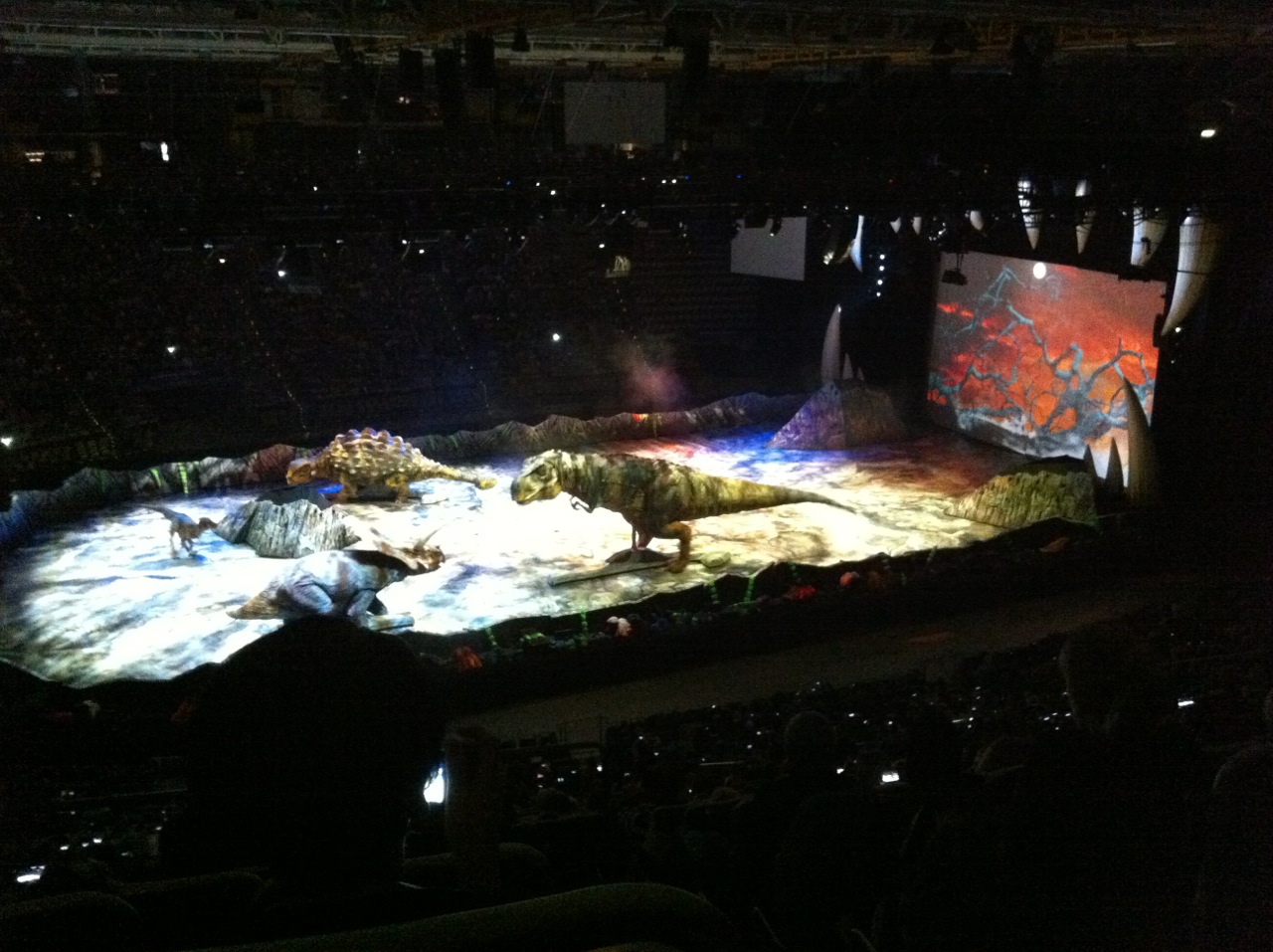
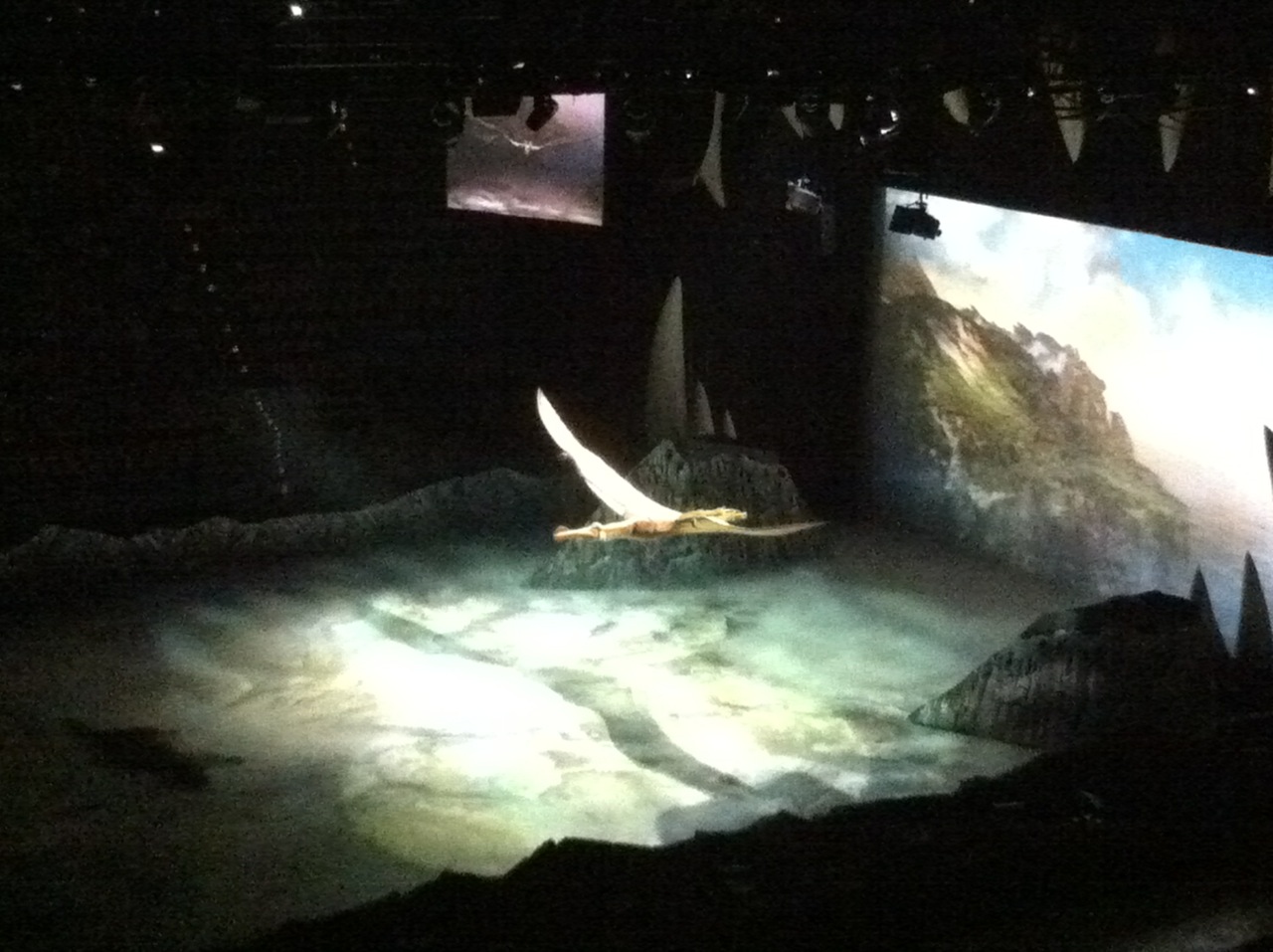
After my detour into giant snail and unpossible staircase-land, I went on to the dinosaurs that were my reason for going to Munich.  If you go to the Dinosaurier Live site, you can see some cool promotional video of the show.  My seats were way up in “sherpa guides and oxygen tanks” territory, but I still took a few pictures.  Click for bigger. (And a quick side note- remember the brontosaurus?  I miss that big guy.)

dinos_triceratops dinos_trex_anklyosaurus_trike dinos_stegosaurus dinos_pteranodan    dinos_brachiosaurus

I debated whether or not to include video clips, but the way they animate the dinosaurs is really quite amazing, so here’s two short clips.

By the time I came out of the Olympiahalle, the overcast day had given way to sunny and gorgeous, because springtime is banging at the door here.  My walk back to the U-Bahn took me right past the Olympiaturm, another place on my “I want to go there” list.   Since the skies had cleared up, and I had an hour to the next train back to Regensburg, I decided to hop in for a look-see.   There’s a restaurant up at the top of the Olympiaturm, and I’d like to eat there some time in the future.  I love restaurants in tall places.  (I’ve been to restaurants in the Skylon in Niagara Falls, the CN Tower in Toronto, and a few other super-tall places.  My love of dining in the sky knows no bounds.)  This is the Olympiaturm.

olympiaturm

Since the weather had cleared,the views from the top were amazing.  It still wasn’t clear enough for me to see the Zugspitze, but I’m ok with waiting until May to see that for myself.  In this picture, you can see the BMW complex.  You can also see the shadow of the Olympiaturm, which cracks me up.

highview

At the foot of the Olympiaturm, there is a pond.  And in that pond, the forces of Springtime were amassing.  And eating pretzels from all the passersby.  Ever seen a mallard duck trying to chew up a piece of pretzel?  It’s high comedy.   Aside from that, it was really quite lovely, though.  A perfect end to a pretty amazing day.

springtime

To top it all off, when my train left Munich, we passed an open field where four small deer were playing in the snow.  Seriously- a perfect day.

Tell me about the last time you had a perfect day.