The first Eurovision was held in Lugano, Switzerland in May of 1956 and it included just seven countries- Belgium, France, Germany, Italy, Luxembourg, Netherlands, and Switzerland. This year is the 59th year of the Eurovision contest, and 37 nations are competing. Last night was the last semi-final, and the final competition is on Saturday, the 10th of May.
My first exposure to Eurovision was in the 2012 Eurovision song competition., the year of the Singing Grannies and Jedward. The spectacle is quite amazing, and I was hooked. In 2013, I missed all the singing parts and only managed to catch the very last section where they do all the vote counting. That bit was dull as toast points.
This year, the competition has been mildly interesting. A lot of very similar sounding solo vocalists, with a handful of standout acts. Here’s some of my favorites from the competition so far, and I haven’t even seen the five that were pre-qualified for Saturday’s final.
Sweden – Sanna Nielsen – Undo – Good song, polished singer, and catchy enough to get lots of radio play.
Russia – Tolmachevy Sisters – Shine – There were a lot of audience boos for these two, not because they were bad – they weren’t. They were quite good, but the Russia-Crimea-Ukraine politics bled into the mood of the audience.
Ukraine – Mariya Yaremchuk – Tick – Tock – The running man was a neat visual.
Belgium – Axel Hirsoux – Mother – This guy has a decent voice, but he’s not “pop” enough to win this competition. (He didn’t make it to the finals.)
The Netherlands – The Common Linnets – Calm After The Storm – I like the sound of this band, actually. This song has a little bit of “Every Breath You Take” in it, I think.
Belarus – Teo – Cheesecake – A Belarusian boy band!
Ireland – Can-Linn (featuring Kasey Smith) – Hearbeat – I liked this, but I’m predisposed to enjoy anything with a good fiddle in the background. They didn’t make it to the finals, though.
Poland – Donatan & Cleo – We Are Slavic (My Slowianie) – Poland’s answer to the Spice Girls?
Austria – Conchita Wurst – Rise Like A Phoenix – Austrian drag queen with a killer voice.
Iceland – Pollapönk – No Prejudice – These dudes are totally my favorites to win, even if they do dress like the Wiggles. Plus I dig their dance moves at 1:42.
Will you watch the Eurovision Song Contest 2014 finals tomorrow night?
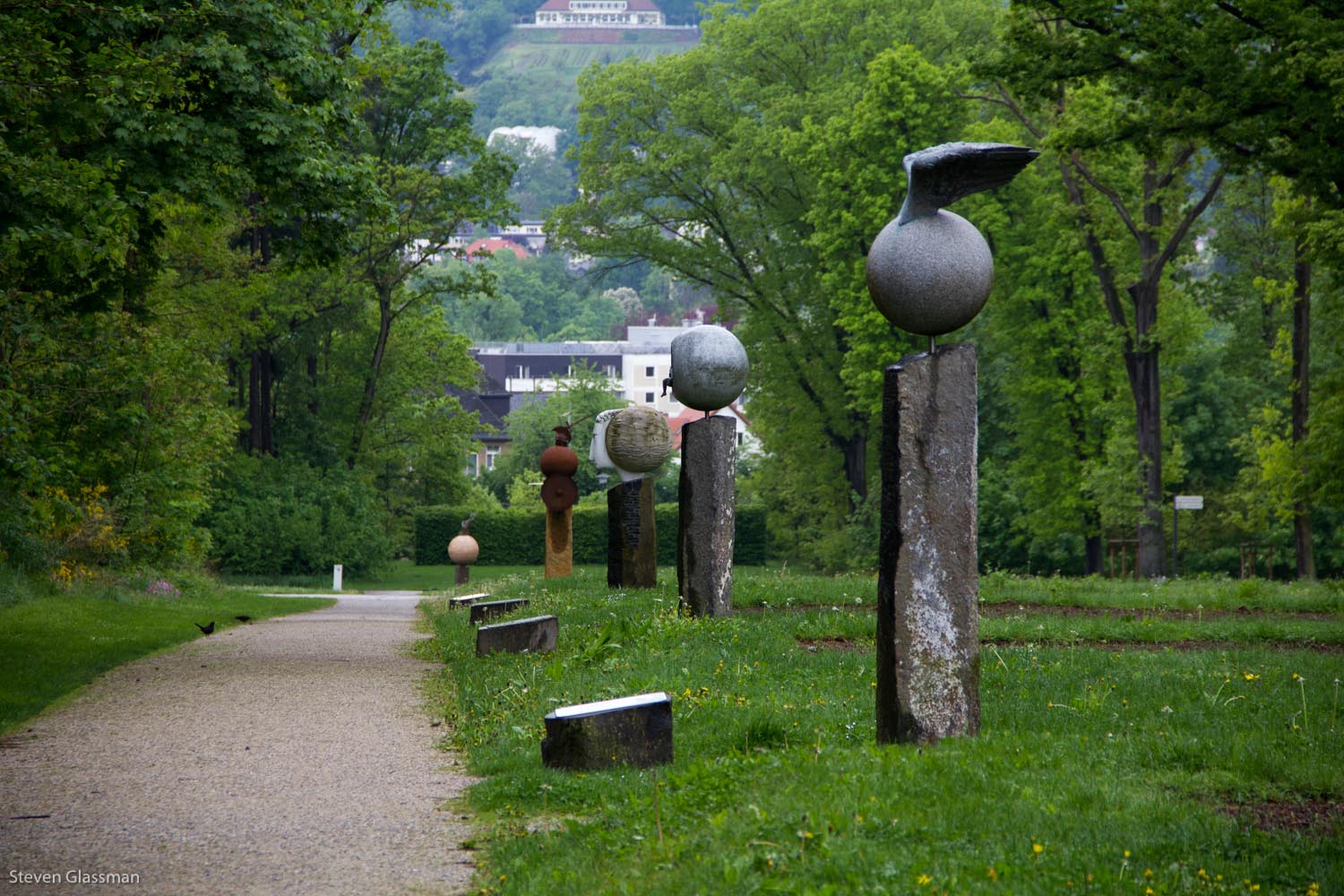
Back in October, Germany Ja! posted about a Planetenwanderweg (planet trail) in Bad Nauheim, and I just had to go see it myself. The Planet Walk is a two kilometer long trail with statues representing the planets of our solar system at a 1:2.8 billion scale and informational plaques next to the statues.
It’s a short hop outside of Frankfurt am Main, so I spent a morning over in Bad Nauheim the last time I was in Frankfurt. There are apparently thermal baths in town- Bad is German for Bath, so this is pretty common for towns that have names starting with Bad. I wasn’t there for the thermal baths, though. I wanted to see the Planet Walk.
The first thing I noticed was that there’s lots of art everywhere. For example, this was in the tunnel between the train platforms at the Bahnhof.
In order to do the Planet Walk, first I had to find it. I knew that the center of this solar system was the sun, and that it’s in Goldstein Park, but Google Maps and Apple Maps weren’t terribly helpful in getting me to a starting point, and all the official town tourism site told me was that it started to the East of the city. After a bit of walking around, I was able to find it though.
The Sun, with a representation of Apollo, the sun god:
The first five planets are relatively close together, so following the trail was very easy at this point.
First up for the planets is Mercury, winged messenger and all around swell planet.
Next, we have Venus on the half shell.
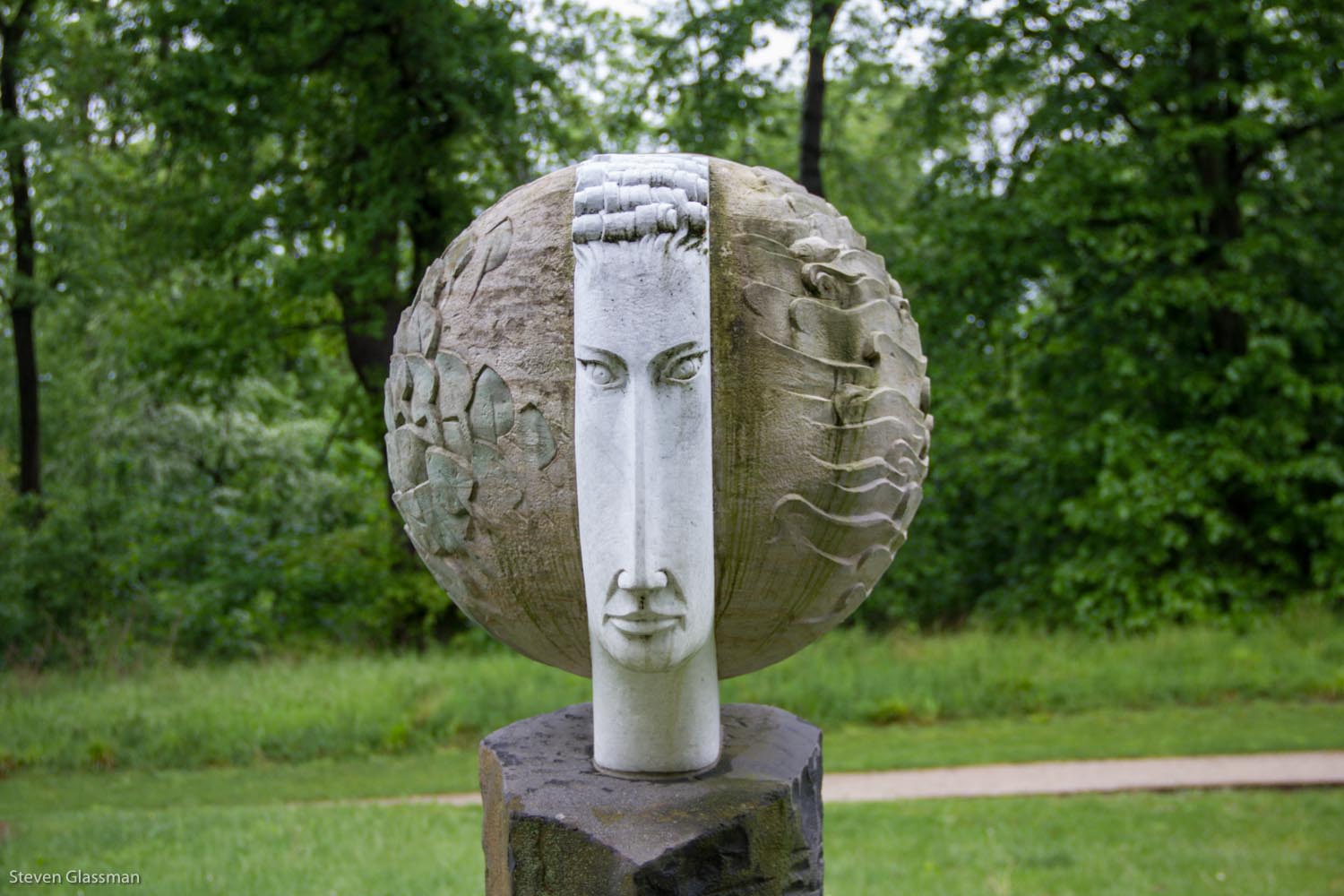
Earth was so interesting that I had to take two pictures, one from the side and one from the front. I should have snapped the other side as well, since it had a representation of plant life.
Following Earth is Mars, bringer of war. I think it’s interesting that the coloration of the statue was made to reflect that of the Red Planet.
At the corner of this particular piece of greenery is Jupiter, hurler of jagged lightning. Insert your own gas giant joke here, please.
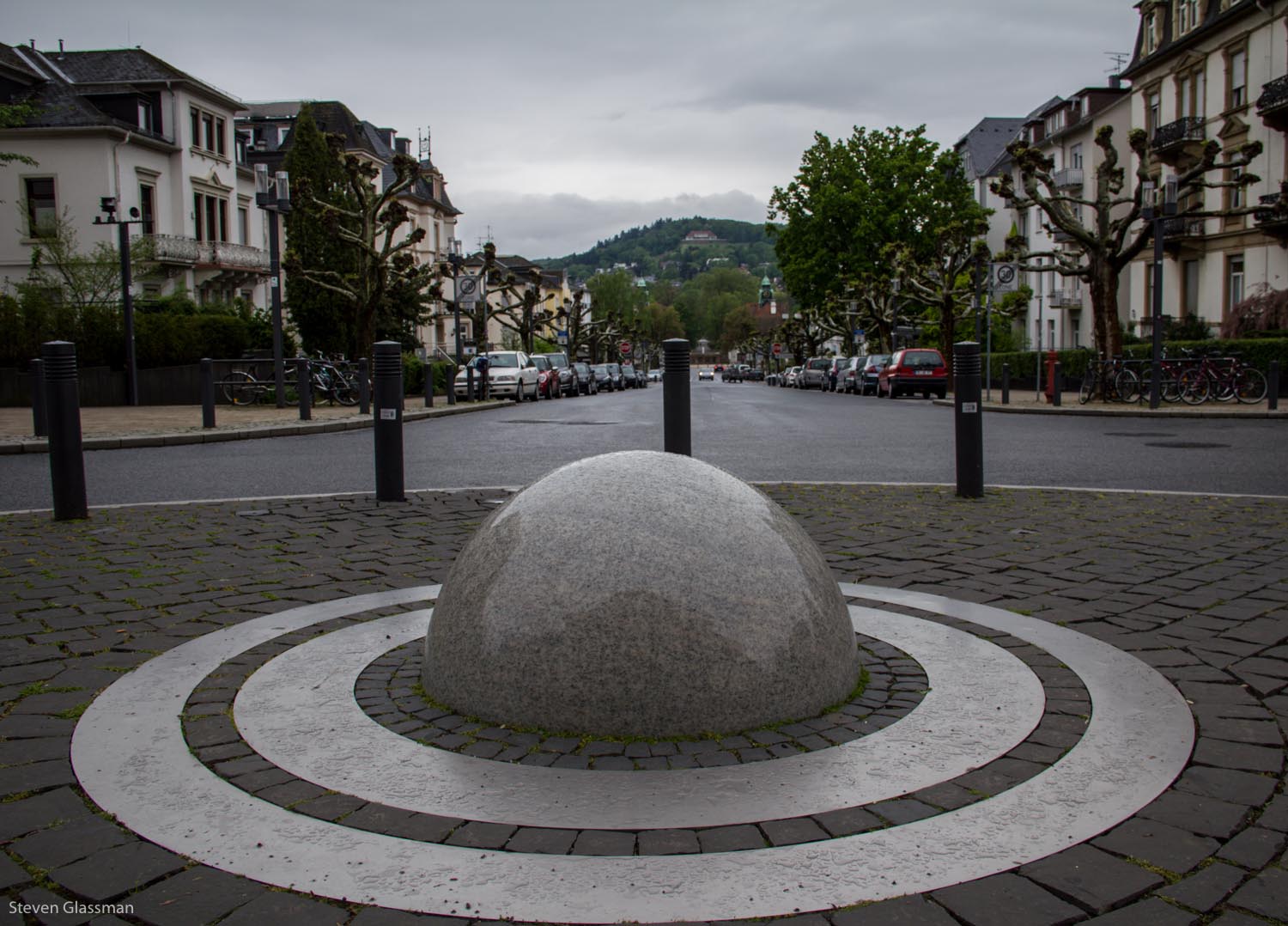
From Jupiter, you have to leave the park, cross the street, go under the train tracks, and exit the Bahnhof through the front door. There you will find the ringed planet Saturn, embedded in the cobblestone in front of the Bahnhof.
From Saturn, it gets much harder to find the planets. Walk down that street until it ends, cross into the plaza behind the street, go past the very large fountain, and enter the Kurzpark. In this big green space, the walkway continues, and eventually reaches Uranus, the lone Greek in our pantheon of Roman planets.
…and this is where I got lost. From Uranus, I knew that it would be a while before I found the next planet, and I knew also that the trail ended up a hill, but I wasn’t to the hill yet. I walked a very long distance through Kurzpark and wound up on entirely the wrong side of things. I used my phone to point me back in the right direction and walked until I found a normal street again.
And that’s where I found Elvis.
No, Elvis isn’t buried here. That honor still goes to Graceland. However, Elvis lived in Bad Nauheim for 18 months when he was stationed at the nearby American military base, and the town is still pretty jazzed about it. They even renamed a street after him.
Running into Elvis made me realize that I had gone the wrong direction after Uranus, and it wasn’t long before I was back on track, easily finding sea god Neptune with the help of carefully re-reading Germany Ja’s post on my phone.
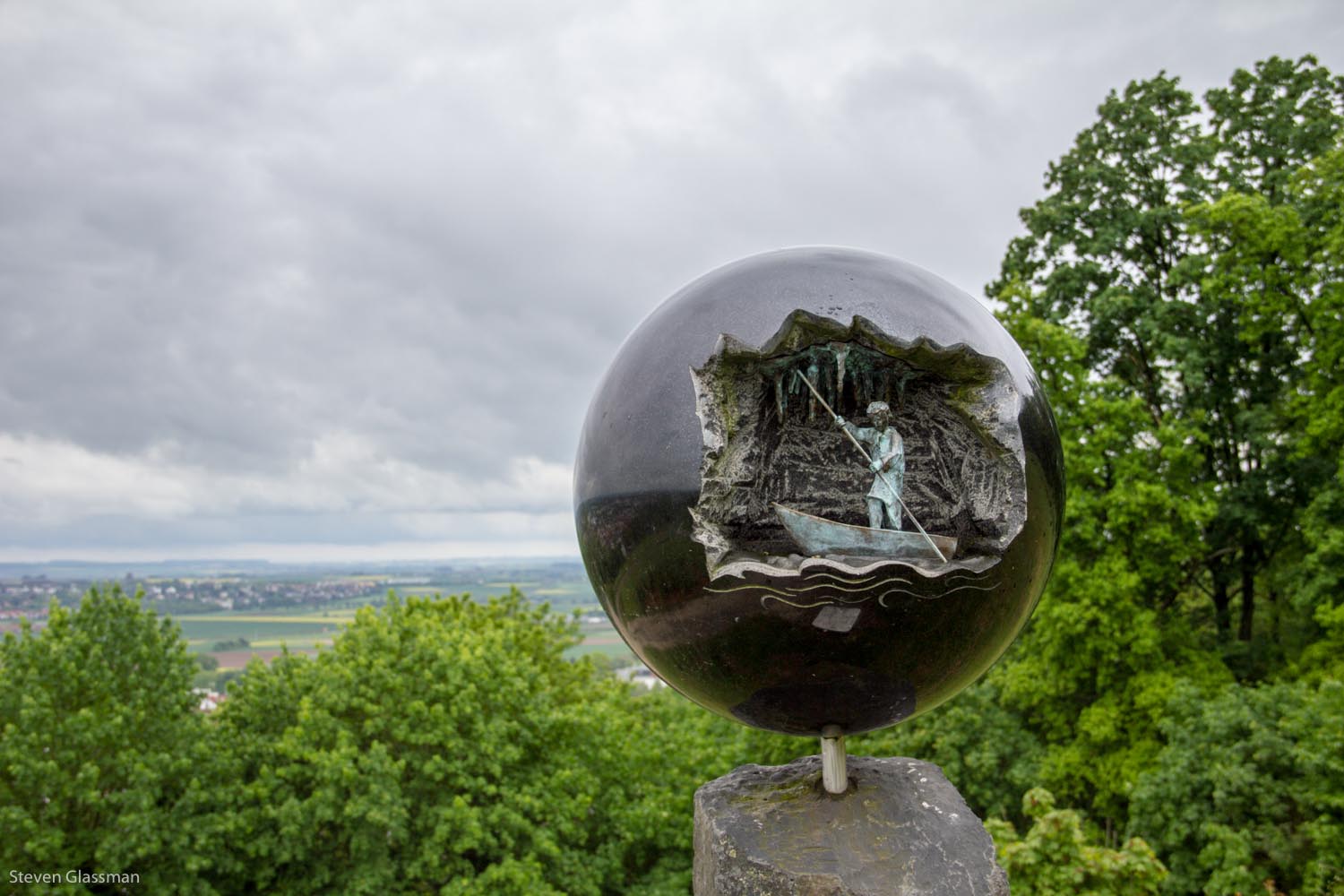
The last part of this walk was a real treat- the Planetenwanderweg was obviously established before Mike Brown and Neil deGrasse Tyson demoted Pluto to the status of Dwarf Planet. To reach Pluto, you have to go up the hill past Neptune, then jog left a bit, then up some stairs, then cross a street, then up some more stairs, then up an ascending path toward the Johannisberg Cafe and Hotel.
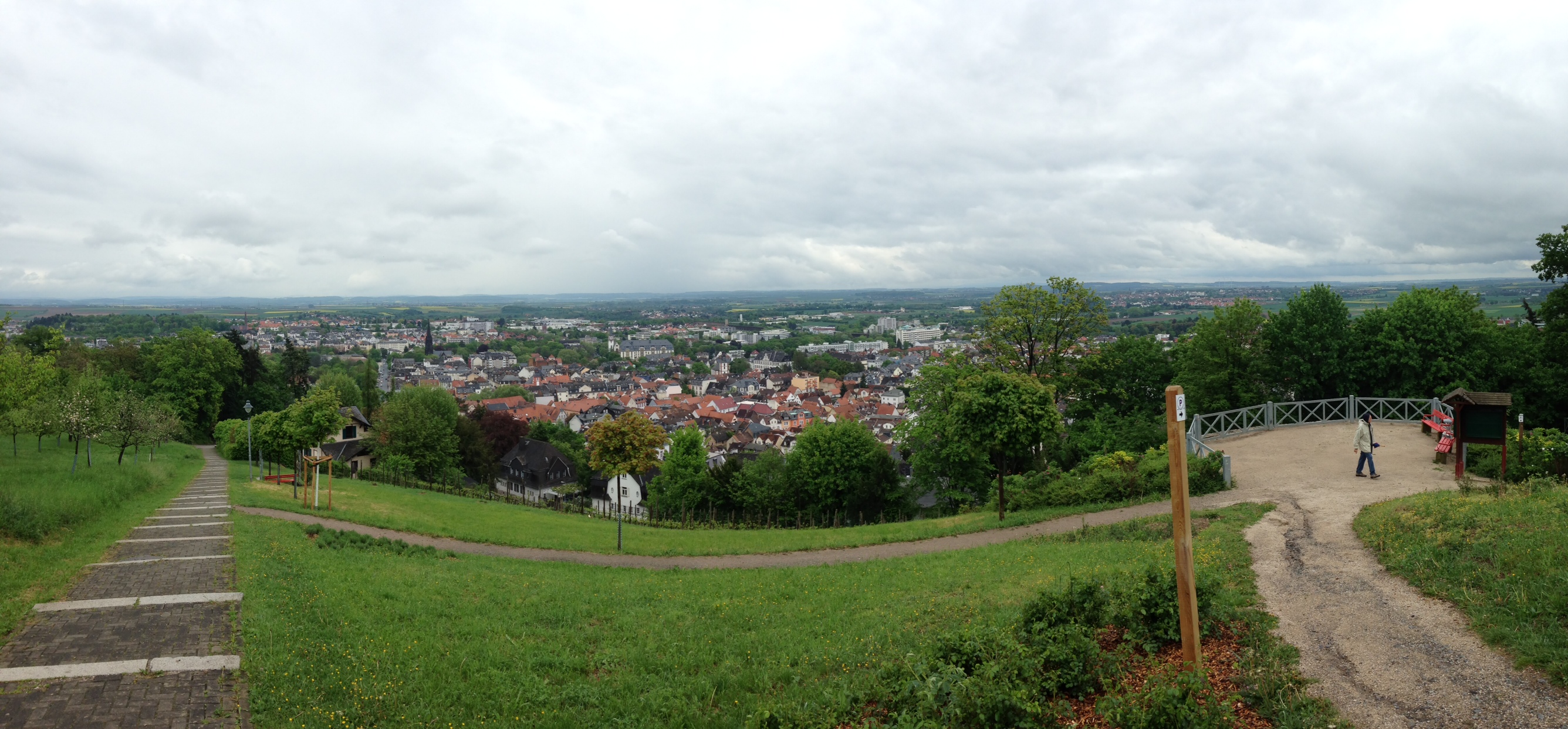
I was out of breath when I reached little Pluto, but the view was completely worth it.
Oh yeah, and there’s this:
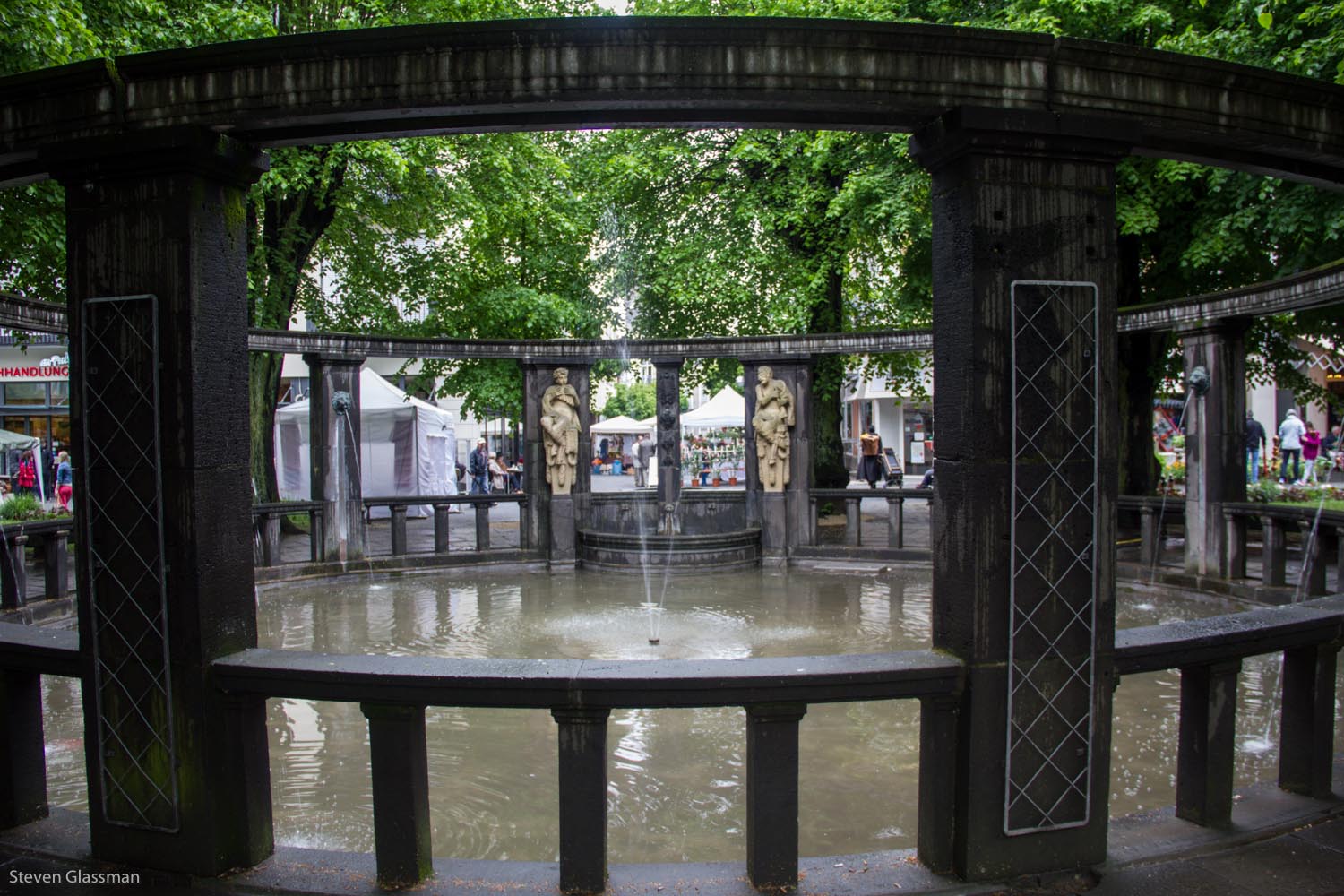
After successfully exploring the solar system, I walked back down the hill to head back to Frankfurt. On the way back, I discovered that Bad Nauheim is a pretty little town. This amazing fountain was on my walk back.
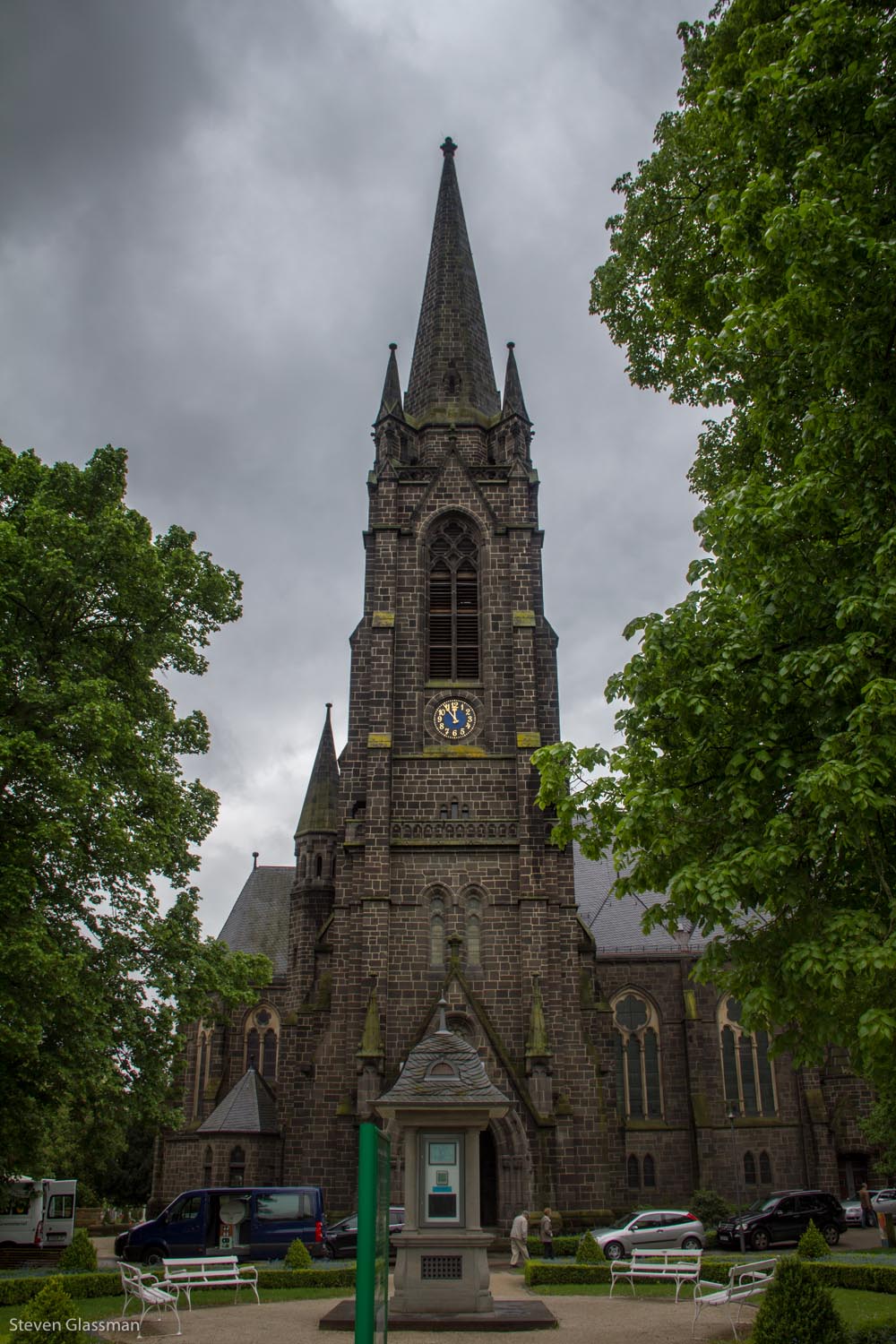
They also have a tall and pointy church. Standard issue in Germany, I believe.
Archways lead back toward the big fountain and the Kurzpark.
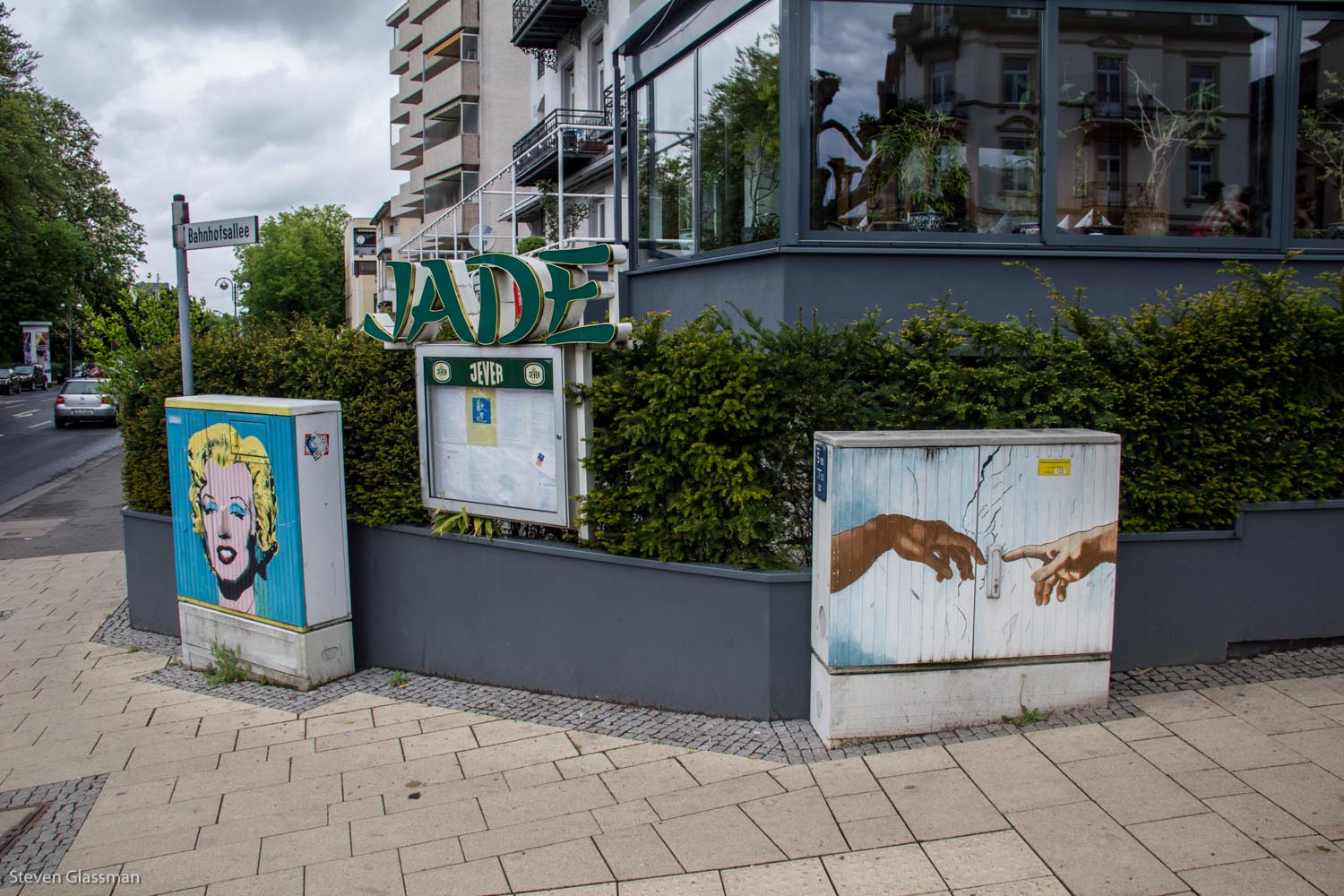
…and there was art everywhere. These two are painted on the utility boxes in front of the Jade restaurant.
Have you ever been to Bad Nauheim? Did you find Elvis?
I’ll be breaking up my Belgium and Luxembourg posts into smaller chunks and posting them out of sequence, because I took almost a thousand photographs in four days. I’m not going to post more than 20-30 pictures for any one post, but I still want to space it out a bit so that it’s not too overloading. So, onward!
My first Belgium post was the city of Bruges in Flanders, the northern part of Belgium. I haven’t seen the movie by the same name yet, but I’m pretty sure that referencing the movie’s title in a blog post about Bruges is a requirement in the Expat Blogger Bylaws. Bruges is the capital of West Flanders, where Ghent is the capital of East Flanders. For a country with relatively small geographic boundaries, there are an awful lot of subsections of Belgium. There are also a great many languages, since Belgium is officially bi-lingual. The northern parts speak Flemish, which is a bit like Dutch, and the southern parts speak French. There’s also a small German-speaking community on the eastern side of Belgium, and English is prevalent as well.
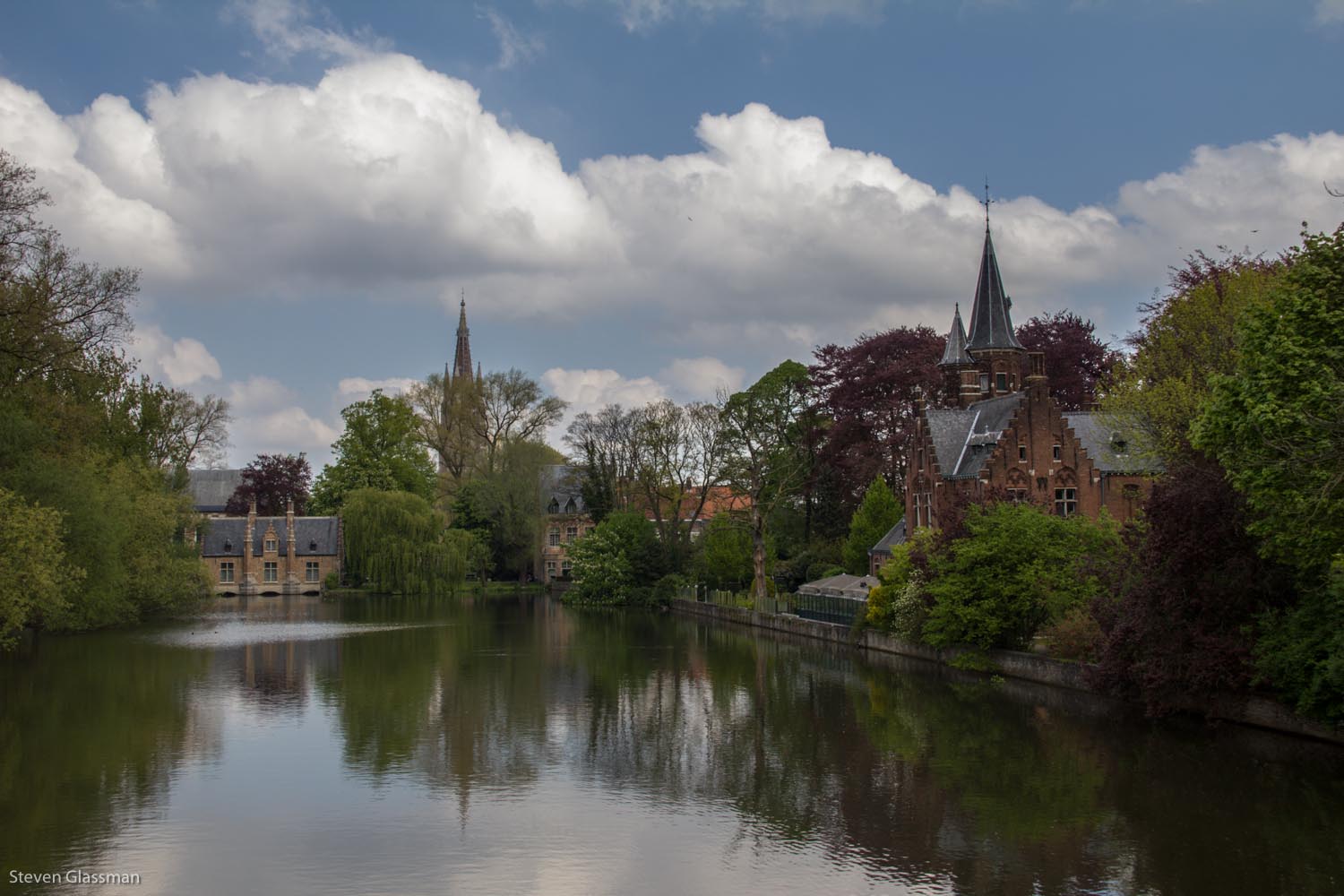
The main export of Bruges seems to be pretty photographs from tourists. If you arrive on a bus from Brussels, as I did, you might start out near Minnewater, or “Lake of Love.” The story goes that you will experience eternal love if you walk over the lake bridge with your partner. There’s a legend attached, and it’s explained in great detail on this site. Regardless of its efficacy as an aphrodisiac, I can’t argue that it’s a really pretty lake.
Also seen in Bruges: A very large swan and duck community. I took other pictures of large quantities of lounging swans, but this picture just looked nicer.
Not all of my pictures have important captions or details. Some were chosen just because it shows how nice the city is, and how nice a day we were having.
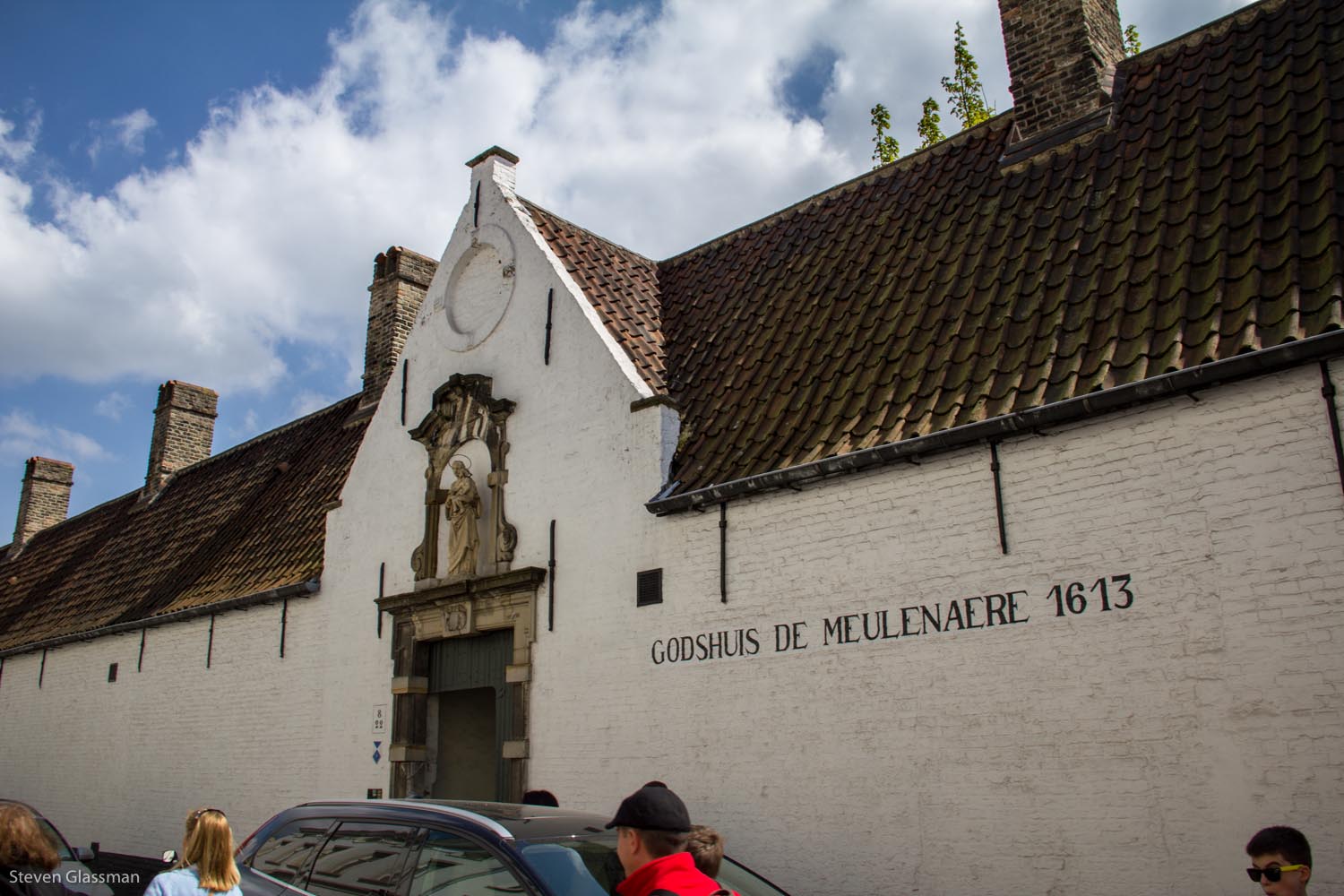
This is a “House of God” where a bunch of nuns used to live. This is a fairly common thing in Bruges. There was a lot of detail about this from the tour guide which I missed.
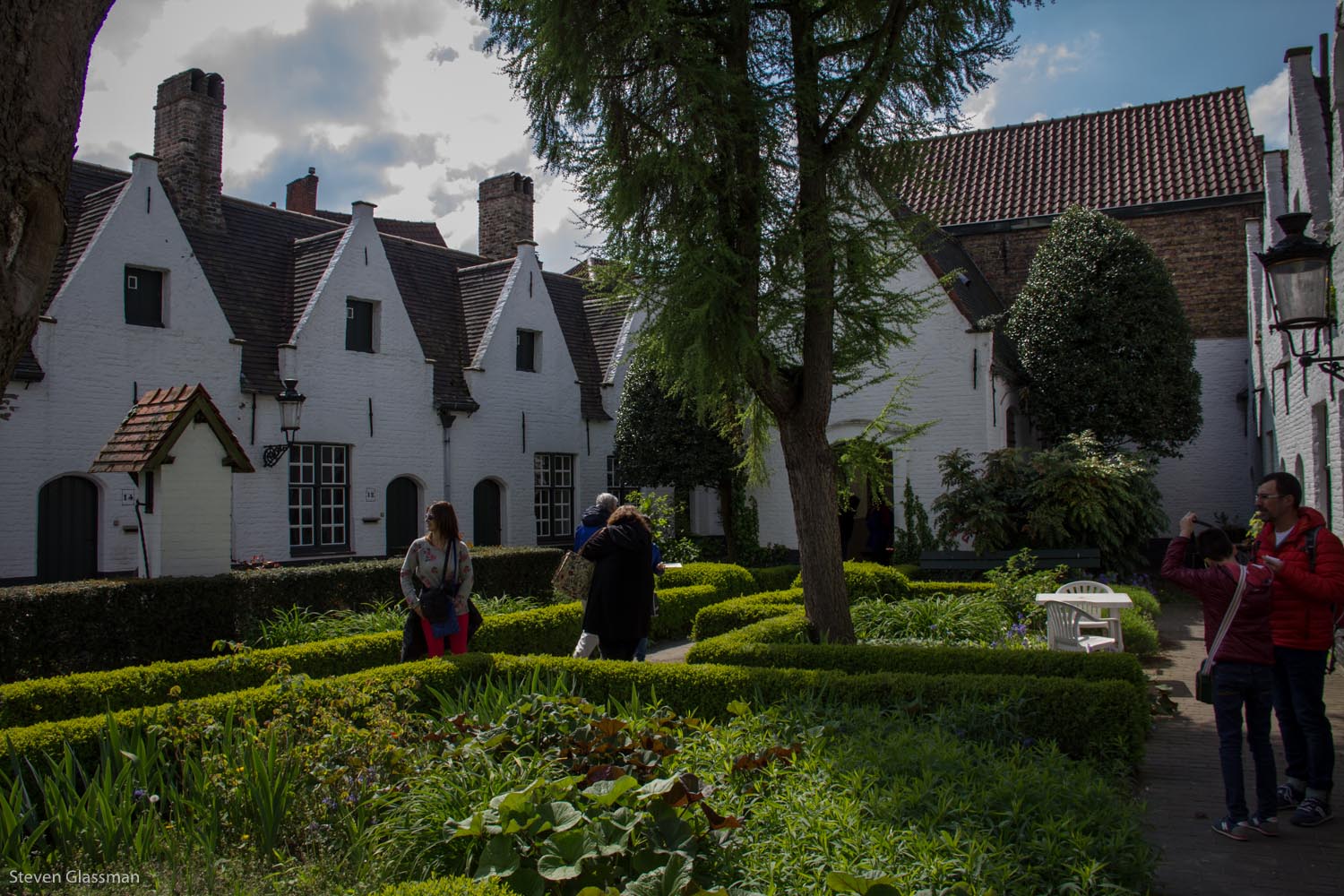
This is the courtyard inside the House of God.
…and this is why I missed what the tour guide was saying. I was too busy stalking a bee with my camera, because that’s how I roll. I quite like bees.
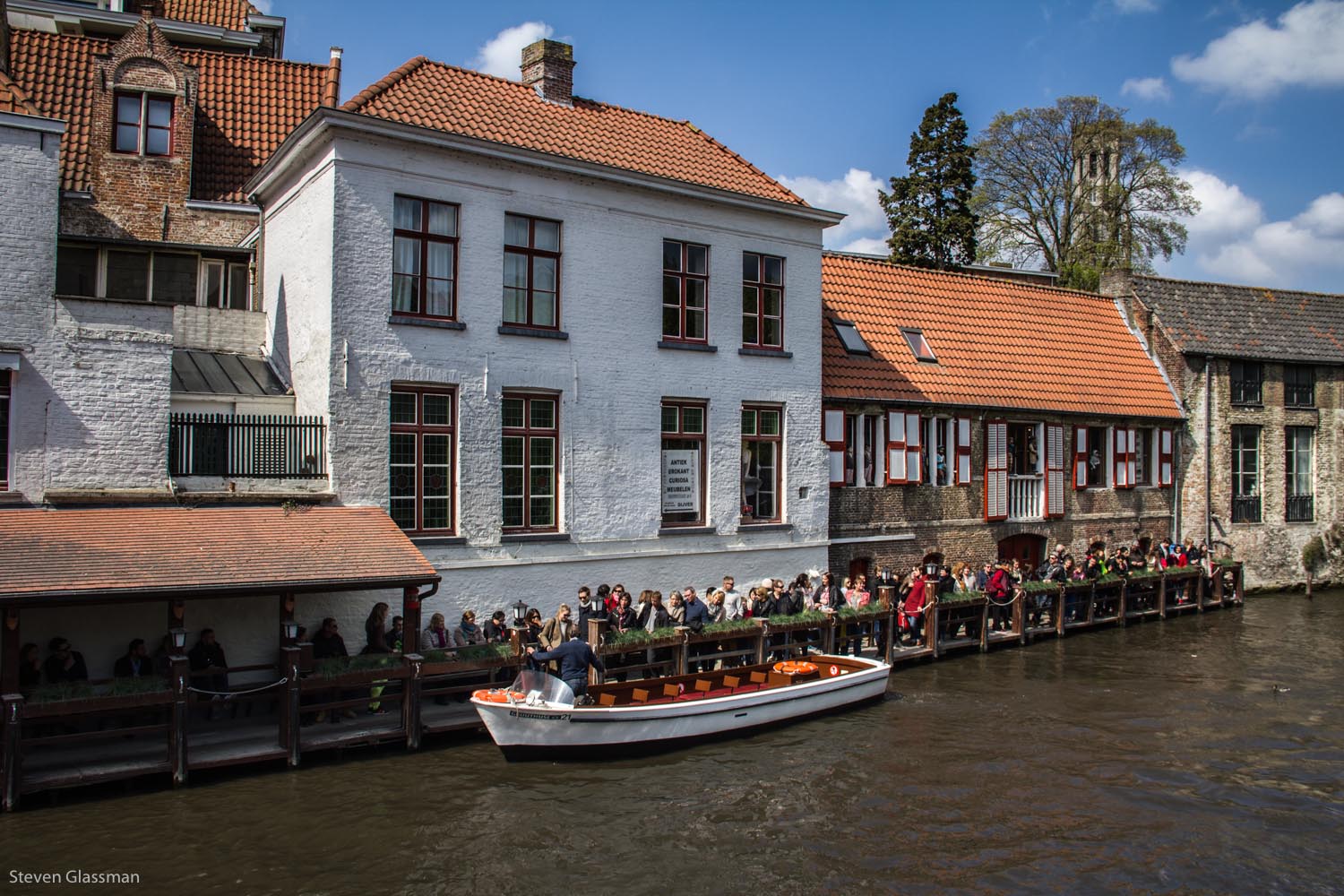
We took a boat tour later in the day, because it covers three or four kilometers of city canal and it’s quite pretty. This was not the boat I was on, but it’s a good shot of the type of boat- they really pack people onto these things. They offer life vests, but most of the canals are only a meter or two deep, so if you fell in you would probably survive quite easily.
I don’t really know why there’s a random Bogey statue here, but I thought it was kinda neat.
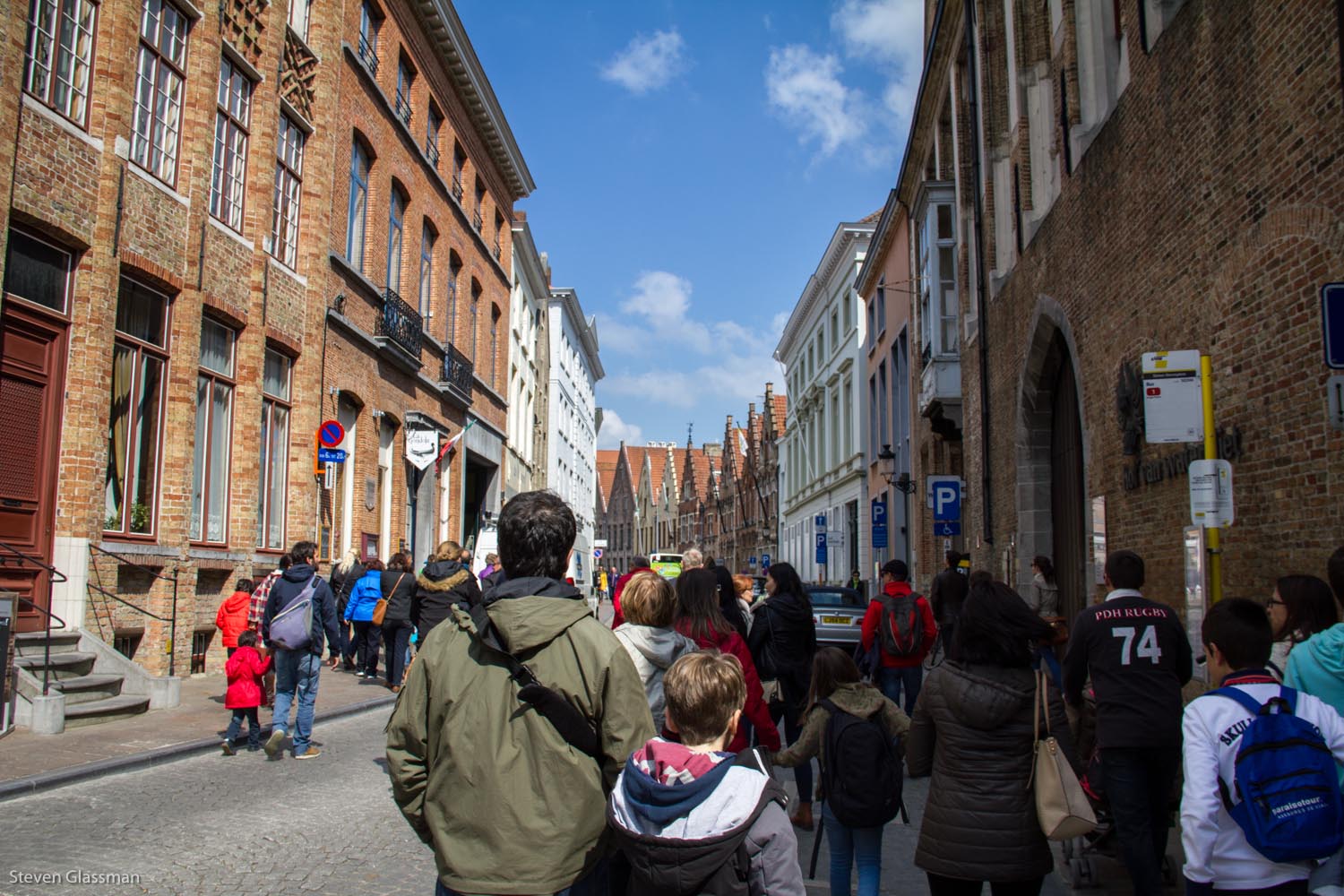
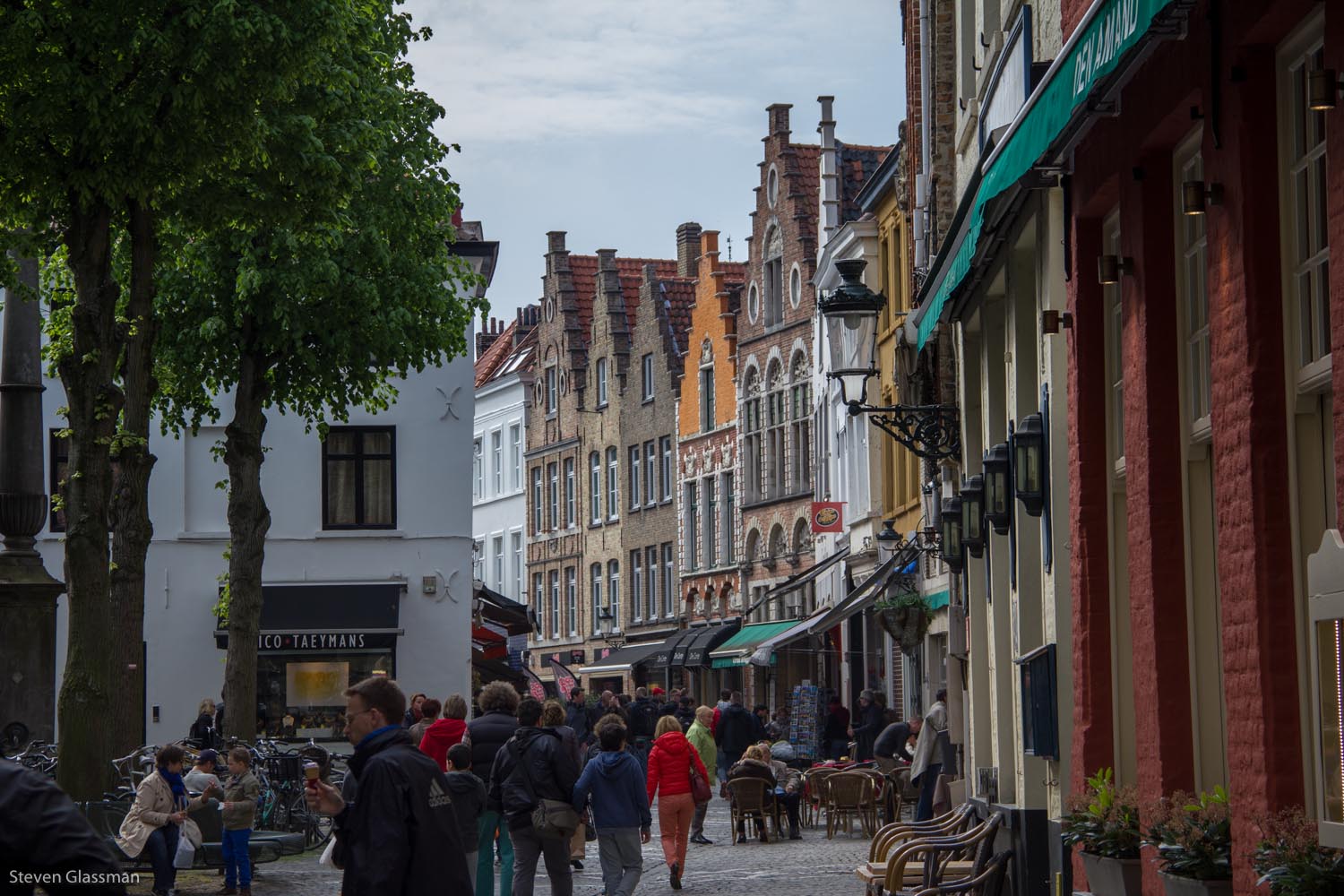
Picturesque street, walking in the direction of the Markt, the main market square.
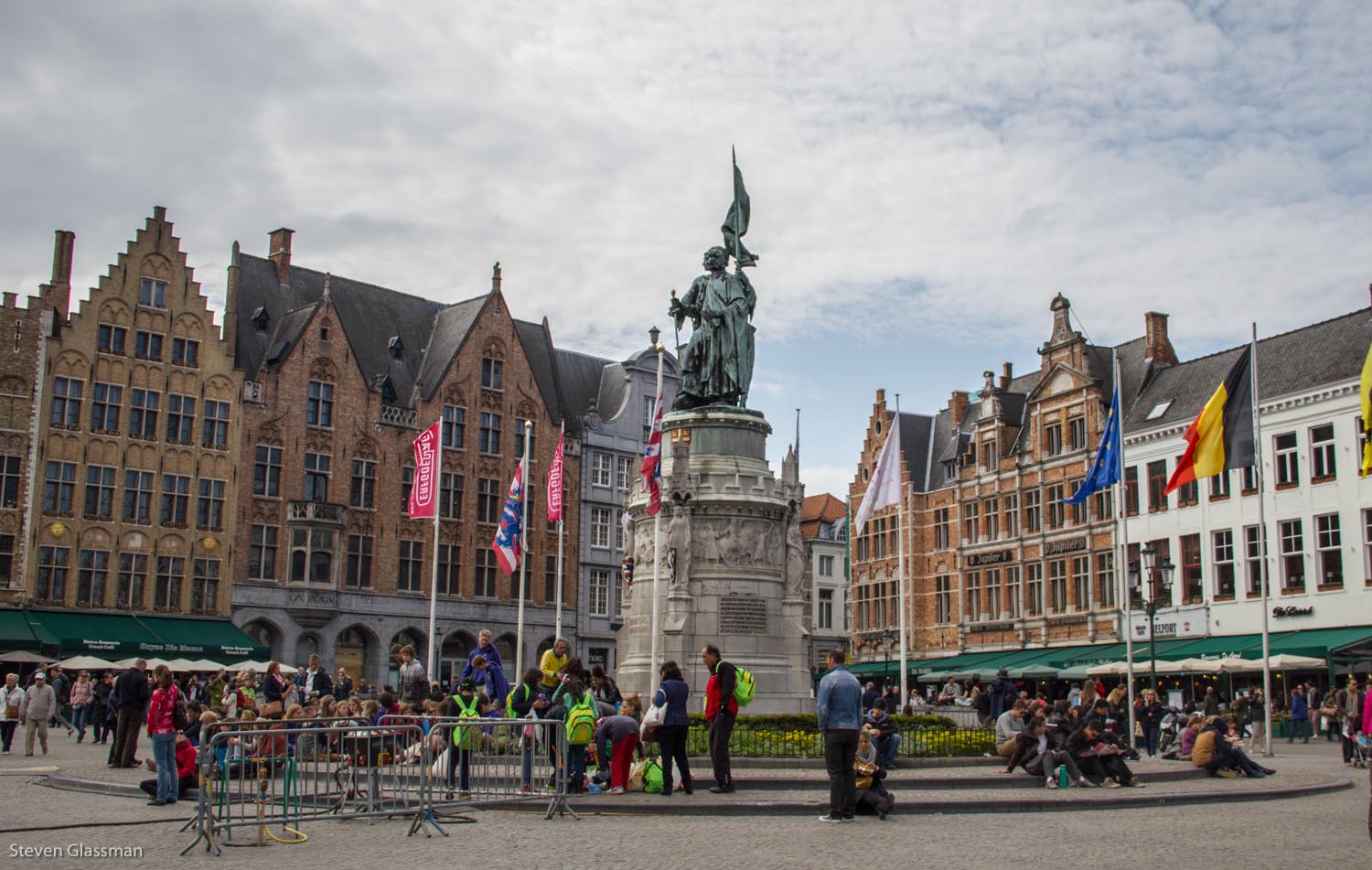
One side of the Markt.
The opposite side of the Markt. This is the Stadthuis, or City Hall. In Germany, they’d call this a Rathaus.
Flag time! The one in the center is the flag of Belgium. It has the same colors as the German flag, but vertically and in a different sequence than Germany’s horizontally barred flag. The flag on the left is the flag of Flanders, and the one on the right, not really clearly visible in this picture, is the flag of the city.
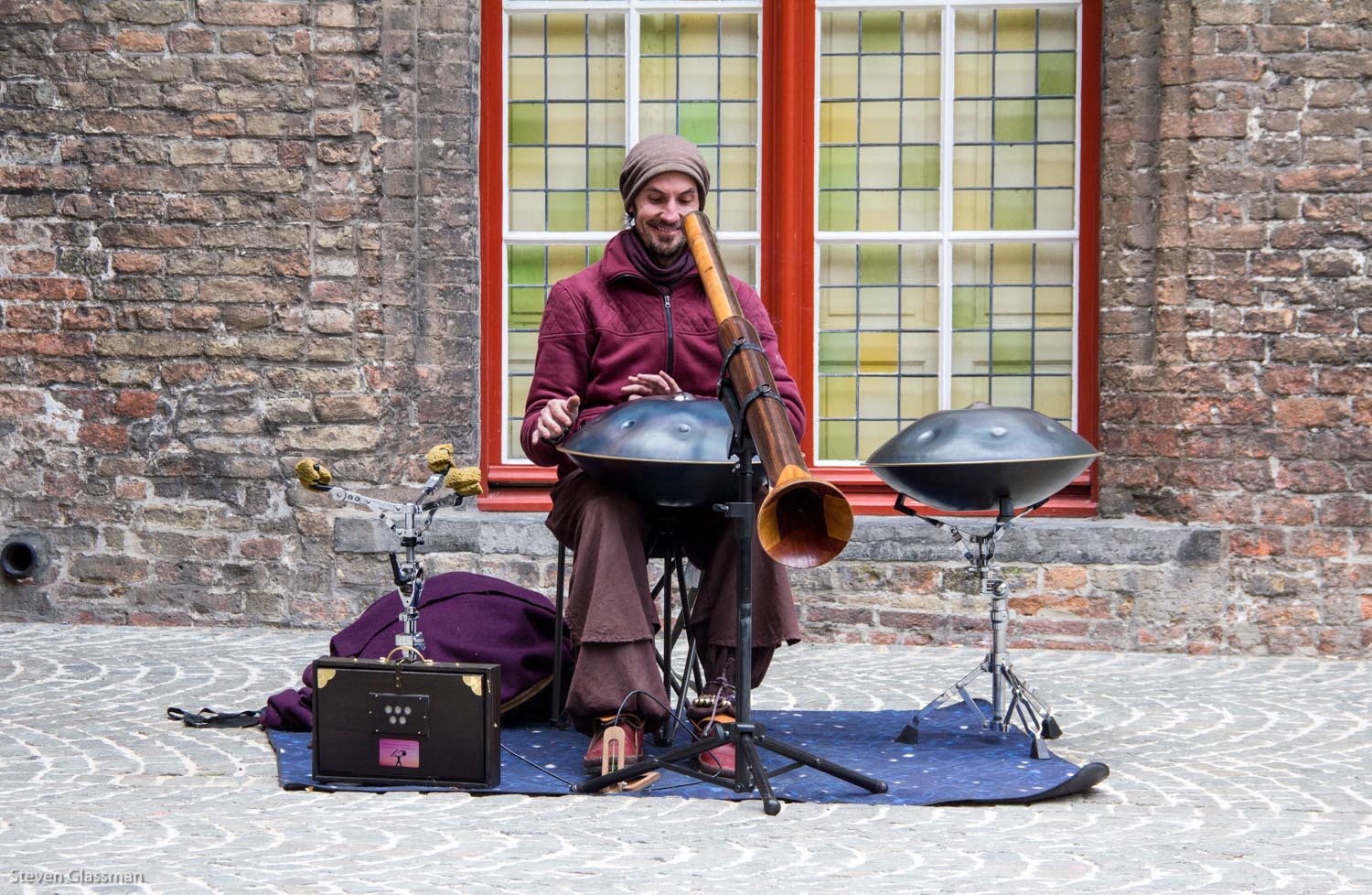
Ever seen a hang drum? They’re kind of amazing if played well. This dude was set up in the courtyard behind the Belfry, the Markt’s big tower visible a few pictures further down.
This video is not the same hang drum player as the one in Bruges, but you can get a sense of what the instrument sounds like.
This is also in the Markt.
Throughout the day, I kept seeing people on tandem bicycles. I’ve never seen so many two-person bikes as I did in Belgium.
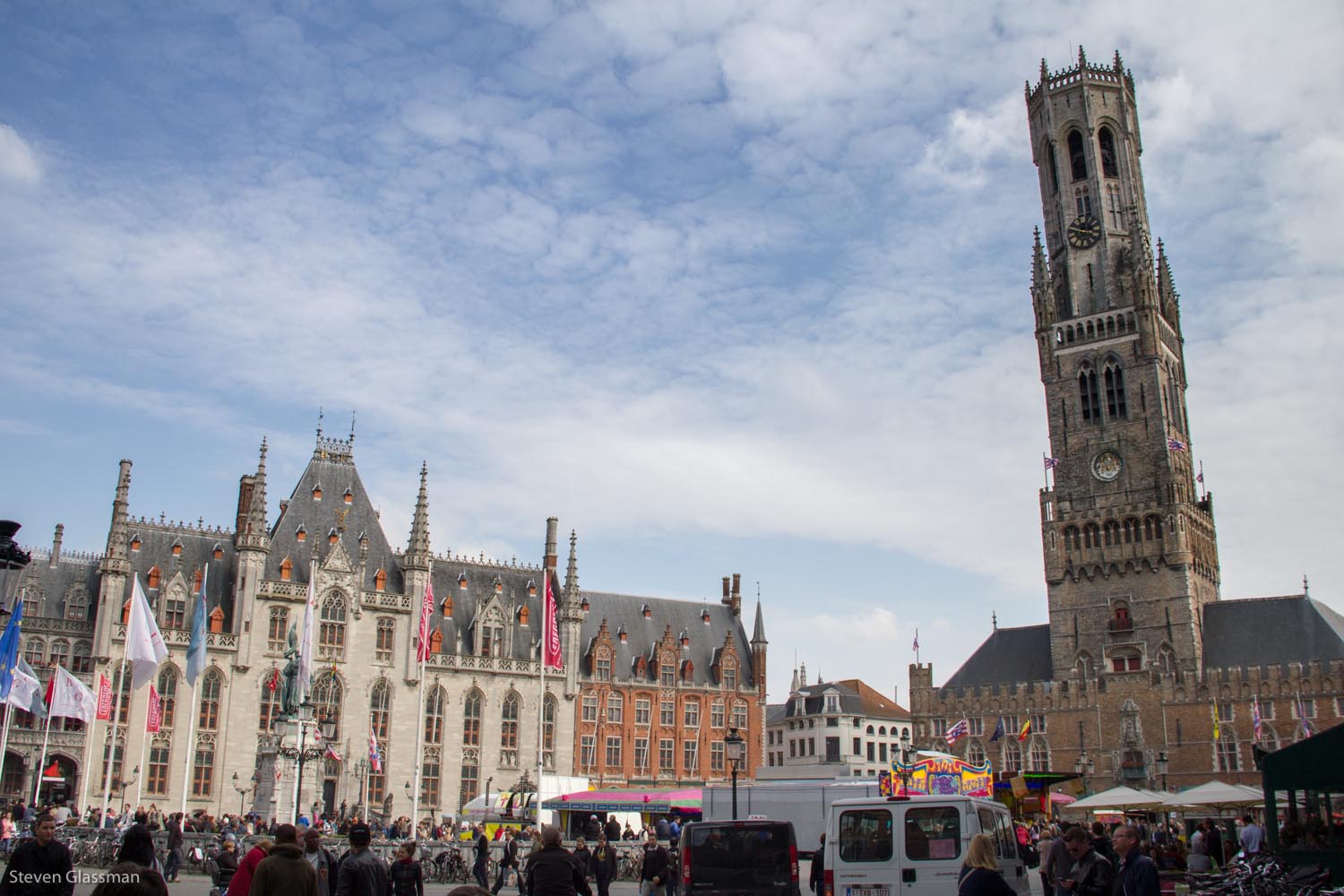
This is a picture from across the Markt. It’s the only shot where I managed to get the entire Belfry tower into the picture because most of my other photographs were taken from the base of the Belfry. I did not get to climb this one- the line to get in was longer than the amount of time I had.
I did some wandering from square to square. The pointy buildings in the center of this shot are typical of Bruges architecture.
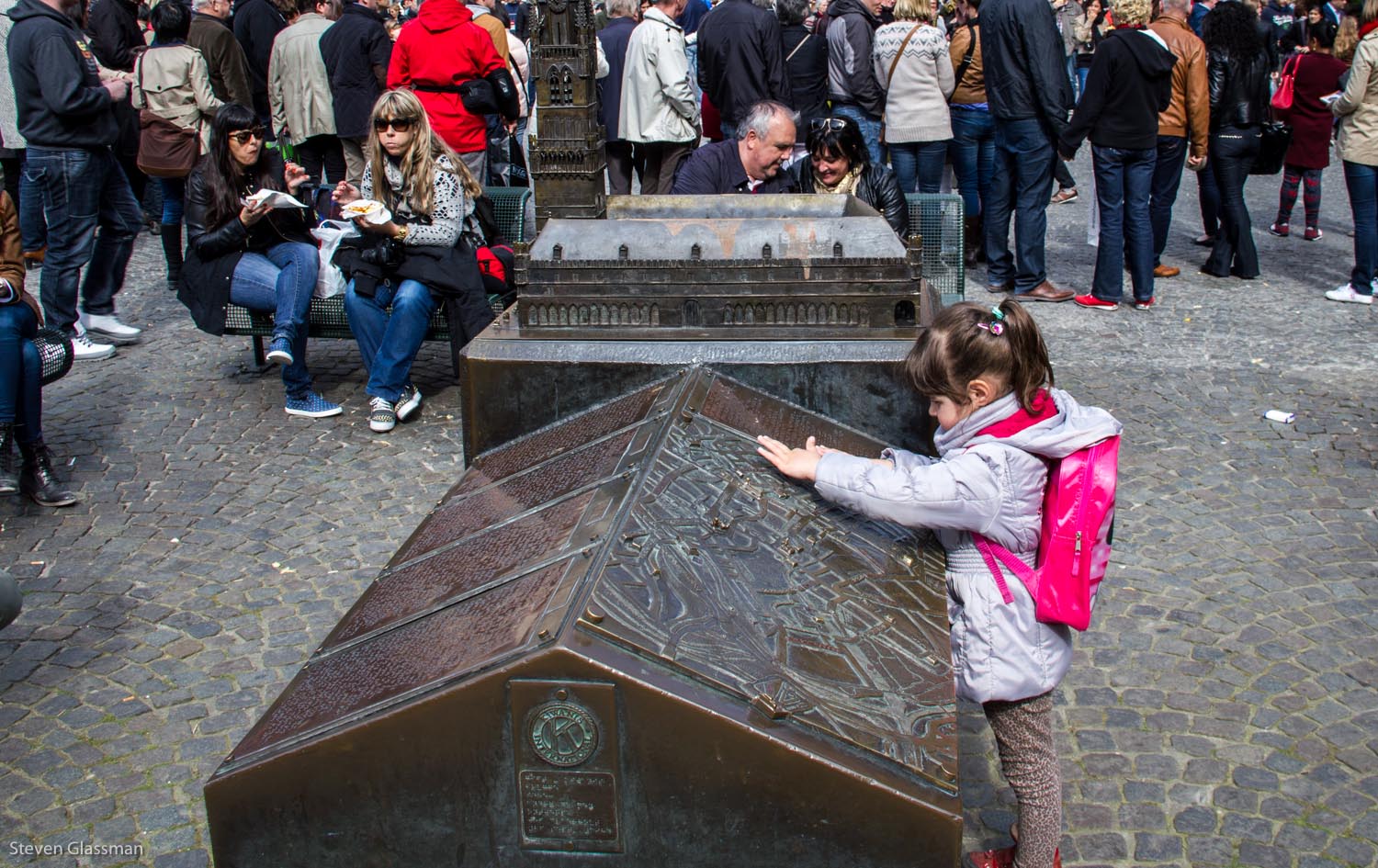
Many of the cities have these metal relief maps, with braille on them. It’s rather ingenious, even though I can’t even imagine how a blind person would find their way through the maze of the city to find the braille map without assistance.
In other news, the facial expression on the blonde girl eating in the background is hilarious. I didn’t realize she was making that face until I was sorting my photos.
City squares always seem to have “floating” dudes trying to make some cash. This one was a little different though- normally they’re seated. They all have the giant weighted base and the staff going up to the left arm- I’m positive that’s what’s supporting his weight. This one was different in that he kept swinging his legs back and forth. He may have had stirrups or something. In any case, it’s a pretty striking illusion. If I hadn’t seen this five different ways in five different cities, I might not have spent so much time thinking about how it’s done.
This dog was so very happy. They kept feeding him!
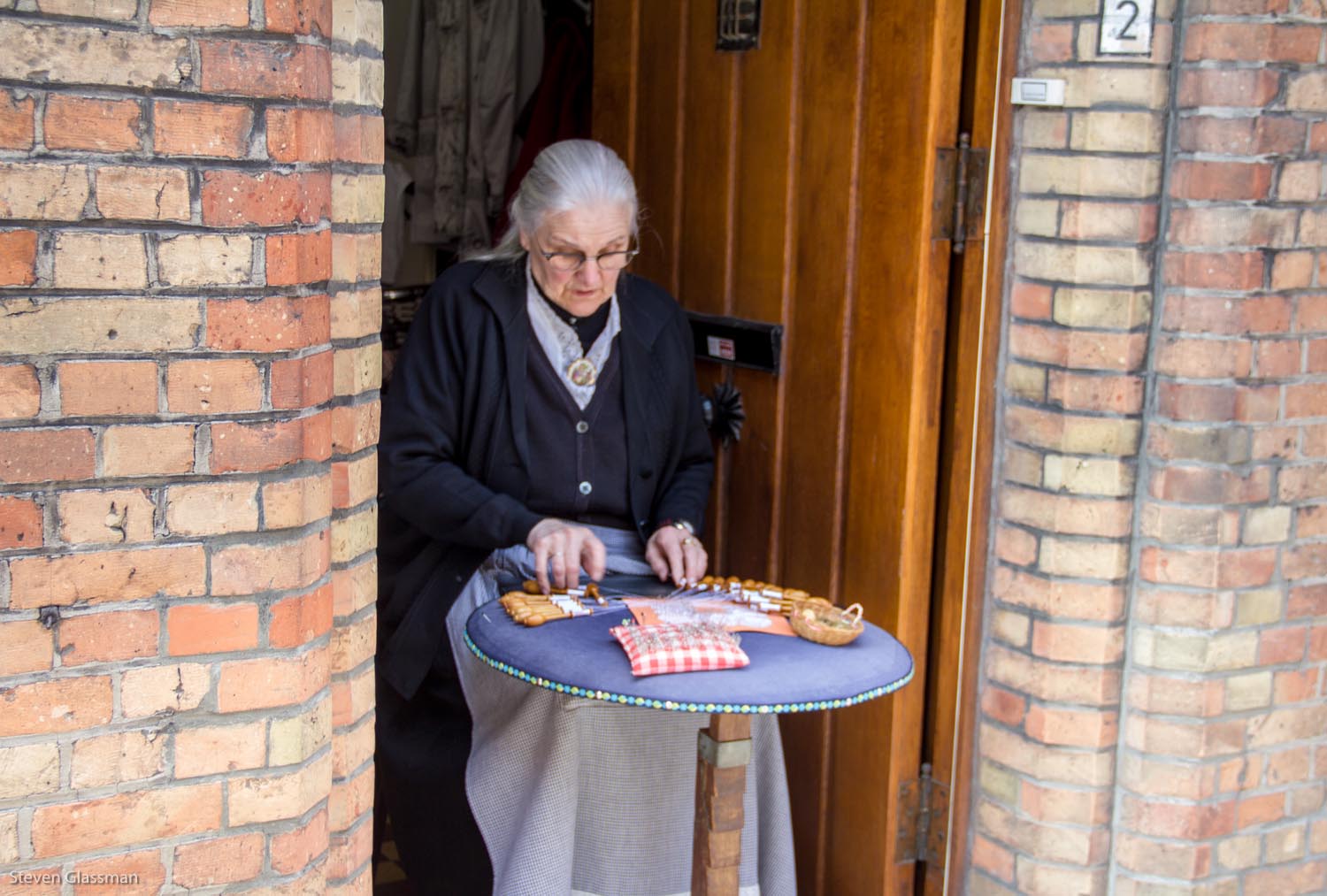
There were displays of lace all over the city and I didn’t make the connection to Brussels Lace until I saw this woman actually sitting in her doorway making lace in real time.
In hindsight, I should have gotten some video- she was moving her hands incredibly fast.
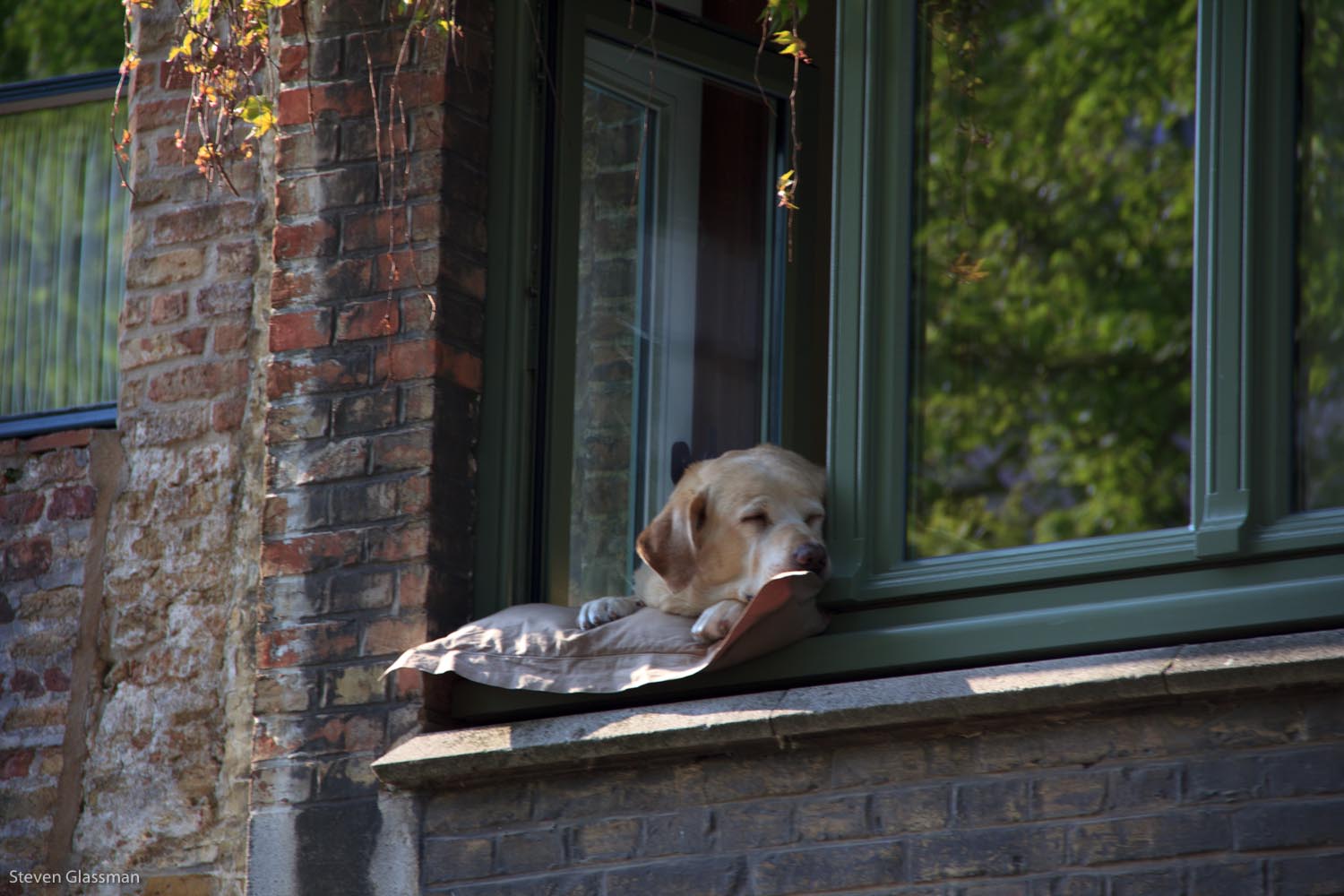
Of all the pictures I took from the canal boat cruise part of the day, this is the very best one. This dog was snoozing in a window that was canal adjacent. It looked like the perfect place to have a nap.
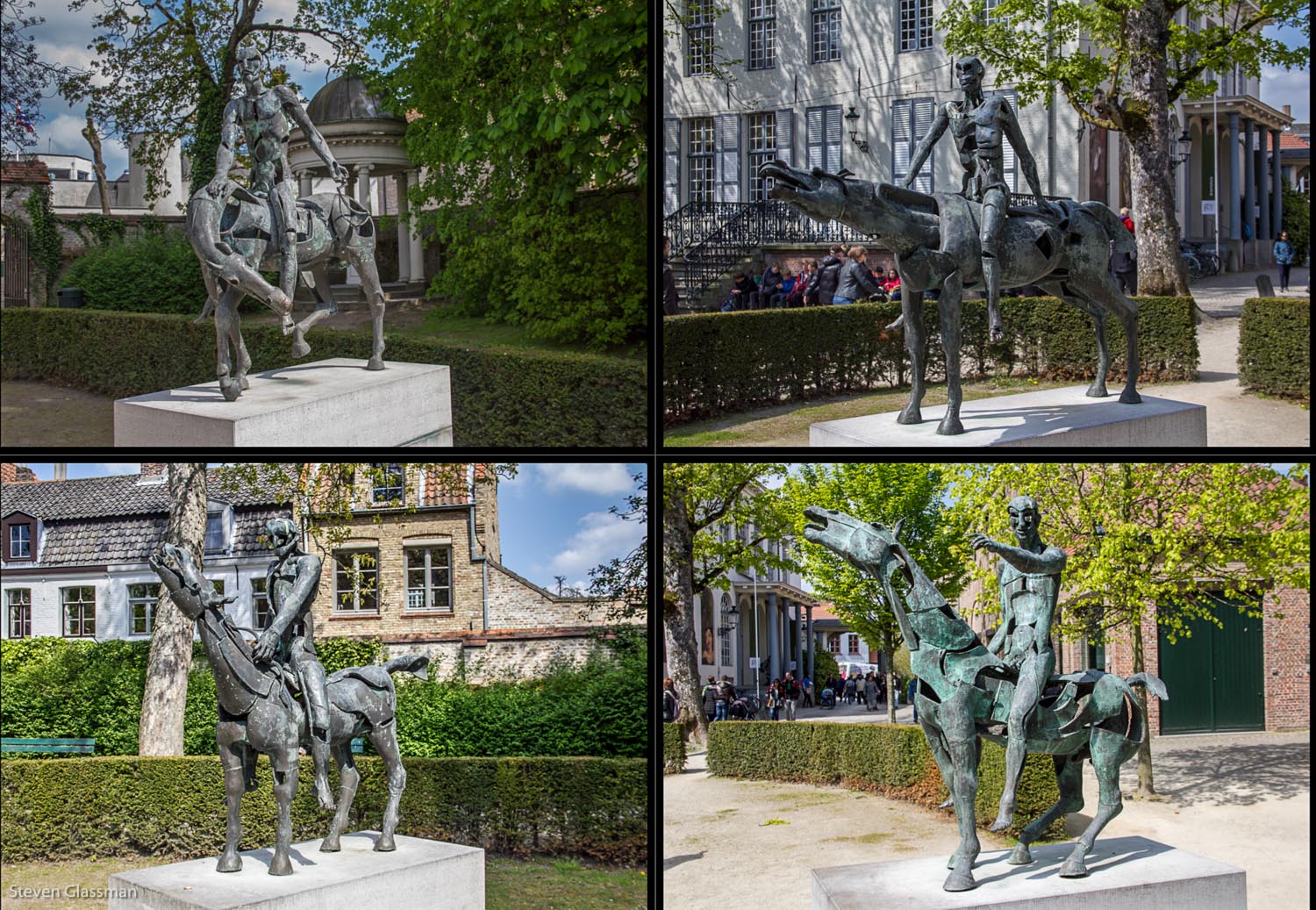
On the walk back to the bus, we passed through a sculpture garden containing sculptures of the Four Horsemen of the Apocalypse, by sculptor Rik Poot.
I’ll give you a moment to stop giggling about the man’s name.
So the one in the upper right is obviously Death, but I’m not certain of which is which on the others. Clockwise from Death, I believe it’s War, Famine, and Pestilence. I could easily be wrong though, and I didn’t think to photograph their labels while I was there.
Every year, on Palm Sunday, the Prösslbräu Brewery in Adlersberg has a one-day festival called Palmator, a celebration of their dark, strong bock beer of the same name. On this day each year, the Palmator is first served from the brewery’s kegs. On an unrelated note, any time I put anything about this brewery into Google Translate, I have to giggle. Adlersberg is the name of the place where the brewery stands, but it literally translates to Eagle Mountain. This amuses me greatly.
The first year I was here, I attended Palmator and was blown away by how strong the stuff is- and how delicious. Last year I skipped it because we weren’t done with our seven months of winter and the temperatures were below freezing. This year, the weather was perfect. I went with some friends, and we walked up the hill. It’s possible to get there without walking up this hill, but where’s the fun in that?
We had pretty spectacularly nice weather. This is the view from the top of that same hill.
They changed the layout since the first year I went to Palmator. There was much more tent coverage before, whereas now they’ve done away with the tent and left more beer garden style seating out in the open. This is much nicer, actually, particularly if the weather is rocking like this.
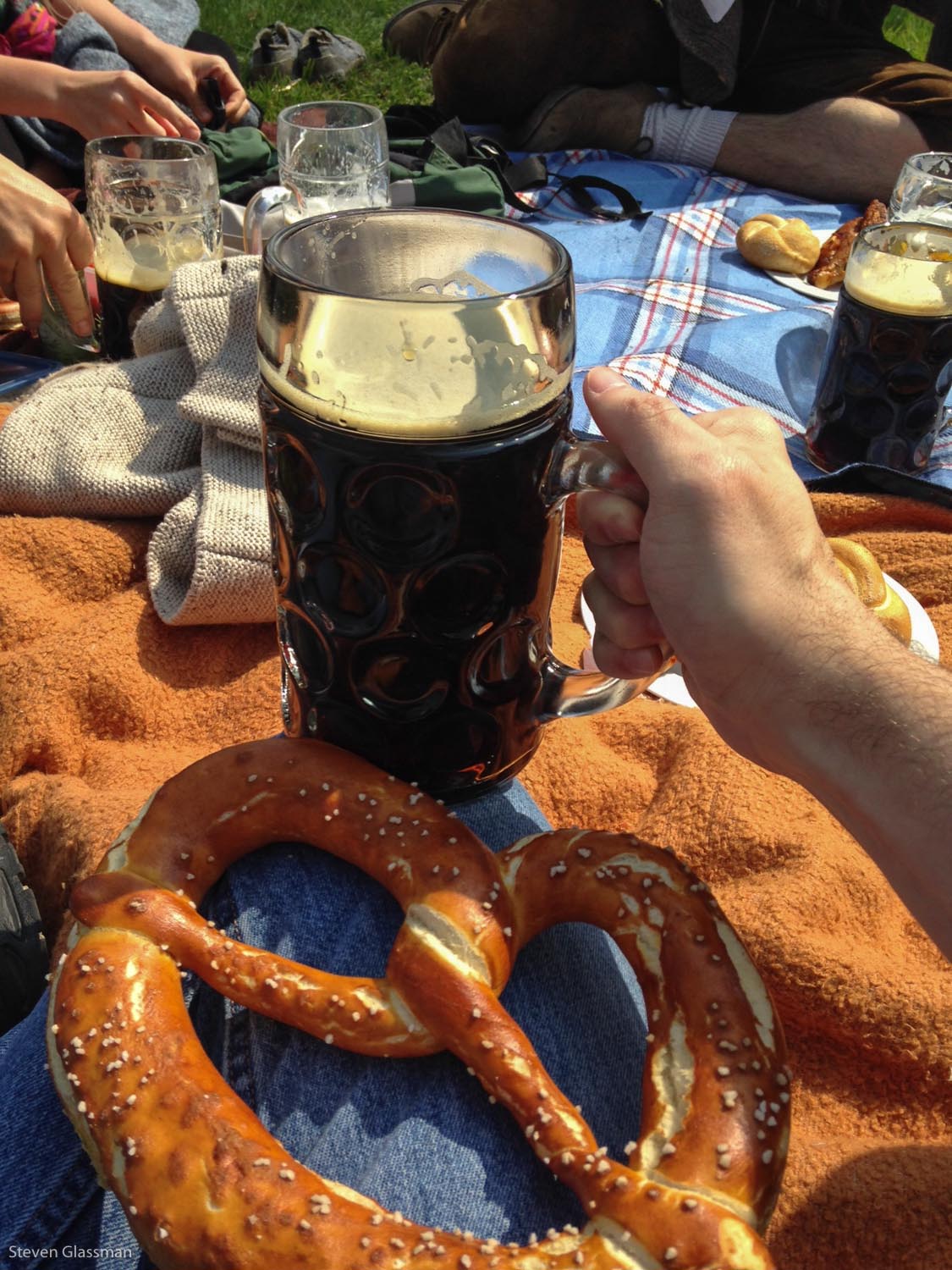
This is the beer in question- the Palmator. It is absolutely delicious, and extremely deadly. This glass is a Maß, or one full liter of the stuff. By the end of the glass, I was quite buzzed. The giant pretzel was soft and fresh and delicious.
When the tables got full, blankets became the next best way to enjoy the day. Our group brought blankets because my friends are smart like that.
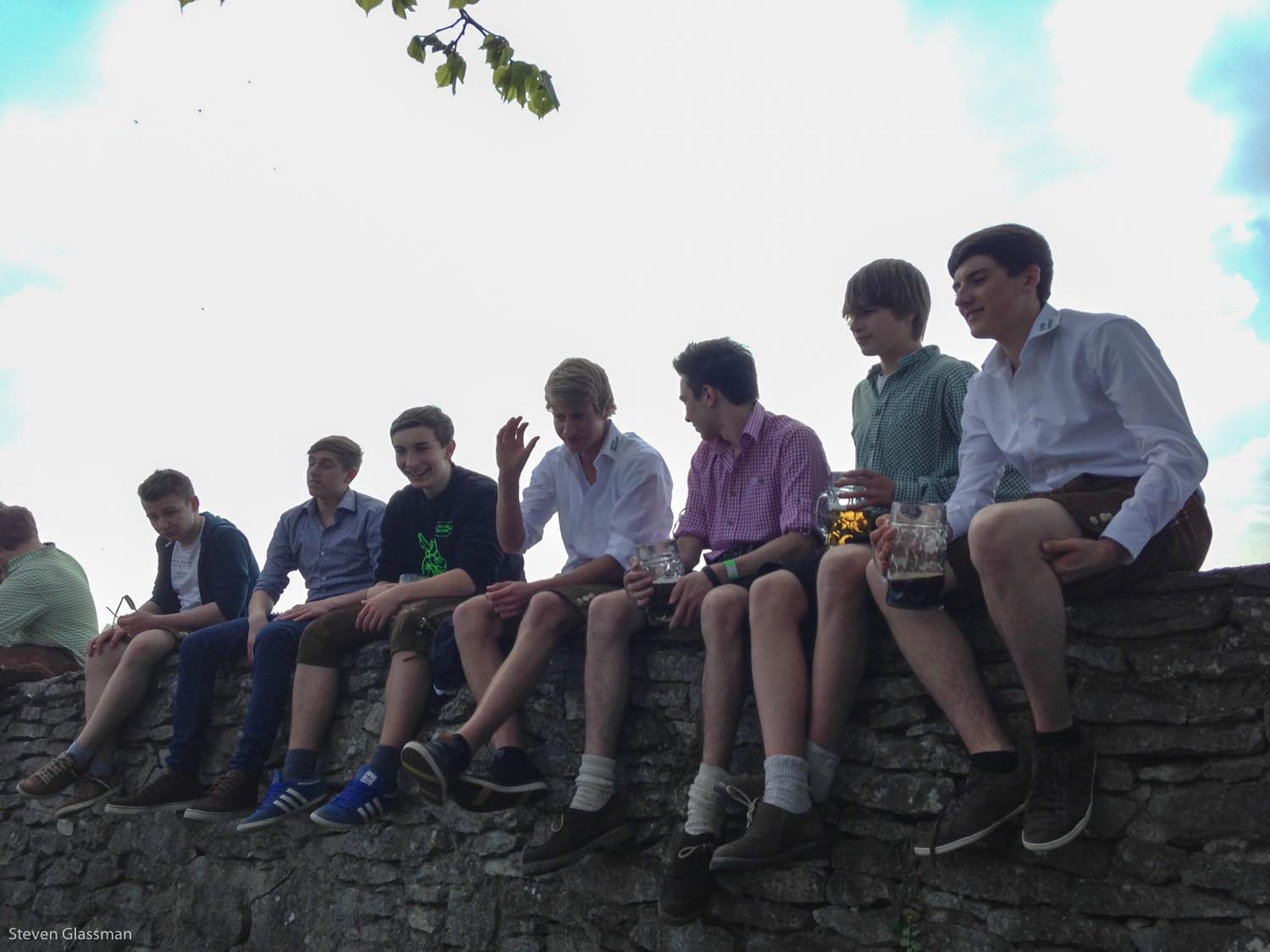
Another popular thing is to sit on the wall. At certain points, the wall is well above my head, but people still clamber up onto it to sit and enjoy their Palmator in the sun.
Have you ever been to Palmator? Have you been to any Starkbierfest?
This weekend, a one-day meetup of bloggers descended on Heidelberg for some tourism and a light lunch. The bloggers who came along for the fun are (in no particular order,) Nina of Indie Rock Kid, Charlotte of Sherbert and Sparkles, Frau Dietz of Eating Wiesbaden, Kathleen of Lehrer Werkstatt, Jordan of Beer Time with Wagner, and Bev of Confuzzledom. I had lots of fun with this group. This is really a great bunch of people, and I highly recommend their blogs for your perusal.
Charlotte, Kathleen, and I started in Frankfurt, and we picked up Nina in Mannheim. From there, we took the S-Bahn into Heidelberg where we were met by Bev and Frau Dietz (with an attached Mini-Dietz accessory.) Heidelberg local Jordan also met us there. She’s a student in Heidelberg, so she served as our tour guide. Once everyone was present, we set out for the castle.
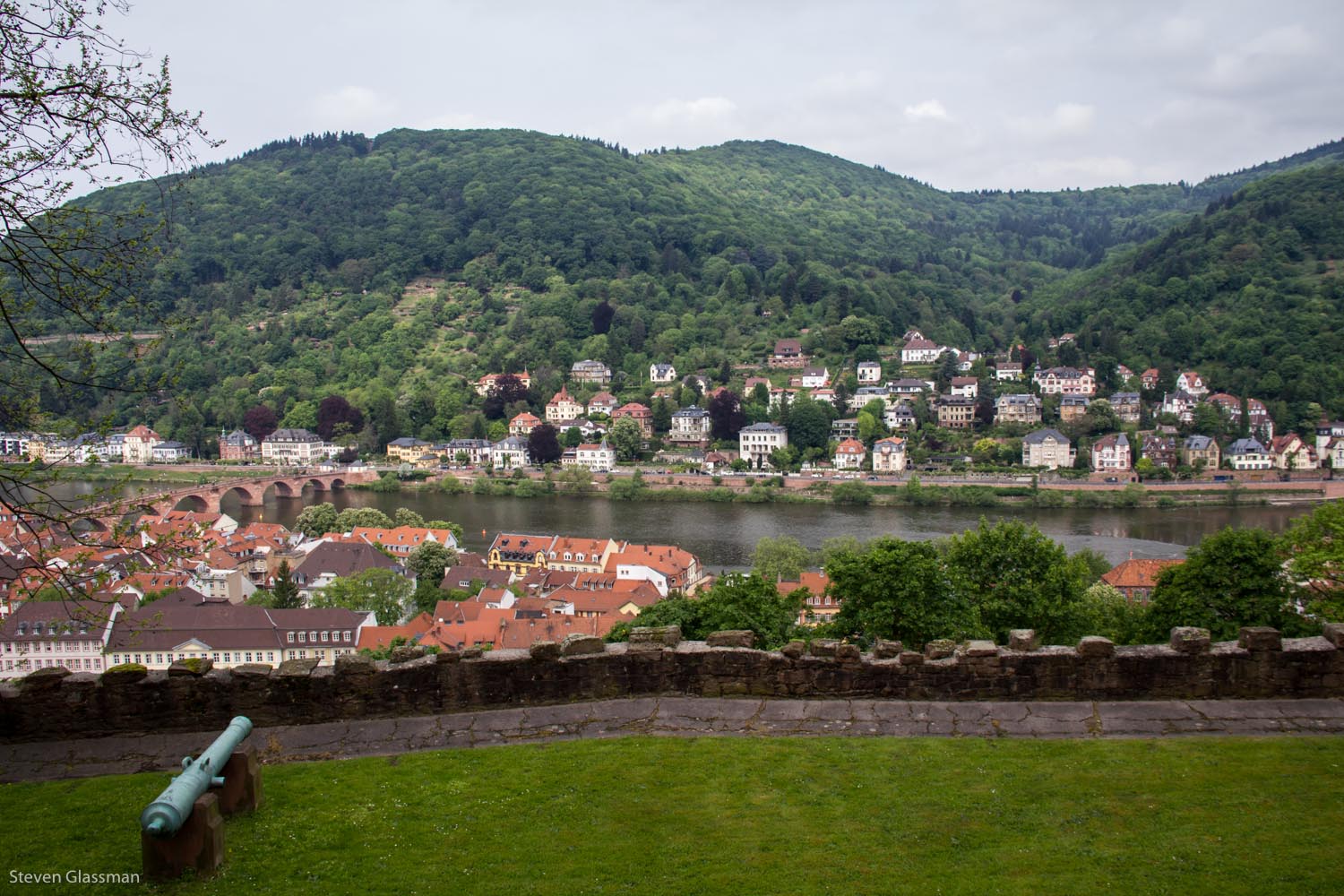
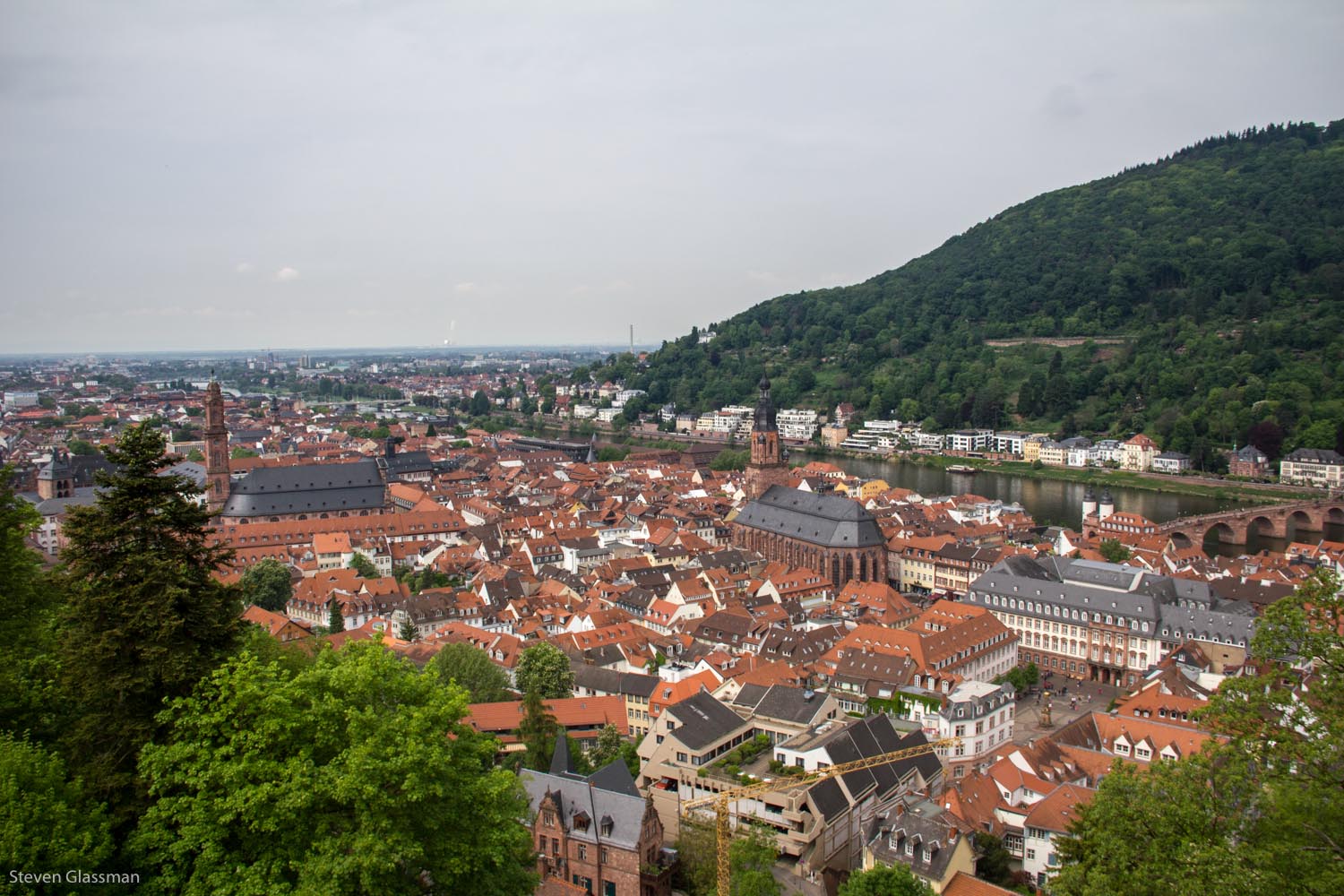
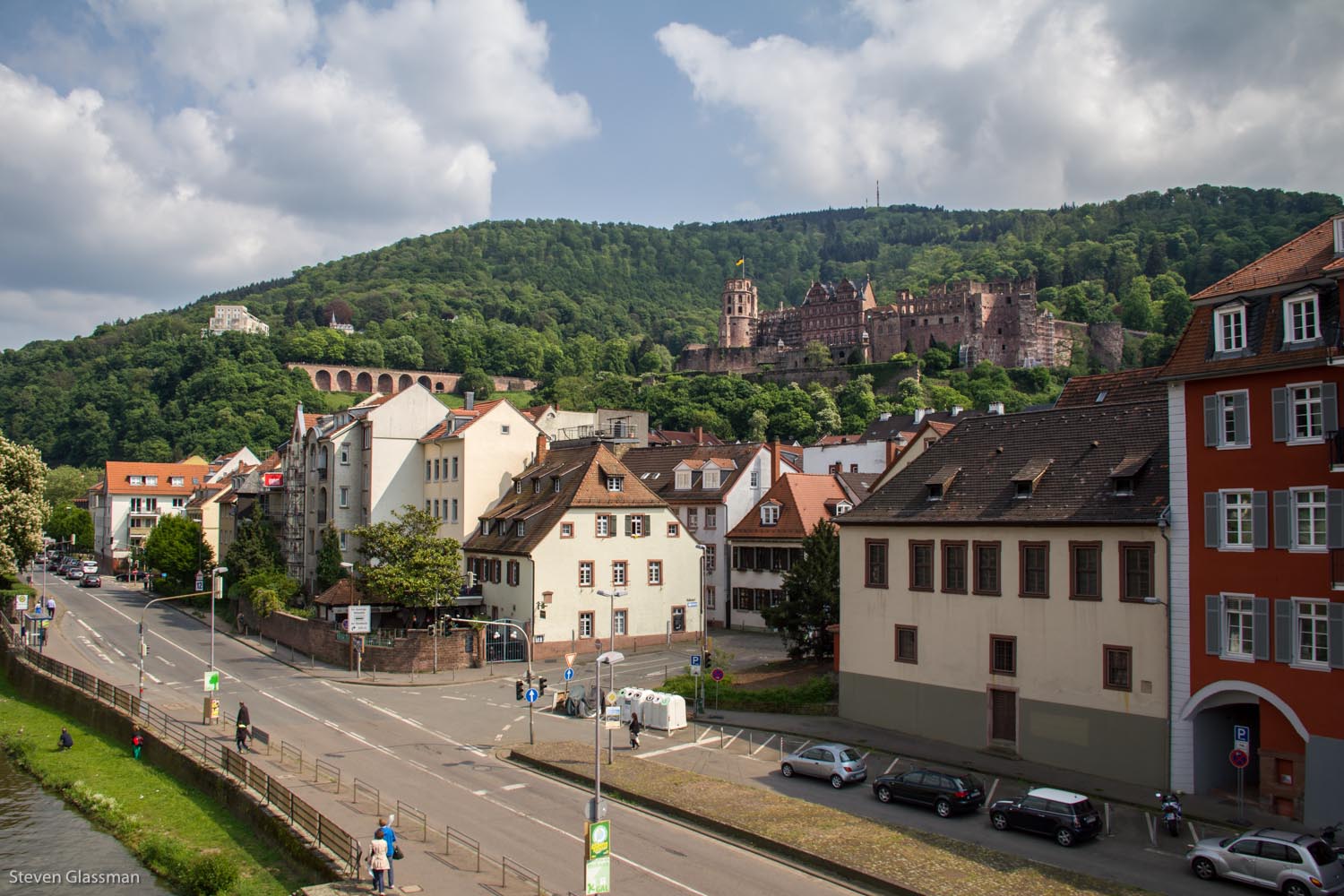
Heidelberg’s castle is on a hillside overlooking the Neckar river. There’s a funicular to get up to the top, but the climb is doable on foot. Steep, but doable. The view from the top is fairly spectacular.
Visible from the top is the Karl-Theodore-Brücke over the Neckar river.
Inside the castle, one of the first things we saw was a giant wine barrel.
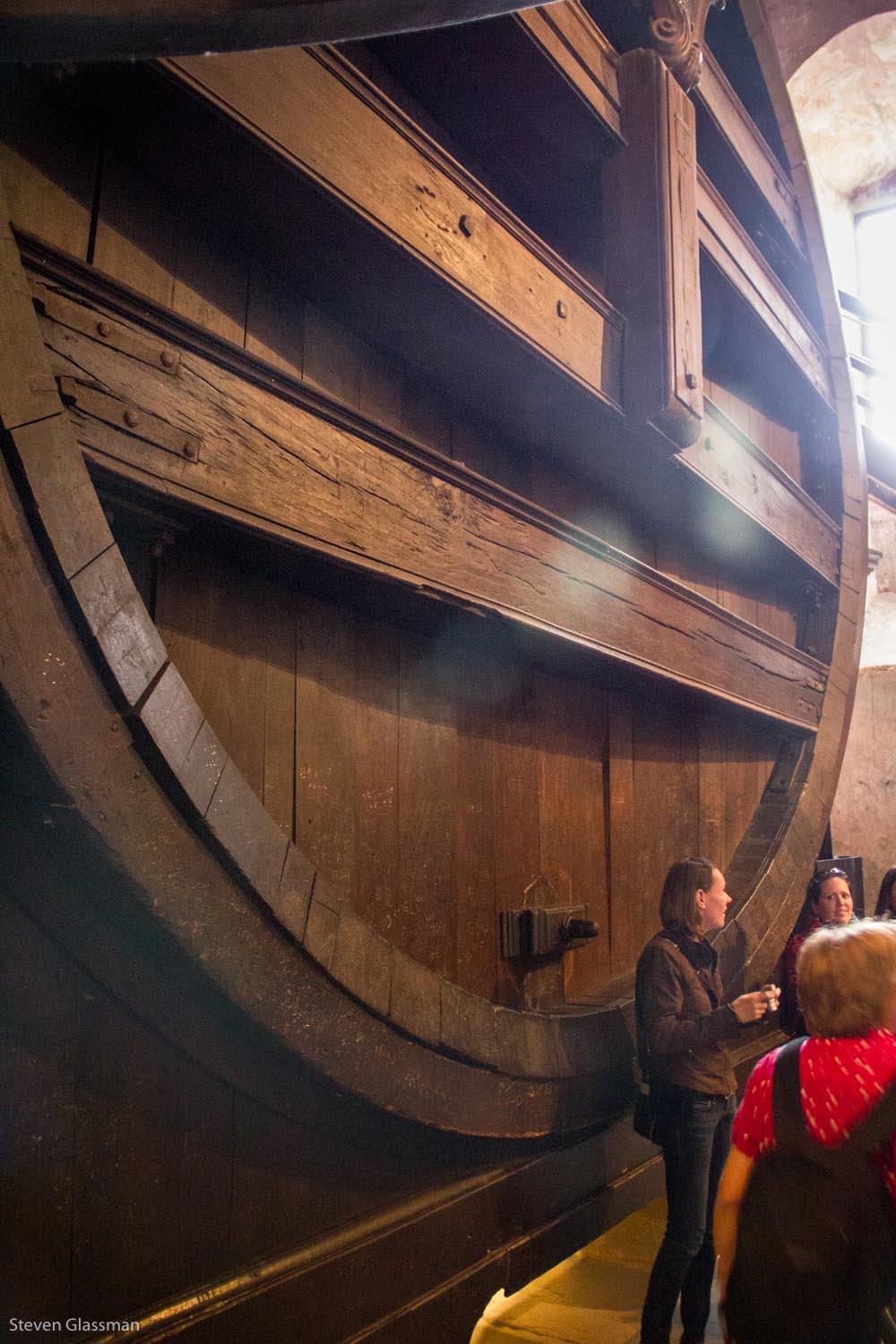
This was nothing compared to the other wine barrel around a corner. Behold the Heidelberg Tun (Großes Fass), the world’s largest wine barrel. My good and dear friend Wikipedia says that this was built in 1751 from one hundred and thirty oak trees. Wikipedia goes on to say that at the time of its construction, it “had a capacity of 221,726 litres (58,573.8125 U.S. gallons). Due to the drying of the wood its current capacity is 219,000 litres (57,853.6795 U.S. gallons).” Here’s the Heidelberg Tun:
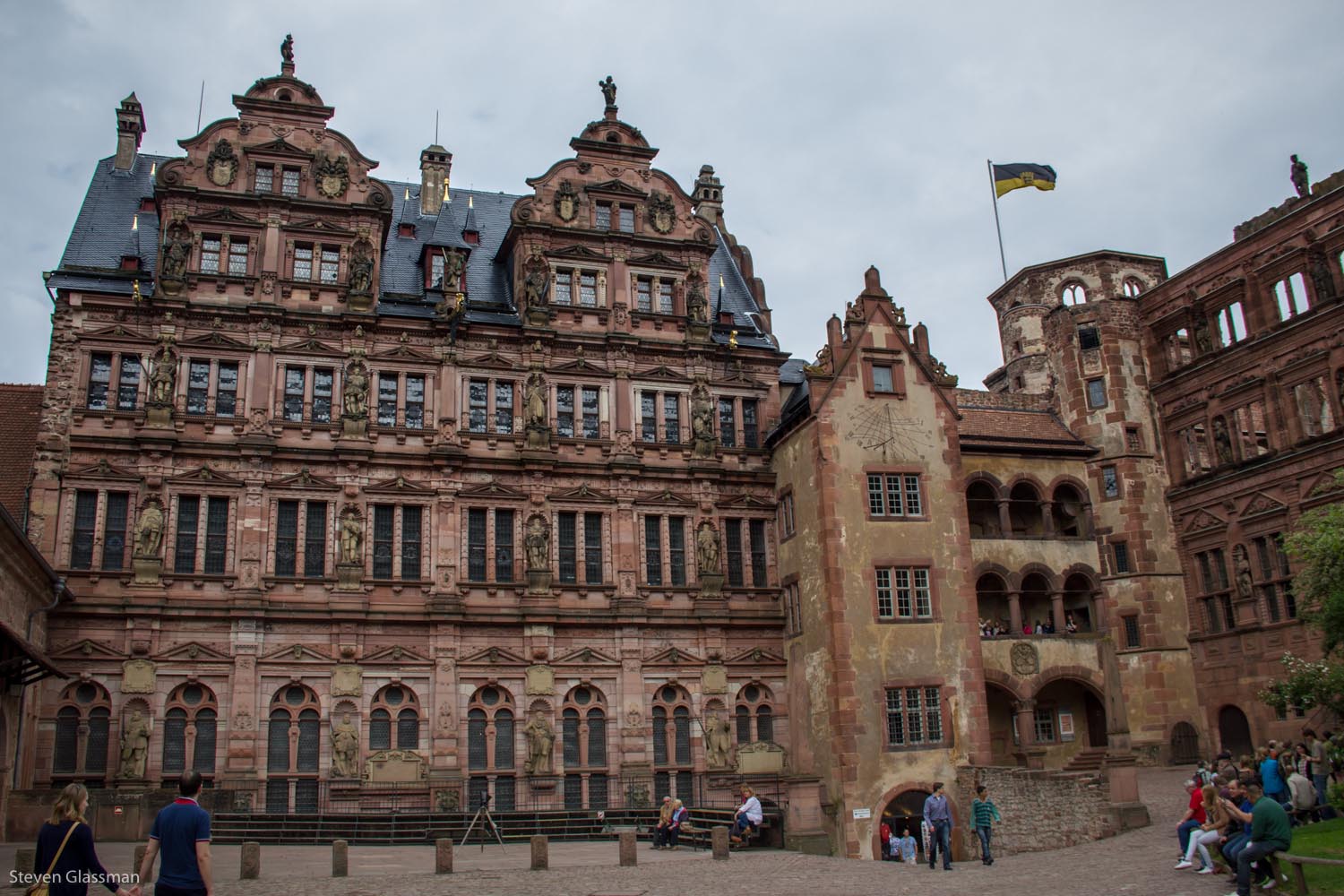
After leaving the giant wine barrel, we saw some of the exterior of the castle, even passing by a wedding that was going on there.
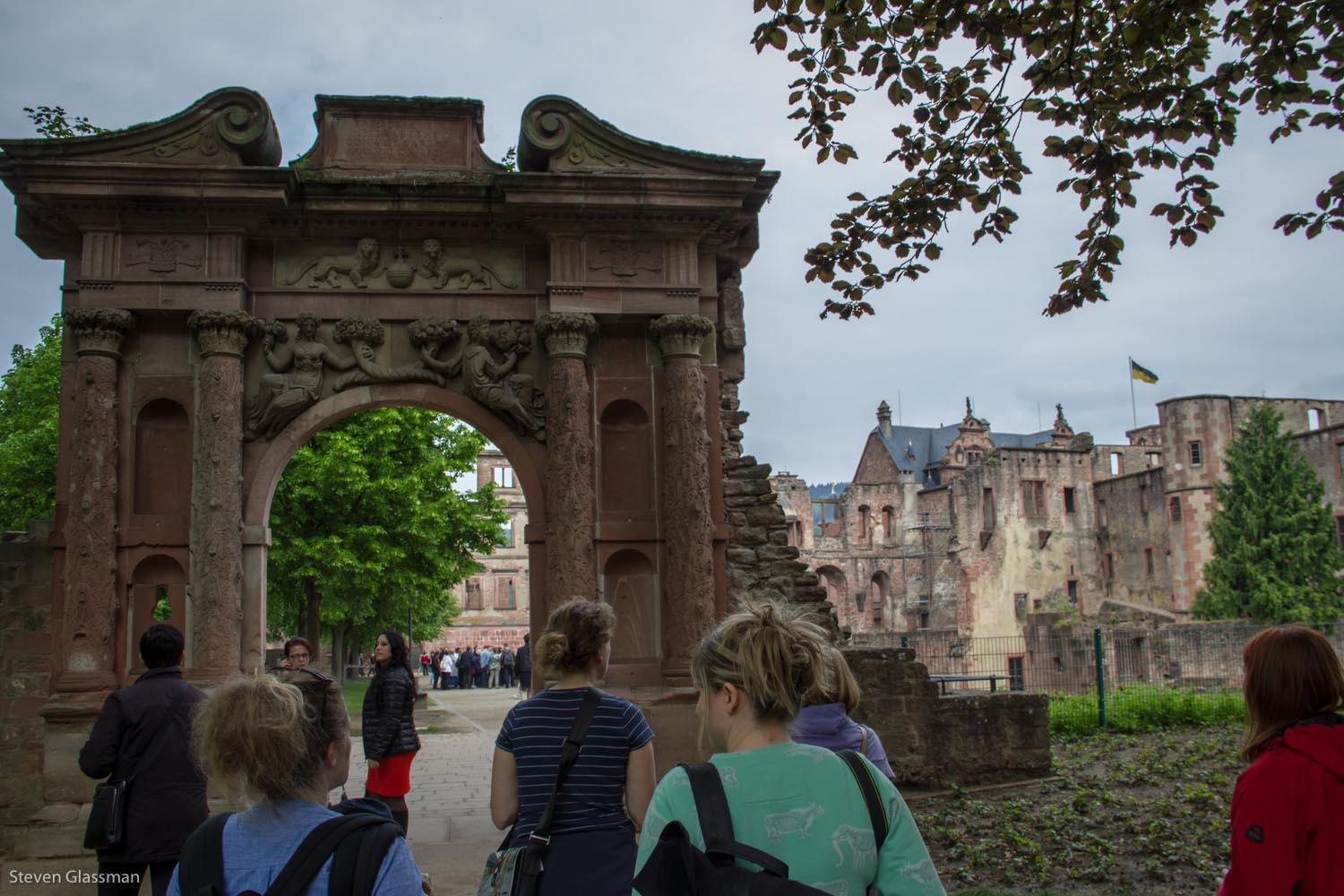
Through the Elisabethentor, there were more nice views to be had.
From here, we picked out our path to the city center, to have lunch. First, we had to get down there. Luckily, there were stairs nearby.
Walking into the Marktplatz…
We ate lunch at Café Knösel, because it was close, the menu looked pretty decent, and Tripadvisor rated it well. I didn’t know at the time that it’s the oldest cafe in Heidelberg, open since 1863. I had a pricey but delicious plate of salmon, spinach, and potatoes.
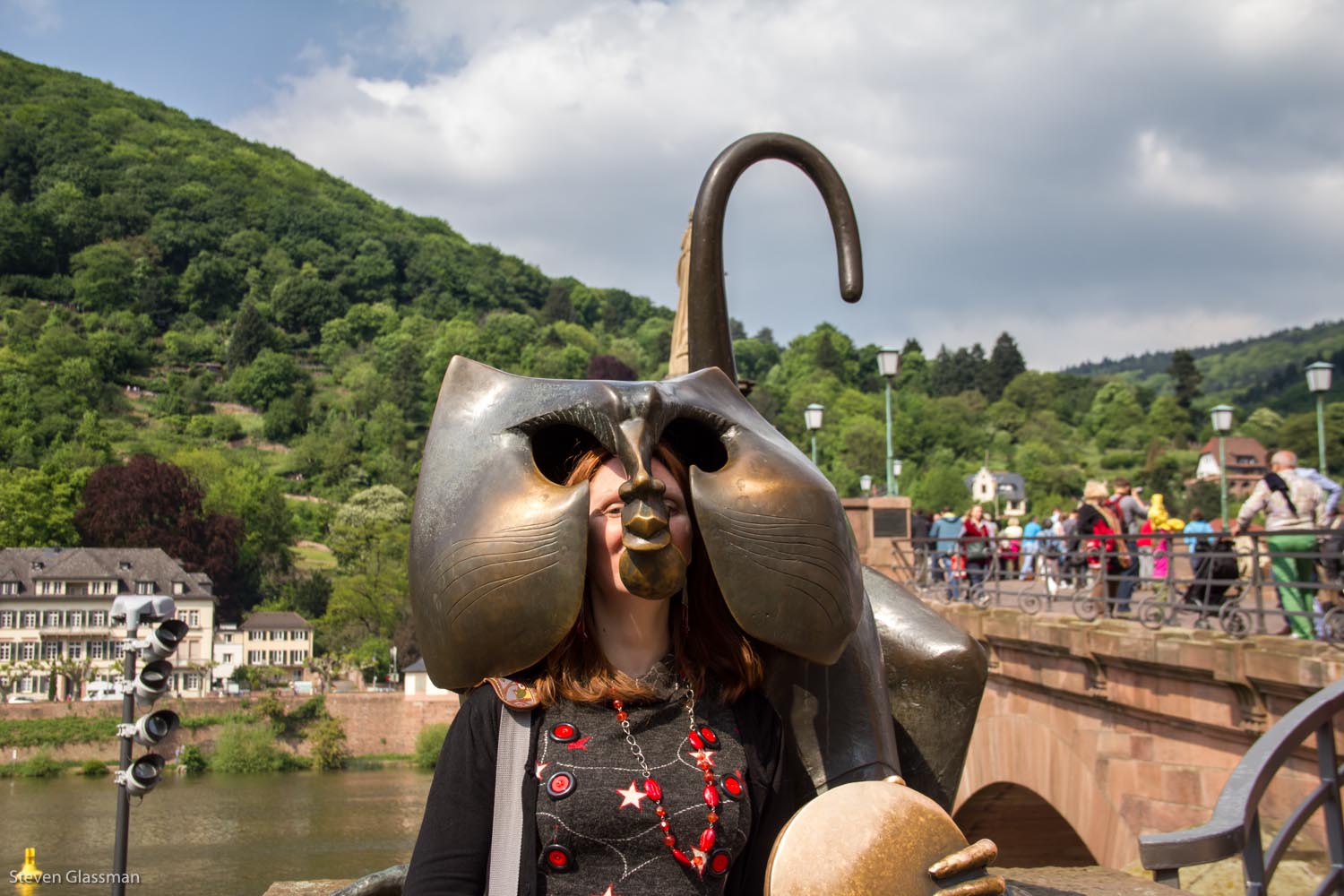
After lunch, we hopped over to the Karl-Theodore-Brücke. There’s a rather nifty statue of a monkey at the end of the bridge which has space enough to put your head inside, cheerfully demonstrated here by Bev.
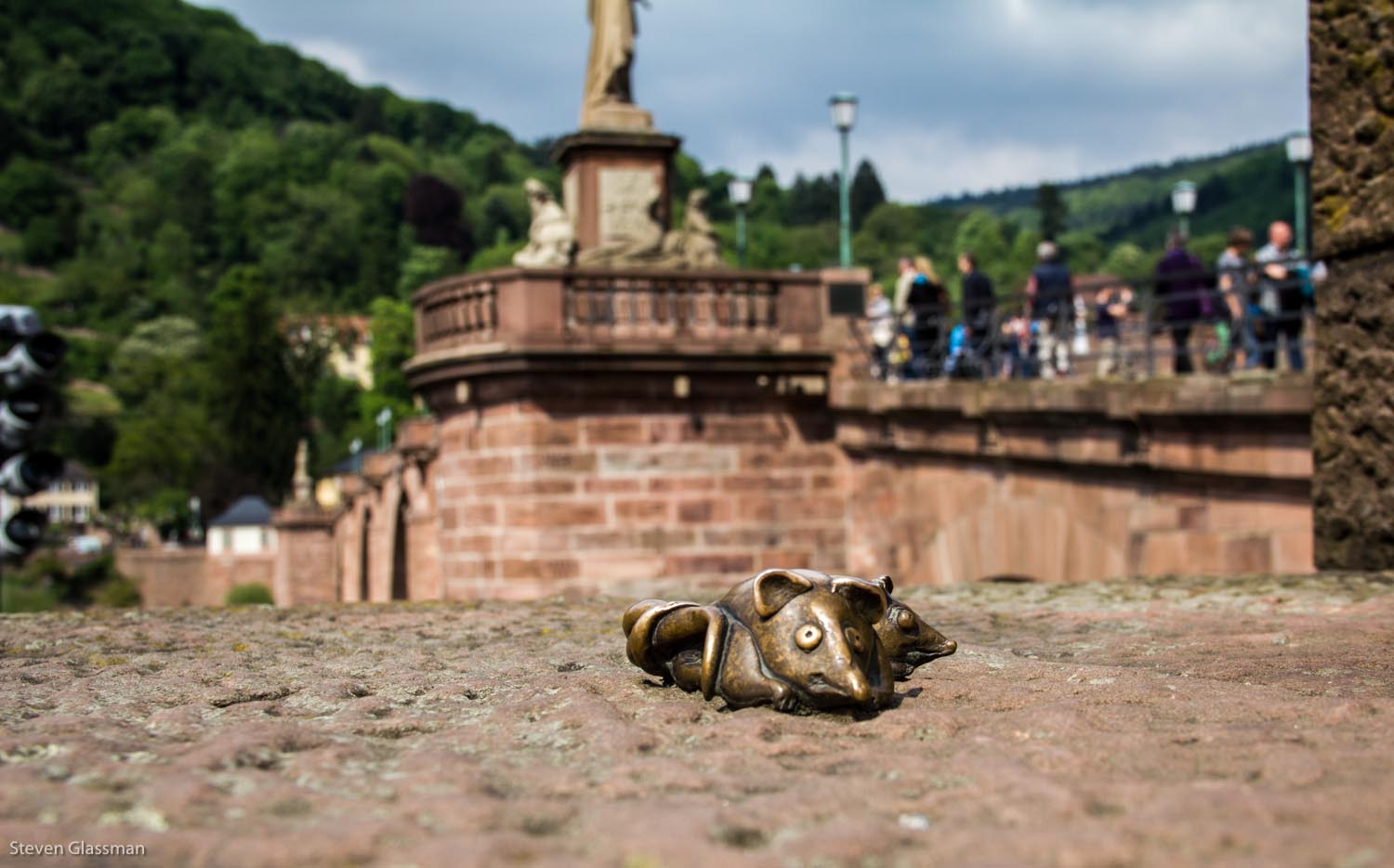
On the low wall next to the monkey sculupture are these little metal mice. I quite liked these little guys.
This is the view of the castle, Schloss Heidelberg, looking back from the Karl-Theodore-Brücke.
…and back at the archway leading onto the bridge.
After we visited the bridge, we wandered toward the Studentenkarzer. On the way there, we found another tourist…
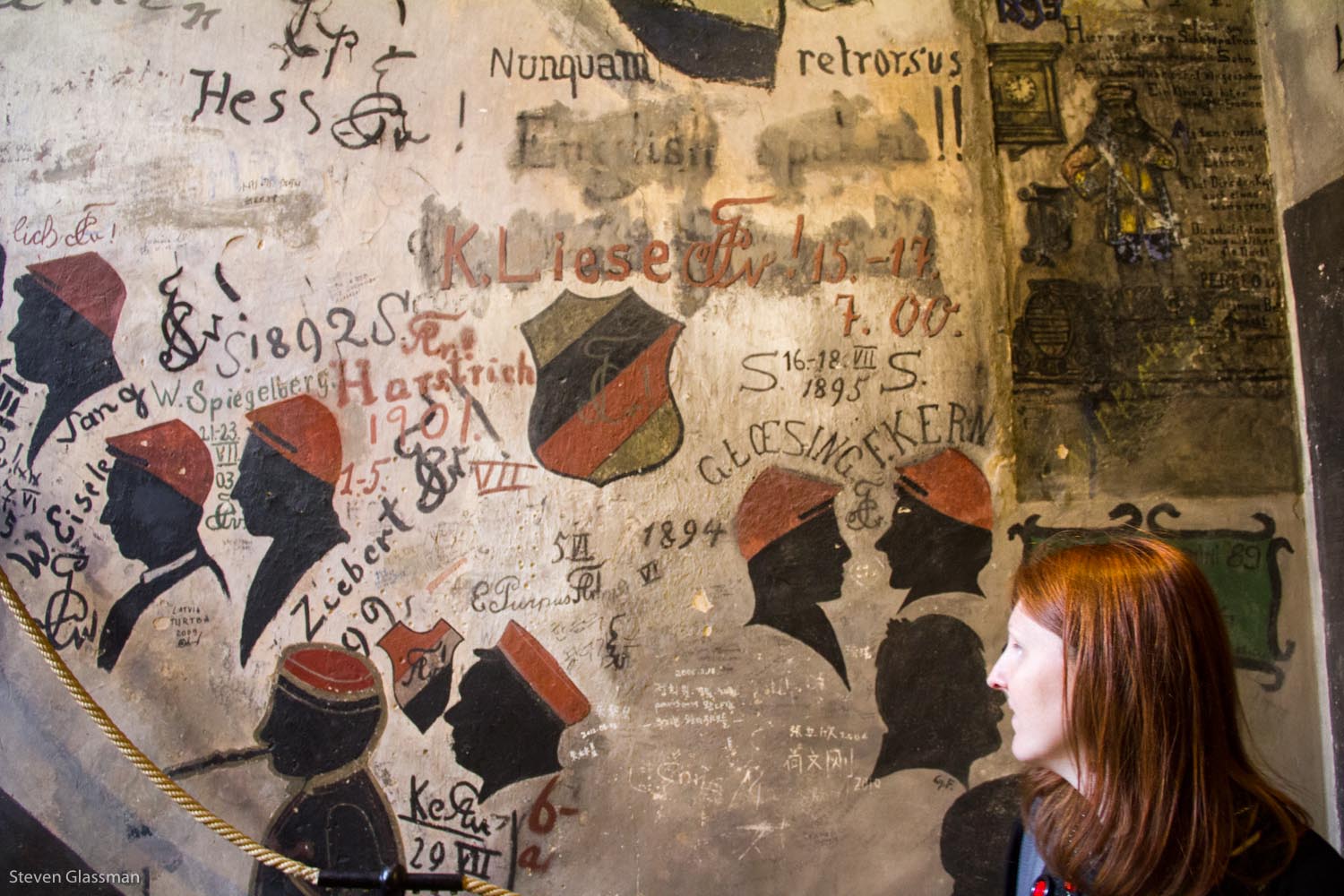
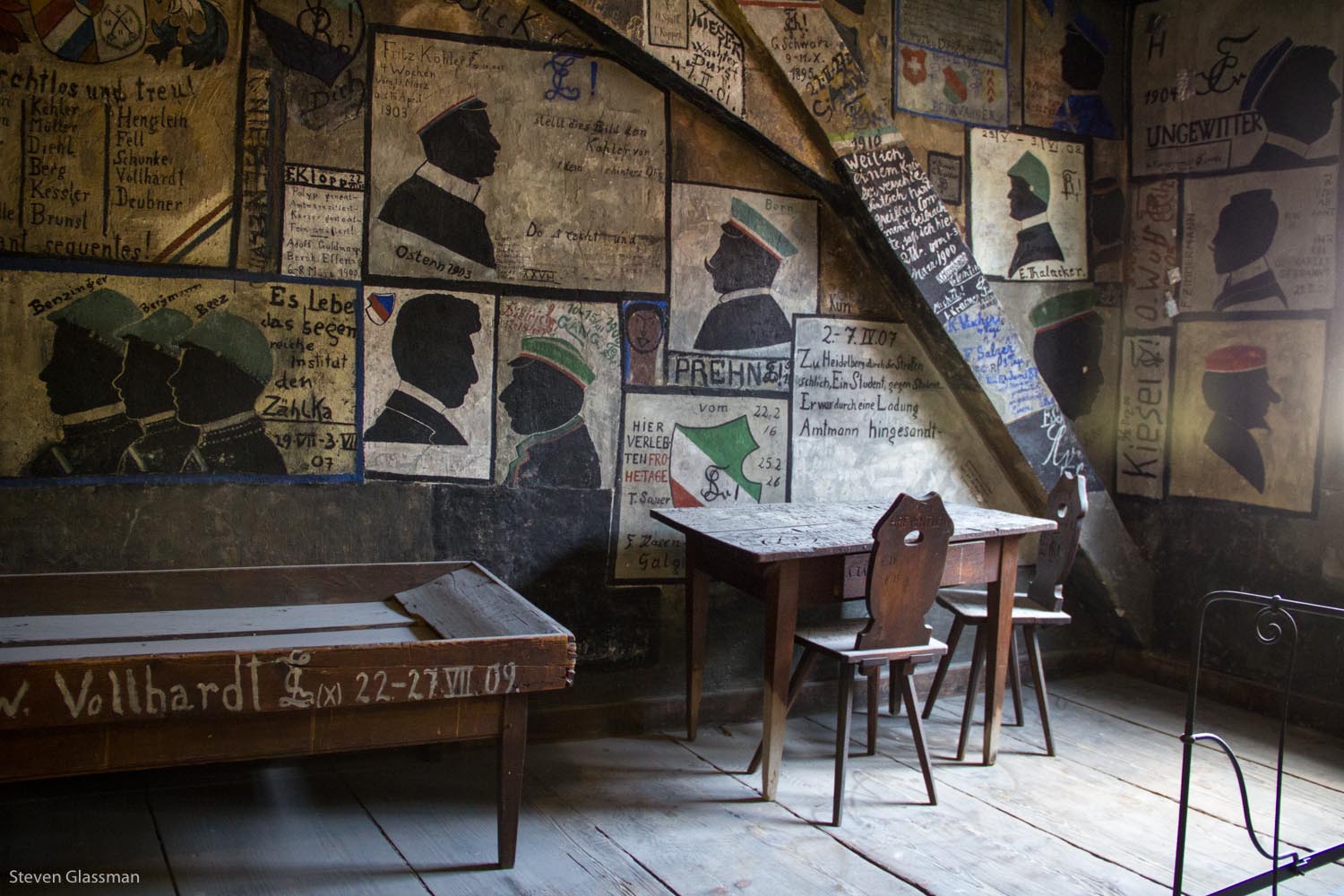
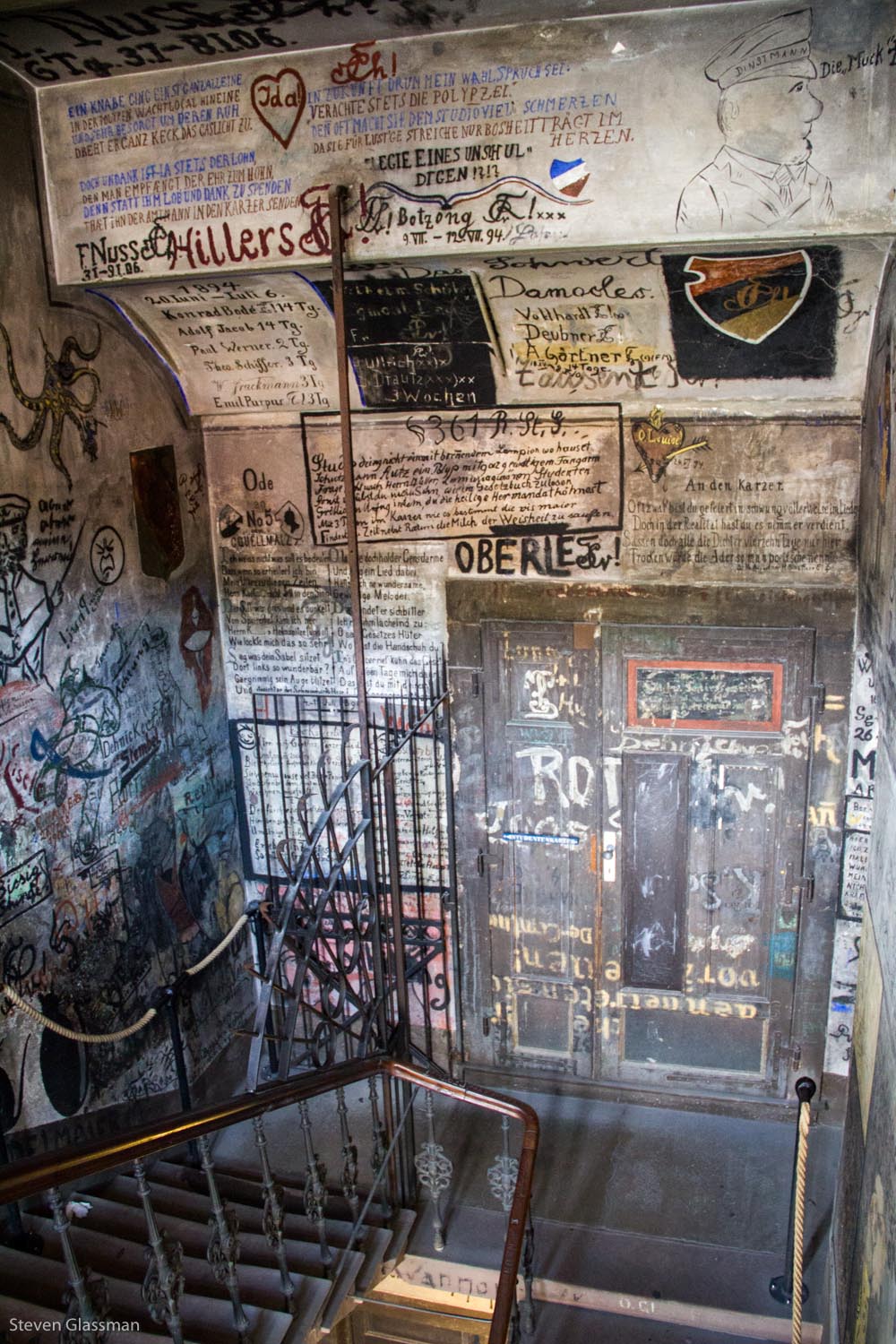
Heidelberg is a University town. Founded in 1386, the Heidelberg University is the oldest university in Germany and the third to be established in the Holy Roman Empire. The Studentenkarzer, or student jail, was in service from 1823 to 1914. Students would be sent there for drunken misconduct, messing about with the police, throwing rocks at churches, or dueling. The perpetrators would be sent to the jail for anywhere from a few days to a few weeks, depending on the offense.
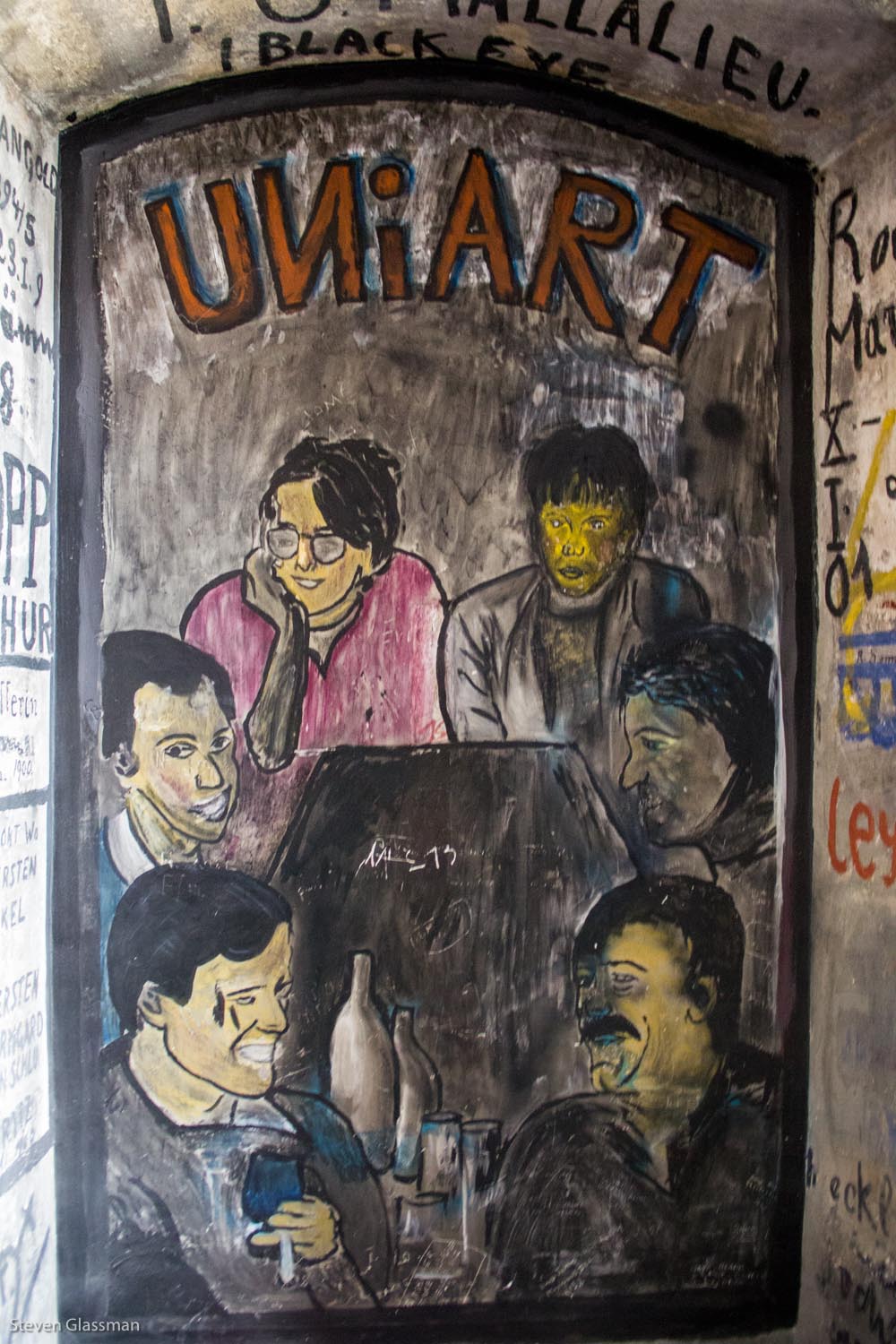
Students were still allowed to attend classes, and over the years a tradition formed of marking the walls with graffiti to note the person, their offense, and logos from their fraternity houses. The Heidelberg Studentenkarzer has been preserved in its original state, with the original furniture left in place, as well as the marks of the incarcerated from years gone by. 120 year old graffiti is rather interesting.
The next eight photographs are all from inside the Studentenkarzer.
Next to the Studentenkarzer is a small University Museum documenting the history of Heidelberg University. There was a great deal of fascinating old technology, but it’s really best summed up by this Pneumothorax treatment device from 1950. Heidelberg is a research university, and it’s really fantastic to think about the innovations made here over the years.
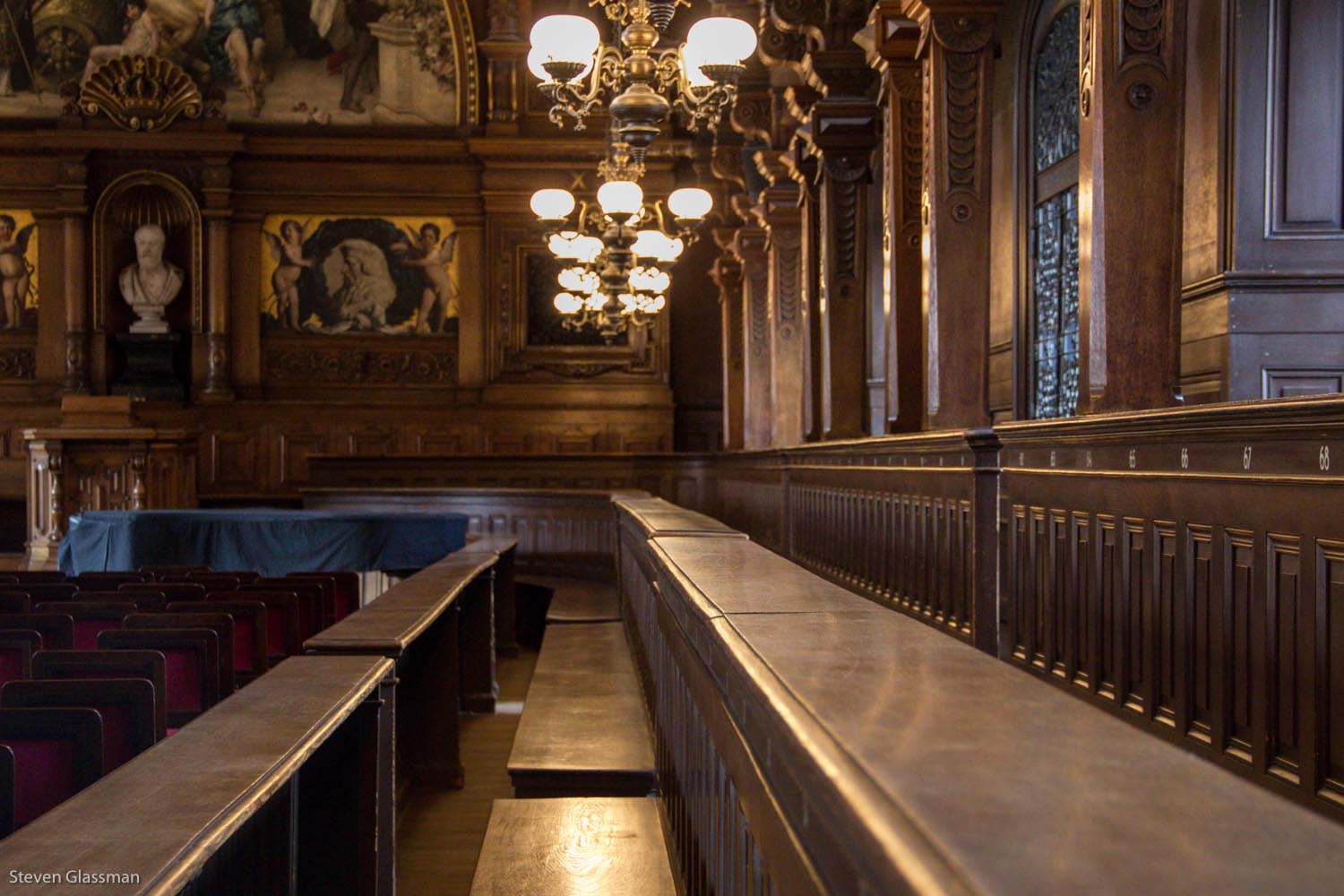
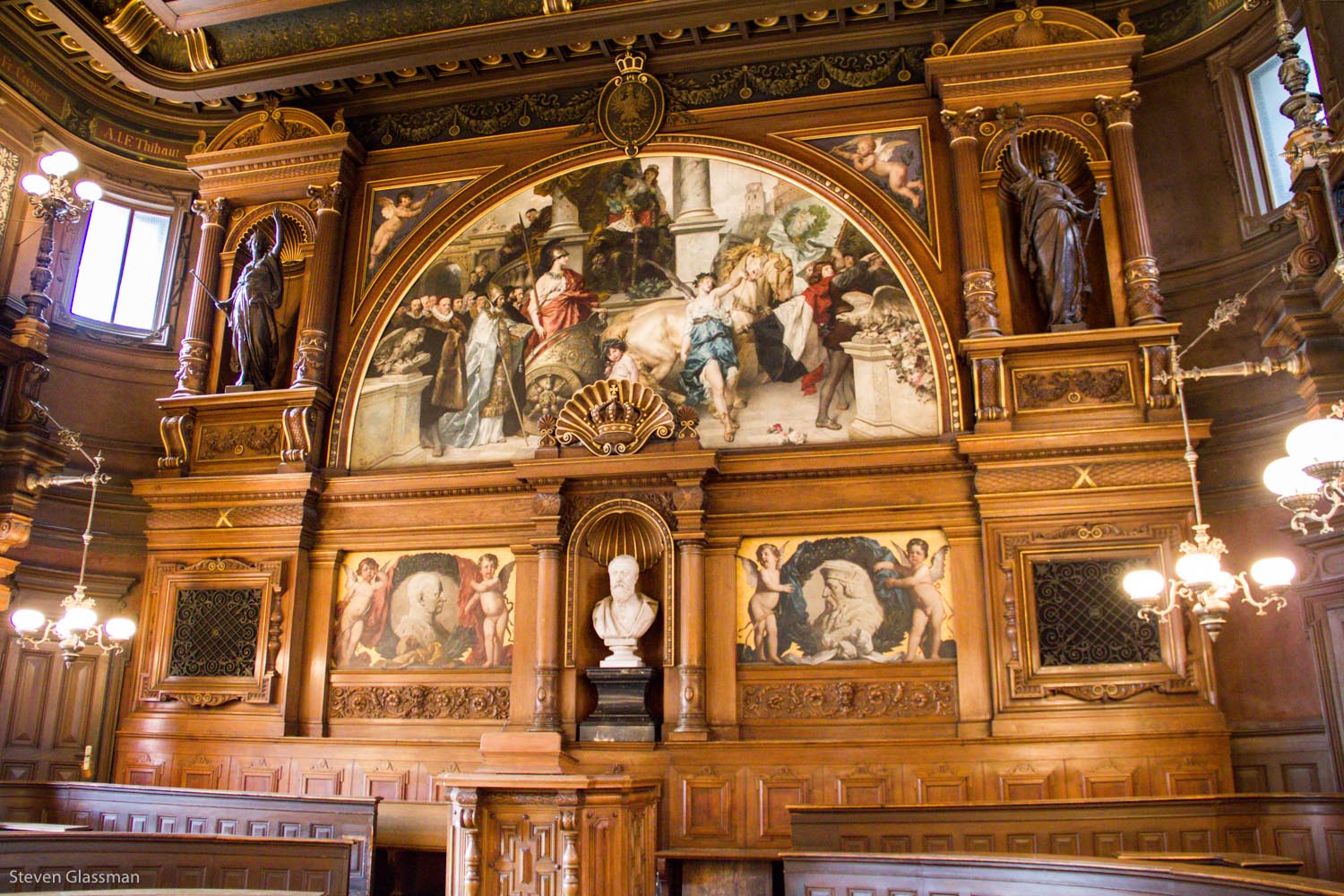
Upstairs from the museum is the Great Hall, which is, well, a great hall.
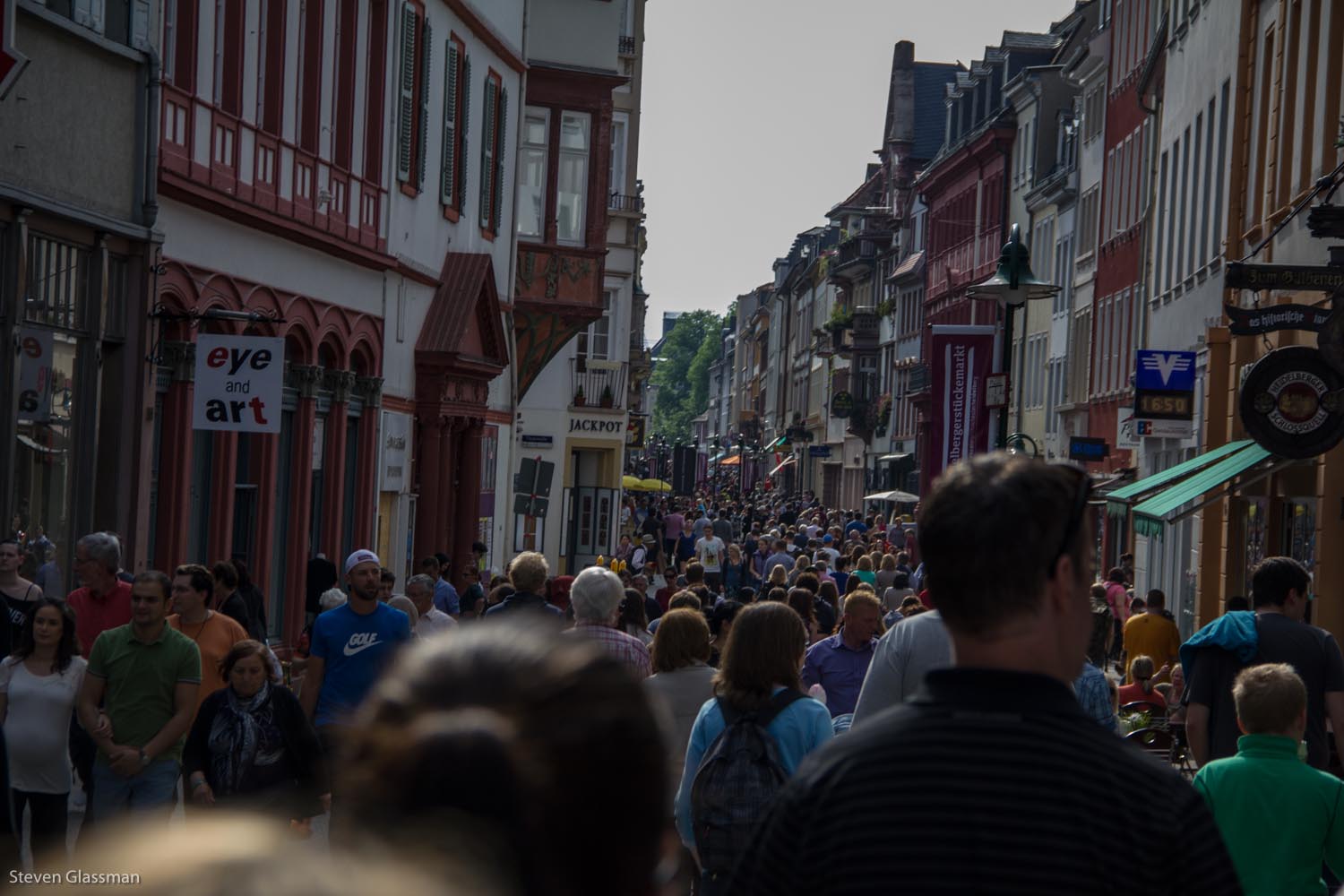
After the great hall, the group stopped for frozen yogurt, before heading down the main shopping street to pick up the bus back to the Bahnhof.
































 Whimsy. Tacos. The DMV.