Burg Prunn

One of the things that you learn while living in Germany is that castles are to Germany what Waffle House, Coca-Cola, and the name Peachtree are to Atlanta.  There are castles everywhere over here.  Some of them aren’t all that stereotypically castle-ish.  For example, there’s Prunn Castle.

Burg (Castle) Prunn sits on the edge of a hill, so the view from the castle wall is nothing short of spectacular.  There’s literary historical significance to this castle, also.  The “Prunner Codex“, the fourth oldest complete manuscript of the high German heroic epic, the Nibelungenlied, was discovered in this castle.

The castle goes back to the 11th century, and there are clearly two parts to the castle. The central tower, and the buildings which were constructed around the tower later on.

prunn02

There is a small courtyard near the main entrance to the castle.  Unfortunately, pictures are not permitted inside the castle, so I can only show you the outside walls.  The inside was cold, but fascinating.  The entire structure has even been immortalized in Lego.

prunn03

Have you been to Burg Prunn?  What’s your favorite castle?

No Limits

Americans have a lot of myths and misconceptions about Germany.  We think that all Germans wear lederhosen and dirndls– they don’t; that’s just in the South of Germany.  We think that all Germans love beer and pretzels- ok, that part is actually mostly true.

Before I moved to Germany, I had a weird misconception that the Autobahn was a single world-famous stretch of roadway.  I stupidly didn’t register that “Autobahn” is really just the name for Germany’s entire system of highways until I was already here and seeing the separate segments of the highway.  I now know that Regensburg sits at the intersection of the A3 and the A93, and both of those roads are considered “The Autobahn.”

We think that the entire Autobahn has no speed limit.

nolimitsIt only takes one time on the highways here to see that this isn’t entirely true.  There are places on Germany’s roadways with no posted speed limits, designated by the circle and slashes seen to the right of this paragraph.  One ADAC estimate says that roughly half of the Autobahn  does indeed have a posted speed limit.  I can attest to this, since I drove on the Autobahn last week for the first time.

I don’t usually have a car here- when I moved over, I sold my beloved Honda Civic in favor of using the bus and train to get around.  I didn’t want to deal with the expense of parking, of getting gasoline, of insuring a car- and I really don’t need one here.    I drive when I’m in the United States, but not here.

When several of us went to Zürich for business last week and I had the opportunity to sign on as a second driver for the rental car, I didn’t have to think too long before signing up.  As a result, I got to drive a bit in both Germany and Austria.  I have a few thoughts on the experience:

  1. The places that do have speed limits here are somewhat infuriating because the speed limit changes rapidly and often.  In a five-minute span, you can find yourself seeing multiple speed limit changes.  It’s usually somewhat logical-  120 kilometers per hour to 100 to 80 as you approach a tunnel, for example.  Sometimes, though, it can be downright schizophrenic:  120 kilometers per hour to 80 to 100 to 60 to 120 and then, suddenly, no limits again.  In the US, highway speed limits tend to be one speed for much longer stretches of roadway.
  2. Even on the sections of the Autobahn that don’t have posted speed limits, there is still a recommended speed.  The Richtgeschwindigkeit, or recommended speed, is 130 km/h.  I can say from my new experience that 130-140 is actually a very comfortable speed.  This is perfectly logical, since this is roughly equivalent to 80-87 miles per hour.
  3. Our rental car was a Volkswagen Touran, which is basically the minivan version of a VW Golf.  This car isn’t really built for speed-  at one point on a straightaway, I took the car up to 180 km/h (112 mph) just to see what it felt like.  It felt terrifying.  At that speed, the entire vehicle felt like it was catching an updraft.  There was no sense of real control of the vehicle, and I was concerned that any good gust of wind would completely crash us.  I leveled it back down to a more relaxed speed very quickly, and didn’t break a three digit mph speed again for the rest of the trip.  I saw plenty of people doing 200-220 km/h on the Autobahn, but you really have to have the right car to do it without spontaneous outbreaks of sudden and horrible death.

Would I rent a fast car some time and drive fast on the Autobahn again?  Probably, it was kind of fun despite the terror.  Maybe next time I just need a faster car…

Have you been on the Autobahn?  What’s the fastest speed you’ve ever driven?


There’s A Signpost Up Ahead

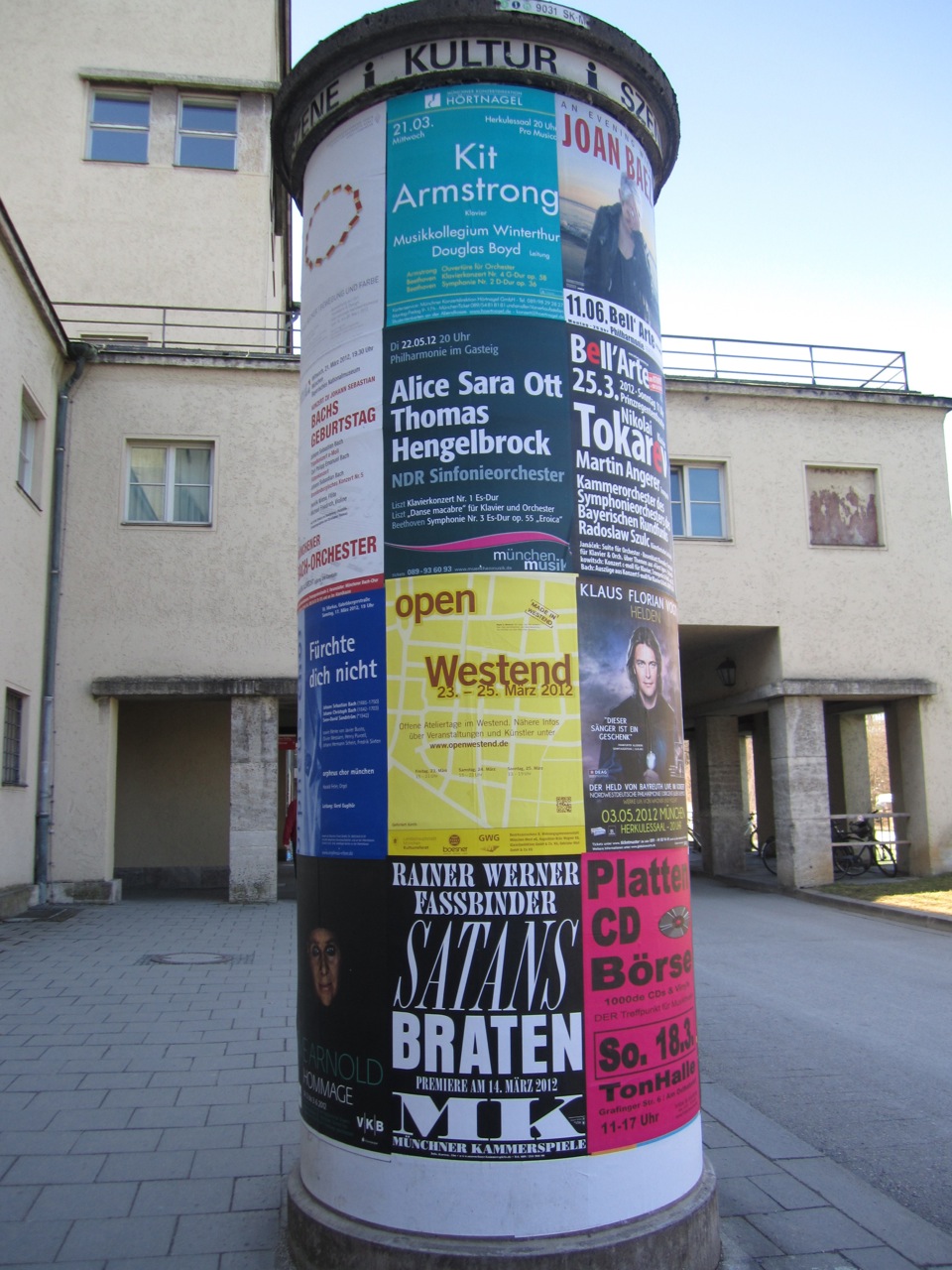
Over the last year, I’ve noticed that you don’t see as much posted advertising in Germany as you do in the US.   Certainly you almost never see a full sized billboard along a highway here.  Sure, there’s advertisements on bus stops and benches, and posted on buildings near major roadways, but the big billboard sign isn’t a thriving species here.

The cylinder of advertisement, however, is everywhere:

signpost02 IMG_0826

I find the cylinders to be fascinating, because they contain so much information, and yet they’re still wildly ineffective for advertising.  If you’re driving past in a car, would you really catch more than a word or two off of this ad-pole?

Is the advertising where you live different or unusual than what you’re used to?

Q&A Time, Part 3!

A short while back, I posted an ‘Ask Me Anything’ post.  Some folks used that as a chance to ask for advice in advance of their upcoming travels to the area, and I tried to answer what I could of those in regular e-mail.  Some of the remaining questions are really interesting, so I’ve decided to do a series of “You asked, I answer” posts.  Let’s get started!

Here’s a question from Rarasaur:  Is there any object (not food related, that’s too easy) that can make you homesick?

I thought about this one for a while, and my answer is no, not really.  I put very little personal investment into things.    Everything I own right now is either in a 5×10 storage unit in Florida, or in my 45 square meter apartment here, and neither one of those locations is anywhere near full.  People can make me homesick.  Flavors can make me homesick.  Sometimes even smells or songs or the  memory of what something feels like can make me homesick.

But an object?  No.  Just no.

Here’s another question from Rarasaur: Is there a habit or custom that you’ve picked up in Germany that you’d take home with you forever when you come back to the States?

There are a few, I think.

I suspect that my consumption of consumer goods and my handling of trash and waste will be forever altered by my time here.

I take my shoes off at the door of my apartment now.  That’s not specifically a German custom, but I didn’t do it before I moved here and I’ll probably keep doing that.

I carry canvas bags to the grocery store with me now because you pay for the plastic bags you need at the grocery here.  I’ll probably keep doing the canvas bag thing when I’m back in the states.  I also buy a lot less food here because I have to carry it all home with me on foot.

I’m sure there’s more, but that’s all I can think of off the top of my head.

Here’s yet another question from Rarasaur:  Have you learned about any particularly interesting German artist/cook/painter/writer/politician/whoever that Americans never really speak about, but all Germans know?  If so, pass on the knowledge, por favor. 🙂

Before living in Germany,I didn’t know about Karl May, the author of the Winnetou novels.  I didn’t know about “Dinner For One.”  I didn’t know about German media folks who are household names here like Michael “Bully” Herbig or Stefan Raab.

Beyond that, I’ve mostly just learned a great deal more about names that are not completely unknown to me as I travel to the places that were part of their lives, because I research the hell out of everything I see and everything I write about.  Living in Europe puts me in a fantastic position to learn about these names, because the signs and history are all around me.   Johannes Kepler lived here in Regensburg.  Napoleon was here for a time, after he was wounded in the Battle of Regensburg.  Albrecht Dürer lived in nearby Nürnberg.   I learned more about Falco when I went to Vienna, and somehow missed seeing his gravesite when I was walking around Vienna Zentralfriedhof.  (And I learned more about that Mozart guy, too.)

Do you have anything you’d like to ask?  The Ask Me Anything post is still open!

Living On The 49th Parallel

We’re a few days into Spring now, according to the calendar, but the temperatures outside still scream WINTER to me.   The sunlight, though, is definitely springtime sun.  Ever since this winter was declared the darkest on record since records began, I’ve been feeling the darkness much more acutely.  A few weeks ago, we had about one week of warmer temperatures and sunlight- a  Spring tease, if you will.

sungone

This week, it snowed again.  And it got cold, damned cold.

49thParallelThe problem is that Germany pretty far north.  Bavaria, where I live, is on the 49th Parallel.  In North America, the 49th Parallel roughly describes the border between the US and Canada.   For someone who spent most of his life up until 2011 in Florida, this takes some getting used to.

During the core part of Winter,  the days are much shorter than anything I’m used to.  This is especially true in late November and December- it’s night-time dark by the time I leave the office at the end of the day.  Last year, I actually bought one of those sun lamps that people use to combat Seasonal Affective Disorder (SAD).  I used that lamp almost every day last winter, and I barely noticed the omnipresent gloom.  This year, I mostly didn’t pay attention to the lamp, and the end result was I didn’t leave my apartment as much, I didn’t travel as much, and I was generally less interested in doing much of anything. My friends noticed I was especially grumpy for about two months, and that it was obvious that I was super cranky and unhappy.

Lesson learned.

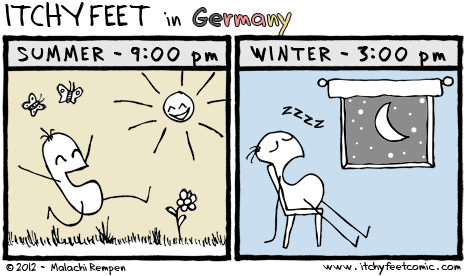
The trade-off is in the summer months, though. I was astonished last year while visiting Amsterdam to note that it was still basically daylight after 10pm, and didn’t start to get dark until close to 11.   When we switch to daylight savings time this weekend, that will put sunset at close to 8pm.  I’m really looking forward to it. (The switch for Germany is on the 31st of March, if you’re wondering.)

As usual, Itchy Feet nails what we’re all thinking:

germany_sunset

Summer time is coming.  Do you prefer longer or shorter days?