Ich spreche ein bisschen Deutsch.

Before I got to Germany, I had never heard of CEFR, the Common European Framework of Reference for Languages. This is partly because it’s a European framework, and North America has a different set of standards. Mostly, though, I hadn’t really spent much time thinking about how people learn languages before I got here. Once I arrived in Germany, however, I had to make a decision about how much time and energy to commit to picking up German.

It may surprise many people to learn that I could live here for the entire run of my contract without speaking a word of the local language. Some people do. Regensburg has a large university as well as a tremendous amount of industry, with international companies like BMW, Continental, GE, and Siemens present. In addition, German children start to learn English in school. When I first arrived here, I started a lot of conversations with, “Do you speak English?” The answer was always the same: “A little.” This, followed by a fluency in English that far surpasses my skill in any other language.

My job interaction is primarily with other members of my department back in the United States, or to people in my local office who are all basically fluent in English. My contract is only for three years, and my residence and work permits do not require any proficiency with the language. And yet…

I know someone who has been here for seven years and is only just now starting to learn German. I don’t want to be that guy. I don’t want to be the stereotypical monolingual American who refuses to adapt and acculturate, so I’ve tried almost from day one to integrate myself as much as possible. This means trying in earnest to learn the language.

When I moved over in 2011, I purchased the Rosetta Stone software. Rosetta Stone is good, to be sure, but it didn’t quite work for me because it doesn’t explain the grammar. German grammar is a horrendously complicated, nightmare inducing crapfest. This is a huge part of why it’s so complicated:

germanarticles

I would absolutely kill on the vocabulary exercises in Rosetta Stone, but every time a grammar exercise came up, I would bomb it utterly. There are interactive parts of the Rosetta Stone program that put you one on one with other people learning the language, and even a small classroom environment where you learn in a small group- the software comes with a basic headset so you can interact in real time with video and audio. I never used those portions of the software though, and my learning curve became a sort of stagnant crazed line.

Last September, I finally gave in and joined a local language course at the Volkshochschule, the German equivalent of a community college. It runs two nights a week for two hours and fifteen minutes each night. The classes are split up into CEFR levels, and so I started with the A1/1 class.

The CEFR levels are set from A to C, with the highest C being a level of mastery that comes close to a native speaker’s proficiency:

A1 Breakthrough or beginner

  • Can understand and use familiar everyday expressions and very basic phrases aimed at the satisfaction of needs of a concrete type.
  • Can introduce him/herself and others and can ask and answer questions about personal details such as where he/she lives, people he/she knows and things he/she has.
  • Can interact in a simple way provided the other person talks slowly and clearly and is prepared to help.

A2 Waystage or elementary

  • Can understand sentences and frequently used expressions related to areas of most immediate relevance (e.g. very basic personal and family information, shopping, local geography, employment).
  • Can communicate in simple and routine tasks requiring a simple and direct exchange of information on familiar and routine matters.
  • Can describe in simple terms aspects of his/her background, immediate environment and matters in areas of immediate need.

B1 Threshold or intermediate

  • Can understand the main points of clear standard input on familiar matters regularly encountered in work, school, leisure, etc.
  • Can deal with most situations likely to arise whilst traveling in an area where the language is spoken.
  • Can produce simple connected text on topics that are familiar or of personal interest.
  • Can describe experiences and events, dreams, hopes & ambitions and briefly give reasons and explanations for opinions and plans.

B2 Vantage or upper intermediate

  • Can understand the main ideas of complex text on both concrete and abstract topics, including technical discussions in his/her field of specialization.
  • Can interact with a degree of fluency and spontaneity that makes regular interaction with native speakers quite possible without strain for either party.
  • Can produce clear, detailed text on a wide range of subjects and explain a viewpoint on a topical issue giving the advantages and disadvantages of various options.

C1 Effective Operational Proficiency or advanced

  • Can understand a wide range of demanding, longer texts, and recognize implicit meaning.
  • Can express him/herself fluently and spontaneously without much obvious searching for expressions.
  • Can use language flexibly and effectively for social, academic and professional purposes.
  • Can produce clear, well-structured, detailed text on complex subjects, showing controlled use of organizational patterns, connectors and cohesive devices.

C2 Mastery or proficiency

  • Can understand with ease virtually everything heard or read.
  • Can summarize information from different spoken and written sources, reconstructing arguments and accounts in a coherent presentation.
  • Can express him/herself spontaneously, very fluently and precisely, differentiating finer shades of meaning even in the most complex situations.

The first thing I noticed about the class was that there is no way I could have succeeded if I’d started it when I first arrived. There is no English spoken in these classes, and I found that I needed a base layer of German language skill to even follow the class. However, I’m glad I started going- the class does a few very important things for me that Rosetta Stone never did:

  1. It explains the grammar and verb conjugations – This alone is well worth the price of admission. My German has improved significantly since I started the classes just because I finally understand the verb conjugations.
  2. It gives me the huge satisfaction of real time feedback – One of the best things about being in the class is that if I’m wrong about something, the teacher will correct me immediately. Rosetta Stone will tell me that I’m wrong, but it will never tell me why I’m wrong. I can’t understate how frustrating that is.
  3. It makes me stay on task – With Rosetta Stone, it’s far too easy to do an exercise or two and then go slack off for a while. It requires a special kind of discipline to keep going back to it when it’s self guided learning, and I don’t have it. (Editor’s note: This is why I don’t work out consistently, too.) With a class that I paid for, I keep going. Being part of a group learning experience is a tremendous motivator to keep it up.
  4. It forces me to interact in spoken German in real timeMy professor has a little yellow and blue ball that she uses during class. She’ll ask a question, and throw the ball to someone in the classroom. The person with the ball has to answer the question, then throw the ball to someone else in the class. They ask the question to the person now in posession of the ball, and the new ball-bearer answers. This process repeats until everyone in the class has interacted on this question, with the teacher correcting us on grammar, sentence structure, conjugation, pronunciation, and so forth. If someone uses a new vocabulary word during their answer, it goes up on the white board. One of the most commonly repeated things in the classroom is “Verstehen Sie das?” Do you understand this?

Since September, I’ve done two more classes, all part of the A1 level. My current class goes until late February, and then there’s one more class to cover all of A1. I still speak like a two year old, but I’m getting better. I’m picking up more words when I listen to other conversations or television or radio, and the meaning of things is starting to filter through in tiny pieces.

I’ve decided that I’m going to stop after the last A1 class, at least for now. I’ll have been going to German classes nearly non-stop for seven months, and I’m kind of burnt out on the time expenditure involved- between the classes, the homework, and the travel to and from the class location, this has been burning a lot of time, and I’m really feeling it. I’m confident that I won’t stop learning the language just because I’m stopping the classes, though- the classes have given me a great starting point to keep learning in the real world.

Tell me about your experiences learning a new language. Have you had success with language classes since you arrived?

Expat Tools

I was having a conversation with Alex of Ifs Ands & Butts about how we get our respective television fixes,and I realized that there’s a good blog post in talking about some of the technological tools that I use to get by in Germany without losing my mind.   I suppose I should post a Disclaimer: I have not been paid, sponsored, or otherwise compensated for endorsing anything in this post.  It’s just stuff I find useful for getting by outside my home country.

This list really falls into three categories-  Websites, Software/Apps, and Hardware.  Let’s start with the software.

iTunes11

iTunes:   Let’s start out with one of the two most important applications for maintaining my sanity.  Not only does this contain my music collection, without which I would be a ravenous, rabid beastie, but it also lets me rent movies from time to time, and it lets me purchase season passes for a few cherished television shows that I would be very sad to miss out on.  I mostly watch these programs and rented movies at home, but if I know I have a very long flight coming up, I sometimes rent a movie or two and load them onto an iOS device just to help pass the time in transit.  I use a variety of other methods to maintain my ridiculous volume of television viewing; this is just one of the methods I use.

SkypeSkype: This is the second important sanity-maintenance application.  Skype is a VoIP (voice over IP) application that lets you talk to people in several different ways.  It has an instant messenger function, for basic text communication, it carries voice, and it also does video chat.  Skype-account to Skype-account calls are always free, but that’s not where the true power of Skype lies.  The real strength of Skype is that it can call out to the existing phone network.  This means you can speak to people on their regular cell phones and land lines for a fraction of the regular telephone cost.  I bought fifty dollars of Skype credit roughly eight months ago and even with regular calls back to family members in the US, I haven’t run out yet.   It’s important to note that this is both a computer app and an iOS application.  I sometimes run Skype just for voice calls from my phone, and the sound quality is every bit as good as a normal phone call.  Lastly, I paid a little bit extra for what is called a Skype-In Number.  This is a local phone number in an area code of your choosing which connects directly to your Skype account.  In my case, I got an area code 561 phone number because the majority of my family and friends are in 561, a South Florida area code.  If they dial that 561 number, it costs them nothing more than any other local phone call, and it dials my Skype account directly.  If I don’t have Skype running, they get sent to voice-mail.   This is a thing of beauty.

A Slingbox:  Some people have access to HBO Go and Showtime Anytime accounts.  For those that don’t, a Slingbox is another useful way to view US-bound television.  The trick with a Slingbox, however, is that you have to have someone back in the US willing to leave it attached to their television.  Preferably someone who doesn’t mind if you occasionally take control of their television to view it remotely.  I no longer have a Sling of my own, but I do have a friend in a town outside of Chicago who lets me access his Sling from time to time.  It can be quite nifty.

Hulu, Netflix, Pandora, and Other Entertainment Websites: Each of these is a source of video or audio entertainment.  Spotify is now accessible in Germany, but it wasn’t when I got here.  There are various entertainment websites out there which help to complete the fabric of my pop culture addiction.  I make daily visits to The Daily Show, The Colbert Report, and The Rachel Maddow Show online.  Of course some of these aren’t visible from outside of the United States, which brings me to…

hidemyassA VPN: A VPN, or “Virtual Private Network,” is a service that can be used in many different ways.  Many companies use them to help a remote worker access an internal network, or to help secure the work being done.  For an Expat, though, a VPN is most valuable as a means of making the Internet at large believe that you’re on an IP in the United States.  Why is this useful?  Many entertainment websites, because of International copyright and licensing laws, restrict access from connections outside of the US.  In order to access Hulu, Netflix, Pandora, and a bevy of other sites, you need to have an IP address that appears to be inside the United States.  There are many different VPN services out there.  The one I use is entirely software, from a company called Hide My Ass.  I’ve also seen hardware VPNs.  These usually consist of a specially programmed router that you purchase, and the VPN connection is handled automatically by that piece of hardware.

There are also several methods to catch up on your television that are of questionable legality.  I do not condone these next two methods, but I’m including them here for completeness:

      1. There are sites that will stream shows, such as watch32.com and movie2k.to
      2. There are torrents.  Sites like showRSS in tandem with a proper BitTorrent client can help you to grab shows as they air.

Google_translateGoogle Translate and Leo: Both of these exist as both mobile apps and Websites.  Google Translate helped me through my first few months, especially in the grocery store.  It has the nifty feature of allowing you to speak a word or phrase in German to your phone, and it will attempt to translate using basic voice recognition.   It will also pronounce things for you using simple speech synthesis, which can also be extremely useful. However, Google Translate isn’t always the most precise translator, which is where Leo comes in.  Leo on the iPhone is just a word translation app.  It will give you a variety of meanings, including pronunciation and the gender of the German word.  For anyone trying to learn the language, this is an incredibly useful tool.

Facebook, Twitter, Instant Messaging, and other Social Networking sites:  While Skype is great for making phone calls to a few people on a regular basis, the time difference between the US and here makes it unrealistic to keep in touch with everyone via phone calls.  That’s where social networking comes in.  As much as I despise Facebook, I can’t deny that it has made it easier than ever to see what’s going on with my nieces, to communicate with friends all over the country, and to make sure that certain technologically challenged family members can still see pictures that I post from my time here.  Without Facebook, I would have significantly less contact with my family.  Without Instant Messaging, I would be massively out of touch with everyone else.

Similarly, a lot of people use What’s App to communicate with other folks on disparate cellular networks using only your data, rather than typical cross-network SMS charges.  Hanley from Pink Parliament swears by TextPlus, which I haven’t used myself.  From her description, she uses TextPlus the way I use Skype: “Textplus is a life saver. I use it every day. You can get 1300 mins for 20 bucks, it works on both 3G and wifi and the other person doesn’t have to have it for you to call. You can call landlines and cell phones.”

plugadapter Electrical Adaptors: It should go without saying that someone like me is going to have a lot of gadgets.   The good news is that most of the important ones can handle the varied voltage.  Most laptop computers, cell phones, and tablets can handle the varied voltage without too much difficulty.  That just leaves the shape of the plugs.  The picture to the left of this paragraph is a set of electrical adapters that I purchased in the local MediaMarkt store for just a few euros.  As you can see, it’s got the US plug style on the front, and the German plug style on the back.  It doesn’t do any voltage conversion, but for most gadgets, that’s all you need.  You always want to read your documentation to be sure, though.  The alarm clock I brought with me from the US?  Utterly useless on this voltage.  I had to buy a new one here.   My electric razor can handle this voltage just fine, but the Water-Pik cannot.  My printer/scanner won’t work on this voltage, but I have a single voltage converter, also purchased in the US, connected to that one device.

By the way, I left my television behind when I moved, and bought one here.  When I move back, I’ll do the same thing-  this one will get sold off  locally for a very good price, and I’ll buy another set when I get into a new apartment in the US.  The reason for this is very simple-  the video systems in these two countries are very different.  Even if you aren’t looking at the electrical plugs, the video has different connectors, different picture types, and so forth.  I suppose it might be possible to use a German television in the US, but there are too many reasons to just start over with a US marketed set.

This list isn’t exhaustive, but it does cover some of the most important things I use.  Fellow expats, what tools do you use to make your life abroad easier?

It’s A Sunshine Day

Back in November, the inimitable Rarasaur nominated me for the Sunshine Blogger Award.  I don’t usually do Blog awards, because that’s just not what this blog is about.  However, Rara is one of my very favorite bloggers, so I wanted to pay this forward a little bit.  Better late than never, right?

sunshine-awardHere’s the Sunshine Blogger Award Rules:

  •     Display the award logo on your blog.
  •     Link back to the person who nominated you.
  •     State 5 things about yourself.
  •     Pass the award onto 8 other bloggers and link to one of their specific posts so that they get notified by pingback.

Five Things About Me:

  1. I love old TV shows that almost nobody remembers, like Streethawk, Flying Blind, Lush Life, Automan, and Mr. Merlin.
  2. I do a really good George Takei impression. And a pretty decent Mickey Mouse as well.  And while we’re on the subject of stupid human tricks, I can make the sound of one hand clapping.
  3. I am chorally trained. I sang in high school and for the first three and a half years of college. I sing in the Bass-Baritone range and used to be part of a barbershop quartet. I also have a secret stash of recordings of me doing Karaoke in the early 1990s. Tell no one.
  4. I have some form of headache almost every day.  Some are mild sinus things, and some are walloping migraines.  I’m used to it.
  5. I have seen the Village People perform live in concert on several separate occasions. I would kill to acquire a recording of their live version of Iko-Iko.

For those who I am about to pass the award on to,  please don’t feel obligated to do anything with it.  The award isn’t created by any official group, like a WordPress Advisory Board or anything.  It’s just one set of bloggers showing appreciation for the contributions of other bloggers.

However-  I don’t like chain letters or posts that say “pass this on or else.”   While I am following the rules of the award by listing eight bloggers below, my linking to you here doesn’t mean you’re required to do anything about it.

Moving on, then.

I hereby pass this award onto these 8 bloggers, in no particular order:

  1. Das Regensblog: For seemingly being more amused than I am about living in Regensburg. Plus lots of tasty food posts.

    More anthropomorphic body fluids


  2. Sarah Stäbler: For being an incredibly happy and optimistic person.
    http://sarahstaebler.wordpress.com/2013/01/18/faces-on-cars/
  3. TQE | That Queer Expatriate:  For just having a generally well-rounded, fun to read blog.
    http://www.elmada.com/?p=8922
  4. Ifs, Ands, & Butts: For being well-travelled, informative, and fun.
    http://www.ifsandsandbutts.com/2013/01/wisdom-teeth.html
  5. Pink Parliament: For incredible enthusiasm in the face of a new and different life in an unfamiliar country.
    http://pinkparliament.wordpress.com/2012/12/15/well-i-got-the-iphone-5/
  6. The Impossible Quest: For having impeccable taste in Sci-Fi, tv, movies, and the like.
    http://theimpossiblequest.blogspot.com/2012/11/caprica-too-soon-end-or-isnt-magda.html
  7. Geek Mädel: For being insanely interesting.  And interestingly insane.
    http://geekmadel.com/2012/05/07/why-you-should-live-alone-at-least-once-in-your-life/
  8. Pop Culture Boner: For being consistently hilarious and occasionally thought-provoking while talking about my favorite subject in the world.
    http://popcultureboner.wordpress.com/2012/12/31/the-best-and-worst-of-2012/

Bavaria Filmstadt

Last weekend, while I was about 85% recovered from the touch of cold-flu-whatever, I had my first guest visit from the US, my friend Lorrie. We’re both fans of movies and television, so we decided to visit Bavaria Filmstadt, a working film and television studio on the outskirts of Munich. I had only just learned of the film studio’s existence, but I’ve seen a lot of their work. I suspect most of you have seen stuff from Bavaria Filmstadt too.

This studio has been active for decades, and many well known titles were filmed here. Here is just a few that filmed here:

To get to the studio from the Hauptbahnhof, we first took a U-Bahn for part of the way, and a Tram for the last part of the trip. The tram deposits you within walking distance (about half a kilometer) from the main gate. The studio is clearly marked. This first sign pointed us in the right direction, and a series of smaller signs told us when we got 400 meters away from the main gate, 300 meters away, and so forth.

studio01

At the main gate, you have to select your experience- there’s a tour, a “4D adventure,” and the Bullyversum. The Bullyversum is a separate section related to the films of Michael “Bully” Herbig, a comedic actor from the region who has become famous for his parody movies. I actually have the sci-fi one, “Traumschiff Surprise: Periode 1” on DVD. Here’s the trailer for that, just to give you a sense of what the movie is like:

We elected to do the tour and the 4d movie, but not Bullyversum, since a) the tour was in German and Lorrie speaks only English, b) she had never seen any Bully movies, and c) neither one of us was particularly interested in that part of the park. As it was, the tour and the 4d movie would take up about two hours of daylight, leaving us with little time to see anything else in Munich.

Once we paid our admission and tour fees, we had a short wait for the tour to begin. This gave us a chance to pop into the studio’s McDonald’s for a quick beverage- tromping around in the snow is thirsty work.

studio02

We also went into the studio’s gift shop, which was McDonald’s adjacent. There were three things I nearly purchased. The first was a plush Falkor from The Neverending Story. He was so soft!

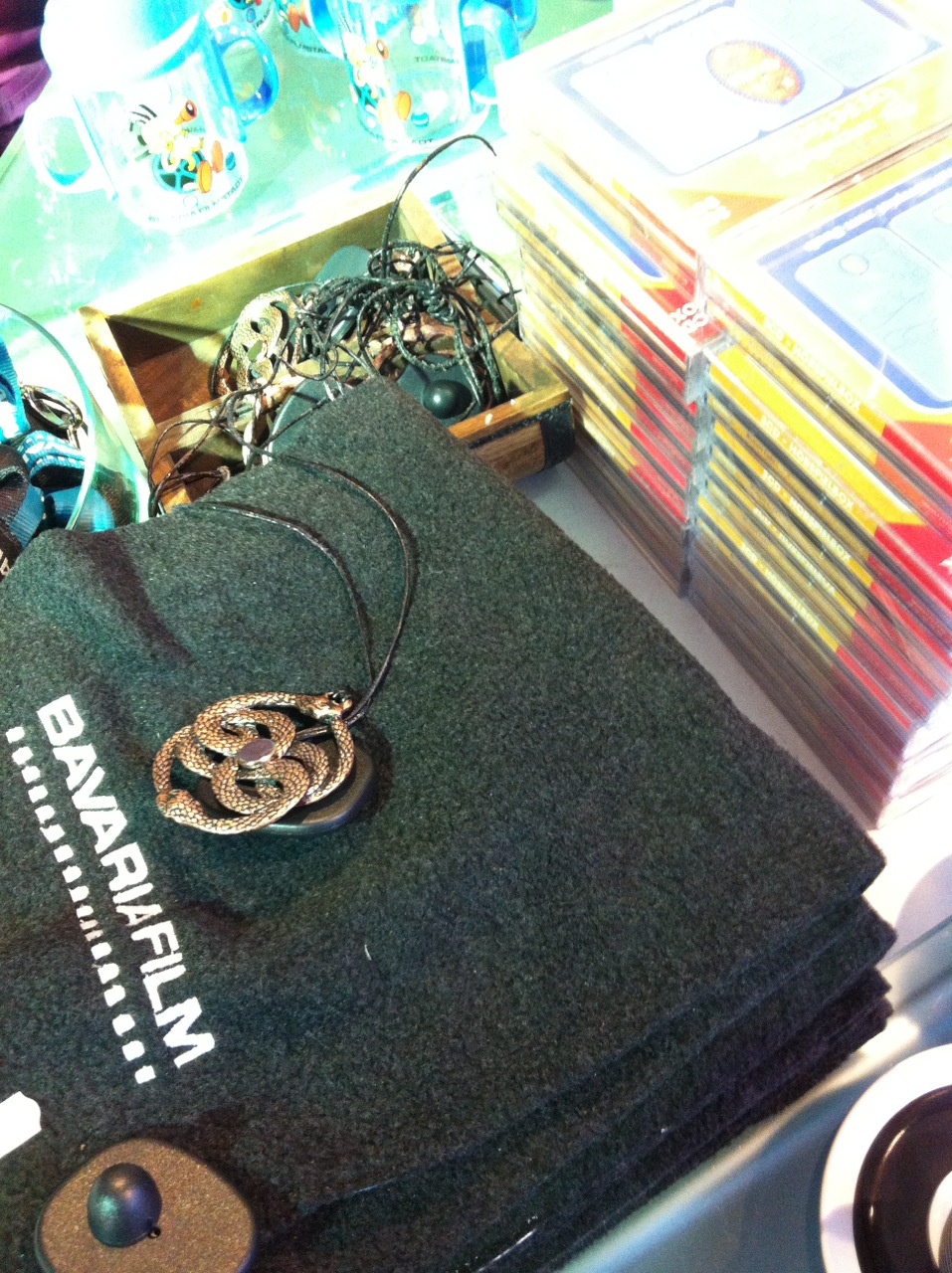
The second thing I nearly purchased was an Auryn, also from The Neverending Story. After all the trouble they went to to find the Auryn in the movie, it turns out there’s an entire box of them for sale in Munich!

giftshop01giftshop02

The third thing I nearly purchased in the gift shop was a uniform shirt from Traumschiff Surprise. They were surprisingly high quality, and there’s something fun about a dayglow color like that.

giftshop03

After a few minutes wandering around the gift shop, the group started to gather for the tour. We moved outside to be with that group, and to look around at some of the scenery in the waiting area. There was a large model of the submarine from Das Boot, as well as a section of the spacecraft from Enemy Mine.

Enemy Mine

Additionally, there were some replicas of things used in The Neverending Story. Seen here are the Rockbiter and the Racing Snail:

story01 story02

Before much longer, it was time for the tour to begin. Parts of the tour went into hangar style buildings, but a great deal of it involved being outside in the snow. In hindsight, this was not an ideal winter activity.

The golden carriage below is from a current theatrical release, Ludwig II, which is about King Ludwig the second of Bavaria, the man responsible for many impressive buildings and monuments all over Germany.

studio04

One part of the tour allowed someone to re-enact a scene from a popular German television show.

Bavaria Filmstadt Tour

One of the big set-pieces of the tour was the Das Boot section. There were numerous models of the submarine in various sizes, including a life-sized tower.

dasboot01 dasboot02

In addition, you can walk through the interior of the sub. This was originally done in three side-by-side sections on a gimbal so that motion could be simulated realistically. It has now been layed out in one single track that you walk through. You can see engineering, sleeping quarters, and the conn with a periscope. This is not for the claustrophobic.

dasboot03

After Das Boot, the tour went outside again to show us the viking ship from the “Vicky The Viking” movie, Wickie und die starken Männer. (Literal translation: Vicky and the Strong Men.)

Wickie's Boat

Vicky The Viking is based on a popular cartoon. Here’s some video to show you the differences:

Finally, we got to the section that I was most interested in- The Neverending Story. They had a lot of behind the scenes imagery, like a shot of the Swamps Of Sadness set and this giant poster photograph showing puppeteers working on the Falkor model with the Rockbiter standing by:

story03

Also present were the original matte painting of the Ivory Tower, and the models used for the Southern Oracle.

story04 story05

My favorite part, naturally, was the giant bluescreen Falkor. Obviously, this was put in place for the children on the tour:

story06

…but really, I’m just a big kid, and I couldn’t resist a shot. Plus, as a bonus, you can see in the monitor behind my hand what it looked like with the bluescreen composite.

story07

The 4d movie, when we got to it after the tour, was a full experience ride with 3D glasses that lasted about five minutes. It was entertaining, but not as cool as the life-sized Falkor model.

Are any of the movies or shows produced at Bavaria Filmstadt in your favorites?

Sick And Tired Of Being Sick And Tired

In the first week of 2013, I got sick.  It was on Wednesday that I started to feel tired and cold.  When I went home after work, I got into my bed, fully clothed, pulled the blanket up over my head, and slept for a while.  Over the next few days, there was a lot of shivering, a lot of sleeping, and a lot of randomly weird body aches.  I still don’t understand why being sick means you have to feel like someone has been continuously throwing oranges at you.

After my first round of sleeping off the fever, I had to start using pharmaceuticals.  In order to get what you need for a cold in Germany,  you have to go to an Apotheke.  You can’t buy over the counter cold medicine in grocery stores here like you can in the US; you must go to an Apotheke for your medicinal needs.  They all use either a variant of this red ‘A’ logo, as seen on this receipt, or in some cases, an internationally recognized green cross.

apotheke

What I purchased this time around is pictured below, except the Ricola cough drops.  Those are the same here as they are in the US.

Aspirin – This is pretty much the same as it is in the US.  The packaging is different, to meet Germany’s exacting packaging and trash rules, but aspirin is aspirin.  I grew up having Bayer aspirin all my life, and didn’t realize until I got to Germany that Bayer is a German company.  They’re a very big name in medicine here.

Grippostad – This is a multi-symptom cold medicine.  It has components for head and body aches, runny nose, cough, and fever.   It also has a boost of vitamin c, and it’s pretty effective at masking the rest of those symptoms for a little while.

Lemoncin – This is for sore throats.  It’s a lemony losenge.  It tastes pretty good.

pharma

Aside from that, I just fight being sick with lots of water, eating when I need to, and taking lots of rest.

How do you cope when you’re sick?